
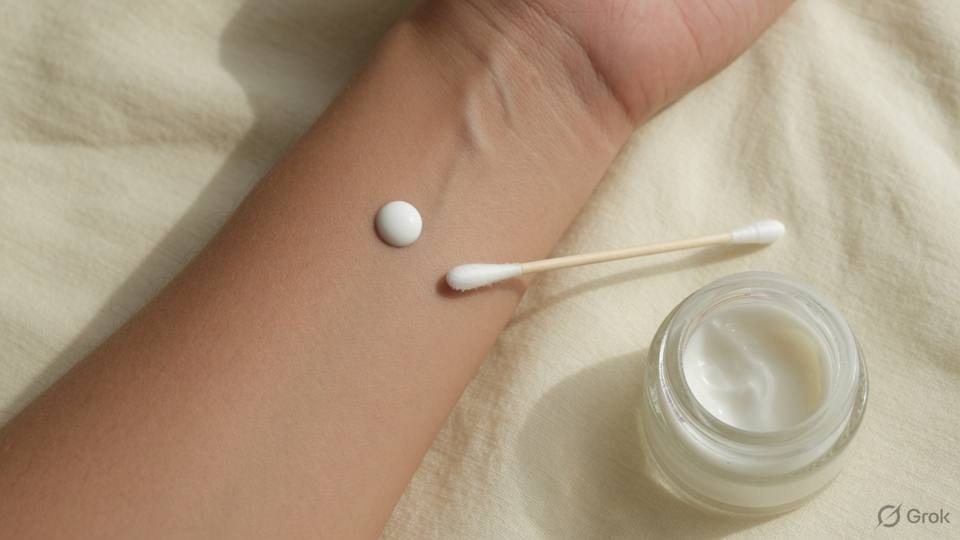
A screen, not a clearance
A patch test is a personal tolerance screen. It tells you whether one person's skin reacted to one sample on one site over two days. It does not test for microbes, stability, or legal status, and a quiet patch is not a safety certificate. The method is small on purpose: about a 1 cm square on the inner forearm, intact skin, no cut, no rash and no eczema. Apply a small amount of the product, leave it uncovered unless the supplier says otherwise, and read the site at 24 hours and again at 48 hours. Record the site, the product, the batch code, the times and what you saw.
The inner forearm is used because it is convenient, relatively protected, and easy to read. It is not the face, and a product that is quiet on the forearm may still sting near the eye. That is why a patch test is not a green light for a new product on a client's face; it is one filter among several. Do not patch on the face first, do not patch two products on one square, and do not patch a product that has not passed the bench checks and the microbial work if it contains water. A patch test on a poorly preserved cream tests the cream and the contamination at the same time, which is not a useful experiment.
A patch test on a client with a known reaction history, broken skin, or a known allergy is not a useful screen. Refer that client to a doctor rather than using the patch to prove the product is safe. The same applies to a client who has reacted to a similar product before, or who is using a prescribed topical treatment on the site. The patch test is not designed to challenge a known allergy, and a reaction on such a client is predictable rather than informative. Record the referral in the same way as a test result, with the date and the reason, so the decision not to patch is visible if the client asks later.
Write the result even when it is clear. 'No reaction at 24 and 48 hours' is a record. 'Fine' is not, because it does not say when it was checked or what was looked for. If the client cannot return for the 48-hour read, say so and treat the test as incomplete rather than passed. A single read at 24 hours misses delayed reactions, and a delayed reaction is exactly the kind a patch test is meant to catch. The two reads are the minimum, and a test with only one read should not be described as complete, even if the first read was clear.
- 1. Confirm the product has passed the bench checks before patch testing.
- 2. Choose intact skin on the inner forearm, with no cut or rash.
- 3. Mark about a 1 cm square and note left or right.
- 4. Apply a small amount of one product and leave it uncovered.
- 5. Record the product, batch code, site, date and time.
- 6. Read the site at 24 hours and write what you see.
- 7. Read again at 48 hours and write the result.
- 8. Refer any client with a reaction history instead of testing.
Bench example
A client agrees to try a new lotion before it is offered in the salon. The maker checks that the batch has passed the pH recheck and the heat screen, and that the record is complete. A 1 cm square is marked on the left inner forearm, and a small amount of batch 20261025-01 is applied at 10:15 on Monday. The site is left uncovered. At 10:00 on Tuesday the maker reads it: no redness, no swelling, no itch. At 10:00 on Wednesday the read is the same. The record says 'left inner forearm, 1 cm, batch 20261025-01, applied 10:15 Mon, read 24 h clear, read 48 h clear'. The client is told that this means she tolerated the sample on that site for two days, not that the product is safe for everyone or that it has passed a laboratory test. A second client with a history of eczema on the arms is not patched; she is referred, and the salon does not use her as a test site. The form is signed by the maker and kept with the batch record, and the client is told the result in plain words rather than being shown a tick.
Caution: A quiet patch does not prove the jar is free of bacteria, stable, or legal to sell. It is one person's tolerance on one site for two days.
Running the patch test
Run the test the same way every time, or the results cannot be compared. Choose the site, clean it gently and let it dry. Mark about a 1 cm square with a skin-safe marker, and write down which arm and where. Apply a small amount of the product, roughly the size of a grain of rice for a cream, and spread it thinly inside the square. Do not cover it unless the supplier's instructions say to cover, and do not wrap it in cling film, because occlusion changes how the product behaves and can produce a reaction that would not happen in normal use.
One product at a time. Two products on one patch tells you nothing about either, and if a reaction appears you cannot tell which one caused it. If several products need testing, use separate sites with at least a few centimetres between them, and label each site on a diagram. Do not test a product on broken skin, and do not test on skin that has been shaved, waxed or treated with an acid in the previous 24 hours. The skin barrier needs to be intact for the test to mean what it is supposed to mean. If two products must be compared, use two sites, two forms, and two batches of product, and keep them far enough apart that a reaction cannot spread from one to the other.
The client should keep the site dry and avoid scrubbing it, and should not apply another product over it. Give written instructions for what to do if it itches or burns: wash it off with water and contact the salon. Do not tell the client to 'see how it goes' for two days if there is swelling or blistering; that is a stop signal, not a data point. The maker should be reachable during the test period, or the test should not start before a weekend or a holiday. Give the client a number to call and a time by which to call it, and write both on the instruction card so the advice does not depend on memory.
Record the test in a form that can be read later. The fields are product name and batch code, site, size, date and time applied, the 24-hour reading, the 48-hour reading, the result, the action and a signature. A photograph is useful if the client agrees, but the written description is the record. If the client misses a read, write 'not read' rather than leaving the field blank, because a blank looks like a clear result to the next person. Keep the form with the batch record, not in a client file alone, because the batch record is where an investigation will look first.
- 1. Clean the site gently and let it dry completely.
- 2. Mark a 1 cm square and record the arm and position.
- 3. Apply one product thinly inside the square.
- 4. Leave it uncovered unless the supplier says otherwise.
- 5. Give written instructions for itching, burning or swelling.
- 6. Read at 24 hours and record what you see.
- 7. Read at 48 hours and record the result and the action.
- 8. File the form with the batch record and keep a copy.
Bench example
A maker prepares to patch test a cream with a new fragrance. The site is the right inner forearm, cleaned and dried, marked with a 1 cm square. The product is applied at 11:00 on Thursday, and the client is given a card that says to wash it off and call if it burns, swells or blisters. At 11:00 on Friday the site is read: a faint pink area at the edge of the square, no swelling, no itch. The maker records 'mild redness at edge, 24 h' and asks the client to return the next day. At 11:00 on Saturday the redness has settled and there is no itch. The result is recorded as 'mild transient redness, settled by 48 h', and the action is 'do not use on the face; refer for a second opinion before any further trial'. The batch is not offered to clients on the strength of this patch; it goes for a lab sample instead, and the form is filed with the batch record. The maker also records that the site was not covered and that the client kept it dry, because both details change how the result should be read.
Caution: Do not cover a patch with cling film unless the supplier instructs it. Occlusion changes penetration and can turn a quiet product into a reacting one.
Reading a reaction and what to do
A clear patch means no visible change and no itch at either read. It says that this person tolerated this sample on this site for 48 hours. It does not say the product is safe for every person, and it does not say the batch is free of microbes. Mild redness that settles may be irritation rather than allergy, but it is still a warning: do not put the product on the face, and do not treat a second patch as a clearance. Itch, swelling or a raised patch is a stronger signal: wash it off, do not use the product, and refer if it spreads or does not settle. A blister or a spreading rash needs medical help.
Wash the site with water if there is any reaction, and do not apply a soothing product over it without advice, because that adds a second variable. Record what you see in plain words: redness, raised area, itch, swelling, blister, spread. Note the time the reaction appeared and whether it changed between the reads. A reaction that appears at 48 hours but not at 24 is a delayed reaction and is important; a reaction that is present at 24 and gone at 48 may be irritation. Neither is a diagnosis, and the record should not pretend to be one. If the client sends a photograph, keep it with the form and note the date it was taken, but do not use the photograph instead of a written description.
The hair-colour patch test is a different test, run according to the brand's instructions, usually 48 hours before a colour service. Do not mix the two methods, and do not use a cosmetic cream patch as a substitute for a colour patch. Colour products contain different chemistry and have their own instructions, including where to apply and how long to wait. If a client has reacted to a colour before, the answer is not a bigger patch; it is a referral and, where the brand requires it, no service. Keep the brand's instruction sheet with the service record, and follow its timing rather than a salon habit that has drifted over the years.
A patch test is not a marketing tool. Do not tell a client that a product is 'patch tested and safe' as though that were a guarantee. Say what was done: a small amount was applied to the inner forearm and read at 24 and 48 hours, with no reaction. That is an accurate sentence. Anything stronger is a claim the test cannot support, and it invites a problem the salon cannot answer when a different client reacts. The honest sentence is short and specific, and it protects both the client and the salon when a different person reacts to the same product.
- 1. Read the site in good light and compare it with the surrounding skin.
- 2. Write plain descriptions: redness, itch, swelling, blister, spread.
- 3. Record the time each sign appeared and how it changed.
- 4. Wash off any product that burns, itches or swells.
- 5. Do not apply another product to the reacting site.
- 6. Refer a spreading rash or a blister for medical help.
- 7. Mark the test incomplete if the 48-hour read is missed.
- 8. Use the brand's own method for a hair-colour patch test.
Bench example
A client returns at 48 hours with an itchy, raised patch exactly the size of the marked square. The maker washes the site with water, records 'raised, itchy area, 1 cm, appeared between 24 and 48 h', and advises the client to see a pharmacist or doctor if it spreads. The product is not used again on that client, and the batch is flagged in the record. A second client has faint redness at 24 hours that has gone by 48; the maker records 'mild redness 24 h, settled 48 h, no itch', marks the result as irritation rather than allergy, and does not put the product on the face. A third client cannot attend the 48-hour read, so the form says '48 h not read, test incomplete', and the salon does not describe the test as passed. In all three cases the record is written the same day, and none of the results is turned into a claim about the product. The three forms are filed together, and the batch record carries a note that one client reacted and two did not, which is the full picture rather than a selection of it.
Caution: A patch test that is described as 'passed' when the 48-hour read was missed is a false record. Write 'incomplete' and do not rely on it.
This is a Nandu Nai textbook. It is a private brand book, not a government licence, and it does not give the right to give medical treatment.