
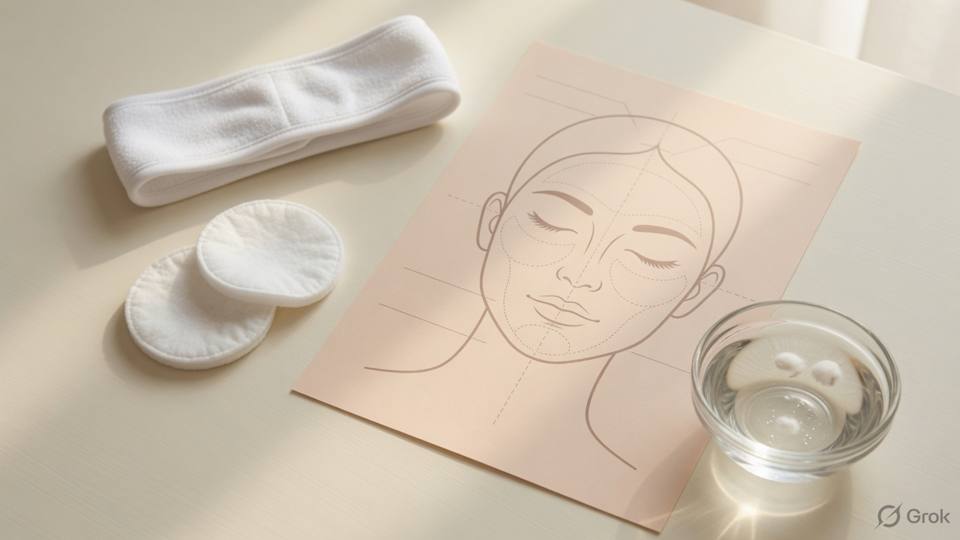
Skin type, skin condition, and the ten questions that come first
Skin type is the inherited baseline: how much oil the skin makes, how well it holds water, and how easily it flushes. Most clients can name their type, and they are often right about the oiliness and wrong about the cause of it. A skin condition is the state of the skin this month: acne, dehydration, pigmentation, redness, eczema, or a reaction to a product. Type changes slowly, over years and with age. A condition can change in a week. The card needs both, written in separate fields, because the type sets the long plan and the condition sets the intensity of today's service.
Several ordinary things move the condition without touching the type. A new foaming wash, a hot-water habit, a course of medicine, a wedding season of late nights, hard water after a move, and the week before a period can all leave the same face looking different. In an Indian salon the same client may arrive oily and congested in June and tight and flaky in December, with the same inherited type underneath. Ask what changed in the last month rather than only what the client usually has. That one question turns a vague booking into a plan you can defend.
Ask the questions in a fixed order so that a busy Saturday does not make you skip one. Start with the result the client wants, then move to products, retinoid or acid use, isotretinoin, pregnancy, allergy, recent services, and anything active on the skin today. Write the answers in the client's own words next to your own observation. Do not turn the consultation into an interrogation; explain that you ask because the answers change what is safe, not because you are curious. A client who understands the reason will tell you more, including the products they forgot to bring and the tablet they did not think counted as medicine.
Use the answers before you touch the skin. If the client is on a retinoid, the wax is off the table for that area. If the skin is flushed, the steam is off. If there is a cold sore, the whole facial waits. Say the plan out loud, including what you are skipping and why, and get a clear yes before you begin. Record the plan, the refusal, and the consent on the card. The record is not paperwork for its own sake; it is what stops the next visit from repeating a mistake and what protects you if a reaction appears two days later.
- 1. Greet the client, wash your hands where they can see, and ask what they want from today in their own words.
- 2. Ask what they apply in the morning and at night, and write the product names rather than 'a cream'.
- 3. Ask about a retinoid or a strong acid, including the last application, and treat an unsure answer as leave-on.
- 4. Ask about isotretinoin now or in the past year, and write the month the course ended.
- 5. Ask whether they are pregnant, trying to conceive, or breastfeeding.
- 6. Ask about allergies to wax, fragrance, nickel, latex, and any product from a previous salon visit.
- 7. Ask when the area was last waxed, threaded, peeled, or treated, and what happened afterwards.
- 8. Look at the area in good light for a cold sore, cut, sunburn, rash, or a lump you will not touch.
- 9. Ask about medical conditions and medicines that thin the skin or increase sun sensitivity.
- 10. Say the plan and its limits, then record consent before you begin.
Salon example
Shalini, thirty-four, books a glow facial two weeks before her sister's engagement. She calls her skin combination and asks for steam, a scrub, and a clean-up of every bump. Under a clean light her forehead is shiny, her cheeks are flaky, and the sides of her nose are pink. She mentions an acid toner used twice a day and very hot showers. The esthetician records the type as combination, the condition as dehydrated with mild irritation, and the cause as over-cleansing and heat. The plan is a mild milk cleanser, a warm not hot compress, a short enzyme step on the cheeks only, no steam, extraction of one open comedone on the nose, a hydrating mask, moisturiser, and sunscreen. Shalini is asked to stop the toner for five days and to lower the shower temperature. She leaves without the polished glow she imagined, but with calmer skin, and at the next visit the flaking has gone and the shine remains, which is what a combination type should do. Shalini admits that she expected a tighter face, and the esthetician explains that tightness after a facial is usually dryness, not cleanliness.
Caution: A client's label for their skin is a starting point, not a finding; write what you see and what you decide in separate fields.
Retinoid, acid, and isotretinoin: the pause that protects
A retinoid is a vitamin A derivative used for acne, pigmentation, and the appearance of ageing. It may be a cosmetic retinol or a prescription product such as adapalene or tretinoin. Both speed up the turnover of the surface, and both can leave the skin thinner and more reactive even when it looks calm. A strong acid used at home, such as a leave-on glycolic or salicylic product, has a similar effect on the surface. The client may not call these treatments medicine, so ask by product name and by what the bottle looks like, not only by the word retinoid. Write down the answer while it is fresh.
For a leave-on retinoid or a strong acid, the usual pause before waxing is about five to seven days after the last application. This is guidance, not a guarantee, and the product label or the prescriber's instruction comes first. A wash-off cleanser with a mild acid is not the same as a leave-on cream, but if the client cannot tell you which one they use, treat it as leave-on and skip the wax on that area. Do not shorten the pause because the client has an event. A wax on fragile skin can lift the surface along with the hair and leave a mark that outlasts the event by months.
Isotretinoin is an oral medicine prescribed for severe or persistent acne. While the course is running, do not wax, do not perform an aggressive peel, and do not use a strong scrub or heat on the face. The skin tears easily, heals slowly, and reacts to friction. Threading and a gentle cleanup may be possible on intact skin, but keep the tension low and stop at the first sign of lifting. After the course, a common guide is to wait about six months before waxing or a resurfacing service. The actual date is a medical decision; ask the client to confirm it with the prescribing doctor and record that you asked.
When the requested service is unsafe, offer something that is not a consolation prize. A gentle cleanse, a cool compress, a short massage on intact skin, and a moisturising mask are real services with a real result. Say plainly what you are skipping and why. If the client wants to proceed anyway, repeat the limit once and let them decide about the safe option, not about the unsafe one. Note the product, the pause, the refusal, and the doctor conversation on the card. That note is what lets the next esthetician pick up the plan without guessing, and it is the first thing to read when a client returns with a complaint.
- 1. Ask for the exact product name and whether it is a cream, a gel, or a tablet.
- 2. Ask how often it is applied and when it was last applied.
- 3. Ask whether the skin stings, peels, or feels tight after washing.
- 4. Look at the jaw, cheeks, and around the nose for fine peeling and loss of shine.
- 5. For a leave-on retinoid or strong acid, do not wax the area inside the usual five to seven day pause.
- 6. For isotretinoin, do not wax and do not perform an aggressive peel at any point in the course.
- 7. If the course has ended, take the end date and wait for the doctor's clearance; a common guide is about six months.
- 8. Offer a gentle cleanup, a cool compress, and hydration instead of the requested strong service.
- 9. Record the product, the pause, the refusal, and the doctor conversation on the card.
Salon example
Farah, twenty-seven, wants her upper lip and brows waxed before Eid. She mentions adapalene gel, applied every night for three months, and says her skin is fine. Under the light there is fine peeling along the jaw and above the lip, and she admits that her moisturiser stings. The esthetician explains that the surface is fragile and that wax can remove skin as well as hair. She does not wax the lip. She offers a gentle cleanup with no acids, a cool compress, and a brow tidy with scissors, and she asks Farah to speak to the doctor who prescribed the gel about pausing it. Farah is unhappy about the lip, because the event is close, and the esthetician shows her the peeling in the mirror rather than arguing. Farah books the cleanup, returns eight days after stopping the gel with the doctor's agreement, and the patch test is calm. The wax is done then, in two small strips, with a note on the card that records the pause, the clearance, and the fact that no service was done while the skin was fragile.
Caution: A date on the calendar is not a clearance; the prescriber's note is what allows the service after isotretinoin.
Pregnancy, allergy, and the services you decline
Pregnancy changes the skin for many clients: oiliness may rise or fall, melasma may appear on the cheeks and upper lip, and the skin may flush or itch more easily. Waxing and threading are usually fine when the skin is not reactive, but the service should be shorter and cooler, and the client should not lie flat on her back for a long facial late in pregnancy. Read the label of every product for a pregnancy warning, and avoid heat and strong acids when the label is unclear. Do not promise that a service will prevent or remove melasma. Sun protection and a dermatologist's plan do that work, not a facial.
Allergy history is the other half of the safety check. Wax can contain rosin, fragrance, or a dye; a cream can contain fragrance or a preservative; a metal tool can carry nickel; gloves can carry latex. Ask what happened after the last salon service, including redness that lasted more than a day, swelling, or a rash on the neck. A first-time client and any client with a reaction history gets a patch test when the brand requires it, usually twenty-four to forty-eight hours before, on the inner forearm or behind the ear. Record the date, the product, and the result. If a client has reacted to a product before, do not repeat it to see whether it happens again.
Some services are declined, not negotiated. Do not treat a cold sore, a wart, a fungal patch, a cut, a sunburn, or a spreading rash. Do not wax skin that is lifting from a recent peel or a retinoid. Do not use a product the client cannot identify or a mix that is stronger than the label allows. A child gets only a basic cleanup with a parent present and consent. Refusing well has a shape: name what you see, say what you are not doing today, offer what is safe, suggest a doctor for the medical part, and write it down. The client may be disappointed, but disappointment is easier to manage than a scar.
You do not diagnose. You describe what you see and what it means for the service. 'This looks like a cold sore, and I cannot treat the area while it is active' is enough. Do not name a disease to sound expert, and do not guess at a medicine. If the client asks what it is, say that a doctor can tell them and that your job is to keep the service safe. Then record the refusal and the referral in plain words. A short, calm explanation protects the client, protects the salon, and keeps the relationship intact for the next visit.
- 1. Ask about pregnancy, trying to conceive, and breastfeeding before you discuss any product or heat.
- 2. Ask about allergies to wax, rosin, fragrance, nickel, latex, and any product from a previous visit.
- 3. Ask what happened after the last wax, peel, or bleach, including redness that lasted more than a day.
- 4. Inspect the area for broken skin, a cold sore, a rash, sunburn, or swelling.
- 5. Read the label of every product you plan to use, including the patch-test instruction.
- 6. Patch test a first-time client or a client with a reaction history, and record the date and result.
- 7. Choose the cooler, shorter service when a product or a condition is unclear.
- 8. Name what you are declining, offer what is safe, suggest a doctor for the medical part, and write it down.
Salon example
Kavya, thirty-one, is twenty-two weeks pregnant and wants a facial bleach, a full-face wax, and a brightening facial for her baby shower. She has melasma across both cheeks and says her skin has become more sensitive since the pregnancy. The esthetician declines the bleach because the label warns against use in pregnancy and because the result would not touch the pigmentation anyway. She asks about the last wax, and Kavya remembers a rash on her upper lip that lasted three days. That is a reason to patch test, not to repeat the full wax on the day. The esthetician offers a cool cleanup with no steam, a hydrating mask, and sunscreen, keeps the appointment short, and raises the head of the bed. She suggests a dermatologist for the melasma and writes the refusals and the reason on the card. Kavya books the cleanup and leaves with a plan instead of a promise, and the esthetician asks her to bring the dermatologist's note if she wants anything stronger after the baby is born, and reminds her that a hat and sunscreen are the only reliable daily care for the pigmentation until then.
Caution: Pregnancy is not a reason to improvise a gentler version of a product the label warns against; it is a reason to skip it.
This is a Nandu Nai textbook. It is a private brand book, not a government licence, and it does not give the right to give medical treatment.