
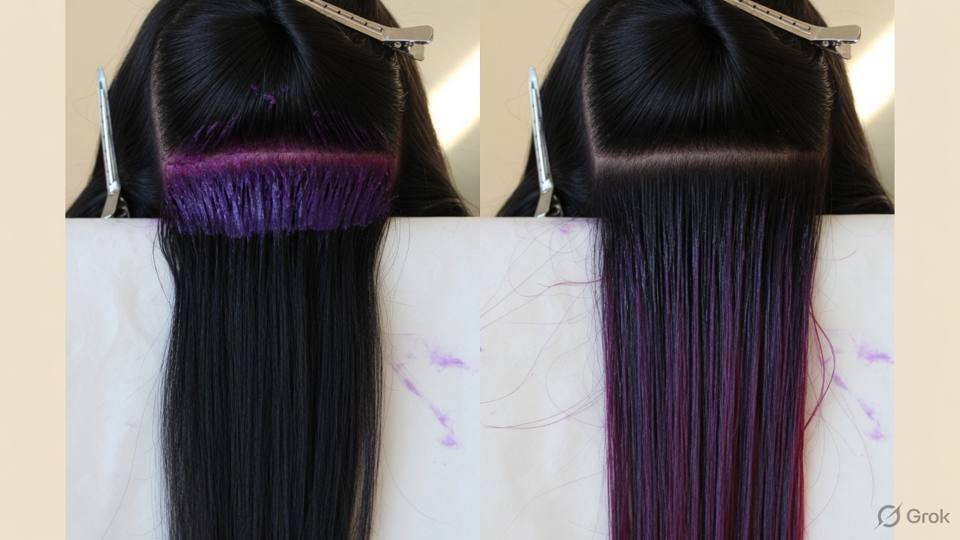
Virgin application versus root retouch
A virgin application is colour on hair that has never been coloured, and it is a different service from a retouch even when the formula is the same. On virgin hair, every strand needs product, from root to end, and each zone processes at a different speed. The general order for a permanent colour is the mid-length and ends first, then the root last, because scalp heat accelerates the root and the ends need a head start. For a first full grey coverage, the resistant hairline and temples go on first within the root zone, then the rest of the root, then the mid-length and ends. The manufacturer's directions win if they specify a different order, and the strand test tells you whether the zones need different timing.
A root retouch is colour on the regrowth only, usually the first one to two centimetres. It is the most common service in a colourist's week, and the one where discipline matters most. Apply to the new growth, keep the product inside the regrowth band, and do not drag the brush through the old colour line to tidy it. The old colour has already been processed; a second application over-deposits it and creates a darker band. Work around the head in a consistent pattern, starting at the most resistant area, usually the temples or the parting, and finish where the hair is easiest. Then check the resistant area first, because it will be the last to cover.
The two services need different formulas as well as different orders. A virgin global may need a slightly warmer or more natural base at the mid-length to avoid a hollow result, and the ends may need a lower volume or a shorter pull-through. A retouch needs the exact target formula at the root, plus a plan for the mid-length and ends that does not involve more permanent colour every visit. That plan might be a gloss, a toner, or nothing at all. The mistake is to treat the retouch as a global and pull the formula through the whole head, which darkens the ends a little more every six weeks until the client has a two-tone result.
The choice between the two is a consultation decision. Ask when the hair was last coloured, what was used, and whether the mid-length and ends have been lightened or coloured repeatedly. If the client has a six week history of a global colour, the service is a retouch, not a global. If the client has never coloured and wants a uniform shade, the service is a virgin application. If the client has a mix of old colour and virgin root, the service is a retouch plus a mid-length plan, and the card should show both. Naming the service correctly at the start prevents the most expensive mistake in the appointment: doing the wrong job well.
- 1. On a virgin permanent application, apply mid-length and ends first, then the root last, because scalp heat speeds the root.
- 2. For first full grey coverage, apply the resistant hairline and temples first within the root zone, then the rest.
- 3. On a root retouch, apply only within the first 1 to 2 cm of regrowth and never drag through the old line.
- 4. Start a retouch at the most resistant area, usually the temples or the parting, and check it first.
- 5. Keep the retouch formula at the target level and do not pull it through the mid-length every visit.
- 6. Plan a gloss or toner for the mid-length instead of adding permanent colour to the ends each time.
- 7. Ask when the hair was last coloured and with what, and name the service before you mix.
- 8. Follow the manufacturer's application order when it differs from the general rule.
Salon example
Roshni has never coloured her hair and wants a global level five warm brown with full coverage of her twenty percent grey. This is a virgin application. I section the hair into four, apply the colour to the resistant hairline and temples first, then the rest of the root, then the mid-length, and finally the ends for the last ten minutes at a lower volume. The temples get forty minutes, the mid-length thirty, and the ends ten. The result is even from root to end. Six weeks later she returns, and the service is now a retouch: the same formula on the one and a half centimetres of regrowth, the temples first, and a gloss on the mid-length for the last ten minutes. I do not pull the permanent formula through the ends. The card records both services separately, because the difference between them is the reason her colour stays even over a year. She also asks why the ends get a lower volume, and I explain that the ends are older and more porous, and that the same strength would over-deposit them while the root was still developing.
Caution: Do not treat a six week regrowth as a global. Pulling permanent colour through the ends at every retouch darkens them a little more each visit until the result is two-tone.
Why roots process faster
The root processes faster than the mid-length and ends for two reasons. The first is heat: the scalp is at body temperature, and the product sitting close to it is warmed from below, which speeds the peroxide reaction. The second is condition: the root is newer hair with a tighter, less damaged cuticle, but it is also the zone where the product is applied last in a virgin service, so it needs less time to reach the same point. Add the fact that the root is often the darkest natural hair and the ends are often porous and lighter, and you have a zone that can move a full level ahead of the rest of the head in a few minutes. That is how hot roots appear.
Hot roots are a bright, warm band at the scalp that is lighter than the rest of the hair. They happen when the root is applied at the same time as the mid-length and ends, or when a lightener is applied to the root first, or when the developer is too strong for the root. They also happen when a client's natural root is lighter than the coloured ends, which is common after months of box colour. The fix is not to tone the hot band darker on the same day, because that creates a second band. The fix is to change the order next time: apply the mid-length and ends first, the root last, and check the root sooner.
On a retouch, the root is the only zone receiving permanent colour, so the speed difference is less of a problem and the overlap is the bigger risk. Apply the product to the regrowth and check it at the manufacturer's time, not earlier, because a retouch that is rinsed early leaves a shadow at the scalp. On resistant grey, the root may actually need more time than the rest, despite the heat, because grey has no pigment to develop. That is why the temples and hairline are checked first and given the full time. The rule is not that roots are always faster; it is that roots behave differently, and the strand test and the check tell you how.
Control the variables you can. Keep the room at a normal temperature, because a cold room slows the ends and a hot room speeds everything. Do not cover a lightener with a plastic cap unless the manufacturer says so, because trapped heat accelerates the root further. Apply in a consistent order so the timing per zone is known, and use two timers if the zones start at different times. Write the actual start and check times for the root, mid-length, and ends. When a client asks why the root is checked first, the answer is simple: it is the warmest part of the head, and the warmest part moves first.
- 1. Expect the root to process faster because of scalp heat, and apply it last on a first lift.
- 2. Do not apply lightener to the root first unless the manufacturer's method says to.
- 3. Check the root before the mid-length and ends, and rinse it first if it reaches the target early.
- 4. Avoid hot rooms, direct sun, and plastic caps on lightener unless the brand permits them.
- 5. On a retouch, give the root the full manufacturer time, because early rinsing leaves a shadow.
- 6. On resistant grey, expect the root to need the full time despite the heat, and check the temples first.
- 7. Use separate timers for zones that start at different times, and write the times on the card.
- 8. If hot roots appear, correct the order and the timing next visit rather than toning the band darker today.
Salon example
Tanya has a level four base with old box colour on the ends, and she wants a level six warm brown. The previous salon applied the root first and the ends last, and she has a bright orange band at the scalp that fades into a darker mid-length. On this visit I do not try to fix the band with a darker toner, because that would leave a second band. I apply the mid-length and ends first at 20 volume, then the root at 20 volume ten minutes later, and check the root at twenty-five minutes. The root reaches level six while the ends are still at level five, so I rinse the root first and then the ends. The result is more even, though the old band is still visible. I explain that the band will soften over two or three visits as the root grows and the ends are refreshed with gloss, and I record the order so it is not repeated. She also asks whether a cool room would slow the root enough to apply everything at once, and I explain that the scalp heat is inside the head, not in the room.
Caution: Do not fix hot roots by toning the band darker on the same day. That creates a second band, and the hair has already been through one process.
Section size and the manufacturer's timing
Section size decides whether the product reaches the hair. A section that is too thick holds product on the surface and leaves the inside dry, so the outside lifts or deposits while the inside stays at the starting level. For most colour work, a subsection of about one centimetre is right, and for dense or long hair it may need to be thinner. Divide the head into four quadrants first, then work in horizontal or diagonal sections that you can see and control. Weave or slice according to the service, and keep the sections consistent so the timing is consistent. A neat head is not decoration; it is the only way to know that every strand received the same product for the same time.
Timing comes from the manufacturer, not from habit. A permanent colour is often thirty to forty-five minutes, a demi is often twenty to thirty, a toner is five to twenty, a gloss is ten to twenty, and a lightener is checked from twenty and then every five to ten. Those are typical ranges, and the tube or technical sheet is the authority. If the brand says twenty minutes, do not leave it forty because the client is not covered. If the brand says do not exceed thirty, do not add ten for a resistant patch. The correct response to under-development is a formula change, not a longer clock. The correct response to over-development is a rinse, not a hope.
Long services need a sequence, not a single timer. On a full head of foils, work in a pattern that lets you return to the first foil at a known time, and write the start time of each zone. On a global colour with a pull-through, the root timer and the end timer are separate. On a retouch with a gloss, the retouch develops first and the gloss goes on after the rinse. Mix in batches so the product on the last section is as fresh as the product on the first. If you are running behind, remix rather than stretch, and tell the client what is happening. A client who understands the delay is calmer than a client who is left guessing.
Record the timing per zone. The card should say root thirty-five minutes, mid-length fifteen, ends eight, toner five at the ends and seven at the root. That level of detail is what makes a result repeatable and what makes a complaint answerable. It also protects the client: if a patch appears, the record shows whether that zone received more product or more time. Section size and timing are not glamorous parts of the craft, but they are where even colour is won or lost. A beautiful formula applied in thick sections for a guessed time is a lottery, and the client is the one who buys the ticket.
- 1. Divide into four quadrants, then work in subsections of about 1 cm for even saturation.
- 2. Keep subsection size consistent, because a thick section processes unevenly from the outside in.
- 3. Use the manufacturer's development time, typically 30 to 45 minutes for permanent colour.
- 4. Check lightener from 20 minutes and then every 5 to 10, and never leave foils unattended.
- 5. Use separate timers for zones that start at different times, and write each start time down.
- 6. Mix in batches on long or thick hair so the last section gets fresh product.
- 7. Remix rather than stretch if you run out, and tell the client what is happening.
- 8. Record the time each zone received, so the next visit can repeat the result or explain a patch.
Salon example
Bhavna has long, thick hair that reaches her waist, and she wants a global level four with a copper tone. The head is too large for one application to be even if I work from a single bowl and a single timer. I divide into four quadrants and work in one centimetre horizontal sections, mixing two batches. I start the root at the temples, write the time on the trolley, and work around the head. The root timer runs thirty-five minutes. The mid-length goes on twenty minutes before the end, and the ends get the last eight minutes at a lower volume. I use two timers, one for the root and one for the mid-length, and I check each zone before I move on. The result is even from the scalp to the tips. If I had used one bowl and one timer, the first section would have processed for fifty minutes and the last for twenty, and the copper would have been patchy. She also asks whether the timer can be set from the first section or the last, and I explain that each zone gets its own start time, because the first section is already working while the last is still dry.
Caution: Do not guess a development time because the salon is busy. A guessed time is the most common cause of a patchy result and the hardest to explain to a client.
This is a Nandu Nai textbook. It is a private brand book, not a government licence, and it does not give the right to give medical treatment.