
The wheel as a tool, not a decoration
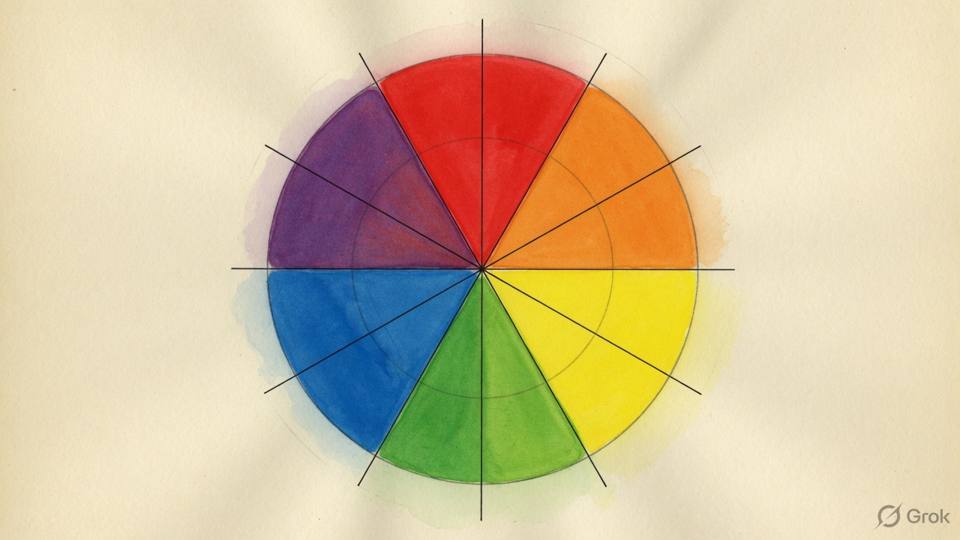
The colour wheel is a working tool, not a poster on the wall. In hair colour it does one job: it tells you which tone sits opposite the tone you want to remove. Blue sits opposite orange, violet sits opposite yellow, and green sits opposite red. The secondary corrections follow the same logic. Blue-violet sits opposite yellow-orange, and blue-green sits opposite red-orange. That is the whole system you need at the chair. The wheel does not tell you the brand, the level, the ratio, or the time. It tells you the direction, and the rest comes from the product and from the strand in front of you.
Read the unwanted warmth before you choose a corrector. A lifted level six is orange, so the opposite is blue, and a blue-based ash at level six is the natural choice. A lifted level nine is yellow, so the opposite is violet, and a violet toner at level nine is the natural choice. The level matters as much as the hue, because a blue toner at level nine can cool the yellow past neutral and leave a grey or green cast. The same blue that rescues a level six can ruin a level nine. This is why the wheel is read together with the level chart, never on its own.
Do not over-correct. A client who asks for a cool brown usually still wants brown, not grey, and killing every trace of warmth leaves a flat, dusty result that reads as old. Leave some gold in a warm brown target, and leave some beige in a sandy blonde. On dark bases, a heavy ash can turn the surface dull and slightly green under fluorescent light. Use one neutralising tone per application, because two correctors in one bowl usually fight each other and the result is a tone that belongs to neither. If the target needs two corrections, correct the dominant warmth first and reassess at the next visit.
The wheel predicts direction, not the final result. Porosity, the starting level, the artificial pigment already on the hair, the developer, and the brand's dye load all move the finish. A formula that looks perfect on the swatch can grab dark on porous ends or fade cool at the root. That is why every formula goes on a strand before it goes on the head, and why you check the strand wet and dry. The wheel tells you where to aim. The strand test tells you where you landed. Keep both, and write down what you saw, because the next visit will be easier if the direction and the result are on the card.
- 1. Use the three primary opposites: blue cancels orange, violet cancels yellow, and green cancels red.
- 2. Use blue-violet for yellow-orange at levels 7 to 8, and blue-green for red-orange at levels 5 to 6.
- 3. Match the corrector to the reached level, because blue at level 9 can go grey or green while blue at level 6 is correct.
- 4. Leave some warmth in a warm brown or beige target; a fully neutralised result looks grey and old.
- 5. Apply one neutralising tone per bowl, and correct the dominant warmth first if two tones are fighting.
- 6. Dilute a strong toner with clear or use a lower volume on porous ends, per the manufacturer.
- 7. Check a toner every 5 minutes, because porous hair can grab in under 10.
- 8. Strand test the exact toner on the exact hair, then record the direction and the result on the card.
Salon example
Neha has a level six base that was lightened three months ago and has faded to a strong orange, especially through the mid-length. She wants a cool brown, not a blonde, and she brings a photo of a level five ash brown. I read the mid-length at level six and the ends at level five with high porosity. The unwanted tone is orange, so the direction is blue, and because the target is level five I choose a blue-based ash at level five rather than a pure blue additive. I test it on a hidden section at the nape with 10 volume, checking at five and ten minutes. At five the strand is still warm. At ten it is neutral brown with a slight cool edge, and the ends have grabbed faster than the root. I mix the real formula, apply to the ends last, and check every five minutes. The result is a level five cool brown with no green and no grey. If I had used a strong blue additive at full strength, the porous ends would have gone slate.
Caution: A pure blue corrector on a level nine yellow base can turn the hair green. Read the level and the exposed pigment before you choose the corrector.
The three corrections you will use most
The first correction is blue for orange, and it covers the largest share of the work in a salon that lifts dark hair. Orange appears around levels five to seven, which is exactly where most first lifts land. A blue-based ash at the target level neutralises it without turning the hair grey, provided you watch the timing. On a level six orange base moving to a level six cool brown, the blue is doing a small, precise job. On a level seven orange base moving to a level seven beige, a blue-violet usually blends better than a pure blue because the exposed pigment has already moved toward yellow. Read the strand at twenty minutes and choose between blue and blue-violet from what you see.
The second correction is violet for yellow, and it belongs to the blonde end of the scale. Yellow appears at levels eight to ten, and it is the easiest warmth to neutralise badly because the hair is already light and porous. A violet toner at level nine takes five to fifteen minutes, and it can pass from clean to lilac-grey very quickly on the ends. Check every five minutes, and have the shampoo bowl ready before you start. A blue toner at level nine is a risk: it can knock the yellow into a grey or green cast that is hard to remove without another lightening step. When the target is a cool platinum, violet and pearl are the tools, and patience is the method.
The third correction is green for red, and it is the one most often misused. Red appears in the natural underlying pigment at levels two to five, and it also appears as artificial red from old box colour or a red gloss. Green neutralises it, but green is a strong direction and it can turn a porous brown olive in a few minutes. Use green as a toner or as a small part of a formula, not as a full-strength permanent shade on its own. For a red-orange cast at level five or six, blue-green is usually safer than pure green because it splits the correction across two directions. Test on the ends first, because the ends are where olive shows up.
The discipline behind all three corrections is the same. Identify the dominant unwanted tone, choose one opposite direction, match it to the level, and test it on the hair. Do not stack a blue toner on top of a green correction in the same visit, and do not try to fix a warm result by adding more of the same corrector without checking. If the first correction lands short, rinse, assess, and book a second pass rather than pushing the product. Correction is a sequence of small decisions, and each decision is checked before the next one is made. The colourist who checks is slower for ten minutes and faster for the whole appointment.
- 1. Blue cancels orange at levels 5 to 7, and blue-violet is the better fit when the orange has moved toward yellow.
- 2. Violet cancels yellow at levels 8 to 10, with a 5 to 15 minute check and a rinse ready at the bowl.
- 3. Green cancels red at levels 2 to 5, but use it as a toner or a small part of the formula, never as a full-strength shade.
- 4. Blue-green handles red-orange at levels 5 to 6 with less risk of olive than pure green.
- 5. Never stack two correctors in one bowl; correct the dominant tone, rinse, and reassess.
- 6. Test every corrector on the ends first, because porous ends grab the correction and show olive or grey sooner.
- 7. Stop a toner at the first clean result, not at the time on the clock, and check every 5 minutes.
- 8. Record which corrector was used, at what level, and for how long, so the next visit starts from evidence.
Salon example
Ayesha has a level four base with an old red box colour on the mid-length and ends. She wants a neutral dark brown, not red, and she has been covering the red with more red for two years. The mid-length reads level four with a strong red cast, and the ends read level three from build-up. The unwanted tone is red, so the direction is green, and because there is also some orange in the artificial pigment I choose a green-based ash at level four rather than a pure green. I strand test on the ends with 10 volume: at five minutes the red is softer, at ten it is neutral, and at fifteen the strand starts to look olive. I stop at ten. On the head I apply the ends last, check at five and ten, and rinse at ten. The result is a level four brown with a slight cool cast, and the client sees brown instead of red. I book a gloss at four weeks rather than promising the red will never return, because artificial red always fades warm.
Caution: Green is powerful on porous hair and can turn a level five brown olive in under ten minutes. Check at five minutes even when the manufacturer prints a longer time.
Testing a formula before the head
Every new client, every new product, and every correction gets a strand test. Take a hidden section, usually at the nape or under the top layer, about one centimetre wide. Mix the exact product, shade, and developer you plan to use, not a sample from an older bowl. Apply enough to saturate the strand, cover it if the manufacturer says to, and start the clock. The point of the test is to see the real behaviour of this hair with this formula, including the speed of the lift, the tone at each stage, and the condition of the strand afterwards. A test that is mixed differently from the service teaches you nothing.
Check at ten, twenty, and thirty minutes, and note what you see at each check. Wipe the product off a small patch with a damp towel and read the strand wet, then let it dry and read it again. Wet hair looks darker and cooler, so the dry reading is the one the client will see. At the end, rinse the strand, dry it, and feel it. Stretch it gently. If it stretches and returns, the hair has tolerated the process. If it stays stretched, feels gummy, or breaks when you pull, stop the plan. That strand is telling you what the whole head would do, and no additive or bond builder overrides that answer.
Test the toner separately, because a toner behaves differently from the lightener that came before it. On a porous lightened strand, a violet toner can grab in three minutes and go grey, while the same toner on a resistant root takes twelve. Apply the toner to the test strand, check at five minutes, and note how fast the tone develops. If the ends grab too fast, plan to dilute the toner with clear, use a lower volume, or apply the toner to the ends last. Those adjustments belong in the test, not in the middle of the service with the client's head half finished.
A strand test is a decision point, not a formality. If the test says the hair will not reach the target today, the answer is to change the target, change the developer, change the timing, or book another visit. Do not proceed because the bowl is already mixed, and do not tell yourself the strand was unusually porous. The strand came from the same head. Record the formula, the checks, the final level, and the condition on the card. On the next visit, that record is the test you no longer have to guess at, and the client's hair history becomes a document instead of a memory.
- 1. Take a 1 centimetre hidden strand at the nape or under the top layer, never from the face-framing hair.
- 2. Mix the exact shade, developer, and ratio planned for the service, and never reuse an old bowl.
- 3. Check at 10, 20, and 30 minutes, wiping a patch clean and reading the strand wet and dry.
- 4. Stop and change the plan if the strand is gummy, stays stretched, or breaks when pulled.
- 5. Test the toner on the lightened strand separately, because porous ends can grab in 3 to 5 minutes.
- 6. Note the lift at each check, not only the final colour, so you know how fast this hair moves.
- 7. Record the formula, times, reached level, and condition on the client card before the service begins.
- 8. Treat a failed strand test as a result, not an obstacle: change the target, the volume, or the date.
Salon example
Kavya is about forty percent grey, with resistant grey at the temples and a natural level four through the rest. She wants a level four cool brown, and she has been colouring at home with a box shade that has left her ends darker than her roots. I take a strand at the nape and mix the intended formula: a level four natural base with a level four ash, at 20 volume, one to one as the brand instructs. At twenty minutes the grey is still translucent and the resistant temple hair, tested separately, has barely moved. At thirty the nape is close but the temple strand is still patchy. I mix a second test with more natural base and leave it forty minutes, which is within the brand's limit, and the temple covers. The test tells me two things: the formula needs the natural base, and the temple needs to be applied first and checked first. Without the test I would have had a client with a grey halo at the hairline and a colour that looked patchy in daylight.
Caution: A patch test checks allergy and a strand test checks behaviour. One does not replace the other, and a negative patch test does not make an over-processed strand safe.
This is a Nandu Nai textbook. It is a private brand book, not a government licence, and it does not give the right to give medical treatment.