
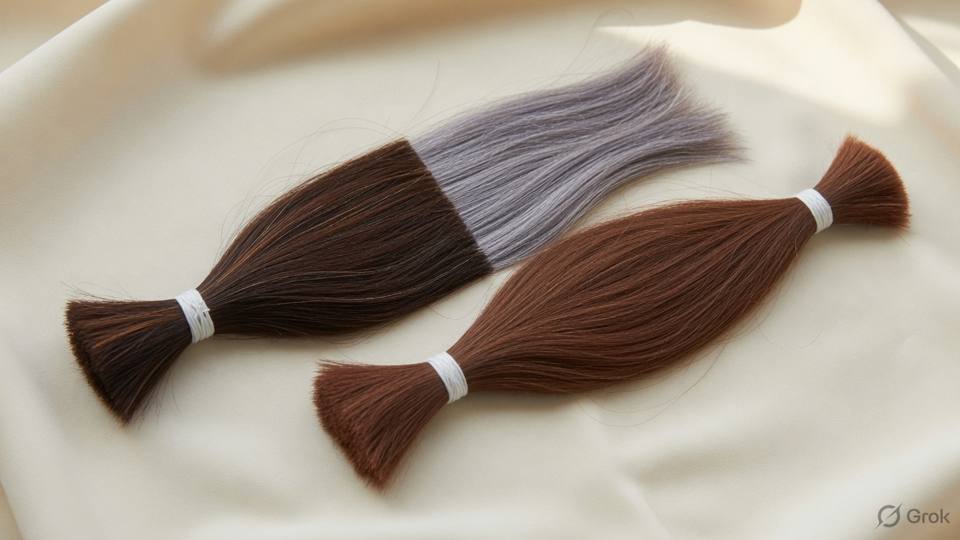
Why grey resists
Grey hair is hair without pigment. The strand has a cuticle and a cortex, but the melanin that gives it colour is gone or nearly gone, so there is nothing for a translucent colour to sit against. A fashion shade applied alone to grey looks correct for a few days and then fades into a pale halo, because the colour had no base to hold it. Grey also tends to have a denser, more glassy cuticle in some clients, which resists penetration. The result is a strand that needs pigment put back, and needs enough time for that pigment to enter. The problem is not a lack of developer strength. It is a lack of colour inside the hair.
Raising the developer volume is the wrong first answer, and it is the most common error. Forty volume does not add pigment to grey; it lifts whatever natural pigment remains and opens the cuticle wider, which can make the grey look brighter and the coverage thinner. On resistant grey, a higher volume often produces a hotter, more translucent result that fades faster than a lower volume with a richer formula. The correct levers are the formula's natural base, the development time within the brand's limit, the application order, and the size of the section. Those four levers control coverage. The volume controls speed, and speed is not the problem.
Assess grey before you choose a service. Work in daylight, part the hair in several places, and estimate the percentage across the head rather than at one spot. Under thirty percent is scattered grey that can be woven or blended. Thirty to fifty percent usually needs a global formula with a natural base, or a deliberate blend if the client wants dimension. Over fifty percent, or a client who wants solid coverage, needs a global application with enough natural base to cover the most resistant areas. Note where the grey is densest: the hairline and temples are usually the most resistant, and the crown is often easier. Those notes decide the application order.
Check the scalp as well as the hair. Grey clients are often older, and older scalps are thinner, drier, and more sensitive. Broken skin, flakes, or tenderness changes the plan, because a permanent colour on an inflamed scalp is a risk you do not need to take. Ask about previous colour, because a client who has been covering grey with a box shade may have a build-up that reads darker at the mid-length. Ask about the retouch interval, because grey shows at the root within two to three weeks even when the colour itself is still sound. A grey client is booking a rhythm, not a single appointment, and the consultation should say so.
- 1. Treat grey as hair with no pigment: it needs pigment and time, not a higher developer volume.
- 2. Measure the grey percentage across the whole head in daylight, not from one parting.
- 3. Add a natural base at the target level so the grey has something to hold, per the brand's coverage guidance.
- 4. Use 20 volume for most grey coverage, and never use 40 volume as a coverage shortcut.
- 5. Extend the development time within the brand limit, often up to 45 minutes, for resistant grey.
- 6. Apply the hairline and temples first and check them first, because they resist the longest.
- 7. Do not colour a scalp that is broken, weeping, or inflamed; refer instead.
- 8. Set the retouch rhythm at 4 to 6 weeks before the client books, because grey returns to the root first.
Salon example
Asha is sixty percent grey, with the densest grey at the hairline and temples, and she has been covering it at home with a level three box colour for three years. Her mid-length is a level three, her ends are a level two from build-up, and the grey at the temples is almost white. She wants a level four warm brown. The box colour has left a dark band, and the temples have a pale halo because the home kit never covered them properly. I explain that the halo is a coverage problem, not a colour problem, and that a stronger developer would only make it worse. The plan is a global level four with a natural base at 20 volume, applied to the temples first, developed for the full forty-five minutes the brand allows, with the ends pulled through for the last ten. The temples cover, the halo closes, and the band softens. She books a retouch at five weeks, and I tell her the grey will show at the hairline first, which is normal. She also books a gloss at five weeks, because the mid-length will fade before the next retouch, and the gloss keeps the finish even without adding lift.
Caution: A higher developer volume does not cover resistant grey. It lifts the remaining natural pigment and can leave the grey brighter and the coverage thinner.
More pigment, more time
Coverage is built from pigment, and the pigment comes from the formula. A natural base at the target level gives the grey a colour to hold, and the fashion tone on top gives it the direction the client asked for. The usual approach is the target shade mixed with a natural base at the same level, in the proportion the brand recommends for the grey percentage. Some brands publish a specific coverage line, and those lines exist because the pigment load is higher. Use them. A formula built from a sheer fashion shade and a high volume will look right on the day and fade to a halo in ten days, which is the worst outcome for a client who is paying for coverage.
Time is the second lever. Resistant grey, especially at the temples, needs the full development time the brand allows, which is often forty-five minutes for a permanent colour. Do not shorten the time because the rest of the head looks ready. Check the resistant area first, and if it is still translucent at thirty-five minutes, use the remaining time. Do not extend beyond the brand's maximum, because the extra minutes add damage rather than coverage. If the grey is still not covered at the maximum time with a proper base, the formula is wrong, not the clock, and the next visit needs a different base or a different line.
Some brands provide a pre-soften step for resistant grey, and some provide a specific protocol for the first application. Follow the brand's method exactly if it exists. Do not invent one from household products, and do not substitute a lightener pass for a pre-soften unless the brand says so. A pre-soften that is too strong, or left too long, damages the cuticle before the colour arrives and makes the grey take unevenly. If the brand has no pre-soften method, the safer route is more natural base, a longer development within the limit, a smaller section, and a strand test that proves the result before the whole head is committed.
Application order is the third lever. Grey at the hairline, the temples, and the parting is usually the most resistant, so it goes on first and gets the longest time. The crown and the back, which are often easier, go on second. Work in sections thin enough that the product reaches the scalp, because a thick section leaves the grey underneath untouched. At the rinse, emulsify with a little water and massage the hairline gently so the colour releases evenly, then use the brand's after-colour wash. Check the result in daylight before the client leaves, because salon light flatters coverage and daylight exposes a halo.
- 1. Mix the target shade with a natural base at the same level, following the brand's ratio for the grey percentage.
- 2. Use a dedicated coverage line when the brand publishes one, because the pigment load is designed for grey.
- 3. Develop for the full brand time, often up to 45 minutes, and check the temples first.
- 4. Never exceed the brand's maximum time, because extra minutes add damage rather than coverage.
- 5. Pre-soften only with the brand's own method, never with a household mixture or an improvised lightener pass.
- 6. Apply the hairline, temples, and parting first, then the crown and back.
- 7. Section thinly so the product reaches the scalp, and emulsify at the rinse for an even release.
- 8. Check the finished coverage in daylight, not only under salon lamps, before the client leaves.
Salon example
Suman is about seventy percent grey with very resistant white at both temples, and she wants a level five neutral brown. Her hair is fine and her scalp is sensitive, so a high volume is not an option. I test two formulas on separate nape strands: one with the target shade alone, and one with the target shade plus a natural base at level five, both at 20 volume. At thirty minutes the first strand is translucent at the temple section and the second is nearly solid. At forty-five minutes the second is solid and the first still shows a pale edge. The brand's technical sheet allows a pre-soften for resistant grey, so I follow that method on the temples only, with the timing the sheet specifies, and then apply the base formula. The temples cover, the scalp is calm, and the result is even in daylight. The client's card records both test formulas, the pre-soften, and the forty-five minute development, so the next visit starts from a known result. She books the retouch at five weeks and a gloss at three, because the gold in the formula will fade before the coverage does, and the gloss keeps the surface from dulling.
Caution: Do not invent a pre-soften with lemon, baking soda, or a lightener pass. If the brand has no approved method, change the base or the line instead.
Coverage, blending, and refresh
Not every grey client wants solid colour, and the consultation should offer both. Under about thirty percent grey, a weave or a lowlight through the grey can keep dimension, provided the client understands that the grey will still show as highlight. A client with scattered grey who wants a natural, sun-lit look is often happier with a blend than with a flat global shade. The blend needs a formula that deposits on the grey and a placement that distributes it, and it needs a realistic explanation of how it will grow out. If the client wants no visible grey at all, do not sell a blend; sell coverage.
Between thirty and fifty percent grey, the usual answer is a global formula with a natural base, sometimes with a slightly deeper root and a softer mid-length. Over fifty percent, or a client who wants solid coverage, book a global application and plan the retouch rhythm. A global colour on grey is not a one-off service. The root shows in two to three weeks, and a retouch at four to six weeks keeps the coverage clean. If the client stretches to eight or ten weeks, the grey band at the root becomes visible and the mid-length fades, and the correction costs more than the retouch would have.
A fashion shade on grey fades to a halo, and the halo is the most common complaint in a grey coverage client. The fix is not a stronger developer on the next visit. It is a formula with more base, a proper development time, and a smaller retouch interval. If the client wants a cool or red fashion tone, explain that those tones fade fastest on grey and that a gloss at four to six weeks keeps the finish. A tone that is only deposited on the surface, with no base underneath, leaves first. That is chemistry, not a product defect, and saying it early prevents the conversation later.
Refresh is part of the service, not an upsell. A grey client on a four to six week retouch needs a plan for the mid-length and ends, which do not receive fresh colour at every retouch and will fade or dull. A gloss at the midpoint keeps the tone even without adding lift. If the ends are porous, the gloss grabs darker, so dilute it or shorten the time. Record the retouch date and the gloss date on the card, and book both before the client leaves. A coverage client who leaves with a rhythm is a client who stays for years; a client who leaves with one good colour and no plan is a client who tries a box kit in six weeks.
- 1. Under 30 percent grey, offer a weave or lowlight blend only if the client accepts visible grey as highlight.
- 2. From 30 to 50 percent grey, use a global formula with a natural base and a slightly deeper root if wanted.
- 3. Over 50 percent grey, or a client who wants solid coverage, book a global application and a retouch plan.
- 4. Do not use a fashion shade alone on grey, because it fades to a halo within about 10 days.
- 5. Set the retouch at 4 to 6 weeks, and a gloss at the midpoint to keep the mid-length even.
- 6. Dilute or shorten a gloss on porous ends so they do not grab darker than the root.
- 7. Explain that cool and red tones fade fastest on grey, so the client is not surprised at week three.
- 8. Book the retouch and the gloss before the client leaves, and record both dates on the card.
Salon example
Nirmala is thirty-five percent grey, mostly at the front hairline, and she does not want to look fully coloured. She likes the silver at her temples but wants the rest to read as a warm brown with some lightness. A solid global shade would erase the character she likes, so we agree on a blend: a level five natural base woven through the front and crown, with a few finer pieces left untouched at the temple, and a level six gold gloss over the mid-length for warmth. The grey that remains reads as a deliberate highlight rather than a patch. I explain that this look needs a retouch at five weeks, because the woven grey will grow out faster than a solid colour, and a gloss at three weeks to keep the gold from fading. She books both. If she had wanted zero visible grey, I would have recommended a global coverage instead, because a blend sold as coverage always disappoints. She also asks what happens if she misses the five week mark, and I explain that the grey will show at the hairline first and that the retouch will take longer, but the plan does not change.
Caution: A fashion shade alone on grey will fade to a pale halo, usually within two weeks. Sell coverage with a base, or sell a blend honestly.
This is a Nandu Nai textbook. It is a private brand book, not a government licence, and it does not give the right to give medical treatment.