
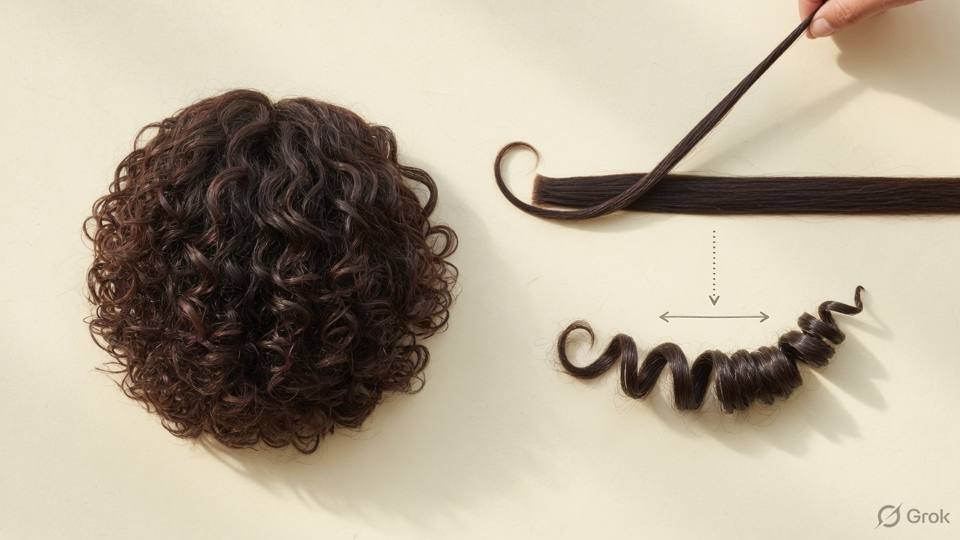
Shrinkage and true length
Shrinkage is the difference between the length of a curl when it is stretched and the length you see when it springs back. It is not a defect and it is not a styling problem; it is how curly hair behaves. On 2C to 3A hair, shrinkage is often ten to thirty percent. On 3B to 3C, it is thirty to forty percent. On 4A to 4C, it can be fifty percent or more. A client with mid-back length when stretched may have a shoulder-length shape when dry. If you cut to the stretched length, you remove hair the client can see, and the result looks short even though the numbers were correct.
Shrinkage changes the cut because the dry shape is the product. A wet curly cut is a line drawn on straight hair that will disappear when the hair dries. The perimeter you cut wet is not the perimeter the client sees. The layers you cut wet sit at a different place once the curl clumps. The face frame you cut wet may spring above the cheekbone instead of below it. For this reason, curly hair is cut dry, or cut stretched and then checked dry, and the final line is decided in the curl shape. The wet check is still useful for tension and for the true length, but it is not the final decision.
The procedure is to measure both lengths and agree on the dry target. Take one curl at the crown, one at the side and one at the front. Stretch each gently and hold the end where it reaches; then release it and let the client see where it sits. Say the difference in centimetres, not in percentages, because centimetres are what the client feels. Ask for the dry target: 'Just below the shoulder at the back, cheekbone at the front.' Write it on the card. Then cut to that target in the defined state, checking the spring after each section. If the client wants a big change, cut in stages and show the mirror between stages.
Do not promise a length you cannot deliver. If the client says 'take off five centimetres' and the hair shrinks by ten, five centimetres of dry length is not five centimetres of stretched hair. Clarify which number you are using and show it with your fingers on the dry curl. If the client wants the stretched length to stay below the shoulder, the dry shape may sit at the collarbone. Say that before the first cut. A curly client who is told the truth about shrinkage becomes a regular; a curly client who is surprised by the result does not come back, however good the cut is.
- Take one curl at the crown, one at the side and one at the front.
- Stretch each curl gently, mark the stretched end, then release and mark the spring.
- Measure the difference in centimetres and say it to the client.
- Agree the dry target at the back, the side and the front before cutting.
- Cut to the dry target in the curl shape, not to the stretched length.
- Check the spring after each section and show the mirror between stages.
- Write the dry target in centimetres on the client card.
- Explain that 3C to 4C hair can shrink by 30 to 50 percent before you quote a length.
Salon example: Nandini's five centimetres
Nandini has 4A coils that reach her mid-back when stretched and sit at her shoulders when dry. She asks for five centimetres off because her ends are dry. I stretch a coil at the back and show her where it reaches; then I let it spring and show her where it sits. The difference is about twenty centimetres. I explain that five centimetres of dry length is not the same as five centimetres of stretched hair, and that cutting five centimetres from the stretched length would take her to the collarbone dry. She thinks for a moment and says she wants the dry shape to stay at the shoulder. I cut dry, coil by coil, checking the spring after every few sections. The cut takes eighty minutes. She sees the shape in the mirror before I finish the front, and asks for the face frame to stay longer. The final shape sits at the shoulder, with the ends healthier and the length she can see. She also asks for a simple night routine, and I show her the loose pineapple and the satin scarf she already owns.
Caution: Do not quote a curly cut in stretched centimetres and then cut the same number in the dry shape. State which length you mean and show the spring with your fingers before the first cut.
Cutting in the curl shape
Cutting in the curl shape means following the direction of each curl rather than pulling it into a straight line. Hold the curl clump between two fingers, follow it from root to end, and cut where the natural end sits. The blade enters at the same angle as the curl, so the cut end blends into the pattern instead of creating a blunt step. This is slower than cutting a straight line, and it is the only way to keep the shape after the hair dries. On wavy hair, the same idea applies with a looser hand: cut damp or dry, keep the layers long, and follow the wave instead of forcing a straight edge.
The pattern decides the detail. On 2A to 2C wavy hair, cut damp or dry, keep the layers long, and avoid short layers at the crown, because a short layer on a loose wave becomes a flip. On 3A to 3C curly hair, cut dry, section by section, and remove weight inside the shape, never at the perimeter with a razor. On 4A to 4C coily hair, cut dry and in the defined state, do not brush the section out before cutting, and work in small sections. On transitioning or heat-damaged curls, cut the straight ends gradually over two or three visits instead of cutting to the root curl in one sitting, unless the client asks for a big chop.
Weight removal is the hardest part. Curly hair looks full but can be dense underneath, and a shape that is too heavy collapses at the root. Remove weight with long internal layers, cut in the curl shape, and leave the perimeter supported. Do not use a razor, and do not use thinning shears on the perimeter or the crown. If the hair is very dense, take a few vertical sections inside the shape and shorten them by two to three centimetres, then check the volume dry. One section at a time. The goal is a shape that holds its volume without a heavy product, and that still looks like the client's own hair.
Finish the cut in the state the client will wear. Apply leave-in to soaking wet hair, scrunch upward, and diffuse on low heat and low speed, or let it air-dry. Do not towel-rub, because it breaks the clumps and creates frizz. Check the shape from the front, the side and the back, and look at the root volume. If one side is flatter, re-cut that side in the curl shape rather than adding product. If the face frame is too short, leave it and plan to adjust at the next visit, because cutting more will not fix it. The cut is finished when the dry shape matches the dry target, not when the wet line looks even.
- Cut dry, in small sections, following each curl clump from root to end.
- Enter the blade at the angle of the curl, not across it.
- Keep layers long on 2A to 2C hair and avoid short crown layers.
- Remove weight inside the shape on 3A to 3C hair, never at the perimeter with a razor.
- Cut 4A to 4C hair in the defined state and do not brush the section out.
- Cut heat-damaged ends gradually over two or three visits.
- Check the root volume dry and re-cut a flat side in the curl shape.
- Finish with leave-in on soaking wet hair, scrunch and diffuse on low heat.
Salon example: Farida's flat crown
Farida has 3C curls, medium density, and she says her crown goes flat by the second day. She wants a shape with more volume at the top. Her previous cut was done with a razor at the perimeter, and the ends look frayed. I cut dry, following the curls, and leave the perimeter alone. At the crown, the hair is dense underneath and light on top, so I take two vertical sections inside the shape and shorten them by two centimetres in the curl shape. I check the volume after each section and stop when the crown lifts without looking hollow. I do not use the razor. I finish with leave-in on soaking wet hair, scrunch and diffuse on low heat. The crown holds, and the frayed ends are gone because I cut the last centimetre in the curl direction. Farida books eight weeks ahead and asks for the same stylist, because the shape still works on day three. She also asks whether she can wear a tight ponytail for the gym, and I show her a loose high tie that leaves the hairline alone.
Caution: Do not razor or thin the perimeter or the crown of curly hair. Remove weight with long internal layers cut in the curl shape, one section at a time, and check the volume dry.
Washing, styling and protecting the cut
A curly cut only works if the washing and styling routine supports it. Shampoo the scalp, not the lengths, and use a conditioner that gives enough slip to detangle without pulling. Wash frequency depends on the scalp: once or twice a week suits many curly clients, but a client who exercises daily may need to rinse and condition more often. Hot water opens the cuticle and increases frizz, so keep the water lukewarm and finish with a cool rinse. Do not brush the hair dry. Detangle in the shower with conditioner and a wide-tooth comb, working from the ends upward, and scrunch the water out instead of rubbing with a towel.
Styling starts with water. Apply leave-in or a curl cream to soaking wet hair, section by section, and scrunch upward to encourage the clump. Do not apply product to damp hair and then scrunch, because the hair is already half-dried and the clumps will break. Use a cotton T-shirt or a microfibre towel to blot, not a terry towel, and never rub. If the client uses a diffuser, set it to low heat and low speed, hover at the root first, then cup the ends. Move the diffuser, do not park it. If the client air-dries, keep the hands off until the hair is dry, because touching breaks the cast and creates frizz.
The finish in the salon should be the routine the client can repeat. Show the products, the amount and the order: leave-in first, then cream or gel, then diffuse or air-dry. Show how to refresh on day two or three with water and a little leave-in, not with a brush. Show how to sleep: a loose pineapple on top of the head, a silk or satin pillowcase if the client has one, or a loose scarf. A cut that looks good only on wash day will be tied back by Wednesday. The client should leave knowing three things: how much product, where it goes, and what not to do.
Protect the cut between visits. A curly cut grows out in shape, so the silhouette stays longer than a straight cut, but the perimeter and the face frame still need a trim. Book six to ten weeks depending on the pattern and the client's patience. At home, avoid tight ponytails at the hairline, because they pull the curl straight and can break the hair. Avoid dry brushing, hot tools without protectant, and sleeping on wet hair. If the client colours or straightens, plan the services apart from the cut and keep the cut simple until the chemical service has settled. The next visit should start with a dry look at the shape, not with a wash.
- Shampoo the scalp and condition the lengths, then detangle with a wide-tooth comb in the shower.
- Keep the water lukewarm and finish with a cool rinse.
- Apply leave-in or curl cream to soaking wet hair, section by section.
- Scrunch upward to form clumps and blot with a cotton T-shirt or microfibre towel.
- Diffuse on low heat and low speed, moving the diffuser instead of parking it.
- Keep the hands off the hair while it air-dries.
- Refresh on day two or three with water and a little leave-in, not with a brush.
- Book the next curly cut in 6 to 10 weeks and check the shape dry first.
Salon example: Leela's day-three hair
Leela has 3A curls and a busy job, and she says she can never make her hair look the same on day two. She washes every day and brushes it dry before work, which is why the curl breaks and the surface frizzes. I cut dry, keeping the layers long and the perimeter soft. Then I wash it in the salon and show her the routine step by step: shampoo on the scalp, conditioner on the lengths, comb in the shower, leave-in on soaking wet hair, scrunch, blot with a cotton T-shirt, diffuse on low heat. I make her do the scrunch herself while I hold the mirror. She is surprised by how much water the hair holds before the product goes in. I write the routine on a card with three lines: soak, scrunch, hover. She comes back eight weeks later with day-three curls that still hold, and says she has stopped brushing altogether. She also asks what to do on a rainy day, and I show her how to diffuse only the roots and let the ends air-dry. She writes the three lines on her phone.
Caution: Do not send a curly client home with a routine that needs a brush, a hot tool or a towel rub. If the client cannot repeat the finish, simplify the cut or the routine before she leaves.
This is a Nandu Nai textbook. It is a private brand book, not a government licence, and it does not give the right to give medical treatment.