
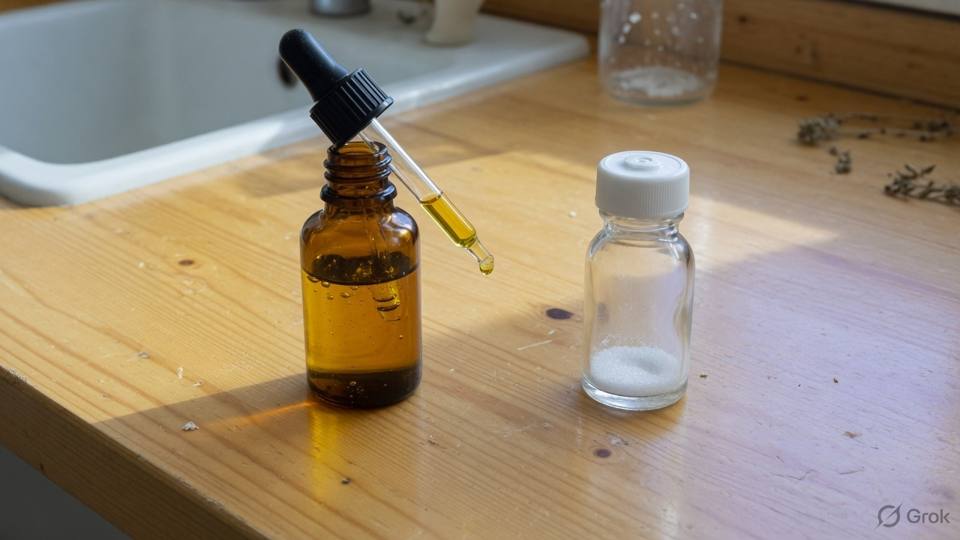
Two different spoilage routes
A cosmetic can spoil in two ways, and the two are often confused. Oil spoils by oxidation: oxygen attacks the unsaturated fats, the oil develops a rancid smell, and the colour may darken. Water spoils by microbial growth: bacteria, yeast and mould multiply in the water phase and can make the product unsafe. An antioxidant addresses the first. A preservative addresses the second. Tocopherol is an antioxidant, and it does nothing to stop microbes. Phenoxyethanol is a preservative, and it does nothing to stop rancidity. A formula needs the one that matches its risk, and a formula with both oil and water needs both.
The confusion is common because both problems show up as a change in smell. A rancid oil smells stale and crayon-like. A contaminated cream can smell sour, yeasty or simply wrong. The nose cannot tell you which route caused the change, and by the time the smell is obvious the product may already have been sold. That is why the tests are separate: an accelerated stability screen looks at oxidation and physical change, and a microbial count or challenge test looks at growth. Neither test substitutes for the other, and neither is replaced by a smell check. Write the two tests as two lines in the plan, with different sample dates.
Water activity decides how much a water phase can support growth, and oil content does not change that. A cream that is 25 percent oil still has a continuous water phase, and that water is where microbes live. A water-in-oil cream is different, because the water sits in isolated droplets, but a breach in the film can still let organisms in. The practical rule for a salon is simple: if water is present and the client will open the pack, a preservative system is required, whatever the oil percentage says on the front of the jar. The oil percentage is a texture number, not a preservation number.
Essential oils are not preservatives. Tea tree, rosemary and similar oils have some antimicrobial activity in a test tube, but at cosmetic levels in a real formula they do not deliver a preserved product, and they add allergens. A product preserved with essential oils alone is a product with a scent and an unmanaged risk. The same applies to grapefruit seed extract and to the many natural preservative blends sold without data. If the supplier cannot give a dose, a pH window and a challenge test report, the material is a fragrance or a marketing ingredient, not a preservative. A scent is not a system, and a label that implies otherwise is a claim the salon cannot support.
- 1. Identify the risk first: oxidation for an oil, microbial growth for a water phase.
- 2. Add an antioxidant such as tocopherol for the oil, at about 0.05 to 0.50 percent.
- 3. Add a preservative system for the water, at the supplier dose inside the legal ceiling.
- 4. Do not count tocopherol, essential oils or plant extracts as preservatives.
- 5. Do not count a preservative as protection against rancidity.
- 6. Test the two risks separately: stability for oxidation, count and challenge for microbes.
- 7. Write both systems on the card with their doses and their reasons.
- 8. Re-test when an oil, a water content or a pack changes.
Bench example: an anhydrous oil that needs only one system
A facial oil is made from caprylic/capric triglyceride 56.00, squalane 24.00, jojoba oil 10.00, dimethicone 5.00, isopropyl myristate 4.00, tocopherol 0.50 and bisabolol 0.50. The lines total 100.00, and there is no water in the formula. No preservative is needed for microbial growth, because there is no water phase and the pack is a dropper that does not admit water in normal use. Tocopherol at 0.50 percent is there to slow oxidation of the jojoba and the squalane, and the batch is filled into a dark glass bottle with a small headspace. The same oil with 2 percent aloe water added would need a preservative and a challenge test, because the water would create a growth route that the tocopherol cannot touch. One added line changes the whole risk profile, and the card must show it. The tocopherol level stays the same, because it protects the oil and not the water. The preservative is chosen from the supplier sheet, kept inside the legal ceiling, and proved by a challenge test in the dropper bottle. A shampoo or a cream with the same oil would need the same two systems, and the records would have to show both.
Caution: Tocopherol is not a preservative and a preservative is not an antioxidant. A product that needs both must carry both, each at its own dose.
Tocopherol, chelators and the oil phase
Tocopherol is used at about 0.05 to 0.50 percent in the oil phase, and it works by being oxidised itself before the oil is. It is a sacrificial material, so its level falls over time and the protection falls with it. Add it to the oil phase before the emulsion forms, so it is distributed through the droplets rather than sitting in a few of them. A water-soluble antioxidant such as sodium metabisulfite is a different tool and is not a substitute; it has its own sensitiser and regulatory issues. Choose the antioxidant for the phase it has to protect, and record the level.
Antioxidants work better in company. A chelator such as disodium EDTA at about 0.10 percent binds trace metals that catalyse oxidation, and it supports the preservative at the same time. A synergist such as ascorbyl palmitate can regenerate tocopherol to some extent, and a plant extract with a declared antioxidant content can add to the effect if the supplier gives a use level. None of these is a guarantee. An oil with a high polyunsaturated content will still oxidise, and heat, light and air will speed it up. The antioxidant slows the process; it does not stop it. A screen that shows a colour change at week two is telling you the antioxidant is losing.
The oil phase itself is the largest variable. A refined triglyceride is more stable than an unrefined seed oil, and a seed oil rich in linoleic acid is more fragile than squalane. If the brief calls for a fragile oil, the formula needs a stronger antioxidant, a smaller headspace, and a pack that excludes light. A clear jar on a shop shelf is a stress test that no antioxidant can fully pass. The supplier's recommended level for the oil is a starting point, and the stability screen is the judge. If the supplied oil is already old, no antioxidant in the formula will rescue it.
Temperature is the enemy in the workshop as well as on the shelf. A long hot hold oxidises oils before the product is even bottled, and a batch that is heated twice is worse than one heated once. Melt the oil phase, combine, and cool without unnecessary delay. If a batch has to be reheated to add a missed line, record it, because the oil has already been stressed and the shelf life may be shorter. A formula that is only stable when it is made perfectly is not stable enough for a salon. Heat once, cool once, and write the temperatures down.
- 1. Add tocopherol at about 0.05 to 0.50 percent to the oil phase, before the emulsion forms.
- 2. Keep the chelator at about 0.10 percent, and count it as support for both systems.
- 3. Choose the antioxidant for the oil's fragility, not for the label story.
- 4. Reduce headspace and exclude light if the oil is high in polyunsaturates.
- 5. Avoid long hot holds and never reheat a batch without recording it.
- 6. Store the raw oil under the supplier's conditions, and check the date before use.
- 7. Test the finished product for smell, colour and viscosity at week one and week four.
- 8. Replace the antioxidant if the oil or its supplier changes, and re-run the screen.
Bench example: a lotion with a fragile oil
The standard lotion card carries 6.00 percent caprylic/capric triglyceride and 0.10 percent tocopherol. A client asks for a version with 5.00 percent unrefined rosehip oil, which is rich in linoleic acid. The oil replaces 5.00 g of the triglyceride, and the water line falls by 5.00 g to keep the total at 100.00. Tocopherol is raised to 0.50 percent, disodium EDTA stays at 0.10 percent, and the pack changes from a clear jar to an opaque pump. The batch is made once, without a reheat, and filled with a small headspace. At week four the warm sample is slightly darker than the control, which is recorded as an early sign of oxidation. The next version drops the rosehip to 2.00 percent and adds 3.00 percent of a stable triglyceride, because the client wants the story but the product has to survive the shelf. The screen, not the brochure, decides how much of a fragile oil the formula can carry. If the screen is marginal, lower the fragile oil before you raise the antioxidant again, because the oil is the source of the problem and the antioxidant is only the brake. Keep the two trial jars side by side and read them at the same hour of the same day.
Caution: An antioxidant slows oxidation; it does not make a fragile oil stable in a clear jar. Change the pack or lower the oil if the screen fails.
Pack, dose and what a smell test cannot tell you
The pack decides how much protection the formula needs. A jar that fingers enter is inoculated every time it is opened, and the product at the surface is exposed to air, light and bathroom humidity. A pump or an airless pack keeps the bulk away from fingers and air, so the same formula can carry a lighter system and a longer shelf life. A clear pack adds light to the stress, and a large headspace adds air. When a formula is moved from a pump to a jar, the preservative and the antioxidant both deserve a second look, and the challenge test should be repeated in the new pack.
A swelling pack is a signal, not a cosmetic problem. Gas produced by microbial growth can bulge a tube or lift a lid, and a fermented or contaminated product can build pressure. A pack that softens or stains may be reacting with the formula, which is a compatibility problem between the product and the plastic. A split phase, a water layer or oil on the surface means the emulsion has failed. None of these is fixed by shaking the bottle before use. Each is a reason to quarantine the batch and look at the record, the pack and the process.
A one-week smell check is not a microbial test. It can detect a strong spoilage odour, but many contaminated products smell normal for weeks, and a product with a fragrance can mask a change entirely. A clear product can carry a high count, and a cloudy product can be perfectly safe. The only way to know is a count and a challenge test. The smell check is useful as an early warning for oxidation in an oil, where the change is often detectable before the colour moves, but even there it is a screen, not a result. A smell check that passes tells you almost nothing about the count.
Write the pack and the test into the batch record together. The record should name the pack type, the fill date, the preservative dose, the antioxidant dose, the challenge test report number and the stability readings. When a complaint arrives, those five facts let the salon find the batch and decide what to do. Without them, the salon can only guess, and a guess that reaches a client is worse than no answer. The pack is part of the formula, and the test is part of the proof. A file that holds the pack, the dose and the report together is worth more than a shelf of samples with no labels.
- 1. Match the pack to the risk: airless or pump for fragile actives, jar only with a stronger system.
- 2. Count the pack change as a formula change, and re-test when the pack changes.
- 3. Check for swelling, softening, staining and a loose closure at every stability read.
- 4. Treat a split phase or a water layer as a fail, and quarantine the batch.
- 5. Do not shake a separated product and sell it; the separation will return.
- 6. Use a smell check only as an early warning, never as a microbial result.
- 7. Record the pack type, fill date, doses and test report number with the batch.
- 8. Keep a retained sample in the same pack, so a complaint can be compared with the original.
Bench example: a jar that swelled
A 100 g moisturiser is filled into 60 g jars and sold over eight weeks. At week six a client returns a jar with a domed lid and a sour smell. The batch record shows pH 5.20, phenoxyethanol at 0.80 percent, ethylhexylglycerin at 0.10 percent, and a challenge test report for the pump version of the same formula. The jar version was never tested in its own pack. The remaining jars are recalled, the batch is quarantined, and a count is ordered. The count shows yeast, and the investigation finds that the jars were filled by hand from an open bucket while the salon was also doing a colour service. The preservative was not the only fault, but the pack made it worse. The next version is filled from a closed container, in a pump, with its own challenge test, and the jar is withdrawn from sale. The salon now fills only in the tested pack, and the record shows the pack beside the dose, so the next person cannot repeat the mistake by choosing a jar. The client was told what happened, and the salon paid for the return without argument.
Caution: A smell test, a clear look and a sealed lid are not proof of preservation. Only a count and a challenge test in the final pack are.
This is a Nandu Nai textbook. It is a private brand book, not a government licence, and it does not give the right to give medical treatment.