
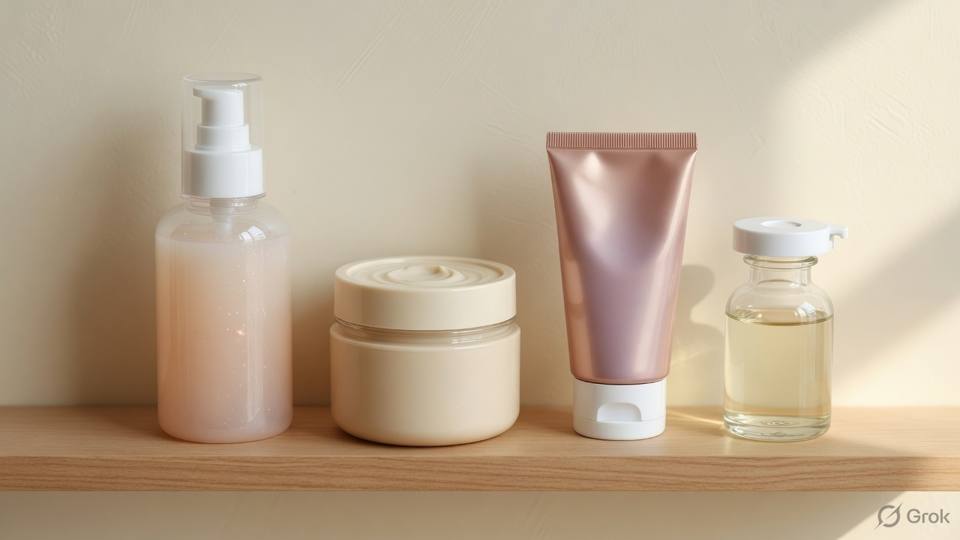
Matching the pack to the formula
The pack is part of the formula, because it decides what the product meets after it leaves the bench. Air, light, fingers and heat all reach the product through the pack, and each one changes the rate of spoilage. An airless pump keeps the bulk away from air and from fingers. A jar invites both. A clear bottle admits light. A dark bottle with a small headspace admits much less. A tube protects the product until it is opened, and then the nozzle becomes the route in. The same lotion can be stable for two years in one pack and fail in eight weeks in another, with no change to a single line of the formula.
Compatibility is the second question. Some oils and actives stain plastic, some solvents soften it, and some fragrances attack a particular resin. A pack that softens, crazes or stains is not a cosmetic problem; it is a material problem that can also contaminate the product. Ask the supplier for the resin and for compatibility data, and test the actual formula in the actual pack. A drop test and a four-week fill test catch most of these faults before a client does. If a pack is changed for cost or for looks, treat it as a formula change and re-run the stability screen.
The dispensing route matters as much as the material. A pump that delivers a large dose wastes product; one that delivers a small dose makes the client pump five times and introduces more air. A dropper lets the client touch the tip and the product. A wide jar is easy to use and hard to keep clean. A tube is good for a cream that is used on hands, and poor for a serum that needs a measured dose. Choose the pack for the way the product will be used, then test the preservative system in that pack, because the use pattern is part of the microbial challenge.
Cost, appearance and shelf presence are real constraints, but they come after function. A beautiful jar that lets the cream oxidise is a return waiting to happen. A cheap pump that jams is a complaint. The right pack is the cheapest one that protects the formula for the intended life, dispenses the right dose, and can be filled cleanly in the salon's actual process. That is a short list, and it is worth more than a long list of finishes. A pack that works is invisible to the client; a pack that fails is the only thing they remember. Write the fill and closure checks into the batch record, so the pack is verified with the same care as the pH.
- 1. List what the formula is sensitive to: oxygen, light, water loss, fingers, heat.
- 2. Choose the pack that limits the biggest sensitivity first, then the others.
- 3. Ask the supplier for the resin and for compatibility data with oils, solvents and fragrance.
- 4. Fill a trial batch in the actual pack and hold it for four weeks before ordering stock.
- 5. Check the dose the pack delivers, and compare it with the intended use.
- 6. Test the pack for softening, crazing, staining and closure damage.
- 7. Treat a pack change as a formula change, and re-run the stability screen.
- 8. Record the pack type and the supplier lot with the batch record.
Bench example: the same serum in three packs
A 10 percent ascorbic acid serum at pH 3.3 is filled into a clear dropper bottle, an amber dropper bottle and a 30 g airless pump. All three hold the same batch. At week one the clear bottle is pale yellow, the amber bottle is unchanged and the pump is unchanged. At week four the clear bottle is brown and smells stale, the amber bottle is light yellow, and the pump is still pale. The formula did not change; the pack did. The salon sells only the airless pump, and the amber bottle is kept for a short-life trial that is made weekly. The clear bottle is removed from the range, even though it was the cheapest and looked the best on the shelf. The batch record lists the pack beside the batch number, so the result can be traced. The formula was not the variable, and the test showed it. A pack trial with three candidates costs less than a recall and answers the question faster than an argument about supplier quality. Keep the three packs labelled with the batch and the fill date, and read them on the same day.
Caution: Do not choose a pack for its look before the formula has been tested in it. A beautiful pack cannot protect an unstable product.
Airless, dark and the actives that need them
Vitamin C and retinol are the two actives that most often demand an airless pack. L-ascorbic acid at 5 to 15 percent and a pH near or under 3.5 is unstable in the presence of oxygen, and it yellows as it oxidises. Retinol at 0.1 to 0.3 percent is sensitive to both air and light, and it degrades faster in a jar that is opened twice a day. An airless pump keeps the bulk away from air until the moment of use, and a dark or opaque pack removes light. Together they buy time that no antioxidant can buy on its own.
An airless pack is not a pump with a nice name. It uses a piston or a bag that collapses as product is drawn, so the volume behind the product does not fill with air. A conventional pump pulls air back into the bottle to replace what was dispensed, and that air is the enemy. A dropper is worse, because every opening exchanges the headspace. When a supplier offers an airless pack, ask how it works and test the dose. A pack that is airless but delivers 2 g per stroke is wasteful, and a pack that delivers 0.1 g makes the client work too hard and introduces air at the nozzle.
Dark glass, opaque plastic and a small headspace all reduce light and oxygen exposure. A clear bottle with a coloured label is not a dark pack, because the light reaches the liquid at the edges. A bottle that is filled to the shoulder has less headspace than one filled halfway, and less oxygen to react with. If the product is a water-based serum with ascorbic acid, a chelator such as disodium EDTA at about 0.10 percent is part of the protection, because trace metals catalyse the oxidation. The pack, the chelator and the pH work as a system, and the stability screen tests the system.
The pack also sets the shelf life claim. A product in an airless pack can carry a longer period after opening than the same product in a jar, and the label should reflect what was tested, not what would be convenient. If the salon cannot afford the airless pack, the honest answer is a smaller jar, a shorter shelf life and a clear instruction to use it within a stated time. What the salon must not do is put an unstable serum in a clear dropper and sell it with a two-year claim because the label looks better that way.
- 1. Identify the actives that are sensitive to oxygen or light, and list them before choosing a pack.
- 2. Choose an airless or opaque pack for ascorbic acid and retinol, and test the dose it delivers.
- 3. Reduce the headspace at fill, and check that the closure seals without trapping air.
- 4. Add a chelator at about 0.10 percent when the formula contains ascorbic acid.
- 5. Keep the pH in the range the active needs, and record it for every batch.
- 6. Fill a trial in the actual pack and read colour and smell at week one and week four.
- 7. Set the period after opening from the test, not from the competitor's label.
- 8. Tell the client how to store and use the pack, and put that instruction on the label.
Bench example: a retinol cream that needed a different pack
A 30 g retinol night cream at 0.20 percent is first filled into a clear jar, because the client likes to see the cream. At week two the cream at the surface is slightly darker, and at week four the smell has changed and the colour is uneven. The formula is remade with the same percentages, filled into an opaque airless pump, and held for four weeks beside the jar. The pump sample is unchanged at week four, while the jar sample is clearly oxidised. The salon switches the pack and shortens the period after opening from twelve months to six, because that is what the test supports. The formula did not change, but the product did. A retinol product in a clear jar is a product that is already losing its active on the shelf. The client liked the jar, and the client also liked the result; the second one is what keeps the sale. Write the pack, the period after opening and the storage instruction on the label. A client who keeps the pump in a hot car has changed the conditions the test covered, and the instruction is the only warning they will get.
Caution: An airless pack is not a substitute for a stable formula. Test the formula in the pack, and set the shelf life from the result.
What a change in the pack tells you
A pack that swells is telling you something is producing gas. Microbial growth is one cause, and it is the one that matters most, because a contaminated product can be dangerous as well as spoiled. A chemical reaction between the formula and the pack can also produce gas, and a fermented ingredient can do it on its own. A swollen tube or a domed lid is a reason to quarantine the batch, not to pierce the lid and sell the rest. Open it in a safe place, note the smell and the appearance, and send a sample for a count before any decision is made.
A pack that softens, crazes or stains is telling you the material and the formula are not compatible. Some solvents attack a particular plastic, and some oils migrate into it and leave a greasy mark that cannot be cleaned. A pump that becomes stiff or a closure that no longer seals is a sign of the same problem. Compatibility is tested by filling the actual pack and holding it, not by reading a resin data sheet alone. If a batch has damaged its pack, the product may also have absorbed something from it, and the batch should not be sold.
A split phase inside the pack is telling you the emulsion has failed. A water layer at the top, oil droplets on the surface, or a product that separates when the pack is squeezed are all failures. Shaking the pack mixes the phases for a few minutes and does not restore the structure, so a product that has separated must not be sold as if nothing happened. A separated product is a failed product, even if the phases can be mixed back for an hour. The cause is usually the emulsifier level, the HLF match, the process temperature or a freeze during transport. The record should show which one, because the next batch will repeat it otherwise.
A one-week smell check is not a microbial test, and a pack that looks clean is not proof. The smell check catches strong spoilage and some oxidation, and it is cheap, so it is worth doing. It cannot tell you the count, and it cannot tell you whether the preservative will hold for the life of the product. Only a count and a challenge test on the finished formula in the final pack can do that. The pack tells you where to look; the lab tells you what is there. Keep both in the record, and never let a pleasant smell close a file that has no test behind it.
- 1. Check every stability sample for swelling, doming, softening, crazing and staining.
- 2. Quarantine any batch whose pack has swollen, and order a microbial count.
- 3. Note the smell and appearance when the pack is opened, and record them with the date.
- 4. Check the pack and the closure for damage before blaming the formula.
- 5. Treat a split phase as a fail, and do not sell the batch after shaking it.
- 6. Use a one-week smell check as an early warning, and never as a microbial result.
- 7. Keep a retained sample in the same pack, so a complaint can be compared with the original.
- 8. Record the pack type, supplier lot, fill date and test report with the batch.
Bench example: a tube that smelled of solvent
A 100 ml tube of hand cream is returned with a soft wall and a smell of solvent. The batch record shows the formula unchanged for six months, but the tube supplier has changed the resin. A trial fill of the same batch in the old tube and the new tube is held for two weeks. The old tube is unchanged. The new tube is soft at the shoulder and the cream inside smells of plastic. The new tube is rejected, the batch is quarantined, and the supplier is asked for the resin change. The salon does not sell the batch, because the product may have absorbed material from the pack. The lesson is that a pack change is a formula change, and a smell that was not there at fill is a result worth acting on. The batch was destroyed, the tube was removed from the range, and the record shows why. The next order of tubes carries the old resin specification. The returned tube is kept as evidence, and the supplier is told why the order was rejected.
Caution: A swollen, soft or stained pack is a fail, not a packaging inconvenience. Quarantine the batch and test before any sale.
This is a Nandu Nai textbook. It is a private brand book, not a government licence, and it does not give the right to give medical treatment.