
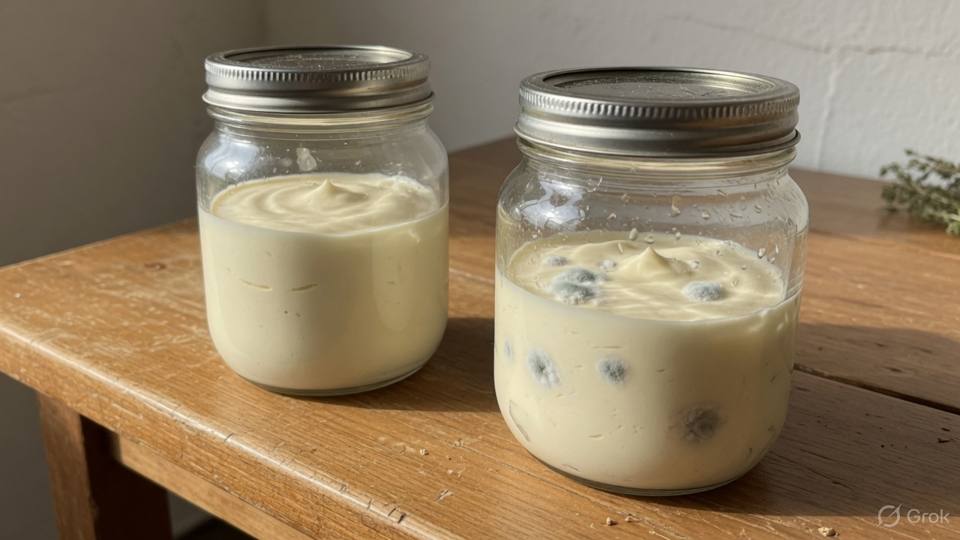
Swollen lid, yeast smell, mould spots
A swollen lid is gas, and in a cosmetic jar the gas is usually microbial. Fermentation produces carbon dioxide, the pressure builds, and the lid domes or the jar bulges. Do not open it to see what it smells like; opening releases spores and pressure, and the contents can spray. Photograph the jar, note the batch code and the date, and move it to a quarantine shelf. A swollen lid is not a packaging fault to be fixed by pressing it down, and it is not a reason to add more preservative to the next batch without finding out what happened to this one.
A yeast smell is a sweet, bready, fermented or solvent-like odour that was not in the batch when it was made. It can appear before any visible change, and it is often strongest when the jar is first opened. A sour or rancid smell is different: rancidity is usually an oil problem, while a fermented smell points to microbial growth. Neither is a smell to cover with fragrance. If the product smells wrong, it is wrong, and the batch goes to quarantine while the cause is investigated. If the smell is faint, close the jar and let it stand for an hour, then smell again at the lid; a smell that grows is a stronger signal than one that fades.
Mould appears as fuzzy spots, often at the rim, under the lid, or at the water line where condensation collects. It can be white, green, blue or black, and it can start in a single spot that is easy to miss. Do not wipe it off and sell the jar. A mould spot on the surface means the organism has grown through the product, and the visible part is only the fruiting body. The whole batch is suspect, including jars that look clean, because they came from the same mix and the same filling session. Do not open every jar to check; open one, photograph it, and treat the rest as suspect until the pattern is clear.
Any of these signs means the batch is quarantined and the record is pulled. Check the water grade, the preservative dose, the pH, the jar cleaning and the fill temperature, in that order. Check whether the jars were lidded warm, whether the lids were wet, and whether the batch was left standing open during a break. The answer is usually in one of those steps, and the record is what makes it findable. If the record is missing a value, write that the value is missing rather than filling it in from memory, because an invented number is worse than a gap.
- 1. Do not open a swollen jar; photograph it and set it aside.
- 2. Note the batch code, the date and the storage conditions.
- 3. Smell carefully at the lid, not with your nose in the product.
- 4. Look for fuzzy spots at the rim, under the lid and at the water line.
- 5. Move the whole batch to a quarantine shelf with a HOLD label.
- 6. Pull the batch record and check water, preservative, pH and jars.
- 7. Keep one affected jar as evidence for the investigation.
- 8. Do not sell, sample or fragrance the batch while it is under HOLD.
Bench example
A client returns a 50 g jar of cream with a lid that domes upward. The maker does not open it. The jar is photographed, labelled with the batch code 20260912-04 and the return date, and placed on the quarantine shelf. The record for that batch is pulled: the preservative was at 0.60%, the pH was 5.41, the water was distilled and dated, and the jars were washed and dried. The filling note says the jars were lidded at 42 degrees Celsius because the batch was running late. A second jar from the same batch, still in stock, is opened carefully in a well-ventilated area and shows a faint fermented smell and a small fuzzy spot under the lid. The whole batch is quarantined, the remaining jars are discarded, and the filling instruction is changed to 'cool below 35 degrees before lidding'. The record and the photographs are kept with the incident note. The client is told the batch is being investigated and is offered a replacement from a later batch, not another jar from the same one. The rest of the batch is not sold.
Caution: Do not press a domed lid back down and put the jar back on the shelf. The pressure came from something growing, and the jar is evidence, not stock.
Unexpected split and pH drift
An emulsion can split for formulation reasons: too little emulsifier, an incompatible ingredient, a cold phase poured into a hot one, or too much shear at the wrong temperature. It can also split because the preservative failed and the microbial load changed the interface. The distinction matters. A split that appears within hours of making is usually a process or formula fault; a split that appears after two weeks in a jar that was fine at filling is more likely to be a stability or contamination problem. Record when the split appeared, not only that it did. Photograph the jar at the first sign and again a week later, because a split that grows tells a different story from one that stays the same.
pH drift is a quiet sign and often the first one. A product measured at 5.40 at filling and 4.90 after a week has changed, and the change means a reaction is happening: an ingredient is hydrolysing, a preservative is breaking down, or organisms are producing acids. Recheck the pH with a calibrated meter, at the same temperature and with the same method, and compare it with the filling value on the record. A drift of a few tenths may be normal for some formulas; a drift of half a unit in a week is a question that needs an answer.
Keep a control jar from the same batch, unopened, stored beside the suspect jar. If the control has also drifted, the cause is the formula or the storage condition. If only the opened jar has drifted, the cause is more likely to be contamination introduced in use: fingers, a wet applicator, or a jar left open. This comparison is why a retention sample is kept, and why it is kept unopened. Without a control, every change is a guess. If the control also drifts, the fault is in the formula or the storage, and the investigation moves to the batch record rather than the client's bathroom.
Do not correct a split by reheating and do not correct a pH drift by adding alkali without knowing the cause. Reheating can fix an emulsion temporarily and make the microbial problem worse; adding alkali to a drifting product may neutralise an acid produced by growing organisms while leaving the organisms in place. Both actions hide the sign that the investigation needs. Quarantine, record, and investigate. A reheated batch may look acceptable for a day and fail again in a week, and by then the record no longer describes what is in the jar. The cause, not the appearance, decides what happens to the batch.
- 1. Note the date the split or drift was first seen.
- 2. Photograph the jar and record the batch code.
- 3. Recheck the pH with a calibrated meter at the same temperature.
- 4. Compare the reading with the filling value on the record.
- 5. Keep an unopened control jar from the same batch.
- 6. Compare the opened jar with the control.
- 7. Do not reheat, re-emulsify or adjust the pH to hide the sign.
- 8. Quarantine the batch and investigate the cause.
Bench example
A lotion is filled at pH 5.42 and looks uniform. After eight days a jar in the salon's display shows a thin watery layer at the bottom. The maker pulls the record and takes an unopened jar from the same batch: it also shows a thin layer, but much less. The pH of the opened jar is 5.01, and the pH of the unopened control is 5.28. Both have moved, and the opened one has moved further. The record shows the emulsifier at the lower end of its range and the batch combined at 68 degrees Celsius, below the 70 to 75 range, because the water bath was slow. The batch is quarantined, the remaining jars are not sold, and the next batch is made with the emulsifier at the mid-range and the phases combined at 73 degrees. The control jar is kept with the record as evidence of what the batch did over time. The two pH readings and the two jars are photographed together, so the comparison is visible rather than merely described. The cause is written in the incident note, not left to memory.
Caution: Do not add alkali to a drifting product to bring the number back. The drift is a symptom; correcting the number can hide the cause.
Quarantine, and never fragrance a bad batch
Quarantine is a physical place and a written status. The jars go on a separate shelf, in a labelled box, with a HOLD label that carries the batch code, the date, the reason and the initials of the person who moved them. The batch record is marked HOLD in the same words. Nobody uses a quarantined jar for a client, a sample or a refill, and nobody moves it back to sale stock without a written decision that says why. A quarantine shelf that is really a storage shelf with a different name is not a quarantine. Label the shelf itself, not only the box, so a jar that is moved out of the box is still recognisably on hold.
Do not fragrance a batch to cover a smell, and do not add preservative to a batch that has already shown growth. Fragrance masks the smell for a while and does nothing to the organisms; adding preservative to a contaminated batch kills some organisms and leaves the dead ones and their by-products in the product, and the dose may still be wrong. The batch is already out of control, and the only honest routes are discard, or investigation followed by discard. A product that has shown a contamination sign is not made safe by a later addition. If a client has already used a jar from the batch, record that too, and tell them what to watch for without alarming them beyond the facts.
Investigate before discarding if the batch is valuable, because the cause matters more than the jar. Check the raw material lots, the water, the preservative dose and its lot, the pH record, the jar cleaning and the fill temperature. Look at other batches made in the same week with the same materials. If two batches share a lot, the lot is a suspect. If every batch in a week failed, the bench or the water is a suspect. Write the findings in a short incident note and keep it with the records. The incident note should be short enough to read in one sitting and specific enough to change a habit, with dates and lot numbers rather than impressions.
Discard through the correct route, in a closed container, and record the quantity. Do not pour a contaminated emulsion down the sink unless the supplier and the local rules allow it. Do not give it away, do not use it as a tester, and do not keep it 'to see what happens' beyond the single jar kept as evidence. The cost of discarding is known and finite; the cost of a client reaction from a batch you knew was bad is neither. If the local rules require a particular waste route, follow it, and keep the receipt or the log entry with the incident note.
- 1. Move the whole batch to a separate, labelled quarantine shelf.
- 2. Write HOLD on every jar and on the batch record.
- 3. Record the batch code, date, reason and your initials.
- 4. Do not use, sample, refill or sell any quarantined jar.
- 5. Do not add fragrance or preservative to a contaminated batch.
- 6. Check the lots, water, preservative, pH, jars and fill temperature.
- 7. Write a short incident note with the findings.
- 8. Discard by the correct route and record the quantity.
Bench example
A maker finds mould spots under the lids of three jars from a 20-jar batch. The three jars and the rest of the batch are moved to a quarantine box with a HOLD label and the batch code. The record is marked HOLD, and the salon owner is told the same day. The maker checks the lots: the preservative lot is the same as the previous batch, which was clean, but the water container was opened three weeks earlier and had been kept on the floor beside the sink. The pH of a control jar has drifted from 5.35 to 5.12. The investigation points to the water and to the storage of the open container. The batch is discarded, the water container is replaced, and the new rule is that water is dated and kept in the cupboard, not on the floor. The incident note is two paragraphs long and is filed with the batch record; the next batch uses fresh water and passes its checks. The owner signs the incident note, and the batch record is marked 'discarded' rather than simply removed, so the gap in the numbering is explained.
Caution: Fragrance does not fix a contaminated batch. It hides the smell, adds another material to a failed product, and delays the only correct decision.
This is a Nandu Nai textbook. It is a private brand book, not a government licence, and it does not give the right to give medical treatment.