
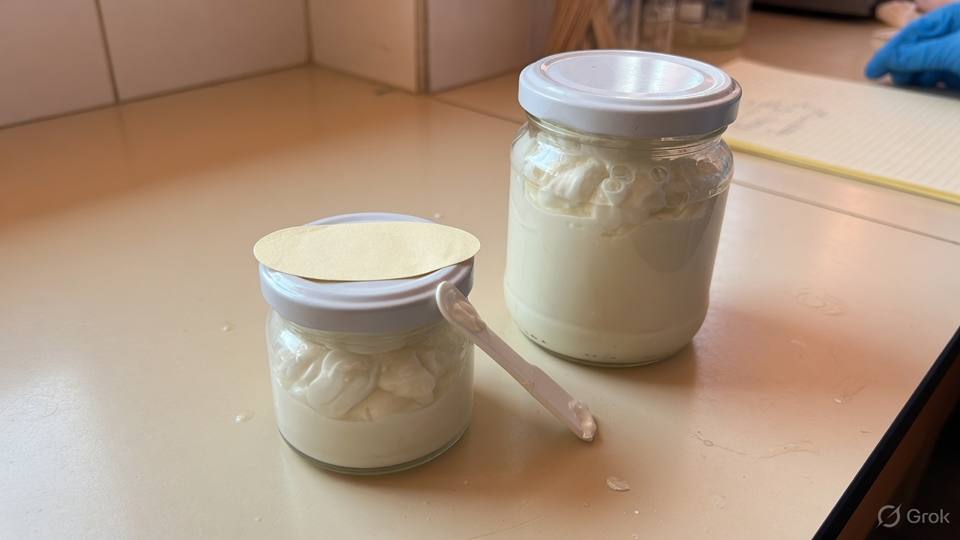
The lab jar label
A lab jar is not a retail jar, and its label says so. It carries the product name, the batch code, the date made, the pH, and the words 'lab sample, not for sale'. It may also carry the tests requested, the storage condition and the maker's initials. The label is there so that the jar can be identified months later, and so that nobody mistakes it for stock. A lab jar with a pretty label and no batch code is a jar with no history, and a jar without history is not evidence of anything. Write the storage condition on the label as well, because a lab sample kept warm is not the same sample as one kept cool.
Write the label before the jar is filled, not after. A jar that is filled and then labelled from memory is a jar that can be mislabelled, especially when several samples are filled on the same day. Use a waterproof pen or a printed label, and put the same information on the lid as on the side, so the jar is still identifiable if the side label comes off. Do not use a label that can be peeled off and moved to another jar; a loose sticker is an invitation to a mix-up. If several jars are filled on the same day, label them in the order they are filled and keep the batch record beside the filling area.
The lab label is also the instructions for handling. If the sample is for a plate count, it should not be opened before it reaches the laboratory. If it is for a pH check, it can be opened, but the reading and the temperature go on the record. If it is a retention sample, it stays closed until its discard date. Marking the purpose on the jar prevents the common mistake of using a lab sample as a tester and then wondering why there is no sample left for the test. A retention jar is the clearest example: it stays closed until its discard date, and the label says so in words that nobody can misread.
Keep the lab label plain and readable. A small jar has limited space, so use the smallest useful set of fields: product, code, date, pH, purpose and the not-for-sale line. If there is not enough room, use a tag or an outer bag with a label, and keep the full information in the record. Readability matters more than design, and a label that cannot be read in poor light is not doing its job. Print the label in a font that is legible at arm's length, and keep the same field order across products so a reader knows where to look.
- 1. Write the label before the jar is filled.
- 2. Put the product name, batch code and date on the label.
- 3. Add the pH with the temperature at which it was measured.
- 4. Write 'lab sample, not for sale' in plain words.
- 5. Add the purpose, such as plate count or retention.
- 6. Repeat the key details on the lid as well as the side.
- 7. Use a waterproof pen or a printed label that will not peel.
- 8. Keep the full details in the batch record, not only on the jar.
Bench example
A maker fills four 30 g jars from a 200 g batch. Two are for a plate count and a yeast and mold count, one is for a challenge test, and one is a retention sample. Each jar is labelled before filling: 'O/W lotion, 20261025-01, 20261025, pH 5.21 at 25 C, lab sample not for sale', with the purpose written underneath, 'micro' on two and 'retention, discard 20261108' on the fourth. The lids carry the code and the date. The jars are packed in a small box with the batch record page, and the box is kept in a cupboard, not on the display shelf. When the laboratory report arrives, the code on the report matches the code on the jars and the record, and the retention jar is still closed. Nobody has used a lab sample as a tester, because the labels said what each jar was for. The box is stored with the batch record, and the retention jar is not opened when the report arrives, because the test sample and the evidence sample are separate. The labels and the record agree on every field.
Caution: A lab sample with no batch code cannot be matched to a record. Write the code on the jar and the lid before the product goes in.
What a retail label needs
A retail cosmetic label is a legal document, and the exact requirements depend on the market and the current rules. In the European Union, for example, a cosmetic label carries the responsible person, the nominal content, the batch code, the ingredients by INCI name in descending order, and any warnings. In India, the cosmetic rules set out the declarations for the product, and those rules change; the label has to be checked against the version in force at the time of packing, not against a label from five years ago. This book does not issue a label approval, and it does not replace a regulatory check.
At a practical level, a retail label needs the identity of the product, its function, the net quantity, the ingredients in descending order of mass, the business name and address, the batch code, the date of manufacture, the use instructions and the warnings that apply. The ingredient list uses INCI names and descends from the largest to the smallest, with ingredients at 1% or less allowed in any order after the 1% point in some systems, but the exact rule must be checked. Water is usually the first ingredient in a water-based product, which is why the order is informative rather than decorative.
Net quantity is the mass or volume that the consumer receives, and it has to be accurate. A jar that is labelled 50 g must contain 50 g at filling, within the allowed tolerance, and the fill mass should be on the batch record. A label that says 50 g on a jar that holds 46 g is a false declaration, even if the jar looks full. The business name and address are the identity of the seller, not a certification; they tell the consumer who is responsible, and they are not a licence number. Check the net quantity with a scale, not with the fill line on the jar, and record the check on the batch card.
Use instructions and warnings have to match the product. A product with an acid or a fragrance may need a patch-test recommendation, a warning to avoid the eyes, or a statement that it is for external use only. Do not copy warnings from another product without checking that they apply. Do not put a claim on the label that the product cannot support, such as 'sterile', 'hypoallergenic' or 'dermatologist tested', unless the process or the test actually happened and the evidence is on file. The label is the most public statement the salon makes about the product, and every line of it should be true.
- 1. Confirm the current labelling rules for the market where the product is sold.
- 2. Write the product identity and its function.
- 3. State the net quantity accurately and check it against the fill mass.
- 4. List ingredients by INCI name in descending order of mass.
- 5. Add the business name and address of the responsible seller.
- 6. Add the batch code and the date of manufacture.
- 7. Add the use instructions and the warnings that apply.
- 8. Check every claim against evidence before the label is printed.
Bench example
A salon prepares a 50 g jar of face cream for sale. The label draft lists the product name and function, 'face cream, 50 g', the business name and address, the batch code 20261025-05, the date of manufacture, and the ingredients by INCI name in descending order: aqua, glycerin, a base oil, an emulsifier, a thickener, a preservative and a fragrance. The use instruction says to apply to clean skin and avoid the eyes, and the warning says to patch test before first use. The maker checks the net quantity by weighing three filled jars and confirming each is at or slightly above 50 g. The label is checked against the current rules by the person responsible, and a claim about 'dermatologist tested' is removed because no such test was done. The label is printed, applied, and a copy is kept with the batch record. Nothing on the label is stronger than the evidence behind it. The label copy is kept with the record, and the printed jar is photographed before it leaves the bench, so the label and the batch are linked.
Caution: Do not copy a licence number, a registration number or a certification mark from another product. A number that belongs to someone else is a false statement on your label.
What a label does not prove
A label describes a product; it does not approve it. The presence of a batch code, a business name or an ingredient list does not mean the product has been tested, registered or licensed. Nobody in this book is issuing a licence, a certificate or an approval, and a salon that writes a label is not thereby a licensed manufacturer. The label is the information the seller is required or chooses to give, and the responsibility for the product remains with the business that puts it on the market. If the business cannot meet the requirement, the honest response is not to sell the product in that market until it can.
Do not imply a licence that does not exist. Do not write 'approved', 'certified', 'laboratory approved' or 'government approved' unless a document supports the words and you can show it. Do not put a fake registration number in the corner to make the jar look official. If a market requires a registration or a notification, the business either completes the process or does not sell the product in that market; a label cannot substitute for the process. When in doubt, get the label and the claim checked by someone who works with the current rules. A label that looks official is not the same as a product that has been assessed, and the difference matters most when a client asks a direct question.
Claims have to match evidence at the level the claim implies. 'Patch tested' can be said if a patch test was run and the record exists, but it should not be turned into 'safe for all skin'. 'Preservative system tested' can be said if a challenge test was done on that formula and that pack, but it does not mean the product is sterile. 'Natural' and 'chemical free' are claims with legal meanings in some markets and no fixed meaning in others; use them only with advice. A claim that is technically true but misleading is still a problem. Keep the evidence for each claim in the batch file, and drop the claim if the evidence is a memory rather than a document.
Keep a copy of every label version with the batch record, and note the date the version was introduced. If the label changes, the change is recorded, and the old jars can be traced to the old label. This is the same traceability principle as the batch code: the label on the jar should lead back to a document, and the document should say what was claimed and why. A label file that is a drawer of loose stickers is not a label record. Number the label versions and write the number on the batch record, so a jar can be matched to the exact words it carried.
- 1. Do not describe a label as an approval or a licence.
- 2. Do not use 'approved' or 'certified' without a supporting document.
- 3. Do not invent or copy a registration number.
- 4. Match every claim to a test or a process that actually happened.
- 5. Keep the evidence for each claim with the batch record.
- 6. Check claims that have legal meanings in the target market.
- 7. Keep a copy of every label version with its introduction date.
- 8. Get the label checked against the current rules before printing.
Bench example
A salon prints a label for a body butter and adds the words 'laboratory approved' because a lab once tested a different product from the same kitchen. The phrase is removed after a review: no report covers this formula, this pack or this batch, and the words imply an approval that does not exist. The label is reprinted with the product name, net quantity, ingredients, business name and address, batch code, date, instructions and a patch-test recommendation. The batch record holds the label version, the date it was introduced and the reason for the change. A client asks whether the product is 'certified organic'; the answer is no, and the label does not say so. The salon keeps a folder with the current label, the previous version and the batch codes that used each, so a jar can be matched to the words that were on it when it was sold. The folder is reviewed once a year against the current rules, and the review is recorded with the date and the name of the person who did it. The review is signed.
Caution: This book does not issue a licence, a certificate or a regulatory approval. A label is a description, and the business that sells the product carries the responsibility for it.
This is a Nandu Nai textbook. It is a private brand book, not a government licence, and it does not give the right to give medical treatment.