
Percent means grams per hundred grams
A percentage in a cosmetic formula is a mass fraction, not a volume fraction. Five percent means five grams of that material in every hundred grams of finished product, so a 100 g batch takes 5.00 g, a 500 g batch at 0.50% takes 2.50 g, and a 200 g batch at 0.10% takes 0.20 g. The line to remember is batch grams multiplied by percent, divided by 100. Write the multiplication on the batch card even when the answer looks obvious, because the next person has to be able to check the figure without trusting your mental arithmetic. A number with no working behind it is a claim, not a measurement.
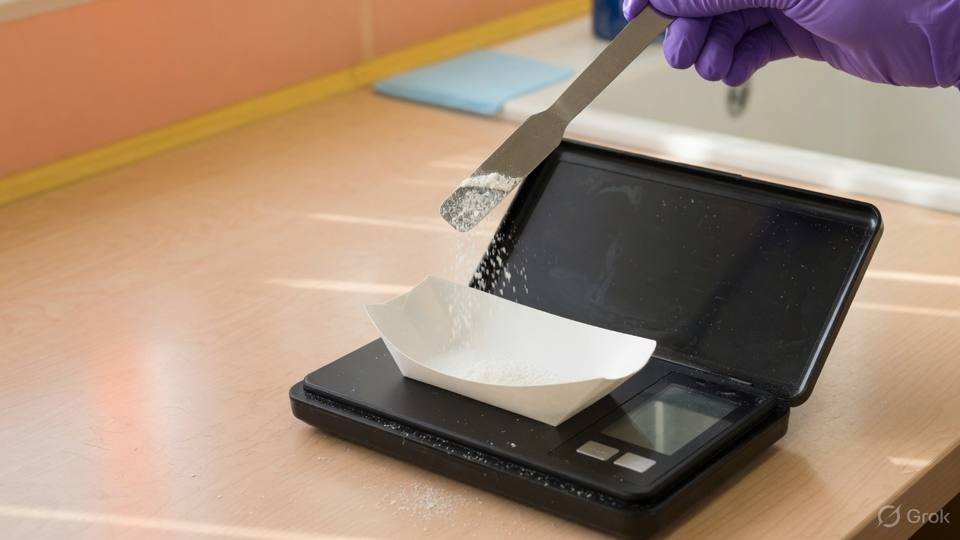
Small percentages are where most weighing errors happen. At 0.10%, a 200 g batch asks for 0.20 g, which a 0.01 g balance can read but a kitchen scale cannot. At 0.05% in a 50 g batch the target is 0.05 g, which is one or two digits of real accuracy and not enough for a preservative. Do not round 0.05 g up to 0.10 g and call it close: that doubles the dose. The batch size should be chosen from the smallest line in the formula, not from the largest jar on the shelf. If the smallest line cannot be weighed well, either scale the batch up until it can or build a premix, which is covered later in this book.
The same equation runs backwards. The actual percent delivered is the grams weighed divided by the batch mass, multiplied by 100. If a 0.20 g target became 0.24 g in a 100 g batch, the actual is 0.24%, which is 20% over target. When a premix is used, the delivered percent is the premix strength multiplied by the premix grams, divided by the batch mass, then multiplied by 100. Water is normally the line that closes the formula to 100, so the water mass is the batch mass minus every other ingredient in grams. Keep all three forms of the calculation on one sheet, because a batch record that shows only the target cannot answer what the jar actually contains.
Rounding needs a rule, or two people will round differently. Round the weighed grams to what the balance can actually read, which is normally 0.01 g. Round the percentage only after the batch has been weighed, never before. Do not round a preservative or an active upward; round down only when the result stays inside the supplier's stated dose range and under the legal ceiling for that ingredient. Write the target and the actual side by side, and if they differ, write why. The choice of ingredient and its permitted dose belong to the formulation book; this book only measures and records what that book decided.
- 1. Write the batch size in grams at the top of the sheet, before anything else.
- 2. Copy each percentage from the approved formula, not from an old batch card.
- 3. Multiply batch grams by percent and divide by 100, showing the line.
- 4. Round each answer to 0.01 g and mark any line below 0.50 g for review.
- 5. Add the gram column and compare the total with the batch size.
- 6. Set the water line to the difference, so the formula closes at 100.00%.
- 7. Weigh each line and write the actual grams beside the target.
- 8. Recalculate the actual percent for every active and file the sheet with the record.
Bench example
A salon writes a trial gel for 150 g. The formula lists 0.80% of an active, 0.15% preservative, 0.10% fragrance and water to 100. The maker converts each line before opening a jar. The active is 150 x 0.80 / 100 = 1.20 g. The preservative is 150 x 0.15 / 100 = 0.225 g, which the balance reads as 0.23 g, and the maker notes that the small upward rounding is inside the supplier's dose range. The fragrance is 150 x 0.10 / 100 = 0.15 g. The other lines total 1.20 + 0.23 + 0.15 = 1.58 g, so the water is 150 - 1.58 = 148.42 g. The same formula at 400 g gives 3.20 g active, 0.60 g preservative, 0.40 g fragrance and 395.80 g water. The maker checks the pattern against three standard cases: 100 g at 5% is 5.00 g, 500 g at 0.50% is 2.50 g, and 200 g at 0.10% is 0.20 g. The arithmetic is written out, not just the answers, so a second maker can repeat the batch without guessing.
Caution: Do not carry gram figures from the last batch to this one. The percentage stays the same and the grams change with every batch size; a copied figure is an unrecorded formula change.
The formula must add to one hundred
A formula is a table of masses that has to total 100.00%. If the listed lines add to 97.5%, the missing 2.5% is not a mystery: it is water or another diluent that was left off the sheet. If they add to 102%, one line is wrong and the batch cannot be rescued by subtracting water by eye. Add the percentage column before you weigh anything, and add it again after the gram conversion. A formula that does not close is a draft, not a work instruction, and it should not be taken to the bench until the table is corrected and re-approved by whoever owns the formula.
The water line is usually the one that closes the formula. In a 300 g batch, if the other lines total 41.10 g, the water is 300.00 - 41.10 = 258.90 g. Do not write water as a percentage first and then convert, because the two routes can disagree by a few hundredths of a gram after rounding. Use the gram subtraction as the controlling figure, then state the percentage it represents for the record. When a premix or a stock solution is used, the water that arrives inside it belongs to the water line, so reduce the water by that mass; otherwise the batch is diluted more than the formula says and every concentration falls.
Watch for lines that appear twice. Glycerin may be listed in the water phase and again in the cool-down phase, and a gum may appear as both a dispersion and a slurry. Sum the duplicate entries and write one combined line, or keep them separate with a note that the total is the sum of the two. The same applies to a trade name and its INCI name appearing on the same sheet as if they were different materials. A formula that double-counts an ingredient can close at 100% and still be wrong, which is harder to catch than a table that plainly fails to add up.
When the total does not close after weighing, stop and find out why. Check the decimal point, the unit, and whether a container was tared twice. Do not add water to make the number look right: the concentrations are already set by what went into the vessel, and diluting changes every one of them. If the batch is already mixed and the error is small, record the deviation, recalculate the actual percentages, and decide whether the batch is a lab sample rather than a sale batch. If the error is large, scrap it. A batch made to a wrong formula teaches nothing except that the checks were skipped.
- 1. Copy the formula onto a clean sheet with one row per material.
- 2. Add the percentage column and confirm the total is 100.00.
- 3. Convert every line to grams for the chosen batch size.
- 4. Add the gram column and compare it with the batch size.
- 5. Calculate water as batch grams minus the sum of the other grams.
- 6. Re-add the complete column after the water figure is entered.
- 7. Merge or annotate any material that appears in two phases.
- 8. Sign and date the check, and attach it to the batch record.
Bench example
A maker drafts a 300 g cleansing gel with 8.0% surfactant, 1.0% thickener, 4.0% glycerin, 0.5% preservative and 0.2% fragrance. The percentage column totals 13.7%, so water must be 86.3%. The gram column is 24.00 g surfactant, 3.00 g thickener, 12.00 g glycerin, 1.50 g preservative and 0.60 g fragrance, which totals 41.10 g. Water is 300.00 - 41.10 = 258.90 g. The maker checks that 258.90 / 300 x 100 = 86.3%, so the two routes agree. A second sheet, written from memory, lists glycerin in both phase A and phase C at 4.0% each, and the percentage column then totals 17.7%. The water line printed on that sheet is 82.3%, taken from the correct version, so the formula now adds to 100% while containing twice the glycerin intended. The maker catches it by comparing the phase entries, merges them into one 12.00 g line, and marks the old sheet superseded. The lesson is kept on the card: a percentage total is checked against the phase entries, not only against the water line, because a double entry can close the sum while changing what the batch contains.
Caution: A formula that adds to 101% is a typing error in the table, not permission to add 1% less water. Correct the table and re-approve it before weighing.
Diluting a paste or a strong stock
Some raw materials arrive as a paste, a flake or a concentrated solution that is stronger than the formula needs. The rule is the same as any dilution: the mass of active required, divided by the concentration of the stock, gives the mass of stock to weigh. If the formula calls for 10% active matter in a 100 g batch, it needs 10.00 g of active. A paste that is 70% active contains 70 g of active in every 100 g, so the stock mass is 10.00 / 0.70 = 14.29 g, written as 14.3 g. The remaining 85.7 g of the batch is made up by the other materials, with the water reduced to account for the water carried in the paste.
Always write both numbers on the record: the active percentage the formula intends and the raw material percentage actually weighed. In this case the record says 10.0% active matter, supplied by 14.3% of the 70% paste. A record that says only 14.3% does not tell the next maker what the product contains, and a record that says only 10.0% does not tell them how much paste to weigh. Check the dilution backwards: 14.3 g multiplied by 0.70 gives 10.01 g of active in 100 g, which is 10.0% after rounding. The 0.01 g difference comes from writing 14.29 as 14.3, and it belongs in the note, not hidden.
Use the assay printed on the certificate of analysis, not the trade name. A paste sold as 70% may be certified at 68% on the lot you received, and the correct stock mass is then 10.00 / 0.68 = 14.71 g. If the certificate gives a range, calculate with the lower figure and record the choice, because an underdose is usually worse than a small overdose for a preservative or an active. Note the lot number and the assay on the batch record so that a later investigation can tell which stock produced which jar. If the certificate is missing, ask the supplier before the batch, not after.
Never dilute by adding water until the mixture looks right. Appearance is not a concentration, and a cloudy paste diluted to clarity tells you nothing about its active content. Weigh the stock, subtract the water it brings from the water line, and record the calculation. The choice of which paste or active to use, and the target percentage in the formula, belong to the formulation book. This book takes the target as given and makes the conversion honest. If the supplier changes the assay between lots, the formula may need re-approval rather than a quiet adjustment at the bench. If the new lot is weaker, the formula may need a higher percentage, and that is a change to be approved and recorded rather than absorbed silently into the weighing.
- 1. Read the assay on the certificate of analysis for the exact lot.
- 2. Calculate the active mass needed: batch grams x target percent / 100.
- 3. Divide the active mass by the stock concentration as a decimal.
- 4. Round the stock mass to 0.01 g and write the unrounded figure beside it.
- 5. Subtract the water carried in the stock from the formula's water line.
- 6. Weigh the stock into a tared beaker and record the actual mass.
- 7. Recalculate the delivered active percent from the actual mass.
- 8. Record the stock lot, assay, and the delivered percentage on the batch card.
Bench example
A 250 g trial shampoo needs 4.0% active from a surfactant paste certified at 65%. The maker first finds the active mass: 250 x 4.0 / 100 = 10.00 g. Then the stock mass: 10.00 / 0.65 = 15.38 g of paste. The paste is 35% water, so it brings 15.38 x 0.35 = 5.38 g of water into the batch, and the water line is reduced by that amount rather than by the full paste mass. The maker checks backwards: 15.38 x 0.65 = 10.00 g of active in 250 g, which is 4.0%. A second formula calls for 10.0% active from a 70% paste in a 100 g batch, so the stock is 10.00 / 0.70 = 14.29 g, written as 14.3 g, and the record states 10.0% active from 14.3% raw paste. Both calculations are written in full on the batch card, with the lot number and the assay beside them, so the next maker can see where every gram came from. The maker also notes that the paste brought 5.38 g of water, so the water line is 5.38 g lower than it would be for the pure active, and the batch mass is unchanged.
Caution: A paste assay is a lot-specific number, not a property of the product name. Recalculate when the lot changes; do not reuse last month's 14.3 g because the drum looks the same.
This is a Nandu Nai textbook. It is a private brand book, not a government licence, and it does not give the right to give medical treatment.