
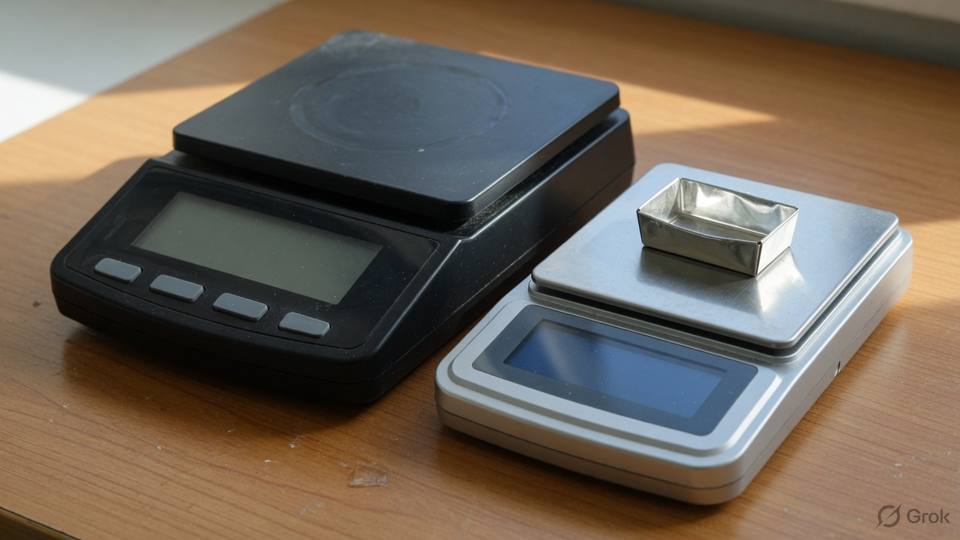
Resolution decides what you can weigh
A bench balance with 0.01 g readability shows two decimal places and is the minimum for small cosmetic additions. A kitchen scale that reads 0.1 g cannot tell 0.20 g from 0.30 g, and at a 0.20 g target that difference is half the dose. Below about 0.50 g the error becomes too large to defend even when the instrument is otherwise in good order, because the displayed digit is a large share of the number you are trying to hit. The rule is not about what the balance cost; it is about the smallest mass the formula asks you to trust. If the smallest line cannot be weighed with confidence, the batch size or the premix has to change.
Resolution is not accuracy. A balance can display 0.01 g and still be wrong by 0.05 g if it is uncalibrated, overloaded, or standing on a sloping bench. Check it with the calibration weight the supplier specifies before a batch, and repeat the check after the balance has been moved, after a power cut, or after a heavy container has been dropped on the pan. Keep it on a firm, level surface away from drafts, speakers, and vibrating equipment. Close the draft shield while reading. Record the check result in the batch record, because a number produced by an unchecked balance is an opinion.
Small pocket scales sold for jewellery are not a substitute for a bench balance. Their pans are tiny, their drift is high, and they usually have no draft shield, so a 300 g batch cannot be weighed on one and a 0.05 g addition is not reliable on one either. Do not stack items on the pan or use the balance as a shelf. Do not exceed its capacity, even briefly, because an overload can bend the load cell and leave a permanent error. Have the balance serviced once a year, or sooner if it fails a check weight, and keep the service note with the equipment file rather than in a drawer.
When a target falls below the reliable range, there are only two honest answers. Make a larger batch so the target rises above about 0.50 g, or make a premix so a larger, weighable mass of the premix delivers the small amount of active. Guessing is not a third answer. Adding a scoop and calling it approximately right produces a batch whose concentration nobody knows, and the error is largest exactly where it matters most: preservatives, actives, and fragrance. The decision belongs on the batch card before weighing starts, with the arithmetic that justifies it. Write the choice on the card before the first weighing, with the batch size or the premix strength, and initial it, so the decision is visible to whoever checks the record later.
- 1. Put the balance on a level, firm bench away from doors and fans.
- 2. Check the bubble level or adjust the feet before switching on.
- 3. Calibrate with the supplier's check weight and write the result down.
- 4. Tare the empty container and wait for a stable zero.
- 5. Close the draft shield before adding material.
- 6. Add slowly and wait for the display to settle before reading.
- 7. Record the actual mass, not only the target.
- 8. Stop and service the balance if the reading drifts or fails a check weight.
Bench example
A maker needs 0.50 g of a preservative for a 500 g batch. The kitchen scale reads in 0.1 g steps: the first attempt shows 0.5 g, the second 0.6 g, and the third 0.4 g, all with the same scoop. The true mass could be anywhere from 0.35 g to 0.64 g, which at a 0.10% target is a dose between 0.07% and 0.13%. The maker stops, borrows a 0.01 g balance, calibrates it with a 100 g check weight, and weighs 0.50 g, which the display shows as 0.50 g and holds. The batch record notes the instrument, the calibration time, and the actual mass. A second maker, working from the same formula, needs 0.10 g of a different preservative in a 200 g batch and finds that even the 0.01 g balance gives only two meaningful digits. The batch is moved to a 1000 g scale-up, where the same 0.10% is 1.00 g, and the record shows why the size changed. Neither maker rounds the small target up to make it easier to weigh. Both records show the instrument and the check weight, because a mass without the balance behind it is only a number.
Caution: A reading that drifts while you watch is not a small nuisance. Stop the batch; a drifting balance means the number on the card cannot be trusted.
Tare, then weigh
Taring means placing the empty container on the pan and setting the display to zero, so the number that follows is the mass of what you add rather than the container plus its contents. Use the same container throughout a batch; changing containers means taring again and invites a double subtraction. Add material slowly and close to the pan, and wait for the display to settle before reading. Do not hold the container in your hand while weighing, because your hand adds force and the reading moves. Do not lean on the bench either, for the same reason, and do not talk over an open powder while the pan is exposed.
Weigh each ingredient into its own tared beaker, or weigh in sequence only when the formula allows it and the previous material cannot stick to the vessel. Never weigh directly onto the pan, because cleaning the pan between materials is slower and less reliable than using a beaker. If you overshoot, do not spoon material back into the stock jar: the spoon is now contaminated and the jar is no longer clean. Set the excess aside as waste, record the actual mass, and decide whether the batch can continue. A record that hides an overshoot is worse than no record, because it teaches the next maker that hiding is normal.
Overshoot decisions need a limit written before the batch, not invented afterwards. A common bench rule is that any line more than 2% away from target is a deviation that must be justified; a preservative or an active is tighter, and the supplier's dose range sets the ceiling. If the overshoot is small and the total batch mass can be corrected by reducing another line, do the arithmetic and record it. If it cannot be corrected, the batch becomes a lab sample or is discarded. Never add extra of everything else to balance one overweighed line unless the formula has been recalculated in full and re-approved, because that changes the batch size and every concentration with it.
Keep the weighing area clear and the containers labelled before the first scoop. A beaker with 12 g of glycerin and a beaker with 12 g of a thickener look identical, and a swapped beaker is a formula error that no later check will catch. Write the material name and the target mass on the beaker, or use a labelled set of small cups. Between materials, put the spatula down on a clean surface, not on the bench mat, and never put a used spatula back into a bulk container. These habits are slower for the first batch and much faster than an investigation.
- 1. Label each beaker with the material name and target mass.
- 2. Place the empty beaker on the pan and tare to zero.
- 3. Add material slowly, close to the pan, with a clean spatula.
- 4. Wait for the display to settle before reading the mass.
- 5. Write the actual mass beside the target on the batch card.
- 6. Never return excess material to the stock container.
- 7. If a line is over target, recalculate or stop; do not add water by eye.
- 8. Clean the pan and the spatula before the next material.
Bench example
A maker tares a 250 mL beaker and weighs 12.00 g of glycerin. The display settles at 12.00 g. A colleague asks a question, and the maker adds another 0.40 g while talking. The actual mass is 12.40 g, which is 3.3% over target on a 12.00 g line. The maker does not spoon it back. The batch card records 12.40 g and the deviation note says the addition was made while distracted. Because the batch is 300 g and glycerin is a humectant rather than a preservative, the maker recalculates the water line to keep the batch mass at 300 g: water drops by 0.40 g, and the glycerin percentage rises from 4.00% to 4.13%. The change is written down, the batch is marked as a lab sample rather than a sale batch, and the next batch starts from the approved formula with the target restored. The record now shows what happened and why the jar is not stock. The deviation note is short and factual, and it is the reason the jar is a lab sample rather than stock, which is exactly what the next person needs to know.
Caution: Do not return an overshoot to the stock jar. The moment the spatula touched the beaker it stopped being clean, and the bulk jar is now a contamination risk.
Spoons are for moving, not measuring
A spoon measures volume, while the formula asks for mass. A teaspoon of glycerin, a teaspoon of salt and a teaspoon of a light oil weigh different amounts, and the same spoon heaped and level differs again. The formula is written in grams, so the only instrument that answers the question is a balance. Spoons are acceptable for moving powder from a jar into a tared beaker, never for deciding how much went in. Keep one spoon per container, clean and dry it between uses, and do not leave a spoon standing in a bulk jar. If a formula arrives in spoons, cups or drops, convert it before the first batch and have the converted sheet approved.
Volume also changes with temperature and with how a powder settles. A spoon of a fluffy powder may hold half the mass of the same spoon filled after the powder has compacted in the bag. A drop from a dropper depends on the tip, the viscosity and the angle, so ten drops of one fragrance are not ten drops of another. This is why a formula written in cups or drops cannot be checked, repeated or scaled. Convert it once, write the gram version into the record, and mark the old sheet as superseded so nobody uses both. If the density is unknown, weigh a measured volume, calculate the density, and record the result rather than guessing a factor.
Converting a volume recipe is straightforward when a density is available. Weigh a known volume in a graduated cylinder, divide the mass by the volume, and you have grams per millilitre. Glycerin is about 1.26 g per mL, so a 5 mL measure is about 6.30 g, not 5.00 g. Water is about 1.00 g per mL, which is why water is the one material where the two numbers coincide. Oils are lighter than water, usually 0.90 to 0.92 g per mL, so a 10 mL measure is about 9.10 g. Record the density source and the temperature, because both change the answer.
Do not use a household measuring cup for a batch that will be recorded in grams. The cup's markings are not accurate enough, the meniscus is hard to read, and the material left on the wall of the cup is unmeasured. A graduated cylinder is acceptable for measuring a volume that will then be converted to mass, but it is not a substitute for the balance when the formula is already in grams. The habit to build is simple: volumes are for moving and for approximate preparation, masses are for the record. Every number that goes into a batch card should come from the balance, not from a spoon.
- 1. Check whether the formula is written in grams or in spoons.
- 2. If it is in spoons, convert every line before weighing anything.
- 3. Weigh a known volume to establish density when it is not given.
- 4. Record the density, its source, and the temperature.
- 5. Convert the volume to grams and add the grams to the formula.
- 6. Mark the old volume sheet as superseded and remove it from the bench.
- 7. Use spoons only to move material into a tared beaker.
- 8. Keep one spoon per container and clean it between materials.
Bench example
An old salon card says one teaspoon of gum and two teaspoons of glycerin for a small gel. The maker weighs a level teaspoon of the gum three times and gets 2.1 g, 2.4 g and 2.2 g, a spread of 14% around the middle value. Two teaspoons of glycerin are weighed at 12.4 g and 12.8 g on two attempts. The card cannot be repeated to better than about a gram, which is too wide for a 100 g batch. The maker converts the recipe: gum 2.2 g, glycerin 12.6 g, water to 100 g, and writes the densities and the trial weights beside the figures. The old card is marked superseded in red and kept in the file for history, not for use. On the next batch the maker weighs 2.20 g and 12.60 g directly, records the actual values, and the gel sets the same way twice. The conversion took about ten minutes and removed a recurring batch-to-batch variation. The maker keeps the old card in the file for history but never copies from it again, because a recipe that cannot be repeated is not a recipe.
Caution: A spoon is not a small scale. If the formula matters enough to record, it matters enough to weigh; converting by guesswork only hides the variation.
This is a Nandu Nai textbook. It is a private brand book, not a government licence, and it does not give the right to give medical treatment.