
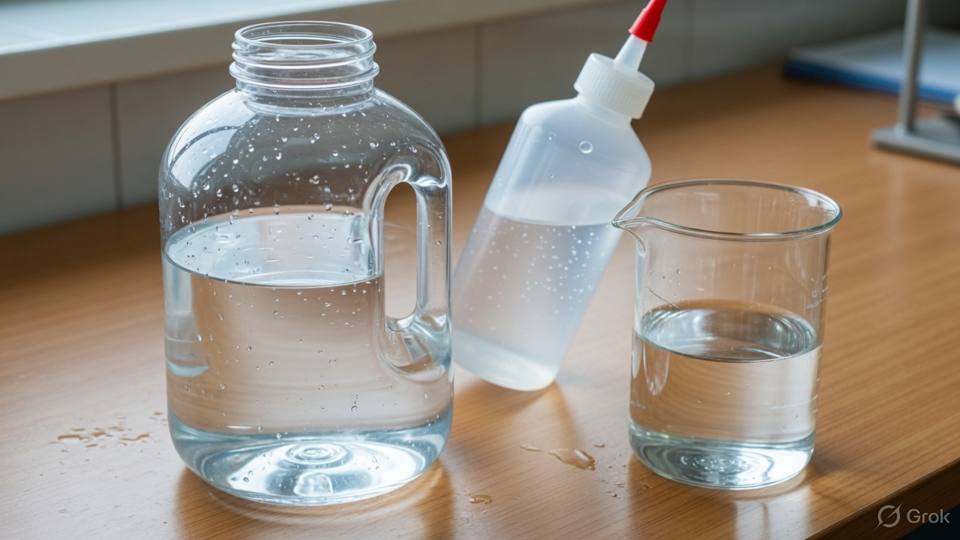
Use distilled or deionised water
Tap water carries calcium, magnesium, chloride, and sometimes iron and copper. Those ions react with surfactants and thickeners, change the feel of the product, and can leave a film on the skin. More importantly, tap water carries microorganisms. A water-based cream, toner or gel is a growth medium, and a product with a weak preservative system can show mould within weeks. Use distilled or deionised water for every water-containing formula, and buy it from a supplier who states the grade on the label. Filtered water from a domestic jug is not the same thing, and neither is water from a bottle that has stood open in the salon.
Distilled water is not sterile. It has been boiled and condensed, which leaves most dissolved salts behind, but it is not packed under a validated sterilisation process, and it becomes contaminated as soon as the container is opened and the batch is exposed to air. That is why a preservative is still required, and why the bench still has to be clean. Water activity, not only water content, decides whether microbes can grow: a formula with high water activity and a weak preservative system is the highest-risk product on the bench. Record the water grade and the lot in the batch record, because a complaint months later cannot be investigated without them.
Handle the water container like a raw material, not like a utility. Date it when it is opened, keep it lidded between uses, and pour into a clean jug rather than dipping a beaker into the stock. Do not store it in an open bucket beside the sink, and do not refill a commercial water bottle from the tap and put it back on the shelf. If the water is cloudy, has particles, or smells different from the last lot, discard it. A five-litre container that has been open for months is not the water you paid for, even if the label still looks respectable.
The choice of water grade is a formulation decision, and this book does not make it. What this book requires is that the grade stated in the formula is the grade in the jug, that the lot is recorded, and that the water is treated as a material with a shelf life. When a formula is scaled up, the water line is usually the largest mass on the sheet, so an error in the water is the easiest way to change every percentage in the batch at once. Weigh it like everything else; do not estimate it by filling to a mark on the beaker.
- 1. Read the formula and confirm which water grade it requires.
- 2. Check the supplier label for the grade and the lot number.
- 3. Date the container on opening and keep it lidded.
- 4. Pour the water into a clean, tared beaker; do not dip into the stock.
- 5. Weigh the water line rather than filling to a volume mark.
- 6. Record the grade and lot on the batch card.
- 7. Discard any container that is cloudy, particulate or off-smell.
- 8. Never top up a water container from the tap.
Bench example
A salon makes a rose water toner with tap water because the distilled container is empty. Three weeks later a bottle shows a grey floating layer and a sour smell. The batch record says tap water, no lot, no preservative lot, and no pH reading. The maker cannot tell whether the problem came from the water, the fragrance, or an underdosed preservative, and every bottle from that batch has to be withdrawn. The next batch uses distilled water from a sealed five-litre container, opened that morning, lot recorded, weighed at 780.00 g for a 1000 g batch, with the preservative at the supplier's stated dose. The pH is recorded at 5.42 after 24 hours, and the batch is held as a lab sample pending a plate count and a yeast and mold count. Nothing in the second batch is different except the water and the records, and those two changes are enough to make the batch traceable and repeatable, even before the laboratory results arrive. The maker also notes that the second batch is a lab sample until the counts come back, because a clean look and a clean smell are not results.
Caution: Distilled water is not sterile water. Do not tell a client that a product made with it is sterile, and do not skip the preservative because the water was bought sealed.
Water bath and the heat of an emulsion
An emulsion is made from two phases that must reach a similar temperature before they are combined. Heat the oil phase and the water phase in a water bath at about 70 to 75 degrees Celsius, and check both with the same thermometer. A water bath gives gentle, even heat and keeps the temperature below the point where some oils oxidise. Stir the water bath itself, not only the beaker, so the heat is even around the vessel. Record the temperature of each phase at the moment of mixing, not the setting on the dial, because a dial is a setting and a thermometer is a measurement.
Never use an open flame near alcohol, solvents or fragrance. Alcohols give off vapour that can ignite at a distance, and a flame on a bench with open bottles is an accident waiting to happen. Use a hot plate or a water bath in a ventilated area, and keep containers closed when they are not in use. If a formula contains a flammable solvent, remove the ignition source from the room, not just from the bench. A fire extinguisher within reach is part of the setup, not an optional extra, and a small fire blanket and a lid for the water bath belong beside it.
Do not fill a beaker more than about two-thirds for a hot phase. Hot liquid expands, and a beaker that is too full will spill when it is lifted or stirred. Use tongs or heat gloves, and put the hot beaker on a heatproof pad, not on a paper towel or a cold stone surface. Do not put a hot beaker straight into cold water, because thermal shock can crack the glass and spill the batch. Add boiling water to the bath slowly, and keep the bath level below the rim of the beaker so water cannot run in. Check the bath level before switching on, not after the beaker is hot, because adding water to a hot bath is its own splash risk.
Measure the temperature of the product, not the wall of the vessel. A probe resting against the glass can read several degrees low, and a batch combined at 60 degrees when the record says 72 will not emulsify the same way. Hold the probe in the middle of the phase, wait for the reading to hold, and write it down. If the two phases differ by more than a few degrees, wait rather than pouring; a cold phase into a hot phase shocks the emulsifier and can leave a grainy or split batch that no amount of stirring will repair.
- 1. Set up the water bath on a stable, heatproof surface.
- 2. Heat the water phase and the oil phase in separate labelled beakers.
- 3. Stir the bath so the heat is even around both vessels.
- 4. Check the temperature of each phase with a clean probe.
- 5. Bring both phases to about 70 to 75 degrees Celsius.
- 6. Record both temperatures at the moment of combining.
- 7. Stir gently until the emulsion is uniform, then remove from the heat.
- 8. Cool on a heatproof pad, loosely covered, and never in cold water.
Bench example
A maker heats 150 g of oil phase and 250 g of water phase in two beakers in the same water bath. The bath is set to 75 degrees Celsius, but the dial is not the measurement. The oil phase reads 71 degrees and the water phase reads 68 degrees, so the maker waits four minutes and reads again: 73 and 72. The phases are combined at those temperatures, and both numbers go on the card with the time. The emulsion turns white and uniform after two minutes of gentle stirring. A second maker, in a hurry, combines at 58 and 74 degrees because only the water phase was checked. The batch looks fine for ten minutes, then shows a thin oily ring at the rim and a grainy texture after cooling. It is kept as a lab sample, not filled, and the record says the phases were 16 degrees apart at combine. The first batch is repeatable; the second is a lesson written in the deviation column. The second batch is not offered to a client, and the deviation is written on the same card as the temperatures, so the record explains the fault without anyone having to remember it.
Caution: A dial setting is not a temperature. If the probe has not been in the product, the number on the card is a guess and the batch cannot be repeated.
Cool down before fragrance and preservative
Fragrance and many preservatives are volatile or heat-sensitive. Add them after the emulsion has cooled below about 40 degrees Celsius. Above that temperature, fragrance notes flash off and the smell changes; some preservatives lose activity, and the product may fail a challenge test even though the label shows the right percentage. Cool with gentle stirring rather than putting a lid on a hot beaker, because a lid traps condensation and the water that runs back into the batch is unmeasured. Measure the temperature in the product, not at the side of the vessel, and wait for the reading to hold before adding anything.
A cool-down that is too fast can cause the emulsion to split or thicken unevenly. Stir slowly and let the air and the water bath do the work; do not drop ice into the product and do not plunge the beaker into cold water. Once the temperature is below 40 degrees Celsius, add the heat-sensitive items one at a time and stir until each is fully dispersed before the next. Record the temperature at each addition, because the difference between 38 and 45 degrees is the difference between a fragrance that survives and one that does not. If the batch is already thick, stirring faster will not recover the lost note; it will only add air, which is another defect on the same jar.
If you miss the window and the batch has already thickened, do not reheat it to fix the problem. The damage is done, and a reheat adds a new risk without removing the old one: the emulsion may split, the preservative may lose more activity, and the record now has an unplanned heat cycle. Keep the batch as a lab sample, note the temperature at addition, and start again with a fresh batch if the product is meant for a client. A reheat is sometimes possible for a simple oil blend, but it is a formulation decision, not a bench correction.
The order of additions matters as much as the temperature. Water-soluble actives usually go in before the cool-down, oil-soluble ones with the oil phase, and heat-sensitive preservatives and fragrance at the end. Follow the formula's phase list rather than your own preference. If the formula does not state an addition temperature, ask the person who owns the formula; do not choose one because the batch feels cool to the back of the hand. A hand is not a thermometer, and a batch at 45 degrees can feel comfortable while it is still too hot for the fragrance. When in doubt, wait another five degrees and read again; the batch will not be harmed by ten extra minutes of gentle cooling, and the fragrance will be.
- 1. Remove the batch from the heat when the emulsion is uniform.
- 2. Stir slowly and cover loosely to keep dust out.
- 3. Measure the product temperature with a clean probe.
- 4. Wait until the reading is below 40 degrees Celsius and holds.
- 5. Add the heat-sensitive preservative first, with gentle stirring.
- 6. Add the fragrance next and stir until dispersed.
- 7. Record each temperature, the time, and the actual mass added.
- 8. Never reheat a batch to recover a missed addition window.
Bench example
A maker adds a citrus fragrance to a lotion at 55 degrees Celsius because the batch looks cool and the schedule is running late. The fragrance smells sharp and disappears within a day, leaving a faint oily note. A second batch is cooled to 38 degrees, checked with a probe held in the middle of the vessel, and the fragrance is added at that temperature. The smell holds for the length of the trial. The two batches use the same fragrance at the same 0.30%, which is 1.50 g in a 500 g batch, but the first was dosed at 55 degrees and the second at 38. The record for the first batch shows the temperature, so the failure can be explained rather than blamed on the fragrance supplier. The second batch is held for a patch test and a lab sample, and the maker writes the target addition temperature on the formula card so the next person does not have to remember it. The maker also writes 'add fragrance below 40 C' on the formula card, so the next batch does not depend on the same memory.
Caution: Fragrance added to a hot batch is not a stronger product; it is a weaker one with an unrecorded loss. Cool below 40 degrees Celsius and measure the product, not the air.
This is a Nandu Nai textbook. It is a private brand book, not a government licence, and it does not give the right to give medical treatment.