
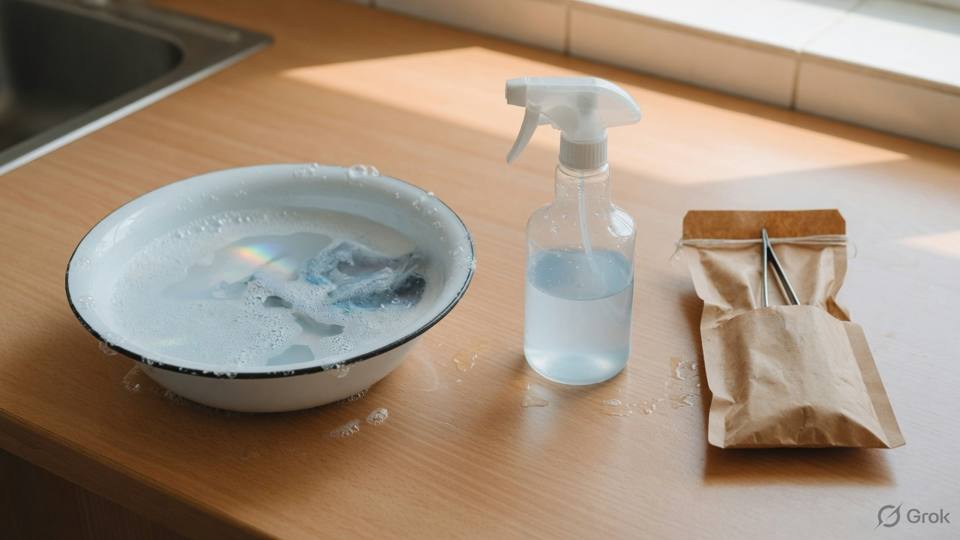
Three words that are not synonyms
Cleaning, disinfection and sterilisation are three different processes, and using the words loosely leads to false claims. Cleaning removes soil, oil and product film with detergent and warm water, followed by a rinse and drying. Disinfection uses a chemical to reduce the number of microorganisms on a surface that has already been cleaned. Sterilisation is a validated process that kills a defined microbial load, and on a salon bench that means an autoclave cycle or another validated method, not a pan of boiling water. A surface cannot be disinfected if it is dirty, because the soil protects the organisms and consumes the chemical.
Seventy percent alcohol is the usual bench disinfectant. The water in the dilution slows evaporation and helps the alcohol penetrate the cell, so the surface stays wet for the contact time, often 30 to 60 seconds. 99% alcohol evaporates too fast to hold that contact time and is less effective on a surface, even though it sounds stronger. Alcohol on a dirty bench moves the soil around and leaves it spread over a larger area. Wipe the surface clean first, then apply 70% alcohol and let it stay wet for the stated time, then let it air dry or wipe with a clean paper towel.
A boiling pan is not sterilisation. Boiling is hot water and it kills some vegetative organisms, but it does not kill bacterial spores and it is not a validated cycle with a recorded temperature and time. Do not call a boiled jar sterile, and do not put that word on a label or in a message to a client. If a process genuinely needs sterilisation, it needs an autoclave with a validated cycle, a indicator or record, and someone trained to run it. A salon making a normal cosmetic batch does not need sterile equipment; it needs clean, disinfected equipment and a closed routine.
The order is always clean, then disinfect, then, only if required, sterilise. Skipping the first step wastes the second, and skipping the second makes the third impossible. Keep the three words separate in the batch record as well. Write 'cleaned with detergent and rinsed' when that is what happened, and write 'wiped with 70% alcohol, 60 seconds wet' when that is what happened. A record that says 'sterilised' when the jar was rinsed in hot water is not a small exaggeration; it is a false statement about a process that nobody performed. Use the same plain words in a message to a client: cleaned and disinfected is honest, and sterile is a claim that needs a validated cycle behind it.
- 1. Remove visible product and soil with detergent and warm water.
- 2. Rinse with distilled water so no detergent film remains.
- 3. Dry on a clean rack or with a clean paper towel.
- 4. Wipe the surface with 70% alcohol and keep it wet for the contact time.
- 5. Let the surface air dry before putting anything on it.
- 6. Use an autoclave only for a validated cycle, with a record.
- 7. Never describe boiling water as sterilisation.
- 8. Write the actual process in the batch record, not a stronger word.
Bench example
A maker fills four 50 g jars for a trial. The jars are washed in warm water with detergent, rinsed with distilled water, and left upside down on a clean rack to dry. The lids are washed and dried separately. The bench is wiped with detergent, then with 70% alcohol, and left wet for a full minute before the jars are placed on it. The spatula is washed, rinsed, dried, and wiped with alcohol. The maker writes in the record: jars washed and rinsed, bench and spatula wiped with 70% alcohol for 60 seconds. A colleague asks whether the jars are sterile, and the answer is no: they are clean and disinfected, which is what a normal cosmetic batch needs. The batch is filled, labelled with the batch code and the date, and held as a lab sample. If the process had needed sterile jars, the jars would have gone through a validated autoclave cycle with a record, and the record would say so. The record is signed, and the words match what was actually done, which is the only standard that matters when someone asks later how the jars were prepared.
Caution: Do not use the word sterile for a washed jar, a boiled pan, or an alcohol wipe. If there is no validated cycle and no record, the word is false.
The bench workflow
A bench workflow is a sequence, not a list of good intentions. Start by clearing the bench so that only the batch, the tools and the record are on it. Wash beakers, spatulas and jars with detergent and warm water, rinse with distilled water, and dry them on a clean rack or with a clean paper towel. Clean the bench surface, then wipe it with 70% alcohol and let it stay wet for the contact time. Wipe the outside of every container that comes onto the bench, because a dusty drum carried from a storage shelf brings contamination with it. Tie hair back, remove jewellery from the hands, and keep food, drink and the phone away from the work area.
Wash your hands before the batch, then use 70% alcohol or clean gloves. Gloves are not a substitute for hand washing, and a glove that has touched a phone, a door handle or a bin is no cleaner than the hand inside it. Change gloves when they tear, when they are visibly soiled, and between handling raw materials and handling clean jars. Use a new spatula for each container, and never put a used spatula back into a bulk jar. Fingers never go into a bulk jar; pour or scoop with a clean tool into a secondary container, then close the bulk container before doing anything else.
The bench does not need to be sterile for a normal cosmetic batch, but it does need to be clean, disinfected and closed to dust and fingers. Keep the work area free of clutter and wipe up spills immediately, because a spill is both a slip hazard and a microbial niche. Do not use a dishcloth on the bench and then on a beaker; use separate cloths or paper towels for surfaces and for glassware. Do not dry glassware with a used towel. Do not store a beaker upside down on a dirty mat, and do not put a lid on a warm jar and stack it, because condensation inside the jar grows things.
At the end of the batch, clean as you go rather than leaving everything for the next morning. Wash the beakers, spatulas and the scale pan, empty and dry the water bath, and wipe the bench. Put the batch record, the calculation sheet and the retention sample together in one place. A bench that is clean at the start of the next batch is a bench that was cleaned at the end of the last one, and the habit is easier to keep than a deep clean after a problem. Record the cleaning in the bench log, with the date, the time and who did it.
- 1. Clear the bench of everything not needed for the batch.
- 2. Wash glassware and tools with detergent and warm water.
- 3. Rinse with distilled water and dry on a clean rack.
- 4. Clean the bench, then wipe with 70% alcohol and keep it wet.
- 5. Wipe the outside of every container that comes onto the bench.
- 6. Wash hands, then use 70% alcohol or fresh gloves.
- 7. Use one clean spatula per container and never reuse it in bulk stock.
- 8. Clean the bench and the equipment at the end, and log the cleaning.
Bench example
A maker starts a 500 g lotion at nine in the morning. The bench holds a balance, two beakers, a thermometer, a spatula, the record and the raw materials. The phone is in a drawer, the tea is in the office, and the hair is tied back. The glassware was washed and dried the evening before; the maker wipes the bench with detergent and then with 70% alcohol, leaving it wet for a minute. A new spatula is used for the preservative, a second for the fragrance, and both are washed at the end rather than being put back in the jars. At 11:40 the batch is filled into four jars, and by noon the bench is clear, the water bath is empty, and the record is signed. A visitor arrives and puts a coffee cup on the bench beside the record; the maker moves it to the office and wipes the spot, because the rule is not about the coffee but about what a full cup does to an open batch. At the end of the day the sink is clean, the cloths are washed and dried, and the bench is clear for the next batch, which is the point of doing the work in the same order every time.
Caution: A cloth that wipes the bench and then a beaker spreads soil to clean glass. Use separate cloths or paper towels, and wash hands after handling waste.
A cleaning schedule that holds
A cleaning schedule is only useful if it names the item, the frequency and the method. The bench surface is cleaned and wiped with 70% alcohol after every batch, fully cleared and cleaned weekly, and cleaned immediately when soiled. Beakers and spatulas are washed, rinsed and dried after every batch, checked for cracks weekly, and rewashed at once if they are chipped. The scale pan is wiped after use and never washed under running water, because water in the body of a balance ends the balance. The water bath is emptied and dried after use and cleaned weekly, and the fridge is wiped for spills and checked for temperature.
Jars and lids are kept lidded and dust-free, wiped on the outside weekly, and cleaned immediately if they are soiled. Store them upside down on a clean tray or in a closed cupboard, not on an open shelf where a delivery box has been resting. Do not keep a bucket of disinfectant for a week and top it up; mix fresh, because a bucket that smells of old cloth is a microbial culture, not a cleaning solution. Do not use alcohol on a wet or dirty surface and call it disinfected, because the water dilutes the alcohol and the soil protects the organisms.
Some habits matter more than the schedule. Do not use a dishcloth on the bench and then on a beaker. Do not dry glassware with a used towel; air-dry it or use a clean paper towel. Do not store a beaker upside down on a dirty mat, and do not put a lid on a warm jar and stack it. Do not keep food in the same fridge as raw materials, and do not eat at the bench. These are small decisions that decide whether the batch starts clean, and they cost nothing except attention. Write the ones that are easy to forget on the schedule itself, so the sheet teaches the habit rather than assuming it.
Review the schedule quarterly and after any incident. If a batch shows a contamination sign, the first questions are about the cleaning record, the water, the preservative and the jars, in that order. A schedule that nobody signs is a schedule that nobody follows. Keep it short enough to complete, specific enough to check, and visible on the wall rather than buried in a folder. When a new person joins the bench, walk them through the schedule on their first batch; a verbal handover is not a training record. The walk-through takes fifteen minutes and prevents the same questions from being answered differently by two people, which is how a cleaning routine drifts.
- 1. Write the item, frequency and method on one page.
- 2. Clean the bench surface after every batch and weekly in full.
- 3. Wash and dry glassware after every use, and check for cracks weekly.
- 4. Wipe the scale pan; never put water into the balance body.
- 5. Empty and dry the water bath after use, clean the tank weekly.
- 6. Keep jars and lids lidded and store them in a closed cupboard.
- 7. Mix fresh disinfectant rather than topping up an old bucket.
- 8. Sign the schedule and review it quarterly and after an incident.
Bench example
A two-person salon keeps a one-page cleaning sheet on the wall beside the bench. The morning maker signs the bench wipe, the glassware wash and the water bath empty. The evening maker signs the floor, the bins and the fridge check. On a Thursday a jar from a Monday batch shows a swollen lid, and the record is pulled. The sheet shows the bench was wiped at 09:10 and the jars were washed on Sunday and stored in the cupboard. The water container was opened on the Monday and dated. The preservative was weighed at the supplier dose. The likely cause is a jar that was filled while still warm and lidded before it cooled, and the batch is quarantined while a lab sample is arranged. The schedule did not prevent the fault, but it made the investigation possible in ten minutes instead of a week, which is the practical value of writing down what was done. The incident is written up in three sentences, and the schedule is changed so that a warm jar is never lidded, which is the only useful outcome of a failed batch.
Caution: A cleaning bucket that is topped up for a week is not a disinfectant. Mix fresh solution, use it, and discard it; old cloth in old water grows organisms.
This is a Nandu Nai textbook. It is a private brand book, not a government licence, and it does not give the right to give medical treatment.