
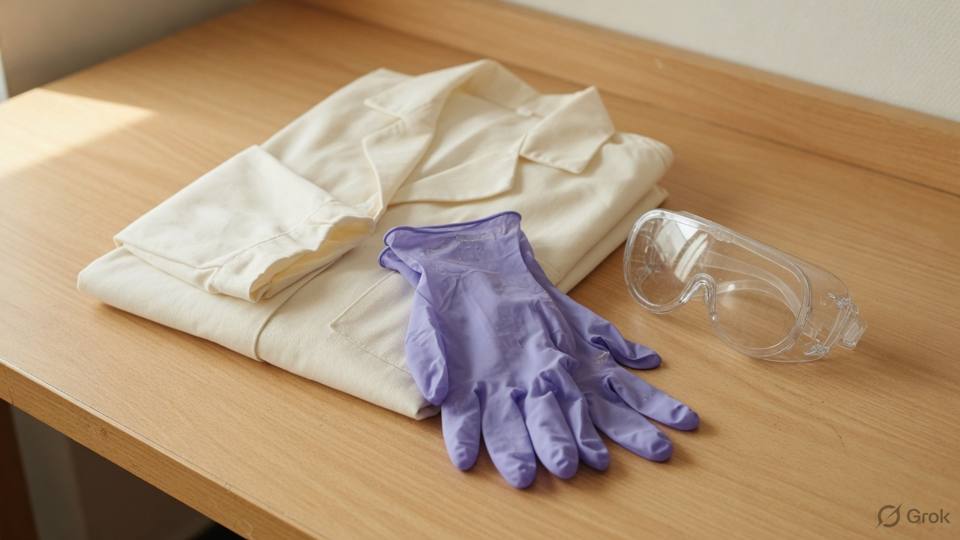
Goggles, gloves and the apron
Protective equipment is chosen for the task, not for the look of the bench. Goggles are needed when handling acid, alkali, hot phases or any powder that can splash or dust; safety glasses are not enough for a splash, because they leave the sides of the eye open. Nitrile gloves are a good default for cosmetic work, and they need to fit so that you can still feel a spatula. Change them when they tear, when they are dirty, and between raw materials and clean jars. Closed shoes and an apron are for caustic or hot work, and a mask is needed when weighing powders that dust, or when the supplier sheet says so.
Gloves are not a substitute for hand washing, and they are not a licence to touch your face. A glove that has been in a bulk jar, on a phone, or on a door handle is contaminated on the outside, and everything it touches afterwards is contaminated too. Wash hands before gloving, change gloves when they are soiled, and take them off without touching the outside with a bare hand. Keep nails short and do not wear rings or a watch on the bench, because both trap material and tear gloves. If a glove is torn during the batch, stop, remove it, wash hands, and put on a new pair before touching anything else on the bench.
Check the equipment before the batch, not during it. Goggles should be clean enough to see through, with an intact strap. Gloves should be the right size and within their date. The apron should be dry and unfastened at the back so it comes off quickly if something spills. The eye wash bottle should be full and in date, and you should know where the nearest tap is. An eye wash that is empty when it is needed is worse than no eye wash, because it was counted as protection. Replace the bottle when it is past its date, and write the check on the batch card so the next maker does not have to trust the shelf.
Store personal protective equipment away from the raw materials. Goggles that have been lying face down on a bench are dirty on the inside, and gloves that have been kept in a hot drawer may be brittle. Keep a spare pair of gloves and a spare pair of goggles in a closed box, and replace the eye wash when it passes its date. The cost of this equipment is small compared with the cost of a splash, and the habit of wearing it is easier when it is always in the same place. A hook beside the bench and a closed box for spares costs little and removes the excuse that the goggles were somewhere else.
- 1. Read the supplier safety sheet before opening a new raw material.
- 2. Put on goggles and nitrile gloves before handling acid, alkali or hot phases.
- 3. Wear closed shoes and an apron for caustic or hot work.
- 4. Use a mask when weighing powders that dust.
- 5. Check that the eye wash is full and in date before starting.
- 6. Change gloves when torn, soiled, or between raw materials and clean jars.
- 7. Remove gloves without touching the outside with a bare hand.
- 8. Wash hands after removing the equipment and before leaving the bench.
Bench example
A maker opens a bottle of concentrated sodium hydroxide to adjust the pH of a 400 g gel. The bottle is kept below eye level and closed between uses. The maker puts on goggles and nitrile gloves, checks that the eye wash is full, and adds the alkali drop by drop with a clean pipette, stirring and checking the pH between drops. A drop lands on the bench and fizzes on a trace of water; the maker wipes it with plenty of water and a paper towel, then cleans the area again with detergent. No skin contact occurs. A second maker, working without goggles because the bottle was small, receives a splash at the inner corner of the eye while opening the cap. The eye is rinsed at the eyewash for fifteen minutes and the person is taken for medical review. The batch is abandoned. The difference between the two outcomes is not skill; it is whether the equipment was on before the bottle was opened. Both makers write the lesson in the bench log, one as a near miss and one as an injury, and the salon adds a rule that the bottle is opened only with goggles on.
Caution: Safety glasses are not goggles. If the task can splash sideways or from below, only sealed goggles protect the eye.
Acid into water, never the reverse
Concentrated acid goes into water, not water into a large volume of concentrated acid. The heat of dilution can spit and boil, and a sudden addition of water to acid can send hot liquid out of the vessel. Add the acid slowly, with stirring, into the water, and keep the vessel on a stable surface at a height where you can see into it. Wear goggles and gloves, and have the eye wash ready before the bottle is opened. If the mixture becomes too hot, stop and let it cool rather than adding more acid to finish quickly. Keep the bottle capped between additions and stand it on a tray, so a tip-over does not become a spill across the bench.
Concentrated sodium hydroxide is caustic. It damages skin and eyes on contact, and the damage can be delayed, so a splash that feels mild at first may blister later. Keep the bottle closed, labelled and below eye level, and never store it in an unmarked container. Use a clean dry scoop for pellets and a clean pipette for solution, and never return unused material to the stock bottle. A pellet that falls on the bench should be picked up with a dry tool, not a wet cloth, and the area should then be wiped with plenty of water. Store pellets and solutions on separate shelves, and never put a wet scoop into a pellet bottle, because the moisture starts a reaction in the stock.
If product or a raw material gets into an eye, rinse with plenty of water and get medical help. If it gets on the skin, rinse with plenty of water and remove any contaminated clothing. Do not attempt to neutralise a splash on skin with another chemical, because the neutralisation reaction produces its own heat and can add a thermal burn to a chemical one. Do not write a first-aid lecture beyond rinse and seek help; the point of the bench rule is to prevent the exposure, and the response is water and medical review. Keep a written note of the product and the time of exposure for the medical assessment, and record the incident in the bench log afterwards.
Store acids and alkalis apart from each other and away from fragrance, alcohol and oxidisers. A bottle that leaks in a cupboard with another reactive material is a problem that starts before anyone opens it. Keep the supplier label on the container, and if a label is damaged, re-label the container with the name, the hazard and the date. An unlabelled bottle of clear liquid is not identifiable by smell or by look, and it should not be used. These storage rules are part of the same protective system as the goggles. A shelf that is checked for leaks once a month is part of the same system, because a leak found late is a fume and a corrosion problem.
- 1. Put on goggles and gloves before opening concentrated acid or alkali.
- 2. Place the vessel on a stable surface and check the eye wash.
- 3. Measure water into the vessel first.
- 4. Add the acid slowly, with stirring, into the water.
- 5. Stop if the mixture becomes hot and let it cool.
- 6. Keep bottles closed, labelled and below eye level.
- 7. Rinse any splash with plenty of water and seek medical help.
- 8. Never neutralise a skin splash with another chemical.
Bench example
A maker needs a dilute acid solution for a pH adjustment. The instruction says to add the acid to water. The maker measures 90 g of distilled water into a beaker, puts on goggles and gloves, and adds 10 g of concentrated acid slowly with a glass rod, stirring between additions. The beaker warms noticeably but does not boil, and the maker waits for it to cool before use. A colleague who reverses the order, adding 10 g of water to 90 g of acid, sees the mixture spit and crack the beaker, and a drop lands on the bench. Nobody is hurt, but the batch is abandoned and the bench is cleaned with plenty of water. The record for the successful preparation states the order, the masses and the fact that the solution was allowed to cool, which is exactly the information the next maker needs to repeat it safely. The record also notes that the acid was added to the water and not the reverse, which is the detail an investigation would look for first. It is written in the same record, not in a separate note.
Caution: Never add water to concentrated acid. The heat of dilution is local and violent; the acid goes into the water, slowly, with stirring.
Spills, waste and the bench log
A spill is handled in a fixed order. Stop and keep people back. Put on goggles and gloves if they are not already on. For an acid or an alkali, neutralise only if you have the correct neutraliser and know the reaction; if not, dilute with plenty of water and wipe from the outside in. For an oil, cover with absorbent paper and then clean the floor with detergent so the next person does not slip. For a fragrance or a solvent, ventilate the area and keep ignition sources away. Put the waste in a closed bin rather than down the sink unless the supplier says the sink is allowed, and write the spill and the cleanup in the bench log.
Do not use a paper towel on concentrated acid and then squeeze it. Do not mix a spill with another chemical to neutralise it unless you know the products of the reaction. A bucket of water is the default for a small aqueous spill, and absorbent material is the default for an oil. If the spill is large, or if the material is unknown, leave the area and get help rather than improvising. The cost of stopping is a few minutes; the cost of a bad reaction is much higher. If the spill is larger than a small puddle, or the material is unknown, leave it, ventilate, and call for help rather than experimenting.
Waste needs a route before the batch starts. Know which materials can go down the sink, which go into a closed chemical waste container, and which go into the general bin. Empty fragrance bottles, solvent residues and any material with a hazard label do not belong in the general bin or the sink without checking. Keep a labelled waste container with a lid, and do not fill it past a safe level. A waste container that is open on the bench is a spill waiting to happen and a source of vapour in the work area. Check the local rules for the sink before pouring anything down it, and keep the waste container away from heat and ignition sources.
Record every spill, however small, with the date, the material, the amount if known, what was done, and who did it. The log is not a punishment; it is how a pattern is found. Three small spills of the same material in a month point to a storage or handling problem that a single incident would hide. Review the log at the monthly bench check, and change the storage or the tool if the same spill keeps happening. The aim is a bench where the same accident does not have a second chance. The same log records the near misses, because a spill that was caught before it reached the floor is still information about how the bench is arranged.
- 1. Stop work and keep other people away from the spill.
- 2. Put on goggles and gloves before approaching.
- 3. For acid or alkali, dilute with water unless you have the correct neutraliser.
- 4. For oil, cover with absorbent, then wash the floor with detergent.
- 5. For solvent or fragrance, ventilate and remove ignition sources.
- 6. Put waste in a closed, labelled container, not the sink.
- 7. Clean the area again and check that it is not slippery.
- 8. Write the spill, the material, the cleanup and the time in the log.
Bench example
A 200 mL bottle of fragrance oil slips from a shelf and breaks on the floor. The maker stops, moves a client away from the area, opens the window and turns off the hot plate. Gloves are put on, the glass is picked up with tongs and placed in a rigid container, and the oil is covered with absorbent paper. The floor is washed twice with detergent and left to dry, and the room is ventilated for an hour before anyone works there again. The spill is written in the log with the time and the material, and the shelf is checked: the bottle had been stored on the front edge, in front of a larger drum. The next week the shelf is fitted with a lip and the bottles are moved back. The log entry from the first spill is what makes the second one preventable, and the change is recorded on the same page. The shelf lip is recorded in the log as the corrective action, so the next review can see whether it worked and whether another spill followed.
Caution: Never squeeze a paper towel that has absorbed concentrated acid, and never mix an unknown spill with another chemical to neutralise it. Water first, then help.
This is a Nandu Nai textbook. It is a private brand book, not a government licence, and it does not give the right to give medical treatment.