
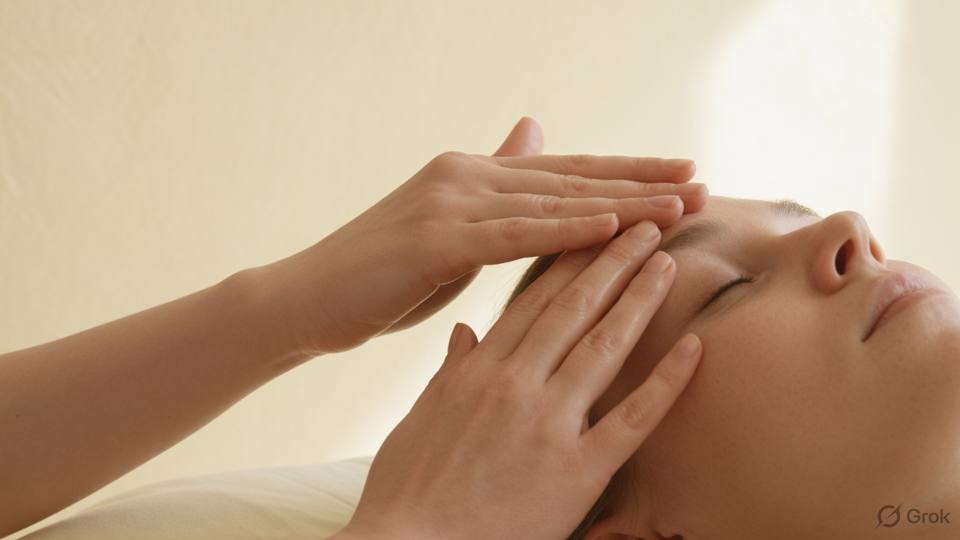
Effleurage direction and pressure
Effleurage is a gliding movement, the first massage stroke most clients recognise. On the face it is used to relax the muscles, spread a light oil or serum, and give the client a sense of care. The direction is upward and outward on the face, following the cheek toward the temple and the forehead toward the hairline. On the neck, the glide moves downward toward the collarbone, and on the shoulders it moves outward. The direction is not a magic route for waste; it is a comfortable direction for the client and a respectful one for the skin. Do not drag the skin downward on the face, because it feels wrong and pulls the tissue.
Pressure should be light enough that the skin moves with the hand rather than stretching under it. Use the pads of the fingers or the palms, not the fingertips digging in. Keep the contact continuous and the speed slow. Three to five passes over each area are enough for a salon facial. More passes do not add a result; they add redness. If the client wants a stronger massage, explain that the face has little padding and that deep pressure can irritate the skin and the sinuses. A firm neck and shoulder glide is often more satisfying than a hard face massage.
The eyes and the lips need their own care. Work around the eye with the ring finger and very light pressure, or skip the eye area entirely. Do not press on the eyeball, the inner corner, or the lid margin. Around the lips, use a light circular glide and avoid pulling the skin. If the client has a beard, work with the direction of the hair or skip the area. If the client wears contact lenses, ask them to remove them or keep the eye area out of the massage. These small choices prevent the most common complaints: stinging eyes and tender skin.
The massage ends with the skin calm, not flushed. Remove the remaining oil or serum with a soft tissue or a warm damp cloth, then apply the mask or moisturiser according to the plan. Ask the client how the pressure felt. Some clients want almost nothing, and some want more on the neck and shoulders. Record the preference on the card. A massage that respects the client's comfort is a service; a massage that follows a fixed routine regardless of the face is a performance. The best pressure is the one the client would ask for again, and the best routine is the one that changes when the face does.
- 1. Ask about contact lens use, recent wax or peel, and any tender area before you start.
- 2. Warm a small amount of product between the palms so the glide is smooth.
- 3. Glide upward and outward on the face, toward the temple and the hairline.
- 4. Glide downward on the neck toward the collarbone and outward on the shoulders.
- 5. Use the pads of the fingers or the palms, never the fingertips digging in.
- 6. Keep the pressure light enough that the skin moves with the hand, not under it.
- 7. Make three to five slow passes per area and avoid the eyeball and lid margin.
- 8. Remove the excess product, ask about the pressure, and record the preference.
Salon example
A client, Devika, books a facial for relaxation after a difficult month. She has normal skin with no active lesions, and she asks for a long massage. The esthetician cleanses, looks, and confirms that the skin is intact. She uses a light oil and begins with the neck, gliding downward toward the collarbone, then the shoulders outward. On the face she works upward and outward, using the pads of her fingers and keeping the pressure light. Devika asks for more pressure on the jaw, where she holds tension. The esthetician explains that the face has little padding and offers firmer work on the neck and shoulders instead. Devika agrees and says the neck work is the part she needed. The massage ends after ten minutes, the oil is removed, and a hydrating mask follows. Devika books the same plan for the next month. The esthetician notes the neck work and the light facial pressure, so the next visit does not start with a conversation about strength or fear of a heavy hand. The note also says that the eye area was skipped at the client's request.
Caution: Facial pressure is not a test of strength; if the skin stretches or the client holds their breath, the pressure is too firm.
When to skip massage
Active acne is the first reason to skip. Massage over pustules, papules, or cysts can spread inflammation, rupture a lesion, and push material into the surrounding tissue. It can also transfer bacteria from one area to another through the hands and the product. If the client has a few small whiteheads, work around them or skip the massage entirely. If the acne is widespread or cystic, do not massage the face. A gentle cleanse, a cool compress, and a calming mask are safer. The client may have booked for relaxation, but the skin's condition decides what the hands can do.
Rosacea-type redness, broken skin, and sunburn are also reasons to skip. Massage increases blood flow, which can make flushing worse and leave the skin hot and uncomfortable. Broken skin, a scratch, a fresh extraction site, or a healing cold sore should not be rubbed. Sunburned skin is inflamed and dry, and massage can increase the pain and the peeling. If the skin is warm to the touch or the client reports stinging, stop the massage and choose a cooling step instead. A cool compress and a light moisturiser are kinder than a stroke that the skin is not ready for.
Recent treatments change the rules. After a peel, a wax, a laser session, or a strong exfoliation, the surface may be fragile for days. Massage can lift the skin, spread product into a raw area, or increase redness. A client on isotretinoin may have thin, slow-healing skin, and a client on a prescription retinoid may be peeling. In pregnancy, avoid long periods lying flat on the back and keep the service cool and short. If you are unsure whether the skin can take massage, skip it. There is no massage emergency that requires you to proceed, and a client who is disappointed today is easier to manage than skin that reacts tonight.
When you skip, say so and offer an alternative. 'I am not going to massage today because the skin is active, but I can do a cool compress and a calming mask.' The client should not feel that the service was reduced without a reason. Record the decision and the alternative on the card. If the client insists, explain once that massage over active acne can spread inflammation, then let them choose the safe service. Do not let a request for relaxation override a skin that is inflamed. The next visit, when the skin is calm, can include the massage.
- 1. Look for pustules, papules, cysts, and widespread acne before planning a massage.
- 2. Skip massage over active acne, and work around a single small whitehead or leave it alone.
- 3. Skip massage on rosacea-type redness, broken skin, a scratch, or a healing cold sore.
- 4. Skip massage on sunburned or hot, stinging skin, and use a cool compress instead.
- 5. Skip massage after a peel, wax, laser session, or strong exfoliation until the skin has settled.
- 6. Be cautious with a client on isotretinoin or a prescription retinoid, and keep the service gentle.
- 7. In pregnancy, avoid long lying flat on the back and keep the service cool and short.
- 8. Say why you are skipping, offer a safe alternative, and record the decision.
Salon example
A client, Arjun, comes for a facial before a presentation. He has oily skin and several inflamed papules on his cheeks, some with a red halo. He asks for a massage because he wants to relax. The esthetician looks, explains that massage over the active spots could spread the inflammation and make the redness worse, and offers a gentle cleanse, a cool compress, and a calming mask instead. Arjun is disappointed, because he booked the facial for the relaxation. The esthetician offers a neck and shoulder massage, where the skin is intact, and keeps the face work light and away from the lesions. Arjun accepts, and the neck work gives him the calm he wanted. The esthetician records the active acne, the avoided areas, and the alternative, and suggests a dermatologist if the papules persist. Arjun admits that the neck work was the part he needed, and he books a shorter facial with the same limits for the week after the presentation, when the redness has settled and after a patch test on the jawline, because the skin reacted to a new product earlier in the year.
Caution: A request for relaxation does not make an inflamed face safe to massage; move the work to the neck and shoulders instead.
What a facial massage can and cannot claim
A facial massage can help a client relax, soften the look of the skin, and make the face feel less tight. It can spread a product evenly and give the client a sense of being cared for, which is a real part of a salon service. It can also reduce the feeling of tension in the jaw and the neck for a short time. Those are modest, honest benefits. They do not need to be dressed up as a medical result. A client who leaves feeling calmer and looking rested has received a good massage, even if the skin's underlying condition has not changed.
A facial massage cannot drain toxins. The body does that through the liver and the kidneys, and the lymphatic system does not need a salon stroke to work. A massage can move fluid for a short time, which may reduce puffiness, but the effect is temporary and is not a detox. A massage cannot cure acne, remove pigmentation, erase a scar, or permanently lift the face. It cannot make a dark mark fade in one session. It cannot replace sunscreen, a prescription, or a doctor's care. Saying this protects the client from false hope and protects you from a claim you cannot support.
The script is simple. 'This massage is for relaxation and comfort. It can help the face feel less tight and look rested for a while. It does not remove toxins, cure acne, or change pigmentation.' If the client asks about lifting, say that the effect is temporary and that the skin's support comes from its own structure. If the client asks about detox, say that the body handles that and that the massage is not a medical treatment. Do not use the word detox on the menu, the bill, or the card. Do not promise a result that a photograph a week later would contradict.
Consent matters for massage more than for many services, because touch is personal. Ask before you begin, explain what you will do, and check during the service. A client may not want the neck, the jaw, or the eye area touched. Respect that without asking for a reason. Record the preference and any area you avoided. If the client has a medical condition that affects the skin or the circulation, ask them to check with their doctor before a longer massage. A calm, honest massage with clear limits is a better service than an ambitious one with a claim that cannot be kept.
- 1. Ask for consent before the massage and explain which areas you plan to work on.
- 2. State that the purpose is relaxation and comfort, not a medical treatment.
- 3. Do not claim that massage drains toxins, detoxifies, or cleans the body.
- 4. Do not claim that massage cures acne, removes pigment, or permanently lifts the face.
- 5. Say that any reduction in puffiness or tightness is temporary.
- 6. Check during the service and adjust pressure or skip an area on request.
- 7. Ask a client with a relevant medical condition to check with their doctor before a long massage.
- 8. Record the areas worked, the pressure, and any preference on the card.
Salon example
A client, Sapna, asks for a facial massage because she read that it drains toxins and lifts the face. The esthetician explains that the massage can help her relax and can make the face look rested for a short time, but it does not drain toxins, and it will not permanently lift the skin. Sapna is surprised, because a previous salon promised a sculpted result. The esthetician shows her the plan: a light effleurage on the face, firmer work on the neck and shoulders, and a cooling mask. She asks about consent for the neck and the jaw, and Sapna agrees. After the service, Sapna says her face feels less tight and her neck feels better. The esthetician gives her a card that describes the service honestly and does not use the word detox. Sapna books again for the relaxation, not for a promise. The card describes the service in plain words, and the menu is changed the following week to remove the detox language from every facial, and the estheticians agree to use the same explanation at the chair.
Caution: Do not put the word detox on a menu or a card; the body clears waste without a facial, and the claim invites a complaint.
This is a Nandu Nai textbook. It is a private brand book, not a government licence, and it does not give the right to give medical treatment.