
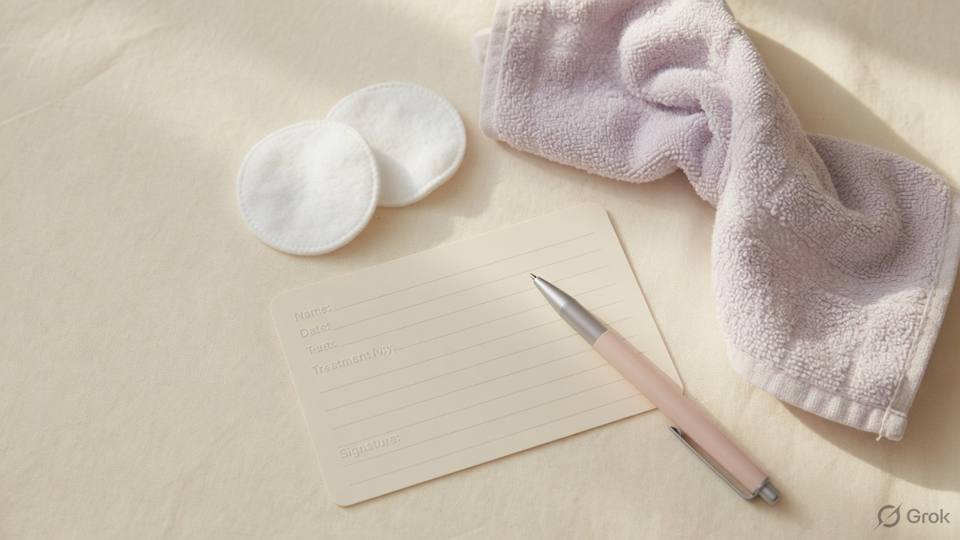
What you write before you touch the skin
The record card is the memory of the service, and it starts before the first product touches the skin. Write the date, the client's name, the service booked, and the result the client asked for in their own words. Then write what you see: skin type, current condition, texture, pores, redness, flaking, and any lesion you will not treat. Add the products the client uses, the medicines that matter, the allergies, the last wax or peel, and the patch-test result. This is not paperwork for its own sake. It is what lets the next visit start with facts instead of a fresh guess.
A useful card has separate fields, not one long paragraph. Keep identity and contact details apart from clinical notes, so that a receptionist can find a phone number without reading about a client's acne. Keep the type in one field and the condition in another, because they change at different speeds. Keep the plan, the refusal, and the consent in a third block. If the salon uses a software system, the same separation applies. If it uses paper, use a printed form with boxes rather than a blank page, because a blank page invites a note that is too short to help anyone.
Write in plain language and keep it short enough to read in thirty seconds. 'Combination type, dehydrated cheeks, one open comedone on the nose, no wax on the upper lip because of a cold sore, client advised to see a doctor' is a complete note. Do not write a diagnosis, and do not use a medical term you cannot explain. Do not write an opinion about the client's habits in a way that would embarrass them if they read it. The client has a right to know what is recorded, and a note that is fair is easier to defend than a note that is clever.
Privacy is part of the record. Keep paper cards in a locked drawer or a closed cupboard, and keep digital records behind a password. Do not leave a card on the trolley where the next client can read it. Do not discuss one client's skin with another client, even as an example without a name. If a client asks to see their record, show it or explain the salon's process. At the end of the service, update the card with what you actually did, not only what you planned. A card written after the client leaves is a story; a card written during the service is evidence.
- 1. Write the date, the client's name, the service, and the result they asked for in their own words.
- 2. Record the skin type in one field and the current condition in another.
- 3. Note texture, pores, redness, flaking, and any lesion you will not treat.
- 4. List the products, medicines, allergies, last services, and patch-test result.
- 5. Write the plan, what you are skipping, and the reason in plain language.
- 6. Record the client's consent and any refusal in the client's presence.
- 7. Keep paper cards locked and digital records password-protected.
- 8. Update the card with what you actually did before the client leaves.
Salon example
A salon introduces a printed card after a complaint about a wax reaction. The card has boxes for type, condition, products, medicines, allergies, last service, patch test, plan, refusal, and consent. The estheticians grumble that it takes five minutes. Two months later, a client returns with redness on the upper lip and says the last esthetician used a new wax. The card shows the wax brand, the patch test date, the fact that the client had used a retinoid four days earlier, and the note that the esthetician had declined the lip and waxed only the chin. The conversation changes from blame to a plan: the client sees the note, understands the decision, and books a patch test for a later date. The five minutes at the chair saved an hour of argument and a client relationship. The salon keeps the printed card and adds a line for 'product batch' after that day, so a bad batch can be traced without relying on memory or a supplier email. The complaint becomes a record of a decision, and the client books the patch test without feeling accused.
Caution: If it is not on the card, it did not happen; a note written from memory after a complaint is worth very little.
Type versus condition on the card
Skin type is the baseline: oily, dry, combination, normal, or sensitive. It is set by genetics, hormones, and age, and it changes slowly. A client does not become a different type after a bad week, although the condition can change completely. Write the type once and review it occasionally, because it can shift with age, medication, or a long-term change in climate. The type tells you what the skin is likely to need over months: lighter hydration for oily skin, richer support for dry skin, and a cautious approach for sensitive skin. It does not tell you what to do today.
Condition is the current state: acne, dehydration, pigmentation, redness, sensitivity, or a reaction. It can change in days. A client who is oily can be dehydrated, and a client who is dry can have acne. A client with sensitive skin can have a calm day, and a client with normal skin can arrive with a rash. The condition is what decides the intensity of the service, the products you choose, and whether you treat at all. A card that records only the type is like a map that shows the city but not the weather, and it will lead you to the wrong service on the wrong day.
Observe in a consistent way. Cleanse first, use the same lamp or window light, ask the client to remove glasses, and compare one side of the face with the other. Look at the forehead, nose, cheeks, chin, and jawline in that order, and note what you see in each zone. Feel the skin lightly if the client agrees, but do not press on lesions. Ask about tightness, stinging, and itching, because the client feels what you cannot see. Write the observation and the client's words side by side. When they disagree, the disagreement is useful information, not a problem to settle.
Use the card to choose intensity at every visit. If the condition is calmer than last time, you may do a little more, but only within the limits of the type and the products. If the condition is more reactive, do less, even if the booking is for a full facial. Note the season, because the same client may need a different plan in a humid month and a dry one. Note a new medicine, a new product, or a recent illness. The card is not a label that follows the client forever; it is a living record that should make today's decision easier and safer.
- 1. Record the skin type once in its own field and review it when something long-term changes.
- 2. Record the current condition at every visit, even when the booking is the same.
- 3. Cleanse before observing, and use the same light each time.
- 4. Compare zones and compare one side of the face with the other.
- 5. Ask about tightness, stinging, and itching, and write the client's words.
- 6. Note the season, new products, new medicines, and recent illness.
- 7. Choose today's intensity from the condition, within the limits of the type.
- 8. Update the plan when the condition changes, rather than repeating the last service.
Salon example
A client, Ishaan, is recorded as oily type with acne. In June the card notes a congested T-zone and a plan with a clay mask. In December he returns with the same oily type but a different condition: his cheeks are flaky, his forehead is tight, and he has been using a strong foaming wash twice a day. The esthetician does not repeat the clay mask. She records the condition as dehydrated with mild irritation and changes the plan to a mild cleanser, a short warm compress, a hydrating mask, and a non-comedogenic moisturiser. She asks him to stop the foaming wash for two weeks. The card shows both visits side by side, so the change is visible. Ishaan returns in January with less flaking, and the plan moves back toward a gentle clean-up rather than a drying mask, and the card shows that the change was based on what was seen, not on a seasonal menu, and it is signed by the esthetician who made the change, which matters when two estheticians share the same client and a busy Saturday.
Caution: Do not let an old type entry decide a new condition; the card is there to show change, not to freeze the client.
The cold sore, the mole, and why you stop
A cold sore is a viral infection that often starts with tingling or burning at the edge of the lip. A cluster of small blisters appears on a red base, then breaks and crusts. It is contagious from the first tingle until the crust has healed, and it can spread to the eyes, to other parts of the face, and to another person through a towel or a hand. On the record card, write what you saw and where, not a diagnosis. 'Cluster of blisters at the right corner of the mouth, client says it started two days ago, service declined' is enough. Then reschedule the service and clean anything that may have touched the area.
A mole or a mark that has changed is the second stop sign. Look for a spot that has grown, has an irregular edge, has more than one colour, or bleeds without being scratched. A new dark spot in an older client deserves attention. You are not expected to name it. Say that it has changed or that it does not look like the surrounding skin, and that a doctor should see it. Do not wax, scrub, or apply a strong product over it. Record the location, the date, and the advice. If the client returns and the spot has changed again, the note gives the doctor a helpful timeline.
The reason to stop is not only the client's safety; it is also the safety of the next client. A cold sore can travel on a towel, a thread, a wax stick, or a hand. A mole that is bleeding can transfer blood to a tool. A changing lesion may be something that a salon should not disturb at all. Stopping protects the person in the chair, the person who comes after, and you. It also protects the salon from a complaint that would be difficult to answer. A lost booking is a small cost compared with a spread infection or a delayed diagnosis.
The script is short and calm. 'I can see a cold sore at the corner of your mouth. I cannot treat that area while it is active because it can spread. Let us book you for after it has healed.' For a changing mole: 'This spot has changed since I last saw you, and I do not treat marks like this. Please have a doctor look at it.' Do not add a diagnosis or a scary story. Write the refusal, the advice, and the date. If the client insists, repeat the limit once and stop. A boundary stated once is professional; a boundary argued five times is a risk.
- 1. Look at the lip edge and the surrounding skin before starting any facial, wax, or threading service.
- 2. Ask whether a spot began with tingling or burning, which is common before a cold sore.
- 3. Do not touch, wax, thread, or apply product over an active cold sore.
- 4. Reschedule the service for after the area has healed, and clean anything that may have touched it.
- 5. Check moles for change in size, shape, colour, or bleeding, and do not treat them.
- 6. Say what you see and what you will not do, without naming a diagnosis.
- 7. Record the location, the date, the refusal, and the advice to see a doctor.
- 8. Repeat the limit once if the client insists, then stop the conversation.
Salon example
A regular client, Mohan, comes for a beard trim and a facial. The esthetician notices a new dark spot on his cheekbone, about the size of a small pea, with an uneven edge. Mohan says it appeared a few months ago and sometimes catches on his razor. The esthetician does not wax or exfoliate the area. He explains that the spot has changed and that he does not treat marks like this, and suggests a dermatologist. Mohan is not worried, but he agrees to book the doctor. The esthetician records the location, the size as he sees it, the date, and the advice, and he avoids the cheek during the facial. Three weeks later Mohan returns with a note from the doctor, who has removed the spot and asked him to avoid waxing the area while it heals. The card makes the follow-up easy, and the esthetician adds a note that the area is healing and should not be waxed for the period the doctor advised, so the next booking does not undo the doctor's work. Mohan also tells the esthetician that the doctor asked whether the spot had been waxed, and the card answers the question without guesswork.
Caution: A new or changing dark spot is not a candidate for a facial; note it, avoid it, and send the client to a doctor.
This is a Nandu Nai textbook. It is a private brand book, not a government licence, and it does not give the right to give medical treatment.