
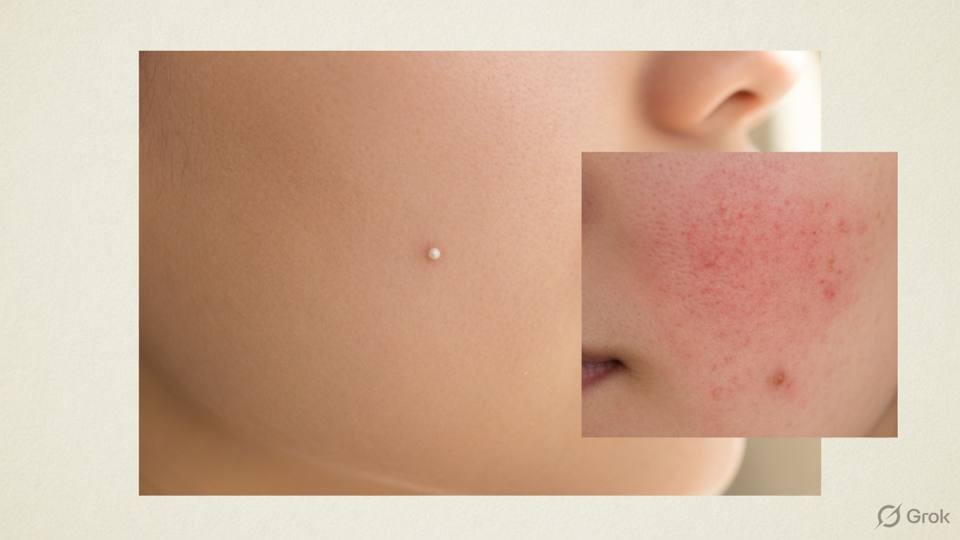
What a safe comedone feels like
A comedone is a blocked pore. An open comedone has a dark plug at the surface and a visible opening; the dark colour is not dirt but oxidised material. A closed comedone is a skin-coloured bump with no opening, and it may take weeks to come to the surface. The safe one to extract is open, soft at the rim, and sitting in a pore that has widened with age or with gentle warmth. It should move slightly under light pressure. If it feels hard, deep, or tender, it is not ready, and pressure will only injure the tissue around it. The fingers learn this difference faster than any lamp.
Preparation decides whether an extraction is safe. Cleanse first, then look, then apply a warm compress for a minute or two if the skin tolerates it. On pigment-prone skin, keep the warmth brief and never hot. The pore mouth softens, the plug becomes easier to lift, and the pressure needed falls. Do not steam the whole face for ten minutes to prepare one comedone. Do not scrub the area to open it. If the comedone has not changed after cleansing and a short compress, leave it for another visit. A pore that is not ready today may be ready in two weeks, and the skin will be intact in between.
The technique is short. Wash your hands again, wipe the area, and use two cotton-wrapped fingers or a clean extractor rather than fingernails. Place the fingers or the loop around the pore, press down and slightly inward once, steadily, and release. If nothing comes in one or two attempts, stop. Do not dig, do not rotate the extractor, and do not use a needle unless the salon protocol and the local rules allow it and the client has consented. Wipe the area with the post-extraction product the label allows, and note which pore was treated. The note prevents the next visit from working the same spot twice in a month.
After extraction, the area may be pink for a short time. That is expected. What is not expected is a swelling, a spreading red area, or a spot that becomes painful over the next day. Tell the client to keep hands off the area, to skip scrubs and retinoids that night, and to call the salon if anything worsens. Do not apply a heavy, fragranced cream over a freshly extracted pore. A light, calming moisturiser and sunscreen are enough. If the client has many comedones, treat a few and plan the rest across visits. Clearing a face in one sitting is not a standard; it is a route to scarring.
- 1. Cleanse the area and look at the lesion under good light before touching it.
- 2. Identify an open comedone with a visible plug and a soft, wide rim.
- 3. Apply a brief warm compress only if the skin tolerates it, never hot.
- 4. Wash your hands again and wipe the area with the salon's cleanser.
- 5. Use two cotton-wrapped fingers or a clean extractor, never fingernails.
- 6. Press down and slightly inward once, with steady light pressure.
- 7. Stop after one or two attempts if nothing comes; the pore is not ready.
- 8. Wipe with the allowed post-extraction product and record the site.
- 9. Tell the client to keep hands off and to skip scrubs and retinoids that night.
Salon example
Priya, thirty-one, has a cluster of dark pores on her nose and two raised bumps beside them. She asks the esthetician to clear all of them because she is meeting her in-laws on the weekend. The esthetician cleanses, looks, and explains that the dark pores are open comedones and the raised bumps are closed. She applies a warm compress for two minutes, then extracts four open comedones with one steady press each. The fifth does not release after two attempts, so she stops and says it is not ready. She does not touch the two closed bumps, because they have no opening and pressure would only bruise the skin. She wipes the nose, applies a light calming gel, and gives a card that says no scrub, no retinoid, and no picking for two days. Priya is disappointed about the bumps, but the nose heals without a mark, and the closed bumps are softer at the next visit three weeks later. The esthetician shows her the card before she leaves, so the instruction is not only spoken and cannot be forgotten in a handbag.
Caution: One or two attempts is the whole allowance; a pore that needs a third press is a pore that should have been left alone.
Cysts, nodules, and the red halo
A cyst is a deep, firm, painful lump with no visible opening. It may be the size of a pea or larger, and it often feels anchored under the skin rather than sitting on it. A nodule is similar but larger and more tender. Neither belongs in a salon extraction. There is no pore mouth to empty, so pressure does not remove the contents; it pushes them deeper and sideways into the surrounding tissue. The result can be a scar, a spreading inflammation, or a dark mark that lasts for months, especially on Fitzpatrick IV to VI skin. The client may beg you to squeeze it before a wedding. The answer is still no.
An angry red papule or pustule with a wide red halo is also off limits. The halo means the inflammation has spread beyond the pore, and squeezing it can turn a small spot into a larger one. The same rule applies near the eye, over a visible vein, on broken skin, and on any mole or mark that has changed. If the client has several cysts or nodules, stop the extraction plan entirely and suggest a dermatologist. Do not attempt to clear the whole face because the booking was long. A referral is a service, not a failure, and it is the only honest option when the lesions are beyond surface care.
The explanation matters as much as the refusal. Name what you see in plain words: a deep lump with no opening, a spot with redness around it, a mark that has changed. Say what you will not do and why in one or two sentences. Then offer what is safe: a gentle cleanse, a cool compress, a calming mask away from the lesion, and sunscreen. Do not promise that a mask will bring the cyst down. Do not apply a strong product to force it. If the client insists, repeat the limit once and stop negotiating. Your hands are the last line between a treatable spot and a permanent mark.
Record the refusal, the location, and the words you used. If the client returns with the same lesion, the note reminds you not to try again. If the lesion has grown, become warmer, or started bleeding, say that a doctor should see it soon. You are not judging whether it is serious; you are noticing change and sending it to someone who can. A calm, specific referral protects the client from a scar and protects you from a complaint. It also teaches the client that a good esthetician knows the edge of the role and will not cross it to keep a booking.
- 1. Look and feel without pressing: a deep, firm, painful lump with no opening is a cyst until a doctor says otherwise.
- 2. Check for a wide red halo around a papule or pustule, which means the inflammation has spread.
- 3. Do not squeeze, lance, or apply heat to force a cyst or nodule to open.
- 4. Do not treat the eye area, a visible vein, broken skin, or a changing mole.
- 5. If several cysts or nodules are present, stop the extraction plan and refer.
- 6. Offer a gentle cleanse, a cool compress, and a calming mask away from the lesion.
- 7. Say what you see and what you will not do, in one or two plain sentences.
- 8. Record the refusal, the location, and the referral on the client card.
Salon example
Ritu, twenty-six, arrives four days before her engagement with a firm, painful lump on her chin. She has covered it with concealer and asks the esthetician to open it so that it settles before the photographs. The esthetician cleanses the area, looks closely, and sees no opening, a deep shadow under the skin, and tenderness when Ritu touches it. She explains that this is a deep lump, not a surface pimple, and that squeezing would push the inflammation sideways and could leave a dark mark for months. Ritu argues that a previous salon squeezed a similar spot and it went down. The esthetician repeats the limit once, offers a cool compress and a calming mask on the rest of the face, and suggests a dermatologist before the event. Ritu takes the compress, skips the mask, and sees a doctor the next day. She sends a message after the engagement thanking the esthetician, because the lump settled without a scar. The esthetician notes the date of the referral and the client's choice, so the next visit starts with the facts rather than a fresh argument.
Caution: A deep lump with no opening is not a challenge for stronger fingers; it is a referral, and the client's event does not change the anatomy.
Cold sores, changing moles, and the stop script
A cold sore usually begins with tingling, burning, or tightness at the edge of the lip. Within a day or two a cluster of small blisters appears, often on a red base, and the blisters break and crust over. It is contagious from the first tingle until the crust has healed, and it can spread to another part of the face, to the eyes, or to another person through a towel, a tool, or a hand. A facial, a lip wax, or a threading service on an active cold sore is not worth the risk. Reschedule after the area has healed, and do not cover it with makeup and continue. The client may say it is only a dry patch; look, ask when it started, and decide for yourself.
The eye is the reason the rule is strict. A cold sore near the eye can cause a serious infection, and a salon cannot tell the difference between a harmless spot and the start of one. Do not touch the area, do not use a shared towel on it, and wash your hands after any contact. Clean and disinfect anything that may have touched it before the next client. If the client has a cold sore and also wants a brow service, do the brow only if the lesion is far away, the client agrees, and your hands and tools stay clean. When in doubt, reschedule the whole appointment. A lost booking is cheaper than a spread infection.
A mole or a mark that has changed is the other stop sign. Look for a spot that has become larger, has an irregular border, has mixed colours, or bleeds without being scratched. A new dark lesion in an older client deserves attention. You are not expected to diagnose it, and you should not try. Say that the spot has changed since the last visit or that it does not look like the surrounding skin, and that a doctor should look at it. Do not wax over it, do not scrub it, and do not use a strong product on it. Note the location and the date you saw it, so the next visit can compare.
The stop script is short and calm. 'I can see a cold sore at the corner of your mouth. I cannot do the facial while it is active because it can spread. Let us book you for after it has healed.' For a changing mole: 'This spot has changed, and I do not treat marks like this. Please have a doctor look at it.' Do not add a diagnosis, a fear, or a product recommendation. Do not let the client talk you into a smaller service on the same area. Write the refusal and the advice on the card. The client keeps their dignity, and you keep the boundary.
- 1. Ask whether the spot started with tingling or burning, which is common before a cold sore.
- 2. Look for a cluster of small blisters on a red base at the lip edge, or an early crust.
- 3. Do not touch, wax, thread, or apply product over an active cold sore.
- 4. Reschedule the service for after the area has healed, and say why.
- 5. Clean and disinfect any tool, towel, or surface that may have touched the area.
- 6. Check moles for recent change in size, shape, colour, or bleeding, and do not treat them.
- 7. Say what you see and what you will not do, without naming a diagnosis.
- 8. Record the refusal, the location, and the advice to see a doctor.
Salon example
Aarti, thirty-eight, comes for a full-face threading and a lip wax before a family photograph. At the corner of her mouth there is a small cluster of blisters on a red base, and she says it started with a tingle two days ago. The esthetician stops the service and explains that this is an active cold sore and that threading or waxing the area could spread it and leave the skin raw. Aarti says it is only dryness from the weather and asks for the brows at least. The esthetician agrees to the brows because they are far from the lesion, keeps her hands and thread away from the mouth, and reschedules the lip and face for ten days later. She cleans the chair and the trolley, washes her hands, and writes the refusal and the advice on the card. Aarti returns after the area has healed, and the lip wax is done without a tear or a new blister. The esthetician also changes the towel and wipes the trolley before the next client, because the earlier lesion touched the same space.
Caution: Do not let a client rename a cold sore as dryness; the lesion decides the service, not the label the client prefers.
This is a Nandu Nai textbook. It is a private brand book, not a government licence, and it does not give the right to give medical treatment.