
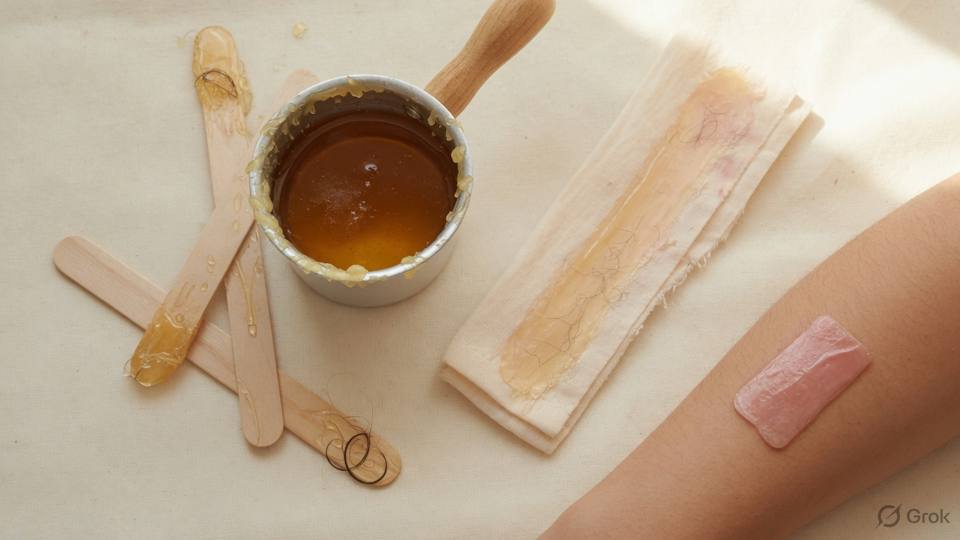
Hair length, growth direction, and preparation
Wax grips hair, not stubble. The working length is about half a centimetre, roughly the length of a grain of rice. Shorter hair is caught poorly, breaks at the surface, and leaves a patch that looks unfinished. Much longer hair is more painful to remove and can tangle in the strip. If the hair is longer than about a centimetre, trim it with clean scissors or a clipper before waxing. If it is shorter than half a centimetre, the honest advice is to wait a few days rather than wax twice in a week. Hair grows in cycles, so a first wax may not clear every hair even when the technique is correct.
Regrowth is usually visible in two to four weeks, and the timing differs by body area, hormones, and the client's own cycle. Do not promise a permanent result from waxing. Do not promise that hair will grow back thinner, although many clients find it softer over time. A client who has shaved for years may have blunt, dense regrowth, and the first wax can look uneven. Say that before you begin. A patch test on a small area is useful for a first-time client, especially one with sensitive skin or a history of reaction. Record the wax brand, the batch if the label gives one, and the result.
Preparation is simple and often skipped. Clean the area so that oil, sweat, and product do not sit between the wax and the hair. Dry it fully, then apply a light powder if the skin is damp, so that the wax grips hair rather than moisture. Check the consultation answers for a retinoid, a strong acid, isotretinoin, pregnancy, allergy, and a previous bad reaction. Look at the skin for a cut, a rash, a cold sore, sunburn, or a mole you should not cover. If any of those are present, do not wax that area. A clean, dry, intact area is the only area you should work on.
The client needs to know what to expect before the first strip. Tell them the hair length you are working with, the direction you will remove, and the fact that redness and tenderness for a few hours are normal. Ask them to hold the skin where you need tension, and explain that you will work in small sections. If they are on a retinoid or have had a reaction, say what you are declining before they undress or lie down. A short explanation at the start prevents an argument in the middle, when the skin is already half-waxed and the client is anxious.
- 1. Check the hair length; about half a centimetre is the working length.
- 2. Trim hair longer than about a centimetre with clean scissors or a clipper.
- 3. If the hair is shorter than half a centimetre, advise waiting a few days instead of waxing twice.
- 4. Clean the area and dry it fully before any product touches the skin.
- 5. Apply a light powder if the skin is damp, so the wax grips hair and not moisture.
- 6. Check the consultation answers for retinoid, acid, isotretinoin, pregnancy, and allergy.
- 7. Look for cuts, rash, cold sore, sunburn, or a changing mole, and do not wax over them.
- 8. Tell the client the expected redness, the regrowth window, and the limits of the result.
Salon example
Sana, twenty-four, books an underarm and half-leg wax three days before a holiday. She has been shaving and the hair is about three millimetres long, dense and blunt. The esthetician explains that this is shorter than the half centimetre needed for a clean lift and that waxing now would break much of the hair and leave a patchy result. Sana is disappointed, because she wanted to travel smooth. The esthetician offers to wax the underarms, where the hair is slightly longer, and to leave the legs for after the holiday. She cleans and dries the underarms, powders lightly, and works in two small strips on each side, checking the direction of growth first. The skin is calm afterwards. Sana is asked not to shave the legs for three weeks and to book the leg wax when the hair is longer. She returns with the right length, and the leg wax lifts cleanly in one pass per strip. The esthetician records the hair length and the date, so the next booking can be timed to the growth rather than to the holiday.
Caution: Waxing stubble is not a shortcut; it breaks hair at the surface and produces the patchy regrowth the client will blame on you.
Temperature, taut skin, and strip control
Temperature is the first safety check and the easiest one to skip when the salon is busy. Test the wax on the inner wrist before it touches the face or body. It should feel warm and comfortable, not hot. If it is too hot, take it off the skin if already applied, let the pot cool, and test again. Test every pot, including one that has been reheated, because a pot can hold heat unevenly. A wax that is too cool will not spread or grip, and a wax that is too hot can burn. The wrist is more sensitive than the back of the hand, which is why it is the better test.
The skin must be taut before the strip is pulled. Keep one hand flat on the skin beside the strip and stretch gently; do not pinch or pull the flesh. A loose fold of skin can bruise or tear. Work in small strips, because a small strip is controlled and a wide strip is a guess. Apply the wax in the direction of hair growth, press the strip down firmly, and remove it against the growth, close to the skin and parallel to it. Pulling upward instead of along the skin lifts the surface and hurts more. Press the skin immediately as you remove the strip to support it and reduce the sting.
Do one area at a time and assess before moving on. If the skin is lifting, bleeding, or showing a deep red line, stop. Do not re-wax the same patch in the same visit to catch a few stray hairs; tidy them with tweezers after the skin has settled, or leave them. Do not wax over a mole, a varicose vein, a recent scar, or skin that looks thin and shiny. Do not apply a strong numbing product unless the label allows it and the salon protocol covers it. The client's comfort matters, but a safe service comes before a perfect one.
Cleanup is part of the service. Remove residue with the product's remover rather than a harsh solvent, and use a light, soothing lotion that the label allows. Do not put a fragranced cream on freshly waxed skin. Look at the area once more before the client dresses, and tell them what normal redness looks like and when to call. Record the wax, the area, the temperature check, and any lifting. If the skin lifted, note it prominently, because the next visit must not repeat the same product or the same technique on skin that has already shown it will lift.
- 1. Test the wax on your inner wrist before it touches the client, every pot and every reheat.
- 2. If the wax is too hot, remove it from the skin, cool the pot, and test again.
- 3. Clean and dry the area, then powder lightly if the skin is damp.
- 4. Hold the skin taut with a flat hand beside the strip, without pinching.
- 5. Apply a small strip in the direction of hair growth and press it down firmly.
- 6. Remove against the growth, close to the skin and parallel to it.
- 7. Press the skin as you remove the strip to support it and reduce pain.
- 8. Do one area at a time and stop if the skin lifts, bleeds, or shows a deep red line.
- 9. Do not re-wax the same patch in one visit; tidy stray hairs later or leave them.
- 10. Remove residue with the proper remover, apply a soothing lotion, and record the result.
Salon example
The wax pot has been reheated for the third time on a busy Saturday. The esthetician tests it on her wrist and finds it hotter than the first time, so she turns the pot down and waits. A client, Nisha, has come for a full-arm wax before a wedding. The esthetician cleans and dries the arm, powders lightly, and starts with a small strip on the forearm, holding the skin taut below it. She applies with the growth, presses the strip, and removes against the growth, close to the skin. Nisha flinches but the skin is calm. On the upper arm, a strip lifts a small flap of skin near the elbow. The esthetician stops at once, does not re-wax the area, cleans off the residue, and applies a soothing lotion. She explains that the skin was thin there and that she will not continue on that patch. She finishes the lower arm only, records the lifting, and asks Nisha to call if the area blisters or spreads, and gives her a card with the salon number and the words to use at a clinic if needed.
Caution: Test the wax on your wrist every time, because a pot that was safe an hour ago can be hotter after a reheat.
The retinoid pause, isotretinoin, and aftercare
A leave-on retinoid or a strong acid makes the surface fragile for days after the last application. The usual pause before waxing is about five to seven days, but the product label and the prescriber's instruction come first. Ask which product it is and when it was last used. A wash-off cleanser with a mild acid is not the same as a leave-on cream, but if the client is unsure, treat it as leave-on and skip the wax on that area. Do not wax a client who has used a strong acid peel at home within the week. The risk is not a little redness; it is a strip of skin coming away with the wax.
Isotretinoin is stricter. While the course is running, do not wax at all, and do not perform an aggressive peel or a strong scrub. The skin is thin, heals slowly, and can tear with ordinary friction. After the course, a common guide is to wait about six months before waxing or a resurfacing service. The exact date is for the prescribing doctor to confirm, not for the salon to shorten because a wedding is near. Ask for the end date, record it, and ask the client to bring the doctor's advice if they want to book earlier. Offer a gentle cleanup or a brow tidy that does not pull the skin.
Aftercare starts before the client leaves. Tell them no sun on the area today, no sauna, no steam, no hot bath, and no swimming pool for the rest of the day. No retinoid or strong acid on the area that night, and no scrub or exfoliating mitt for forty-eight hours. No tight clothing over a freshly waxed bikini line or underarm, and no fragranced lotion or deodorant on the area for the first day. Keep the skin moisturised with a plain lotion. If there is redness, a cool compress helps; ice directly on the skin does not. These instructions belong on a card, not only in speech.
The forty-eight hour window is when most complaints appear. Normal redness and small bumps around the follicles can occur and usually settle. Spreading redness, swelling, warmth, pus, or a blister is not normal and needs a doctor. Tell the client to call the salon and to see a doctor if the area is painful, hot, or spreading. Record the aftercare advice you gave and the client's understanding. If the client had a reaction, note the product and do not use it again. A careful aftercare conversation turns a possible complaint into a returned client, and a written card makes the advice harder to forget or dispute.
- 1. Ask about a leave-on retinoid or strong acid and the date of the last application.
- 2. Do not wax the area within the usual five to seven day pause, or if the answer is unsure.
- 3. Ask about isotretinoin now or in the past year and record the end date.
- 4. Do not wax or perform an aggressive peel during an isotretinoin course.
- 5. After the course, wait for the doctor's clearance; a common guide is about six months.
- 6. Tell the client no sun, sauna, steam, hot bath, or pool on the area that day.
- 7. Tell the client no retinoid or strong acid that night and no scrub for forty-eight hours.
- 8. Give the aftercare card, record the advice, and ask them to call if redness spreads or blisters.
Salon example
Meghna, twenty-nine, wants a bikini-line wax before a beach holiday. She mentions a retinol cream she uses on her face, not on the body, and says it should not matter. The esthetician asks whether she has used it on the bikini line, and Meghna admits she used it there twice last week for ingrown hairs. The esthetician declines the wax and explains the five to seven day pause, the risk of lifting skin, and the fact that the holiday sun would make a raw patch worse. She offers a trim and a gentle cleanse instead, and asks Meghna to stop the retinol on that area and return after at least a week. Meghna is annoyed but accepts the trim. She returns ten days later, confirms the last application, and the wax is done in small strips with a wrist test first. The esthetician gives the aftercare card, including no pool that day, no retinoid that night, and no tight clothing for the rest of the evening. Meghna reads the card before she leaves and asks one question about the pool, which the esthetician answers in one sentence.
Caution: A client who used a retinoid on the body and not the face still has retinoid-treated skin; ask about the area you are about to wax.
This is a Nandu Nai textbook. It is a private brand book, not a government licence, and it does not give the right to give medical treatment.