
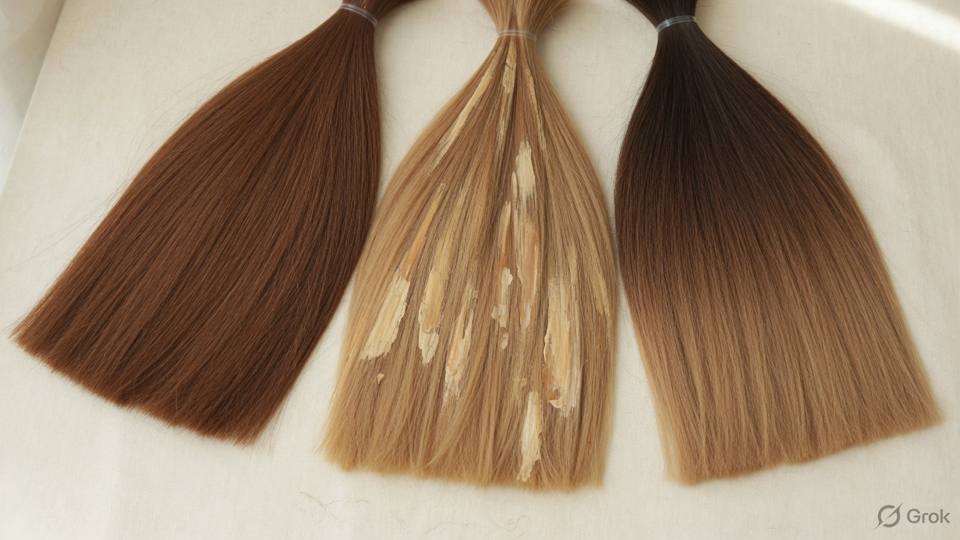
Global colour and gloss
Global colour is one shade from root to end, and it is the right service when the client wants a uniform result. It fits a first full grey coverage, a client who wants one clean level with no visible dimension, and a refresh when the whole head is already the same level. It does not fit a correction, a dimensional look, or hair with very different porosity at the root and the ends. Global does not mean simple. The application order still matters, the development time still matters, and the ends still need protection from over-deposit. A global colour done carelessly is a global colour with hot roots and dark ends.
Apply the roots first, then the mid-length, then the ends. On porous ends, apply the ends last and pull the colour through for the final ten to fifteen minutes, using fresh formula if the brand allows. Do not drag the original bowl through the ends at full strength, because the ends have already absorbed product and will grab darker. If the ends are significantly lighter than the root, treat them as a separate zone with a lower volume or a diluted formula. If they are significantly darker, the service is a correction, not a global, and the consultation should say so before the bowl is mixed.
Gloss is a translucent tone and shine with little or no lift. It fits dull ends, a tone refresh between visits, a post-lightener finish, and a small tonal shift. It does not fit grey coverage, a level change, or a client who wants the hair noticeably lighter. Gloss is often mixed with a low developer, sometimes ten volume, sometimes a brand-specific activator, and it develops in ten to twenty minutes. It sits on the surface and inside the outer cuticle, so it fades in about four to six washes. Say that before the client pays for it, because a gloss sold as a colour change is a complaint waiting to happen.
The pair works well in sequence. A global colour every four to six weeks keeps the base and the grey covered, and a gloss at the midpoint keeps the tone and the shine without adding lift. On a client with porous ends, the gloss grabs darker, so dilute it or shorten the time and apply it last. On a client with resistant grey, the gloss does not cover; do not use it as a substitute for a retouch. Record which service was done, at what level and tone, and when the next one is due. The card should make the difference between a global and a gloss obvious to anyone who reads it.
- 1. Use global colour for a uniform result, first full grey coverage, or a single-level refresh.
- 2. Apply roots first, then mid-length, then ends, and pull through for the last 10 to 15 minutes on porous ends.
- 3. Do not drag the full-strength bowl through porous ends, because they will grab darker than the root.
- 4. Treat a significantly darker end as a correction, not as part of a global service.
- 5. Use gloss for tone and shine with no lift, and expect it to fade in about 4 to 6 washes.
- 6. Never sell gloss as grey coverage or as a level change, because it does neither.
- 7. Schedule a gloss at the midpoint between global visits for cool, red, or faded tones.
- 8. Record the service type, level, tone, and next date so global and gloss are never confused.
Salon example
Tara has a level five base with about twenty-five percent grey, and she wants one clean chocolate brown with no visible highlights. Her ends are a level six and slightly porous from a summer of sun, and her root is a level five. A global colour is the right service: level five natural base with a level five chocolate, 20 volume at the root, and the same shade at 10 volume pulled through the ends for the last ten minutes. The grey covers at the temples with the full thirty-five minutes, and the ends do not go darker because the lower volume and the short pull-through protect them. I finish with the brand's after-colour wash and a light conditioner. She asks for highlights next time, and I explain that a global plus a gloss at six weeks will keep the shine without changing the plan. She books the retouch, and the card records the two volumes and the pull-through time. She also asks about the grey at the temples, and I show her that the coverage is solid in daylight, not only under the salon lamp, before she leaves.
Caution: Do not pull a full-strength global formula through porous ends for the whole development time. The ends will go darker than the root and the result will look like a band.
Balayage and foilyage
Balayage is freehand painting, usually off the scalp, for a soft grow-out. The colour is placed where light would naturally fall: the surface, the face frame, the ends. It fits a low-maintenance client, two to four levels of lift on natural hair, and a dark base going to caramel or honey. It does not fit a client who wants platinum in one visit, a uniform solid colour, or a very dark resistant head with no patience for two sessions. Balayage is a placement method, not a formula, and the result depends on saturation and on how finely the sections are woven. A rushed balayage is a set of horizontal stripes.
Saturation is the whole craft. Paint each section from the mid-length down, with enough product that the strand is visibly coated on both sides, and feather the top edge so the transition is soft. Do not paint in a straight line across the head, because that line becomes a visible band as it grows out. Vary the height, leave some strands out, and build the shape around the client's parting and face. On dark hair, open-air balayage lifts more slowly than foil, so book the time and check from twenty minutes. If the product dries on the surface, the lift stalls, and the client leaves with a warm, uneven result.
Foilyage is balayage placement inside foils, for more lift with a soft grow-out. It fits darker hair that needs more lift than open-air painting, and a client who wants brightness with a blended root. It does not fit a sore or broken scalp, very damaged ends, or a client who insists on zero warmth. Foil near the scalp holds heat, so the root area processes faster than the open air; check sooner than you would on a balayage. Keep the foils thin, saturate fully, and do not let the product dry at the fold. The foil is a tool for control, not a guarantee of a cool result.
Both services need a plan for the grow-out. Balayage grows out softly because there is no hard line, but the tone still fades, and a gloss at four to six weeks keeps the finish. Foilyage grows out with a slightly more defined edge, and a root smudge can soften it if the client wants a longer interval. Tell the client how many sessions the target needs and what the maintenance looks like before you start. A balayage sold as a one-off will be a balayage the client tries to fix at home with a box kit six weeks later. The service is a relationship with the hair, not a single afternoon.
- 1. Place balayage where light falls: surface, face frame, and ends, not in straight lines across the head.
- 2. Saturate each section on both sides and feather the top edge so the grow-out stays soft.
- 3. Expect 2 to 4 levels of lift on natural hair, and book two sessions for a platinum target.
- 4. Check open-air balayage from 20 minutes, because it lifts more slowly than foil and dries at the surface.
- 5. Use foilyage when the base needs more lift, and check sooner because foil near the scalp holds heat.
- 6. Keep foils thin and saturated, and never let the product dry at the fold.
- 7. Book a gloss at 4 to 6 weeks to maintain the tone, and a root smudge if the client wants a longer interval.
- 8. Quote the session count honestly, because a balayage sold as a one-off becomes a home correction.
Salon example
Ishita has a natural level four base, long wavy hair, and a photo of caramel balayage on a level seven base. She wants to keep her dark root and does not want to visit every month. The target is a soft level seven caramel through the mid-length and ends, with the root left natural. Her hair is dense, so I divide it into five horizontal sections and weave fine diagonal pieces, painting from the mid-length down and leaving the root clean. The first pass lifts to level six after twenty-five minutes with a strong orange cast, so I tone with a blue-violet at level six for five minutes and check the ends at three. The result is a warm caramel, not the cooler tone in the photo, and I say so. She books a gloss at five weeks and a second balayage in three months for the brighter pieces. If I had promised the photo in one visit, she would have needed a lightener correction on porous ends within a month. She also asks whether she can go lighter next time, and I explain that a second session in three months will lift the painted pieces one more level without touching the root.
Caution: Balayage is not a guarantee of a cool result. Dark hair lifts warm, and the toner must be planned for the level the balayage actually reaches.
Root smudge and matching the technique to the client
A root smudge is a soft shadow applied at the root after highlights or lightener, to blend the line and cool the brightness. It fits a highlight root that is too light, a low-maintenance grow-out, and a client who wants the root to read as a shadow rather than a stripe. It does not fit a client who wants a light root, and it is not a grey coverage formula. A smudge deposits tone; it does not cover resistant grey at the hairline, and selling it as coverage leads to a visible halo within two weeks. Use it as a finishing technique, not as a substitute for a retouch.
Apply the smudge after the lightener is rinsed, to damp hair, with a low volume, often ten volume, and a shade one to two levels deeper than the target. Work it into the root area with a brush or a comb, feathering downward no more than a few centimetres, and do not drag it through the mid-length. On porous hair, the smudge grabs fast, so check at five minutes and rinse at the first sign of the depth you want. If the client wants a very soft result, dilute the formula or shorten the time. A smudge that is left too long becomes a dark cap, and the correction is another lightening visit.
Match the technique to the client, not to the trend. A client with fine hair and a sensitive scalp is often better served by babylights than by a heavy balayage, because fine weaving gives brightness without bulk. A client with dense coarse hair may find babylights invisible and uneconomic, and a broader balayage will show the work. A client who wants zero visible root line needs a smudge or a soft balayage, not a full highlight. A client who wants solid coverage needs a global or a retouch, not a dimensional service. The consultation is where the technique is chosen, and the choice should be justified out loud.
Name the service in plain English with the target attached: global colour, level five cool brown; balayage, level seven caramel; root smudge, level four. Do not use a brand shade code as the service name, and do not use a technique name as a promise of a result. Write the technique, the placement, the formula, and the timing on the card, because the next visit depends on knowing where the product went as much as on knowing what was in it. A colourist who can repeat a placement can build a client's look over years. A colourist who cannot repeat it starts from zero every visit.
- 1. Apply a root smudge after the lightener is rinsed, to damp hair, at 10 volume and 1 to 2 levels deeper than the target.
- 2. Feather the smudge a few centimetres down from the root and never drag it through the mid-length.
- 3. Check the smudge at 5 minutes on porous hair, because it grabs faster than the root.
- 4. Never sell a root smudge as grey coverage, because it deposits tone but does not cover resistant grey.
- 5. Choose babylights for fine hair that needs subtle brightness, and balayage for dense hair that needs visible lift.
- 6. Choose a global or a retouch when the client wants solid coverage, not a dimensional technique.
- 7. Name the service in English with the level and tone, not with a brand shade code.
- 8. Record the placement, formula, and timing, because the next visit must repeat the shape as well as the colour.
Salon example
Rhea has a level five base with fine highlights that have grown out for four months, and she wants a soft root with no visible line. Her highlights are a level eight at the ends and a level seven near the root, and the contrast is harsh at the parting. A full highlight would add more brightness she does not want, and a global would erase the dimension. The right service is a root smudge: a level four ash at 10 volume, applied to damp hair after a gloss, feathered about three centimetres down and checked at five minutes. The result is a soft shadow that blends the highlight root and lets her go eight weeks between visits. I explain that the smudge will fade in about six washes and that a gloss at four weeks keeps the mid-length from dulling. She books the gloss, and the card records the placement depth, which is the detail that makes the next smudge repeatable. She also asks whether the smudge will cover the grey at her parting, and I explain again that it will not, and that a retouch is the service for that.
Caution: A root smudge is not grey coverage. If the client has resistant grey at the hairline, a smudge will leave a visible halo and the client will blame the technique.
This is a Nandu Nai textbook. It is a private brand book, not a government licence, and it does not give the right to give medical treatment.