
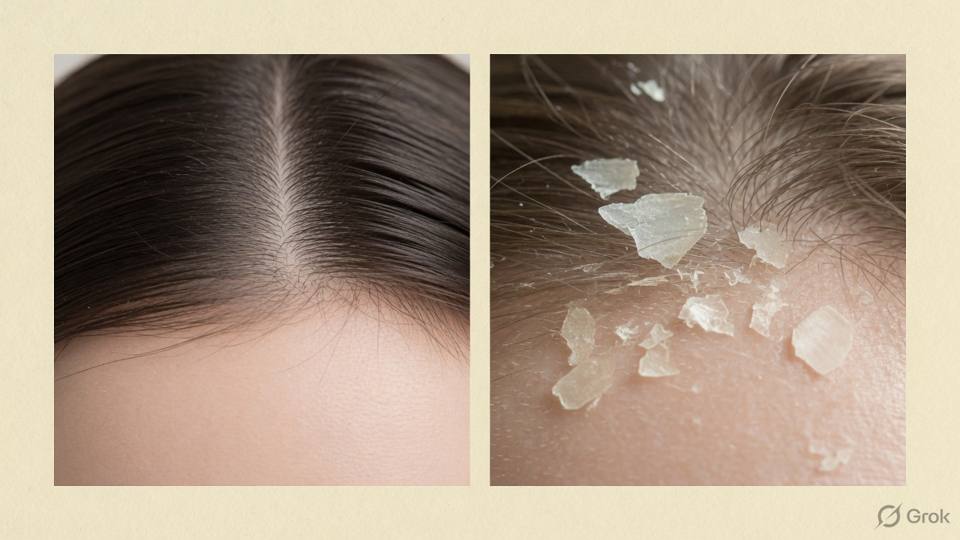
At the basin: a calm, close look
The basin is the only place where you see the scalp at working distance, in good light, with the hair parted section by section. Before the cape goes on, sit the client facing the mirror and part the hair into four: centre, left, right and nape. Use a fine comb and your fingers, not a brush, because a brush drags loose hair across the part and hides what you need to see. Look at the scalp colour, the density at each part, the hairline, the crown, the ears and the nape. This takes about sixty seconds and it changes what you are willing to do with the cut.
Note what is normal for this head before you note what is wrong. A pale scalp with visible fine vessels is normal, and so is a slightly red line where the hair has been tied tightly. What matters is change: a patch that is redder than the rest, a ring of scale around the hairline, a thinning spot at the crown, broken hairs along the front, or a hairline that has moved back since the last visit. Compare left with right and front with back. One-sided redness or one-sided thinning is a reason to slow down and ask questions, because it points to a habit, a tool or a condition rather than to the haircut.
What you see changes the cut in practical ways. If the hairline is inflamed, do not cut a tight fringe or pull the hair back for sectioning; leave softness at the edge and keep tension low. If the crown is thin, do not cut short layers there or the scalp will show under the salon light and in daylight. If the nape has broken hairs from a chain or a collar, leave length at the nape and avoid a clipper line that ends on the breakage. If the part is widening, keep the perimeter solid and move weight to the ends. The cut can hide a lot, but it cannot hide an angry scalp, and it should not try.
Do the close look with the client's consent and with clean hands. Say what you are doing: 'I am going to part your hair in four and look at the scalp before we wash.' If you find something, describe the appearance, not a diagnosis. Use words like redness, scale, a thin patch or broken hairs, and ask how long it has been there. Write the location and the appearance on the card with the date. If the client is embarrassed, keep your voice low, keep your hands gentle and move on to the service only when the scalp allows it. A calm basin check is a professional habit, not an inspection.
- Ask permission, then part the dry hair into four sections with a fine comb.
- Look at the scalp colour at each part and compare left with right.
- Check the front hairline, the temples, the crown, behind the ears and the nape.
- Note broken hairs, a widening part, a thin patch, scale, redness or tenderness.
- Ask how long the change has been there and whether it itches, hurts or bleeds.
- Describe what you see in plain words and avoid naming a condition.
- Write the location, appearance and date on the client card.
- Adjust tension, fringe length and crown layers before you wet the hair.
Salon example: Anita's widened part
Anita, a school principal in her fifties, comes for her usual shoulder-length cut and a root touch-up. She has been tying her hair into a tight bun for years because of the school dress code. At the basin I part the hair in four and see that the centre part is almost two centimetres wide, with fine broken hairs along the front hairline and mild redness at the temples. The rest of the scalp looks calm and the density at the nape is normal. I show her the part in the mirror and ask how long it has been widening. She says about a year, and that the bun feels tighter lately. I do not colour that day. I cut a soft face frame that covers the temples, keep the perimeter solid at the ends, and show her a loose low tie with a covered band. I write the measurements on the card and suggest a dermatologist if the widening continues. She returns in eight weeks with less breakage and a part that has not widened further. She also moves her parting a centimetre to the left, away from the thin line.
Caution: If you see a sudden thin patch, a part that has widened quickly, or a scalp that is red and tender, do not design a cut to cover it and do not colour. Refer to a dermatologist and record the date.
Flaking, itching and tenderness
Flaking is common and most of it is ordinary. Small white flakes that appear in winter, worsen with a missed wash and improve after shampooing usually point to a dry or mildly irritated scalp. Flakes that are thick, yellow, greasy and stuck to the scalp, or patches of silvery scale with redness, are a different picture. So is itching that comes with redness, a burning feeling, weeping spots, or hair coming out in clumps. You are not there to name the condition. You are there to notice the pattern, ask three questions and decide whether the service can go ahead. The pattern, not the word, is your guide.
Three questions do most of the work. First: how long has it been like this, and is it getting worse? Second: does it itch, hurt, bleed or weep? Third: has the client used anything new, including a medicated shampoo, a home remedy, a colour or an oil? A flake that has been stable for years and improves with washing is one situation. A scalp that has become red, warm and tender over a week is another. If the client has been scratching, look for broken skin and small scabs, because shampoo and colour will sting and the cut will be uncomfortable. Do not pick at a flake to see what is underneath.
The service changes as soon as the scalp is tender. No hot towel, no scalp massage, no scrub, no strong shampoo and no chemical service. Keep water lukewarm, apply shampoo with fingertips only and rinse quickly. Do not pull the hair tight for sectioning, and do not cut a fringe that sits on an inflamed forehead. If the tenderness is at the hairline, leave soft hair around it and avoid a clipper line that ends on the redness. If the scalp is weeping or has open spots, stop. A haircut can wait a week; an infection does not. The client may push for the appointment because of an event, and your answer is still the same.
Say what you see without alarm. 'There is redness and some scale near your hairline, and it looks sore. I can cut the length today, but I will not shampoo or scrub the scalp, and I would like you to show this to a dermatologist.' Then offer a clear next step: a dry cut, a rebook date, and a note on the card. Do not recommend a medicated product by name, do not promise a cure, and do not suggest a home acid mix. If the client refuses to see a doctor, you may still cut the hair, but only if there is no weeping, no open skin and no sign of something spreading. Record what you advised.
- Look at the flakes under good light and note the colour, thickness and where they sit.
- Ask how long it has been present and whether it is improving or spreading.
- Ask about itch, pain, bleeding and weeping, not only about appearance.
- Check for broken skin or scabs from scratching at the hairline and behind the ears.
- Stop the service if the scalp is weeping, open or too tender to touch.
- Skip hot towels, scrub, strong shampoo, massage and colour on a tender scalp.
- Refer to a dermatologist in plain words and write the advice on the card.
- Clean the basin, tools, towels and cape before the next client.
Salon example: Imran's sore hairline
Imran, a delivery supervisor, comes in on a Saturday for a short fade before his cousin's wedding. He mentions that his scalp has been itchy for two weeks and that he scratched it in his sleep. Under the light I see a band of redness along the front hairline, greasy yellow flakes near the temples, and two small scabs where he has scratched. The scalp is warm and tender when I part it. I stop before the cape and explain what I see. He asks me to cut anyway because the wedding is on Sunday. I offer a dry scissor cut of two centimetres off the length, with no clipper line at the hairline and no shampoo. He accepts. I keep the front soft, avoid the scabs and finish with a cool dry. I write the referral on the card and ask him to see a dermatologist before the next cut. He returns three weeks later with a calmer scalp and takes the fade then. The wedding photos show no clipper line and no redness, and he keeps the referral slip in his wallet. He says the itching stopped in the first week of treatment.
Caution: If the flakes are thick and yellow, or the scalp is red, warm, weeping or tender, do not scrub, do not apply a strong shampoo and do not cut with a clipper at the hairline. Refer and record.
Referral, record and hygiene
A referral is a service, not a rejection. Learn four sentences and use them in the same order: what you see, what you will not do today, who can help, and when you will be ready to continue. 'I see a red, scaly patch at your crown. I am not going to colour or scrub today because the skin is inflamed. A dermatologist can tell you what it is. Come back when they say it is fine, and I will finish the shape.' Say it once, slowly, and give the client time to ask. Do not add a diagnosis, a product name or a warning about hair loss. The goal is a calm client who knows exactly what happens next.
The record protects the client and the salon. Write the date, the location, the appearance, what you advised and what service you did or declined. Use neutral words: redness, scale, thin patch, broken hairs, tenderness. Note the products used and any reaction, the length removed and the plan. If the client declines the referral, write that too, in their words if possible. A card that says 'client declined referral' is honest; a card that says 'scalp bad' is not. Keep the card where the client's other records are kept, and read it before the next service. The next stylist should not have to guess.
Hygiene starts with hands and continues through every surface the head has touched. Wash hands before and after the basin check and before and after the cut. Use a fresh towel for each client, a clean cape, and a basin that has been rinsed and disinfected. Combs, clips and shears go into the disinfectant after every client, not at the end of the day. Clipper blades are cleaned and oiled, and guards are washed. If you see flaking, do not share a brush, and do not put the salon brush back into the drawer. If you suspect lice or a fungal infection, seal the towel and cape separately and follow the salon's cleaning rule before the next client.
Know when to stop completely. Active scalp infection, ringworm, impetigo, lice, weeping patches or a scalp that is too sore to touch are all reasons to refuse the service and refer. Name what you see plainly, give the referral in writing if the client is reading it, and offer a date after clearance. Clean the station and the tools before you seat anyone else. Do not cut around a suspicious patch to save the appointment, and do not let a colleague use the same clipper. A refused appointment costs one slot. A spread infection costs the salon its reputation and a client her hair. The rule is simple: when in doubt, do not cut.
- Use four sentences: what you see, what you will not do, who can help, when to return.
- Give the referral without naming a condition or a medicated product.
- Write the date, location, appearance, advice and the service you declined.
- Record any product reaction and the products used in the service.
- Wash hands before and after the basin check and the cut.
- Use a fresh towel and cape, and disinfect the basin after every client.
- Put combs, clips and shears in disinfectant after each client, not at closing.
- Seal and wash towels and capes separately if lice or a fungal infection is suspected.
Salon example: the walk-in with a patch
A walk-in client, Mr Rao, asks for a head shave on a Sunday afternoon. He has a round, scaly patch at the back of his head that he has been covering with longer hair. The patch has a raised edge, the skin inside looks pink and a few hairs are broken at the surface. I do not touch it with a comb. I tell him what I see, that I will not shave over it, and that a doctor should look at it before anyone puts a blade on that skin. He is embarrassed and a little angry because he has a family function. I offer a dry trim of the length around the patch with scissors, keeping two centimetres away from the edge, and no clipper. He accepts. I write the referral and the service on his card. Two weeks later he calls to say the doctor has treated it and asks when he can come back. I book him after the course is finished, and I use fresh towels and a disinfected clipper. I keep a note that the clipper was disinfected and the linen bagged, in case the doctor asks.
Caution: If you suspect ringworm, impetigo, lice or an active infection, refuse the service, refer, and disinfect every surface and tool the client touched before the next person sits down.
This is a Nandu Nai textbook. It is a private brand book, not a government licence, and it does not give the right to give medical treatment.