
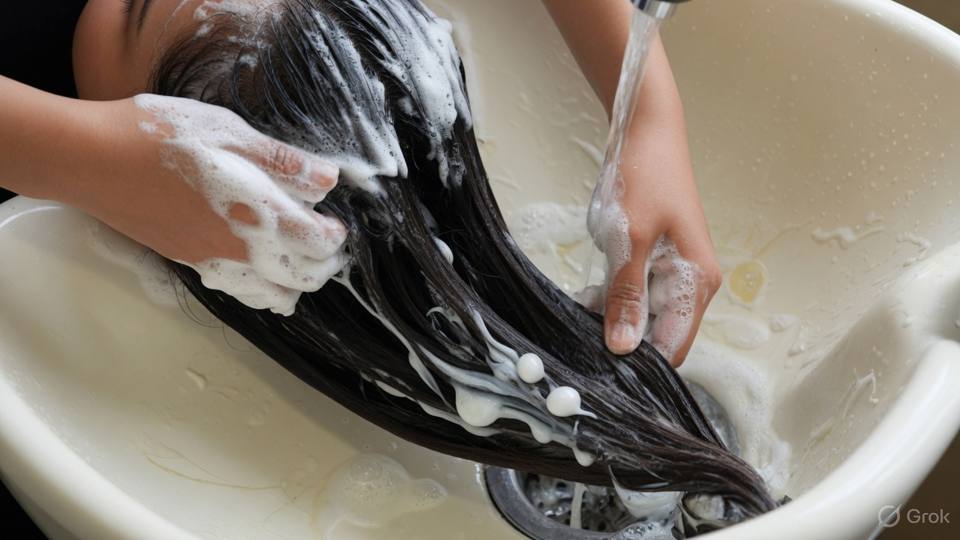
Shampoo choice by scalp
Shampoo is for the scalp; conditioner is for the lengths. That one sentence prevents most of the confusion at the basin. The scalp produces oil, collects dust, holds sweat and carries the residue of styling products, so it is the part that needs cleansing. The ends are older hair with a worn cuticle and no oil supply of their own, so they need conditioning and gentle handling. Choose the shampoo by what the scalp is doing, not by the label on the front of the bottle. A dry scalp and an oily scalp need different products even when both clients have the same hair length and the same haircut.
Read the scalp at the basin before you choose. Oily scalp: the roots look dark and separated, the client washes daily, and the hair smells of oil by evening. Dry scalp: fine white flakes, tightness after washing, and roots that feel rough rather than slick. Product-heavy scalp: a waxy film at the roots, often from oil, gel or dry shampoo used for several days. Sensitive scalp: redness or tenderness, which means no fragrance-heavy product, no scrub and no hot water. Normal scalp: no film, no flakes, comfortable between washes. Match the product to that picture and use the mildest option that cleans the scalp without stripping it.
The choice changes the cut more than it seems. A clean scalp lets you see density, the parting, breakage and the hairline, so the consultation is accurate. Residue makes hair look thicker than it is and hides split ends until the first cut section opens. Over-cleansing makes the ends rough, so the shears drag and the line looks dry; the blow-dry then needs more heat and the finish looks dull. A scalp that has not been washed for a week needs a clarifying wash before a blow-dry, or the brush will slide on oil and the set will collapse. If the scalp is sensitive, the whole service gets gentler: lukewarm water, no massage, no strong product.
Run the basin in a fixed order. Ask when the client last washed and whether oil was applied. Look at the roots under the light. Choose the shampoo and say the reason out loud. Wet the hair for twenty to thirty seconds, then apply shampoo to the scalp only, work it with fingertips for about sixty seconds, and rinse for thirty seconds longer than feels necessary. Shampoo a second time only if the roots still feel coated. Blot the hair, apply conditioner from mid-lengths to ends, comb it through with a wide-tooth comb and rinse cool. Write the shampoo and conditioner used on the card, with any reaction, so the next visit starts from knowledge rather than from scratch.
- Ask when the client last washed the hair and whether oil was left overnight.
- Look at the roots under the basin light for film, flakes, redness or oil.
- Choose the shampoo by scalp condition: oily, dry, product-heavy, sensitive or normal.
- Wet the hair for 20 to 30 seconds before applying any shampoo.
- Apply shampoo to the scalp only and work it with fingertips for about 60 seconds.
- Rinse for 30 seconds longer than you think is needed, until the water runs clear.
- Shampoo a second time only when the roots still feel coated after the first rinse.
- Record the shampoo, conditioner and any reaction on the client card.
Salon example: Nisha's oily roots and dry ends
Nisha, a wedding photographer, washes her hair every day because her scalp feels oily by evening, and she oils the ends twice a week. She wants a blunt collarbone cut and a smooth finish for a shoot on Friday. At the basin the roots are dark and separated, the mid-lengths are rough, and there is a faint oil smell. The scalp itself is calm, with no redness or flakes. I choose a shampoo for oily scalp, use it on the scalp only, and rinse for an extra thirty seconds. The first wash lifts the oil; the second is not needed. I apply a light conditioner from the ears down, comb it through, and rinse cool. The cut takes fifty minutes because the hair is dense. The blow-dry holds because the roots are clean and the ends are not overloaded. She repeats the wash routine at home, and I write 'oily scalp, light conditioner, no oil on the scalp' on her card. Two weeks later she sends a picture from the shoot: the cut still has a clean line and the roots are not shiny. She has stopped oiling the scalp and uses the light conditioner only from the ears down.
Caution: If the scalp is tender, broken, weeping or covered in thick yellow scale, do not shampoo it, do not scrub it and do not apply a medicated product you were not trained to use. Stop at the basin and refer.
Water temperature, conditioner and hard water
Water temperature is a tool. The comfortable temperature for a scalp is about 37 to 38 C, close to body heat, warm enough to soften oil and open the cuticle slightly without stripping the skin. Hot water feels good in winter and does damage quietly: it removes oil faster than the scalp can replace it, lifts the cuticle, increases frizz and fades colour. Cold water does not clean oil well, but a ten-second cool rinse at the end helps the cuticle lie flat and makes the hair easier to comb. Test the water on the inside of your wrist, not with your hand under the running tap, because the hand adapts faster than the scalp.
Conditioner belongs on the mid-lengths and ends, not on the scalp, unless the product label says otherwise. After shampooing, squeeze the excess water out, apply a small amount from the ears down, and leave it for two to three minutes. Comb it through with a wide-tooth comb while it is still on, so the distribution is even and the tangles release without pulling. Rinse with cooler water until the water no longer feels slippery. Conditioner reduces the friction that breaks wet hair, which makes the cut cleaner and the blow-dry faster. Too much conditioner on low porosity hair leaves a film, makes the roots limp and makes the hair slow to dry, which changes the tension you can build with the brush.
Hard water is common in many Indian cities and it changes how the hair feels. Calcium and magnesium in the water leave a mineral film on the cuticle, so shampoo does not lather well, the hair feels rough or stiff after rinsing, and colour can shift. At the basin, notice whether the shampoo forms a poor lather, whether the hair still feels coated after rinsing, and whether the basin or the tap has white scale. You can confirm the feel with the client: 'Does your hair feel rough even after you wash it at home?' Do not test the water with a laboratory kit in the salon; the feel on the hair is enough for a service decision.
The service response is simple. Use a clarifying shampoo once at the start, not every visit, to remove the mineral and product film. Keep the water lukewarm, because hot water makes the film feel worse. Condition the lengths, then rinse cool. For the blow-dry, use a leave-in or a light serum on the ends and keep the nozzle pointed down the shaft so the cuticle closes. At home, suggest a clarifying wash every two weeks if the water is hard, and a filter on the shower head if the client wants one. Do not recommend a home acid rinse or a strong daily clarifier; both can irritate the scalp. If the hair still feels rough and the scalp itches, refer rather than sell another product.
- Test the water on your inner wrist and keep it at about 37 to 38 C.
- Wet the hair thoroughly for 20 to 30 seconds before shampooing.
- Shampoo the scalp, rinse for 30 seconds, and check the root feel before a second wash.
- Squeeze excess water out before applying conditioner from the ears down.
- Leave the conditioner for 2 to 3 minutes and comb it through with a wide-tooth comb.
- Rinse cool for about 10 seconds at the end to help the cuticle lie flat.
- Use a clarifying shampoo once when the water is hard or the hair is heavily coated.
- Blot with a towel instead of rubbing, and detangle before the first cut.
Salon example: Rohit's new flat and stiff hair
Rohit has moved into a new flat and complains that his hair feels stiff and dull after every wash, even though he uses the same shampoo as before. He wants a short back and sides and a slightly longer top. At the basin the shampoo lathers poorly, the water leaves a faint white ring on the steel, and his hair feels rough after rinsing. The scalp is calm, with no flakes or redness. I use a clarifying shampoo once, rinse for longer than usual, and condition the top only. The difference is immediate: the hair feels softer and the comb passes through without dragging. The men's cut takes thirty-five minutes, and I use scissor-over-comb at the sides rather than a razor, because the ends are still dry. I explain that the water is hard and suggest a clarifying wash every two weeks. He books four weeks ahead and says he will ask his building about a filter. He buys a shower filter the next month and says the difference is small but real. I note the clarifying wash interval on his card so the next stylist does not repeat it too soon.
Caution: Do not recommend a daily strong clarifier or a home acid rinse for hard water. If the hair feels rough after every wash and the scalp also itches, refer to a dermatologist instead of selling another product.
When flaking means refer, not scrub
Ordinary flaking is small, dry and white. It sits loosely on the scalp, appears more in winter, gets worse when washing is skipped and improves after a normal shampoo. It does not come with redness, pain, weeping or hair loss. The other picture is different: thick yellow or greasy flakes stuck to the scalp, silvery scale on red patches, a rash that spreads beyond the hairline, tenderness, burning, bleeding from scratching, or hair coming out in small round patches. You do not need to know the name of the condition to see that the second picture is not a shampoo problem. The difference is in the colour, the thickness, the spread and the symptoms.
A tender scalp changes every step of the service. No scrub, no scalp massage, no hot towel, no steamer and no strong shampoo. Water stays lukewarm and the fingers stay flat. Do not pull the hair tight for sectioning, because tension on inflamed skin hurts and can break the hair at the root. Do not cut a fringe that rests on a red forehead, and do not run a clipper line through a patch of scale. Skip colour, bleach and relaxing on the same day. If the client is booked for a chemical service, move it after the scalp has been seen by a doctor. The haircut itself may still be possible, but only with low tension and clean tools.
Stop the service when the scalp is weeping, has open sores, feels hot, or the flakes are thick and spreading. Say what you see and what you will not do. 'There is a red, scaly area at your crown and it looks sore. I am not going to scrub or colour today. Please show it to a dermatologist, and come back when they say it is settled.' Offer a dry trim if the client needs to look tidy for work, keeping the shears away from the affected area. Do not pick at the scale, do not apply a medicated cream and do not cover the patch with a tight style. Write the advice and the date on the card.
The way you speak matters as much as the decision. Clients with scalp problems are often embarrassed and have been told to just wash more. Keep your voice low, describe the skin rather than the person, and avoid words that sound like a verdict. Do not promise that a shampoo will fix it and do not suggest a home remedy with lemon, vinegar or toothpaste. Give one clear next step: see a dermatologist, then rebook. After the client leaves, clean the basin, change the towel and cape, disinfect the comb and clips, and wash your hands. If you suspect lice or a fungal infection, bag the linen and follow the salon's cleaning rule before the next client.
- Look at the flakes under good light and note colour, thickness and whether they sit on red skin.
- Ask how long it has been there and whether it is spreading.
- Ask about itch, pain, burning, bleeding and hair loss, not only about appearance.
- Stop if the scalp is weeping, hot, open or too tender to touch.
- Skip scrub, massage, hot towel, steamer, strong shampoo and colour on a tender scalp.
- Refer to a dermatologist in one clear sentence and avoid naming a condition.
- Offer a dry trim away from the affected area only if the client needs it.
- Disinfect tools, basin and linen, and wash your hands before the next client.
Salon example: Priya's wedding-week flaking
Priya books a wash, blow-dry and trim four days before her sister's wedding. She has been using a medicated shampoo from the pharmacy for a week because the flakes have become worse. At the basin I see thick yellow flakes at the crown, a red patch that extends past the hairline, and a small raw spot where she has scratched. The scalp is warm to the touch and she flinches when I part the hair. I stop before the wash. She is close to tears because of the wedding photos. I explain that I can cut two centimetres off the length dry, with low tension, and blow-dry only the mid-lengths and ends on cool, but I will not wash, scrub or colour the scalp. She accepts. The style looks neat and the scalp is not touched. I write the referral on her card and ask her to see a doctor before the next appointment. She messages two weeks later to say the dermatologist has given her a course and the scalp is calmer. She sends a photo from the wedding with her hair pinned away from the crown, and the scalp is not visible in any of them.
Caution: If the flakes are thick, yellow or greasy, or the scalp is red, warm, weeping or tender, do not scrub, do not shampoo with a strong product and do not cut. Refer to a dermatologist and note the date.
This is a Nandu Nai textbook. It is a private brand book, not a government licence, and it does not give the right to give medical treatment.