
Skin clipper cut

A skin clipper cut takes the hair down to the scalp with a 0 guard, so the head reads as clean skin with a faint shadow rather than as short hair. It suits a man with a strong, even head shape, a firm hairline and a settled routine, and it is the usual choice for swimmers, wrestlers, men in hot kitchens and anyone who wants nothing to manage in the morning. It also suits a man whose crown is thinning but whose front hairline is still clear, because the eye stops noticing the thin patch once the whole head is one length. A very round face or a heavy neck gains little from it, so offer a longer guard at the sides for balance. The service runs 20 to 30 minutes.
Work with the clipper flat against the scalp and let the blade do the cutting; pressure on a bump or a mole will nick the skin and bleed. Start at the nape against the growth, then go with the growth on the sides and the crown, and finish with light passes across the part line and the crown whorl. A 0 guard on fine hair reads as bare skin within a day, while the same guard on coarse, dense hair keeps a visible shadow for a week or more, so tell him which one to expect before you start. Sideburns end at the middle of the ear unless he asks otherwise. Finish with a cool towel and a light moisturiser. Book him again in 3 to 4 weeks.
- 1. Consult with the hair dry, ask how much shadow he wants, and hold a 0 guard against the skin so he sees the finish before the cape goes on.
- 2. Check the whole scalp under a bright lamp for sores, cuts, flakes, lice and ring-shaped patches, and stop the service if anything is open or spreading.
- 3. Open a guideline at the centre nape with the clipper against the growth, in short passes, and clip the line so the rest of the head follows it.
- 4. Cut the sides and back with the 0 guard, keeping the blade flat on the skin, then go over the crown and the part line last, against the growth.
- 5. Check both sides in the mirror with the head level, then with the head tilted, and even out any patch that shows a different shade.
- 6. Cut the neckline along the natural hairline with the corner of the blade, and take the sideburns to the middle of the ear unless he asks for higher.
- 7. Dry the head with a towel, look for missed tufts and pale patches in daylight, and finish them with the clipper, never with a razor.
- 8. Rebook in 3 to 4 weeks, because a 0 guard shows regrowth first at the sides and the neckline.
Salon example: Arjun's cut around a mole
Arjun, 34, swims 5 mornings a week and wanted the closest cut he could get without a razor. He sat down with a small raised mole behind his right ear and a healing scrape on the crown. I checked both under the lamp, decided the scrape was closed and dry, and agreed to work around it. I opened the nape with the 0 guard against the growth, kept the blade flat, and used the corner of the blade near the mole with no pressure at all. The whole head took 25 minutes. I finished with a cool towel, showed him the mole in the hand mirror, and told him to keep the area dry for 2 days. He rebooked for 4 weeks.
Caution: Do not cut over sores, lice, ring patches, pus or sudden patchy loss; stop the service, set the tools aside and refer him to a dermatologist.
Buzz cut, 0.5 guard
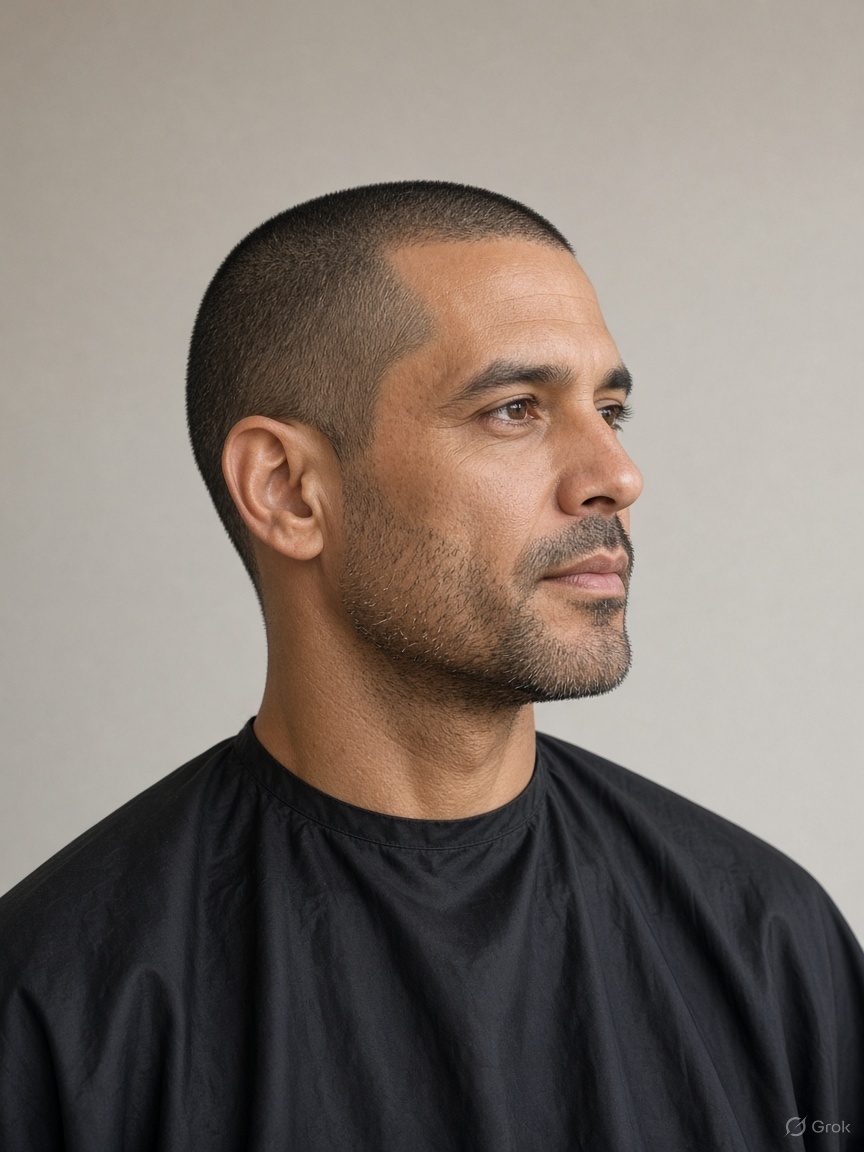
A 0.5 guard buzz cut leaves about 1.5 mm of hair, which is close enough to read as a dark shadow on the scalp but long enough to soften the shape of the head. It suits a man with a good hairline and a square or oval face, men who train daily, men who wear a helmet for work, and men who want a cut that survives 3 weeks without a comb. It is also the kindest first step for a man who is nervous about going very short, because the change from his usual length is visible without being shocking. On a long, narrow face leave a little more at the front. Allow 20 to 30 minutes.
Cut the whole head with the 0.5 guard, going against the growth at the nape and the sides and with the growth across the crown, so the length stays even where the hair changes direction. Keep the blade flat and use short, overlapping strokes rather than long sweeps, because a long stroke digs in at the curve above the ear. At 1.5 mm the same guard looks shorter on fine hair than on coarse, dense hair, where the shadow stays strong for days; show him the difference on his forearm if he doubts it. Sideburns end at the middle of the ear unless he asks for shorter. Wipe the neck with a warm towel, then check the outline. Rebook in 3 to 4 weeks.
- 1. Consult with the hair dry, agree the length in millimetres, and show him a 0.5 guard so he knows the cut will leave a shadow, not bare skin.
- 2. Check the scalp and the nape for sores, flakes and patches, and look at the hairline and crown whorl before the clipper starts.
- 3. Cut a guideline at the centre nape against the growth with the 0.5 guard, and keep it level across the back.
- 4. Work up the back and sides against the growth in short overlapping passes, then take the top with the growth so the length stays even.
- 5. Compare both sides in the mirror with the head straight, then tilted, and correct any step above the ear.
- 6. Clean the neckline along the natural hairline with the corner of the blade, and take the sideburns to the middle of the ear unless he asks otherwise.
- 7. Dry the head, check the crown and the part line in daylight, and trim any missed tuft with the same guard.
- 8. Rebook in 3 to 4 weeks, since 1.5 mm shows regrowth at the sides within 10 days.
Salon example: Rohit's first near-skin cut
Rohit, 27, trains twice a day and hated how his hair felt under a cap. He had never gone shorter than a 2 guard and was worried about his hairline, which had receded at both temples. I held the 0.5 guard against his forearm first so he could see how little hair would be left, then against his temple. He agreed. I opened the nape against the growth, kept the blade flat, and worked up in short passes, then went over the top with the growth. The receded temples looked deliberate at 1.5 mm rather than thin, and he said the head felt cooler. The cut took 25 minutes and he booked four weeks.
Caution: Do not promise a 0.5 guard will hide a receding hairline, because at 1.5 mm the outline of the hairline is fully visible.
Buzz cut, 1 guard
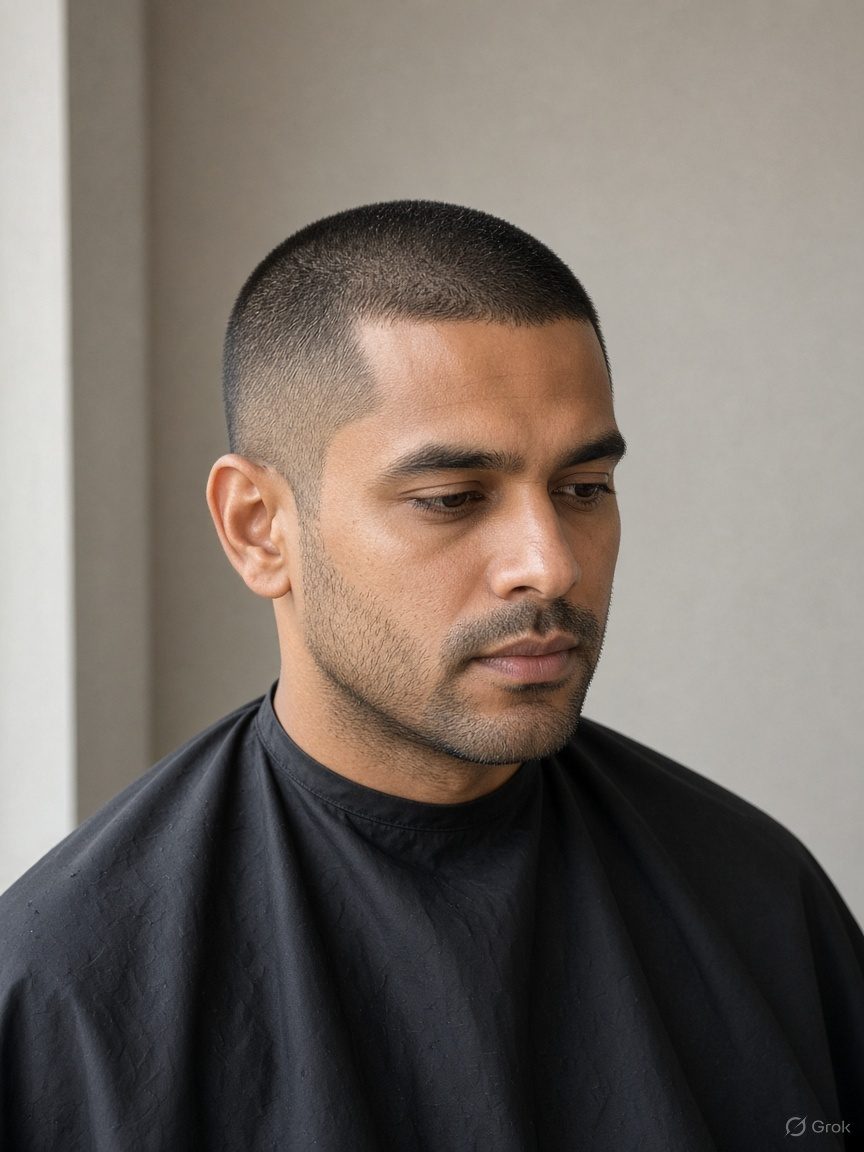
A 1 guard buzz cut leaves about 3 mm, which is the shortest length that still looks like hair rather than a shadow, and it is the cut most men mean when they ask for a buzz. It suits a man with a round or square face, dense hair and a hairline he is happy to show, and it works well for men in sales, security, kitchens and sport who cannot spend time in front of a mirror. On a receding hairline the 3 mm line makes the recession very clear, so raise that before the clipper starts and offer a longer guard at the front if he wants it softened. The service takes 20 to 30 minutes.
Run the 1 guard over the whole head, starting at the nape against the growth, then the sides upward, then the crown and the front in the direction the hair lies. Keep the clipper flat and overlap each pass by half, and lift the blade slightly at the temple curve so it does not catch. At 3 mm fine hair shows scalp through the cut within 2 days, while coarse hair at the same guard still looks solid, so a man with fine hair should expect the shorter result. Sideburns end at the middle of the ear unless he asks for a shorter finish. Brush off the neck, check the outline, and rebook in 3 to 4 weeks.
- 1. Consult with the hair dry, agree 3 mm, and ask whether he wants the front left a shade longer for the hairline.
- 2. Check the scalp and the hairline under the lamp, and note any mole or scar the blade must avoid.
- 3. Cut the guideline at the centre nape with the 1 guard against the growth, and keep it straight across the back.
- 4. Run the 1 guard up the sides and back against the growth, then across the top with the growth in overlapping passes.
- 5. Check both sides in the mirror at eye level and from behind with a hand mirror, and even out the shade above each ear.
- 6. Cut the neckline to the natural hairline, and end the sideburns at the middle of the ear unless he asks for shorter.
- 7. Dry the head, check the crown whorl from 4 directions, and trim any missed patch with the same guard.
- 8. Rebook in 3 to 4 weeks, because at 3 mm the sides lose their shape first.
Salon example: Sameer's cut for a new job
Sameer, 41, had just joined a company that expected a tidy head of hair, and he wanted something he could wash and leave. His hair was dense and straight, with a hairline that had moved back about 2 cm at the temples. I showed him a 1 guard and explained that 3 mm would make the recession plain, then offered a 2 guard at the very front. He chose the even 1 guard instead and said he preferred people to see it. I cut the nape against the growth, worked up the sides, and took the top with the growth. The cut took 22 minutes. He bought no product and rebooked for 3 weeks.
Caution: Do not use a 1 guard on a scalp with an active rash or open spots, because the blade will spread irritation across the whole head.
Buzz cut, 1.5 guard
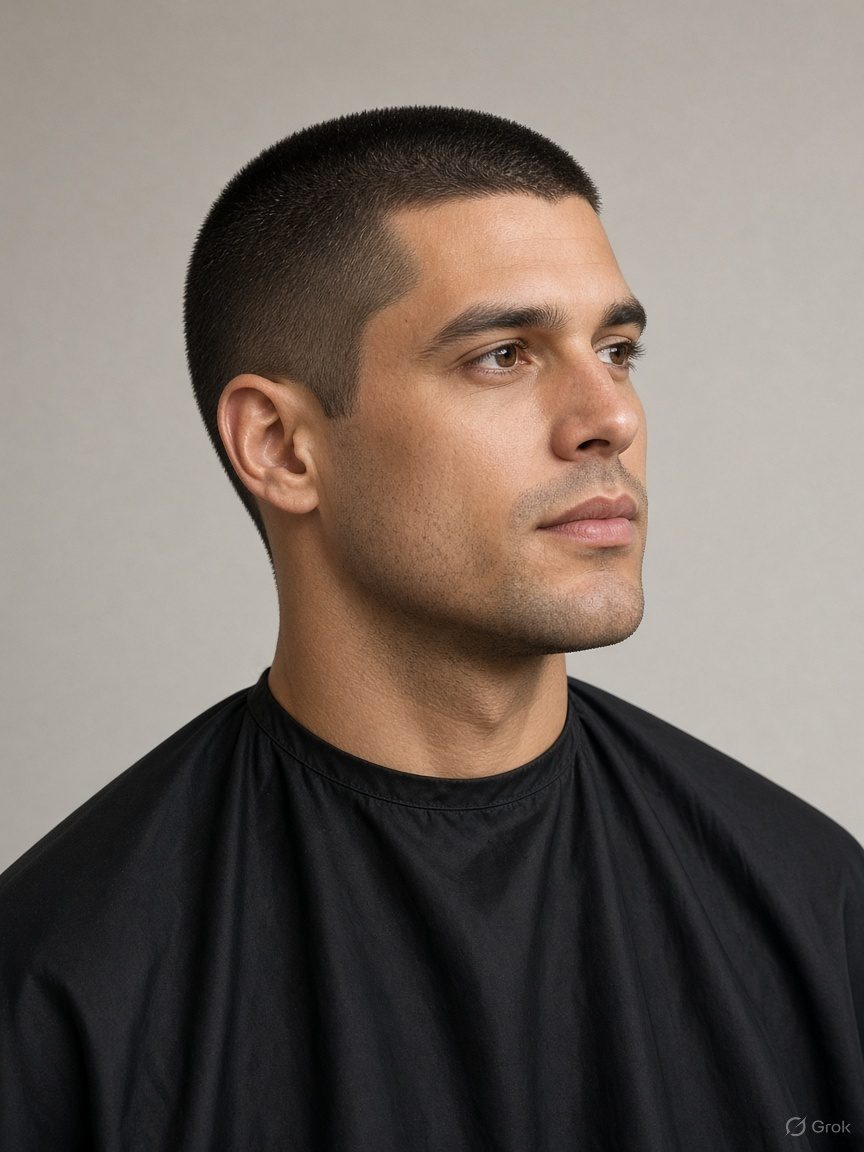
A 1.5 guard buzz cut leaves about 5 mm, which is the length most men settle on when 3 mm feels too bare and 6 mm starts to need styling. It suits a man with medium to thick hair, a head shape he does not mind showing, and a job where a neat, even head of hair is enough. It softens a receding hairline better than a 1 guard, because the 5 mm line carries a little more weight at the front. It also suits men who swim or train daily and want the hair to dry in minutes, and men who work under a helmet all day. Allow 20 to 30 minutes and check the crown twice, because a cowlick shows at this length.
Cut with the 1.5 guard against the growth at the back and sides, then finish the top in the direction of the growth so the hair does not stand up in steps. Go over the crown whorl from 4 directions, since hair there grows in a circle and a single pass always leaves a ridge. At 5 mm the same guard reads shorter on fine hair and looks like a full 6 mm on coarse hair, so judge the result on his hair, not on the number on the guard. Sideburns end at the middle of the ear unless he asks otherwise. Wipe the neck, check both sides in the mirror, and rebook in 3 to 4 weeks.
- 1. Consult with the hair dry, agree 5 mm, and ask whether he wants the same length at the front or a little more.
- 2. Check the scalp, the crown and the hairline, and look for a cowlick or a scar that will change the finish.
- 3. Cut the guideline at the centre nape with the 1.5 guard against the growth, and keep it level across the back.
- 4. Take the sides and back up against the growth, then finish the top in the direction of the growth so no steps show.
- 5. Check both sides in the mirror and look for a ridge at the crown by turning his head slowly in the light.
- 6. Clean the neckline along the natural hairline, and take the sideburns to the middle of the ear unless he asks otherwise.
- 7. Dry the head, check the crown whorl from 4 directions, and blend any ridge with light strokes.
- 8. Rebook in 3 to 4 weeks, because 5 mm looks untidy at the edges before it looks long.
Salon example: Naveen's helmet cut
Naveen, 36, works in a warehouse and wears a safety helmet for 9 hours a day. His hair is thick and slightly wavy, and it used to flatten into a sweaty band under the helmet by noon. He asked for the shortest cut that would still look like hair, so we agreed on 5 mm. I checked the crown first and found a cowlick at the back, which I planned for. I cut the nape and sides against the growth with the 1.5 guard, then took the top with the growth and went over the whorl from 4 directions. The cut took 28 minutes. He said the helmet sat better the next day and rebooked for 4 weeks.
Caution: Do not leave the crown longer than the sides at 5 mm, because a soft patch of extra length there reads as an uneven cut.
Buzz cut, 2 guard
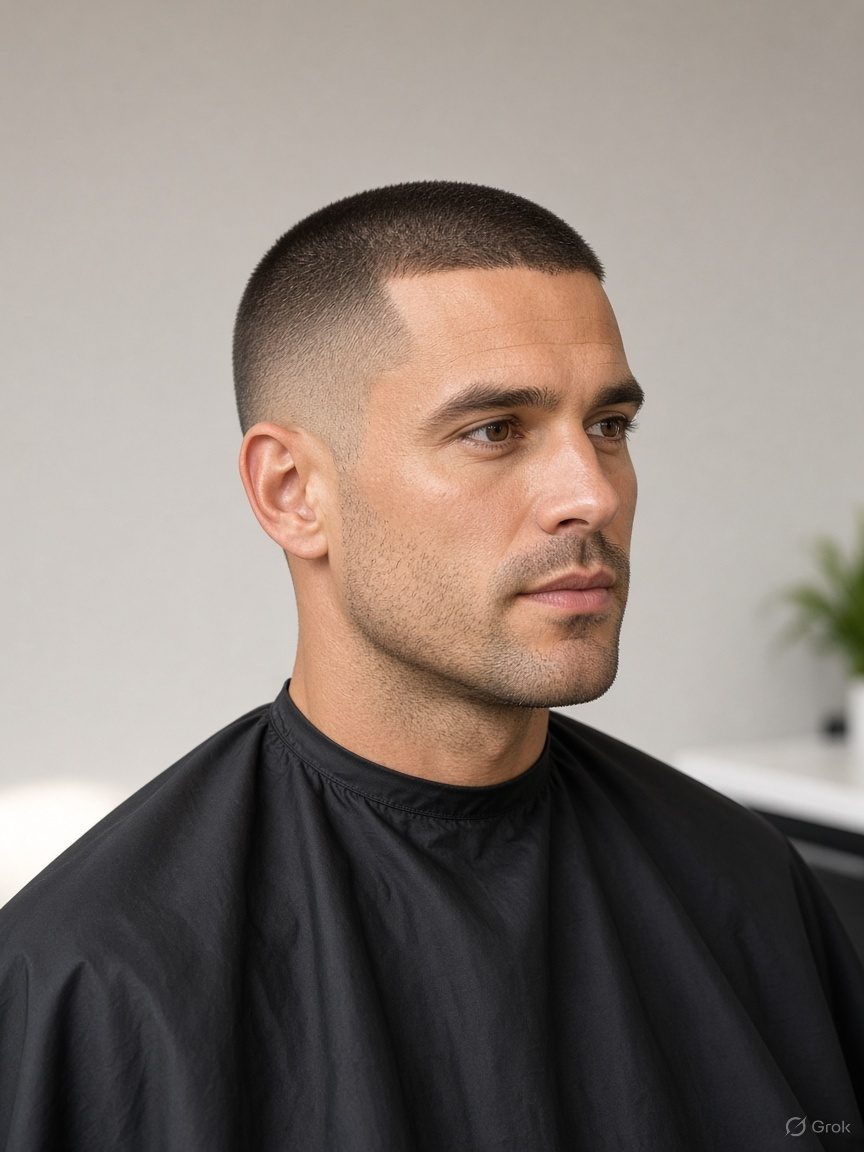
A 2 guard buzz cut leaves about 6 mm, which is the point where the hair starts to look like a very short cut rather than a shaved head, and it covers small scars and moles better than a shorter guard. It suits a man with an oval or square face and medium density, and it is the usual choice for men who want a short cut that still shows a hairline and a little texture at the front. It works under a helmet, under a cap and in a hot kitchen. For a very round face, let the top run half a guard longer so the sides do not add width. The cut takes 20 to 30 minutes.
Take the 2 guard through the back and sides against the growth and over the top with the growth, keeping the blade flat and the strokes short. Check the line above the ear with the comb, because 6 mm is long enough to fold over the ear rim and look untidy. At 6 mm a fine-haired man sees scalp at the crown under strong light, while a coarse-haired man at the same guard looks almost fully covered, so set his expectation before you begin. Sideburns end at the middle of the ear unless he asks for a shorter edge. Finish with a warm towel and a light gel if he wants the front to sit. Rebook in 3 to 4 weeks.
- 1. Consult with the hair dry, agree 6 mm, and show him how the front will sit when the hair has no weight in it.
- 2. Check the scalp for sores and flakes, and look at the ear rims, where 6 mm can fold over and look untidy.
- 3. Cut the guideline at the centre nape with the 2 guard against the growth and keep the line level.
- 4. Take the back and sides up against the growth, then cut the top with the growth and keep the pressure even.
- 5. Check both sides in the mirror and run the comb above each ear to see whether the hair folds over the rim.
- 6. Cut the neckline along the natural hairline with the corner of the blade, and end the sideburns at the middle of the ear unless he asks for shorter.
- 7. Dry the hair, check the crown and the front edge, and trim any stray hair at the temples.
- 8. Rebook in 3 to 4 weeks, since 6 mm keeps its shape for about 3 weeks and then spreads at the neck.
Salon example: Imran's first short cut
Imran, 24, had worn his hair at 4 cm since school and wanted to try something short before his brother's wedding. He was nervous, so I cut the back first and let him watch in the hand mirror before I touched the top. His hair is medium density and straight, with a small scar above the left ear that he wanted covered. At 6 mm the scar still read clearly, so we kept a little extra length around it with the comb and the clipper. The whole cut took 30 minutes, and he kept touching the back of his head in the mirror. He rebooked in 4 weeks and said he would go shorter next time.
Caution: Do not take a 2 guard over a fresh cut or a graze, because 6 mm still lets the blade catch the skin at the edge.
Buzz cut, 3 guard
A 3 guard buzz cut leaves about 10 mm, which is long enough to lie flat, show the direction of growth and carry a soft edge at the front, but short enough that it needs no comb at home. It suits a man with straight or wavy hair of medium density, an oval or long face, and a workplace that allows a short but not severe cut. It is a good choice for a man whose hair is thinning evenly across the top, because one length everywhere hides the difference between the top and the sides. It is less flattering on very curly hair, which stands up at 10 mm instead of lying down. Allow 25 to 35 minutes.
Run the 3 guard over the sides and back against the growth, then change direction on the top and work from the front hairline to the crown so the cut follows the natural fall. At 10 mm the hair bends at the crown and the temple, so go over those 2 areas from 2 directions with light pressure and no digging. Fine hair at 10 mm looks like a 6 mm cut, while coarse hair at the same guard can look almost like 15 mm, so always finish by eye and not by the number. Sideburns end at the middle of the ear unless he asks otherwise. Check in the mirror, tidy the neckline, and rebook in 3 to 4 weeks.
- 1. Consult with the hair dry, agree 10 mm, and ask how he normally wears the front so the cut follows his habit.
- 2. Check the scalp and the crown for thin patches, and note where the hair changes direction.
- 3. Cut the guideline at the centre nape with the 3 guard against the growth and keep it straight across the back.
- 4. Take the sides and back up against the growth, then cut the top from the front hairline to the crown so the hair falls naturally.
- 5. Check both sides in the mirror and compare the temple heights, because 10 mm shows a difference of 2 mm.
- 6. Clean the neckline to the natural hairline, and take the sideburns to the middle of the ear unless he asks otherwise.
- 7. Dry the hair and check the crown and temples in daylight, going over any bent patch from two directions.
- 8. Rebook in 3 to 4 weeks, because 10 mm starts to sit unevenly at the crown after a month.
Salon example: Karan's even cut for thinning hair
Karan, 30, had been watching his crown thin for a year and had started combing hair across it. He wanted a cut that stopped the comb-over without going bare. His hair is fine and straight, and the thinning was even across the top rather than in one patch. I suggested 10 mm all over, with the front left just long enough to sit forward. I cut the sides against the growth, took the top from the hairline back, and checked the crown in daylight, where fine hair shows scalp first. The result looked deliberate and even. The cut took 32 minutes, and he rebooked for 4 weeks with no product at all.
Caution: Do not use a 3 guard on hair that is patchy rather than evenly thin, because one length makes each gap easier to see.
Buzz cut, 4 guard
A 4 guard buzz cut leaves about 13 mm, which is the longest of the plain buzz lengths and the one that reads as short, tidy hair rather than a shaved head. It suits a man with medium to thick hair, a square or oval face and a job where he wants to look neat without looking styled, and it gives a little cover at the crown for a man who is thinning there. Straight hair lies flat at 13 mm and looks almost like a short scissor cut, while curly hair lifts and looks shorter than the number suggests. It is a safe choice for a first short cut. The service takes 25 to 35 minutes.
Go over the back and sides with the 4 guard against the growth, then the top with the growth, and keep the pressure even so the sides do not end up tighter than the top. At 13 mm the neckline shows every stray hair, so finish it with the corner of the blade and a comb, not with a razor. On fine hair the same guard looks about 2 steps shorter than on coarse hair, which holds the length up and looks fuller, so check the top in daylight before you call it done. Sideburns end at the middle of the ear unless he asks for a square edge. Wipe the neck and rebook in 3 to 4 weeks.
- 1. Consult with the hair dry, agree 13 mm, and ask whether he wants the top the same as the sides or a shade longer.
- 2. Check the scalp, the hairline and the crown, and look at how the hair lies at the temple and the part.
- 3. Cut the guideline at the centre nape with the 4 guard against the growth, and keep it level across the back.
- 4. Take the back and sides up against the growth with even pressure, then cut the top with the growth so it keeps its fall.
- 5. Check both sides in the mirror and see whether the sides ended tighter than the top, which is easy to do at this length.
- 6. Finish the neckline with the corner of the blade and a comb, never a razor, and take the sideburns to the middle of the ear.
- 7. Dry the hair and check the outline in daylight, trimming stray hairs at the neck and the temples.
- 8. Rebook in 3 to 4 weeks, because 13 mm shows a soft edge at the neckline after about 20 days.
Salon example: Deepak's neat cut for a family function
Deepak, 45, wanted a clean head for his daughter's engagement and had no interest in styling. His hair is thick and straight, and his crown had thinned enough that a short cut worried him. I chose a 4 guard, since 13 mm would lie over the crown instead of showing it. I cut the sides against the growth and the top with the growth, then checked in daylight that the thinning area still looked even. The neckline needed the comb and the corner of the blade to sit clean. The cut took 30 minutes. He looked at the back twice in the hand mirror and rebooked for 3 weeks.
Caution: Do not cut the sides tighter than the top at 13 mm, because the step will look like a mistake rather than a style.
Buzz cut, 6 guard
A 6 guard buzz cut leaves about 19 mm, which is short enough to stay off the collar but long enough to part, brush or push back with the fingers. It suits a man with thick, straight or slightly wavy hair, a long or oval face, and a workplace that expects a conservative short cut. It is the best buzz length for a man who wants to cover a scar or a thin patch on the crown, because 19 mm lies over the scalp instead of showing it. On very fine hair it collapses and looks patchy, so a shorter guard often looks neater. Allow 25 to 35 minutes.
Cut the sides and back with the 6 guard against the growth in overlapping passes, then work the top from the front hairline back to the crown so the hair falls the way he wears it. At 19 mm the hair starts to bend at the temple and the crown, so use the corner of the blade there and never push the clipper straight into the curve. The same guard looks shorter on fine hair and fuller on coarse hair, and at this length the difference is easy to see, so judge by the mirror, not the guard number. Sideburns end at the middle of the ear unless he asks otherwise. Check the outline, wipe the neck, and rebook in 3 to 4 weeks.
- 1. Consult with the hair dry, agree 19 mm, and ask whether he parts his hair, because that decides the direction of the top.
- 2. Check the scalp and the crown, and look for a scar or a thin patch that the length must cover.
- 3. Cut the guideline at the centre nape with the 6 guard against the growth, and keep the line level across the back.
- 4. Cut the sides and back against the growth in overlapping passes, then cut the top from the front hairline back to the crown.
- 5. Check both sides in the mirror and compare the 2 temples, since 19 mm shows a small difference clearly.
- 6. Use the corner of the blade at the temple and above the ear, and clean the neckline along the natural hairline.
- 7. Dry the hair, check the crown and the outline, and blend any ridge with light strokes of the same guard.
- 8. Rebook in 3 to 4 weeks, because 19 mm starts to look untidy at the neck before it looks long on top.
Salon example: Vikram's cut over a scar
Vikram, 38, had a scar about 3 cm long on the right side of his crown from a fall years earlier. He wanted it covered but did not want long hair. His hair is thick and coarse, so it stands up at shorter lengths instead of lying flat. I tried a 6 guard on one small patch and the scar disappeared under the hair. I cut the sides against the growth, then the top from the front back, checking the scar from above and from the side. At 19 mm the hair lay over it cleanly and the outline stayed tidy. The cut took 34 minutes. He rebooked for 4 weeks and said he no longer thinks about it.
Caution: Do not choose a 6 guard for fine hair without testing a small patch first, because 19 mm can fall open and show the scalp.
Induction cut
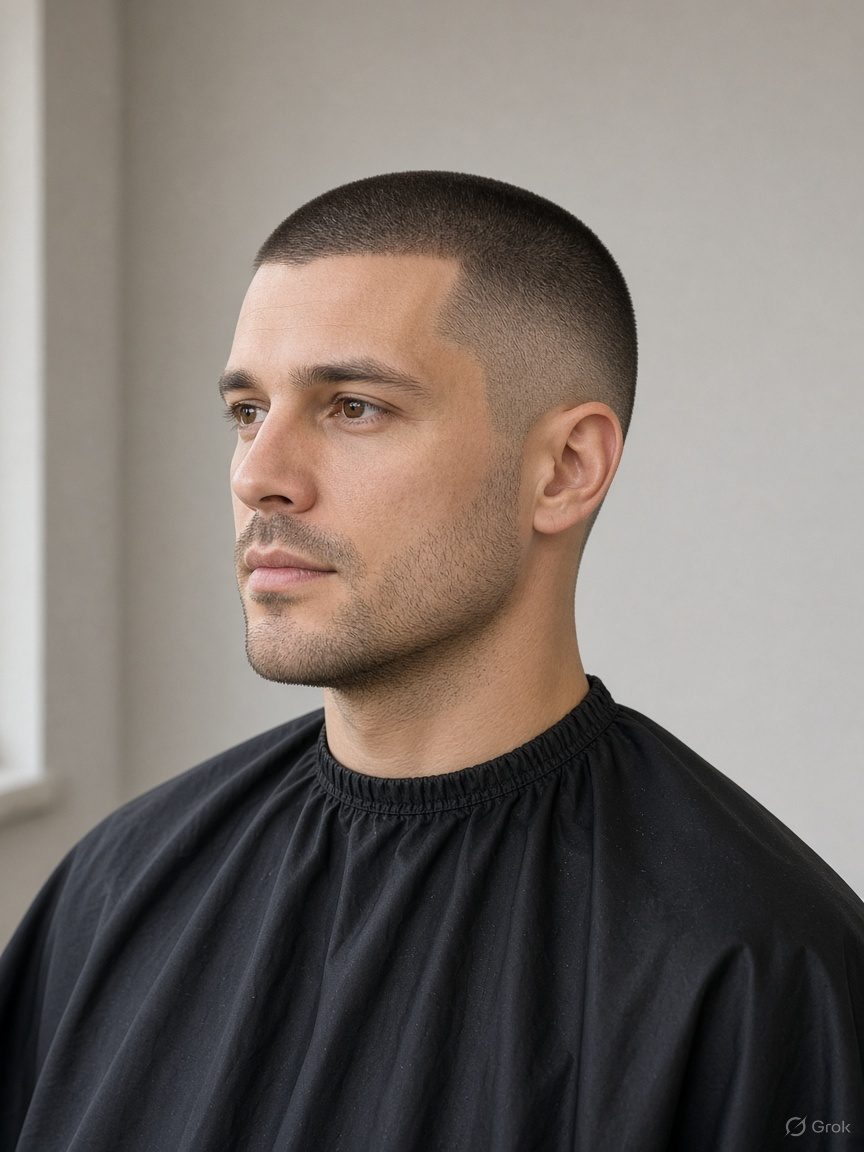
An induction cut is the shortest military cut: the whole head is taken down with a clipper to a stubble, and the top is left a shade longer than the sides so the head still has a front. It suits a man with a strong skull shape, a clear hairline and a reason to keep hair out of the way, such as training, heat, hygiene rules or a fresh start after a long style. It is also the cut a man asks for when his hair is falling out and he wants to stop watching it. It is not flattering on a very flat back of the head. The service takes 20 to 30 minutes.
Take the sides and back down with a 0.5 guard or a 1 guard, whichever the scalp tolerates, then go over the top with one guard longer so the crown and front keep a thin layer. Work against the growth on the sides and with the growth on the top, keep the blade flat, and use short strokes at the temple and above the ear. At this length fine hair looks bare in a day while coarse hair keeps a shadow for a week, so describe both outcomes before you start. Sideburns end at the middle of the ear unless he asks for a clean edge. Rebook in 3 to 4 weeks.
- 1. Consult with the hair dry, agree which guard the sides will take, and say plainly that the top will be only one step longer.
- 2. Check the scalp under a bright lamp for sores, flakes and ring-shaped patches, and look at the shape of the skull from behind.
- 3. Open the guideline at the centre nape with the shorter guard against the growth, and keep it level.
- 4. Take the sides and back down against the growth with short passes, then go over the top with one guard longer in the direction of the growth.
- 5. Check both sides in the mirror and make sure the top still reads as a top, not as a thin patch.
- 6. Follow the natural hairline at the neck with the corner of the blade, and end the sideburns at the middle of the ear unless he asks otherwise.
- 7. Dry the head, check the crown and the hairline in daylight, and go over any missed line with the same guard.
- 8. Rebook in 3 to 4 weeks, because the sides grow into a soft ring before the top does.
Salon example: Manoj's cut before training
Manoj, 22, had a police training start date in 10 days and needed a cut that would pass inspection and survive a hot day outdoors. He had thick, curly hair that had never been shorter than 3 cm, and he was not sure how much he would lose. I cut one small patch at the nape with the 0.5 guard so he could see the stubble, and he agreed. I took the sides down with the 0.5 guard, then the top with the 1 guard so it stayed a shade longer. The whole head took 22 minutes, and the curls were gone at the root. He rebooked for 4 weeks, when he would be back on leave.
Caution: Do not take an induction cut on a scalp with an angry rash, because a stubble cut leaves nothing to cover the irritation.
Butch cut
A butch cut keeps a short scissor top of about 1.5 cm and takes the sides down with a clipper, so the head looks square and flat with a clear difference between top and sides. It suits a man with thick, straight hair, a square or oval face and a low-maintenance routine, and it is a good bridge for a man who finds a full buzz too bare but wants the sides clean. It also suits a man with a small bald patch at the crown, which the 1.5 cm top can cover. Fine hair looks thin at 1.5 cm and needs the top left longer. Allow 30 to 40 minutes.
Set the clipper sides first with a 2 or 3 guard, then cut the top with scissors over the comb at about 1.5 cm, working from the front hairline to the crown so the cut follows the fall. Blend the corner where the top meets the sides with the comb and the clipper, and keep that line soft so it does not read as a step. At 1.5 cm fine hair looks shorter and sparser than coarse hair at the same length, so leave fine hair a few millimetres longer on top. Sideburns end at the middle of the ear unless he asks otherwise. Dry the hair, check both sides, and rebook in 3 to 4 weeks.
- 1. Consult with the hair dry, agree the 1.5 cm top, and show where the sides will stop so he knows how much of the head the clipper takes.
- 2. Check the scalp and the crown for thin patches, and look at how the hair at the front sits when it is short.
- 3. Set the side guideline with a 2 or 3 guard against the growth, and keep the height the same on both sides.
- 4. Cut the sides with the clipper, then cut the top with scissors over the comb at about 1.5 cm, working from the front hairline to the crown.
- 5. Blend the corner where the top meets the sides with the comb and the clipper, and check both sides in the mirror.
- 6. Clean the neckline along the natural hairline, and take the sideburns to the middle of the ear unless he asks otherwise.
- 7. Dry the hair, check the join at the temple and the crown, and soften any step with the comb.
- 8. Rebook in 3 to 4 weeks, because the sides show growth before the top does.
Salon example: Suresh's return to short hair
Suresh, 52, had worn his hair at 6 cm for 20 years and wanted a cut that felt lighter without looking shaved. His hair is thick and straight and had started to thin at the crown in a small round patch. I suggested a butch cut, with the sides at a 3 guard and the top at 1.5 cm, because that length would still lie over the patch. He asked for the top at 2 cm at first; I cut it at 1.8 cm and showed him the mirror, and he agreed to go to 1.5 cm. The sides went quickly, the join at the temple needed the comb twice, and the cut took 35 minutes. He rebooked for 4 weeks.
Caution: Do not leave the butch top at 1.5 cm on very fine hair without warning him, because it will look thinner than the sides within a week.
Burr cut

A burr cut is a very short all-over clipper cut of about 6 mm, with a little more length left on top so the head is not completely even. It suits a man with a round head, thick hair and a taste for the simplest possible cut, and it is common among men who work outdoors, in workshops or in sport. It sits between a buzz and an induction cut, and it is easy to keep neat at home between visits. On a long, narrow face it makes the head look longer, so keep the top at the same length as the sides there. The cut takes 20 to 30 minutes.
Take the sides and back with a 2 guard against the growth, then go over the top with a 3 guard in the direction of the growth so the crown keeps a thin layer. Keep the clipper flat and overlap each pass, and lift the blade at the temple so you do not cut into the curve. At 6 mm on the sides the same guard looks shorter on fine hair and fuller on coarse hair, so check the top and sides together in the mirror rather than trusting the numbers. Sideburns end at the middle of the ear unless he asks for a shorter edge. Wipe the neck and rebook in 3 to 4 weeks.
- 1. Consult with the hair dry, agree 6 mm for the sides and a 3 guard for the top, and show him the difference in the mirror before you start.
- 2. Check the scalp, the nape and the crown, and look at the shape of the head from behind.
- 3. Cut the guideline at the centre nape with the 2 guard against the growth, and keep it level across the back.
- 4. Take the sides and back down with the 2 guard, then cut the top with the 3 guard in the direction of the growth.
- 5. Check both sides in the mirror and make sure the top still sits a little longer than the sides.
- 6. Clean the neckline along the natural hairline, and take the sideburns to the middle of the ear unless he asks otherwise.
- 7. Dry the head, check for missed tufts at the crown and the temples, and go over them with the correct guard.
- 8. Rebook in 3 to 4 weeks, because 6 mm looks even for about 3 weeks and then grows out at the neck.
Salon example: Ravi's cut for a workshop
Ravi, 26, works in a fabrication workshop where metal dust settles in his hair by the end of a shift. He wanted the shortest cut that would let him rinse his head in 2 minutes. His hair is thick and coarse, and it stands up straight when it is short. I set the sides at a 2 guard and the top at a 3 guard, so the head kept a little shape instead of going completely even. I cut the nape against the growth and the top with it, then checked the outline from behind. The cut took 23 minutes. He asked for the sides to be repeated with the same guard once more, which I did, and he rebooked for 3 weeks.
Caution: Do not take the burr top down to the side length on a long face, because an even 6 mm head will make it look longer.
Crew cut
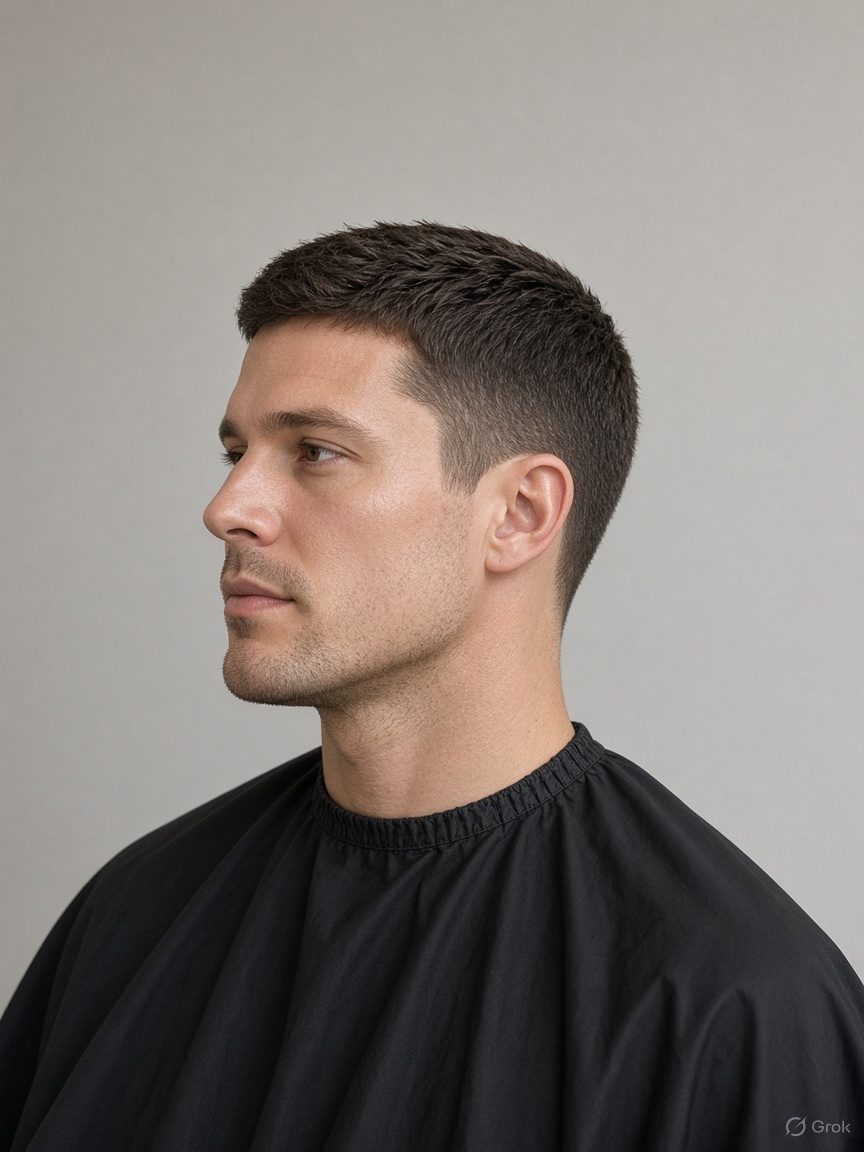
A crew cut keeps a textured top of 2 to 4 cm that is cut to lie forward, with the sides shorter, and it is the standard short cut for school, office and uniform work. It suits a man with straight or slightly wavy hair, an oval or square face and a hairline that still has a firm front, and it flatters a man who wants a little length on top without a quiff. It is not the cut for a man who wants height at the front, because the top is meant to sit flat and forward. Wavy hair holds at 3 to 4 cm; very curly hair needs a longer top. Allow 30 to 40 minutes.
Cut the sides with a 2 or 3 guard and blend them into the top with a comb, then take the top down with scissors over the comb to 2 to 4 cm, working forward from the crown so the front has enough length to lie down. Point-cut the front edge lightly so it does not sit in a hard line, and keep the top flat rather than lifted. At 2 cm fine hair shows the scalp at the crown while coarse hair at 4 cm looks almost bulky, so choose the length by density, not by the photo. Sideburns end at the middle of the ear unless he asks otherwise. Rebook in 3 to 4 weeks.
- 1. Consult with the hair dry, agree 2 to 4 cm on top, and ask whether he wants the front to sit forward or to the side.
- 2. Check the scalp and the front hairline, and look for a cowlick at the front that would lift the cut.
- 3. Set the side guideline with a 2 or 3 guard against the growth, and keep the height even on both sides.
- 4. Cut the sides with the clipper, then take the top with scissors over the comb, working forward from the crown so the front keeps enough length to lie down.
- 5. Point-cut the front edge lightly so it does not sit in a hard line, and check both sides in the mirror.
- 6. Clean the neckline along the natural hairline, and take the sideburns to the middle of the ear unless he asks otherwise.
- 7. Dry the hair, brush it forward and check the front edge again with the hair lifted, then trim any step.
- 8. Rebook in 3 to 4 weeks, because the sides lose their shape before the top does.
Salon example: Anil's forward crew cut
Anil, 33, works in an office and had been cutting his own hair for a year. He wanted a crew cut with the top lying forward, about 3 cm, and the sides short but not shaved. His hair is straight and medium, with a cowlick at the front that had made his own attempts look uneven. I cut the sides at a 3 guard, then took the top over the comb from the crown forward, leaving 3 cm at the front and point-cutting the edge. The cowlick still lifted one corner, so I softened it with 2 light snips. The cut took 34 minutes, and he said it was the first time the front had stayed flat. He rebooked for 4 weeks.
Caution: Do not build a tall front on a crew cut, because the shape must sit flat and forward, not stand up like a quiff.
Ivy League cut

An Ivy League cut is a short, clean cut of about 5 cm on top, parted on one side and tapered at the sides, and it is the neatest of the short classic cuts. It suits a man with straight, medium-density hair, an oval or long face and a job that expects a tidy, conservative look, and it gives a soft alternative to a buzz for a man in his thirties or forties. It needs hair that will lie down at the part, so very curly or very coarse hair fights it. It also needs a daily comb at home to keep the part. Allow 30 to 40 minutes.
Taper the sides with the clipper from a 2 guard at the bottom to a 4 guard near the top, then cut the top with scissors to about 5 cm over the comb, working from the front to the crown so the part can sit. Set the part on the natural side, comb the hair across it and check that both sides balance before you blend. At 5 cm fine hair looks flat and sparse at the part while coarse hair looks full and slightly heavy, so leave fine hair a little longer at the front and thin coarse hair at the crown. Sideburns end at the middle of the ear. Rebook in 3 to 4 weeks.
- 1. Consult with the hair dry, agree about 5 cm on top, and find the side where his hair falls into a part most easily.
- 2. Check the scalp and the hairline, and look at how the hair lies at the crown so the part does not fight the growth.
- 3. Set the side guideline with a 2 guard at the bottom, and plan the taper up to a 4 guard near the top of the sides.
- 4. Taper the sides with the clipper, then cut the top with scissors over the comb to about 5 cm, working from the front to the crown.
- 5. Set the part on the natural side, comb the hair across it, and check that both sides balance in the mirror.
- 6. Clean the neckline along the natural hairline, and take the sideburns to the middle of the ear unless he asks otherwise.
- 7. Dry the hair, comb the part again and check the outline from the front and both sides, trimming any stray hair.
- 8. Rebook in 3 to 4 weeks, because the taper at the sides grows soft first.
Salon example: Gaurav's cut for the bank
Gaurav, 40, manages a bank branch and needed a cut that looked formal without looking old-fashioned. His hair is straight and medium, and he had a natural part on the left that he had been fighting with a wide-toothed comb. I suggested an Ivy League cut, about 5 cm on top, with a taper from a 2 guard at the neck to a 4 guard at the top of the sides. I set the part on his natural side and combed the hair across it, and the shape balanced at once. The top needed a small amount of thinning at the crown to lie flat. The cut took 38 minutes, and he rebooked for 3 weeks to keep the taper sharp.
Caution: Do not force a part against the natural growth, because the hair will lift at the line and the cut will look untidy within a day.
Flat top
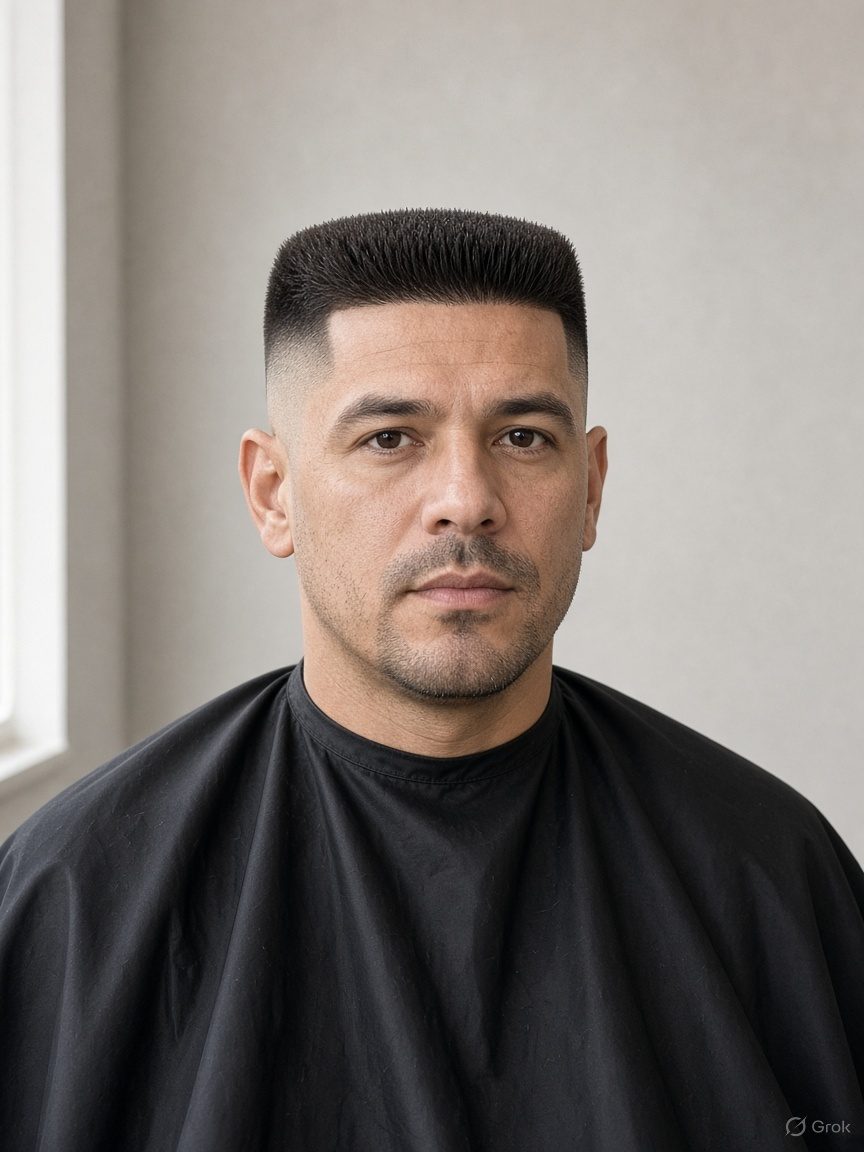
A flat top is a short cut where the top is cut flat and square across, so it stands up as a level platform, and the sides are taken high and tight. It suits a man with thick, straight, coarse hair that stands up on its own, a square face and a taste for a strong, military look. Fine or soft hair will not hold the shape without a lot of product, and a round face looks wider under it. It is a good cut for a man with a very straight hairline who wants the front squared. The service takes 30 to 40 minutes.
Take the sides high with a 1 or 2 guard, well above the ear, then cut the top with the clipper flat across the crown to build the platform, and finish the front edge square with the clipper or the scissors. Check the platform from the front, the side and above, because a flat top looks level from one side and sloping from the other if the head is not held straight. At this length fine hair collapses and reads shorter, while coarse hair holds the height, so choose the platform height by how his hair stands. Sideburns end at the middle of the ear unless he asks otherwise. Rebook in 3 to 4 weeks.
- 1. Consult with the hair dry, agree the height of the platform, and check that his hair stands up when it is brushed back.
- 2. Check the scalp, the hairline and the crown, and look at the head from the side to see where the platform should sit.
- 3. Set the side guideline with a 1 or 2 guard, well above the ear, and keep the height even on both sides.
- 4. Take the sides high and tight with the clipper, then cut the top flat across the crown to build the platform.
- 5. Square the front edge with the clipper or the scissors, and check the platform from the front, the side and above.
- 6. Clean the neckline along the natural hairline, and take the sideburns to the middle of the ear unless he asks otherwise.
- 7. Dry the hair, brush it straight up, and check the platform again with the head level, trimming any high corner.
- 8. Rebook in 3 to 4 weeks, because the platform loses its square edge as soon as the sides grow.
Salon example: Farhan's square platform
Farhan, 29, had wanted a flat top since school but had never had the hair for it. He came in with thick, coarse hair that stood up when brushed back, which is the right base. I checked the head from the side and set the platform height at 2 cm above the crown, with the sides at a 2 guard and a clear band above the ear. I cut the top flat with the clipper, squared the front with the scissors, and checked it from 3 angles while he held his head still. The platform was level. The cut took 36 minutes, and he rebooked for 3 weeks, since the square edge goes soft first.
Caution: Do not attempt a flat top on fine or soft hair without saying that it will need daily product to hold the platform.
High and tight

A high and tight keeps the sides at their shortest high above the ear, with a clear band at the temple, and leaves about 2 cm on top. It suits a man with a square face, a firm jaw and thick hair, and it is common in police, security and military work. It makes a round face look sharper and a long face look longer, so check the head shape before you commit. It is also a strong choice for a man with a receding hairline who wants to stop hiding it. The cut takes 25 to 35 minutes.
Cut the sides with a 0.5 or 1 guard up to the line above the ear, then blend the band into the top with a 2 guard and a comb, and keep the line clean and level from front to back. Cut the top to about 2 cm with the clipper over the comb, straight back, and check that the 2 temples match in height. At 2 cm fine hair looks shorter and flatter, while coarse hair stands and looks taller, so judge the top by the mirror and not by the guard. Sideburns end at the middle of the ear unless he asks for them shorter. Rebook in 3 to 4 weeks.
- 1. Consult with the hair dry, agree 2 cm on top, and show him how high the short band will sit above the ear.
- 2. Check the scalp and the hairline, and look at the head shape from the front and side before cutting the band.
- 3. Cut the side guideline with a 0.5 or 1 guard up to the chosen height, and keep the line level from front to back.
- 4. Take the sides to the guideline with the short guard, then blend the band into the top with a 2 guard and a comb.
- 5. Cut the top to about 2 cm over the comb, straight back, and check that the 2 temples match in height.
- 6. Clean the neckline along the natural hairline, and take the sideburns to the middle of the ear unless he asks for shorter.
- 7. Dry the hair, check the band on both sides in the mirror, and trim any patch that breaks the line.
- 8. Rebook in 3 to 4 weeks, because the band loses its edge first and the top still looks short.
Salon example: Nitin's security cut
Nitin, 31, supervises a security team and needed a cut that looked sharp under a cap and without one. His hair is thick and straight, his face is square, and he had been wearing a 6 mm buzz for 2 years. He asked for a high and tight with 2 cm on top. I set the band 4 cm above the ear with a 1 guard, blended it into the top with a 2 guard and the comb, and cut the top to 2 cm, straight back. The right temple needed 3 mm more taken off to match the left. The cut took 31 minutes, and he rebooked for 3 weeks, since the band is the part people notice.
Caution: Do not set the short band high on a long, narrow head, because it will stretch the face and make the top look thin.
Military cut

A military cut is an even short cut all over, kept clean at the neckline along the natural hairline, with no design lines, no carved parts and no sharp edges. It suits a man with an oval or square face, medium to thick hair and a reason to keep the cut plain, such as uniform rules, training or a job where a tidy head is part of the dress code. It also suits a man who dislikes the look of a fade or a hard outline. It is the simplest cut to maintain and the hardest to hide a bad patch after. Allow 20 to 30 minutes.
Take the whole head with a 2 or 3 guard, going against the growth at the sides and back and with the growth on top, and keep the neckline on the natural hairline so it grows out softly. Check the outline for evenness and resist the urge to square the neck, since a military cut is defined by its plain edge. At 6 mm on fine hair the scalp shows at the crown, while coarse hair at the same guard looks solid, so tell him which he will get before the first pass. Sideburns end at the middle of the ear unless he asks otherwise. Wipe the neck, check the mirror and rebook in 3 to 4 weeks.
- 1. Consult with the hair dry, agree the guard, and confirm that he wants no lines or carved parts anywhere on the head.
- 2. Check the scalp, the hairline and the neck, and look for patches that would break an even cut.
- 3. Cut the guideline at the centre nape with the chosen guard against the growth, and keep it level across the back.
- 4. Take the whole head with the same guard, against the growth at the sides and back and with the growth on top.
- 5. Check both sides in the mirror, then look at the back with a hand mirror, and even out any patch that reads darker.
- 6. Keep the neckline on the natural hairline and do not square the corners, and end the sideburns at the middle of the ear.
- 7. Dry the head, check the outline in daylight, and trim any tuft that stands above the even length.
- 8. Rebook in 3 to 4 weeks, because an even cut looks untidy at the edges before it looks long.
Salon example: Ajay's cut for uniform inspection
Ajay, 23, had joined a uniformed service and was told to keep his hair short with no styling. He had a hard part cut into the side from his last barber, which was against the rules. His hair is medium and straight, and his head shape is oval. I took the whole head with a 3 guard, going against the growth at the sides and with the growth on top, and I left the neckline on the natural hairline. The old part still showed as a faint line, so I went over it twice with the same guard. The cut took 24 minutes, and I told him not to let anyone carve a line again. He rebooked for 4 weeks.
Caution: Do not add a carved part or a squared neck to a military cut, because the plain outline is the whole point of the cut.
Brush cut
A brush cut keeps about 2 cm on top, cut and brushed forward so the front edge sits in a soft line and the whole top looks like a short brush. It suits a man with straight or slightly wavy hair, thick at the front, an oval or square face and a simple routine, and it is a friendly cut for a man who is not ready for a buzz. It hides a thin crown better than a shorter guard because the front is long enough to carry forward. It is not the cut for very curly hair, which will not brush forward. The service takes 25 to 35 minutes.
Cut the sides with a 2 or 3 guard, then take the top with scissors over the comb to about 2 cm, angling the front a little longer so it can be brushed forward. Blend the sides into the top so there is no step, and check the front edge with the hair brushed forward and again with it lifted, because the cut must look right both ways. At 2 cm fine hair looks thinner at the front and needs a little extra left there, while coarse hair looks full and needs a light point cut to sit down. Sideburns end at the middle of the ear unless he asks otherwise. Rebook in 3 to 4 weeks.
- 1. Consult with the hair dry, agree about 2 cm on top, and ask whether he brushes the front forward or to the side.
- 2. Check the scalp and the crown for thin patches, and look at how the front sits when it is brushed forward.
- 3. Set the side guideline with a 2 or 3 guard against the growth, and keep both sides even.
- 4. Cut the sides with the clipper, then take the top with scissors over the comb to about 2 cm, angling the front a little longer.
- 5. Blend the sides into the top so no step shows, and check the front edge with the hair brushed forward in the mirror.
- 6. Clean the neckline along the natural hairline, and take the sideburns to the middle of the ear unless he asks otherwise.
- 7. Dry the hair, brush it forward, check the front edge again with the hair lifted, and point-cut any heavy corner.
- 8. Rebook in 3 to 4 weeks, because the front edge loses its soft line before the sides grow long.
Salon example: Tarun's forward brush cut
Tarun, 27, had a thin patch at the crown and had been wearing his hair long enough to comb over it. He wanted something short that still covered the patch. His hair is straight, and the front is thick enough to carry forward. I cut the sides at a 2 guard and the top at about 2 cm, with the front left slightly longer, and blended the join at the temple. When the hair was dry I brushed it forward and the crown looked even. He asked whether a 3 guard on the sides would look better; I tried it on one side and he stayed with the 2. The cut took 29 minutes, and he rebooked for 4 weeks.
Caution: Do not cut a brush cut on hair that grows in a strong cowlick at the front, because the front will lift instead of brushing forward.
Buzz with a natural neckline
A buzz cut with a natural neckline follows the hairline at the back exactly as it grows, so the cut fades out on its own instead of ending in a line, and it is the softest finish for a short cut. It suits a man with a normal, rounded hairline, medium to thick hair and a routine that does not include weekly barber visits, because a natural neckline still looks tidy at 4 weeks. It is also the right finish for a man with sensitive skin at the nape or a history of shaving bumps. On a very straight neckline it can look untidy, so check it dry. Allow 20 to 30 minutes.
Agree a 2 or 3 guard, about 6 to 10 mm, for the sides and the top, take the hair down with it, then clean the neck with the corner of the blade following the hairline, working in small steps from the centre to each side and lifting the blade at the end of each stroke. Do not square the corners, because the whole point of this finish is that it disappears as it grows. At any guard the same number looks shorter on fine hair and fuller on coarse hair, so check the nape in a hand mirror with good light. Sideburns end at the middle of the ear unless he asks otherwise. Rebook in 3 to 4 weeks.
- 1. Consult with the hair dry, agree the guard for the sides and the top, and explain that the neckline will follow his own hairline.
- 2. Check the scalp and the nape, and look at the hairline shape so you know where the cut should disappear.
- 3. Cut the guideline at the centre nape with the agreed guard against the growth, and keep it level across the back.
- 4. Cut the hair to the agreed length on the sides, back and top, using the guard in the direction the hair grows on each area.
- 5. Check both sides in the mirror and use a hand mirror to see the nape, where the line must look soft from every angle.
- 6. Clean the neck with the corner of the blade following the hairline in small steps, lifting the blade at the end of each stroke.
- 7. Dry the head and look at the nape in daylight, then trim only the hairs that sit below the natural line.
- 8. Rebook in 3 to 4 weeks, because the soft neckline keeps its shape longer than a squared one.
Salon example: Sanjay's sensitive nape
Sanjay, 35, had stopped getting short cuts because every neckline gave him red bumps for a week. His hair is medium density and straight, and the bumps were only at the nape, where a previous barber had shaved the line with a razor. I agreed to a natural neckline and told him there would be no razor at all. I cut the head at a 3 guard, then cleaned the nape with the corner of the blade, following the hairline in small steps and lifting the blade at the end of each stroke. The line looked soft and there was no redness. The cut took 26 minutes, and he rebooked for 4 weeks.
Caution: Do not finish a natural neckline with a razor or a trimmer pressed hard, because that is what causes bumps on a sensitive nape.
Buzz with a squared neckline
A buzz with a squared neckline ends in a straight horizontal line across the back, with the corners squared to the sides, and it is a deliberate, sharp finish for a short cut. It suits a man with a strong neckline, thick hair at the nape and a taste for a defined edge, and it works well with a high and tight or a military cut. It needs more frequent visits, because the square line grows out into a soft curve in about 10 days and looks untidy after that. Ask him to repeat the request before you cut the corners, because a squared neckline is not what every man expects. Allow 20 to 30 minutes.
Cut the hair first with a 2 or 3 guard, about 6 to 10 mm, then set the square line with the clipper held level across the nape and finish the corners with the corner of the blade, checking that both sides sit at the same height. Keep the line just above the natural hairline rather than through it, so the cut still grows out with hair behind it. The same guard looks shorter on fine hair and fuller on coarse hair, and at the nape that difference is what decides how high the line can sit. Sideburns end at the middle of the ear unless he asks for a square edge there too. Rebook in 3 to 4 weeks.
- 1. Consult with the hair dry, agree the guard, and ask twice whether he wants the neckline squared, because the corners change the whole finish.
- 2. Check the scalp and the nape, and look at the natural hairline to see how much room the square line has.
- 3. Cut the guideline at the centre nape with the agreed guard against the growth, and keep it level across the back.
- 4. Cut the hair to the agreed length on the sides, back and top, and keep the nape even before you touch the line.
- 5. Check both sides in the mirror with a hand mirror, and see that the neckline sits at the same height on both corners.
- 6. Set the square line with the clipper held level across the nape, and finish the corners with the corner of the blade.
- 7. Dry the head and check the line in daylight, trimming only hairs that sit below it and keeping both corners equal.
- 8. Rebook in 3 to 4 weeks, because a squared neckline shows regrowth in about 10 days.
Salon example: Prakash's squared line
Prakash, 44, had asked for a squared neckline at 3 different salons and had never had one that lasted. He came in with a 10 mm buzz that had grown into a soft curve at the back. His hair is thick at the nape, which gives the square line something to sit on. I asked him twice whether he wanted the corners squared, and he said yes both times. I evened the nape, set the line with the clipper held level, and finished both corners with the blade. The line sat straight and the corners matched. The cut took 27 minutes, and I told him to book at three weeks, not four.
Caution: Do not square the neckline on the first request alone, because a hard line is permanent for 10 days and not every man wants it.
Short back and sides
A short back and sides keeps a scissor-cut top of 4 to 6 cm and tapers the back and sides short with the clipper, so the cut looks conservative from the front and clean from the side. It suits a man with straight, medium-density hair, any face shape from oval to square, and a job that expects a tidy, traditional look, and it is the safest request for a man who does not want to look barbered. It works for a first appointment and for a man in his fifties who has kept the same cut for years. Fine hair needs the top at 4 cm, not 6 cm. Allow 30 to 40 minutes.
Taper the back and sides with the clipper, starting at a 1 or 2 guard at the neck and opening to a 3 or 4 guard at the top of the sides, then cut the top with scissors over the comb to 4 to 6 cm, working from the front hairline back so the length follows his parting. Blend the join at the temple and above the ear by combing the hair up and taking off the corners. At 4 to 6 cm fine hair looks shorter and needs the longer end of the range, while coarse hair looks heavy and needs a light point cut at the crown. Sideburns end at the middle of the ear unless he asks otherwise. Rebook in 3 to 4 weeks.
- 1. Consult with the hair dry, agree 4 to 6 cm on top, and ask which side he parts on so the top can follow it.
- 2. Check the scalp and the hairline, and look at how the hair falls at the crown and the temple.
- 3. Set the taper with a 1 or 2 guard at the neck, and plan to open to a 3 or 4 guard at the top of the sides.
- 4. Taper the back and sides with the clipper, then cut the top with scissors over the comb to 4 to 6 cm from the front hairline back.
- 5. Blend the join at the temple and above the ear by combing the hair up and taking off the corners, then check both sides in the mirror.
- 6. Clean the neckline along the natural hairline, and take the sideburns to the middle of the ear unless he asks otherwise.
- 7. Dry the hair, comb it into his parting, and check the outline from the front and both sides before trimming any stray hair.
- 8. Rebook in 3 to 4 weeks, because the taper grows soft before the top looks long.
Salon example: Rakesh's cut for 40 years
Rakesh, 57, had worn the same short back and sides since his twenties and had strong opinions about it. His hair is straight and medium, thinning a little at the crown, and he parts it on the right. He wanted the top at 4 cm, not shorter, and the sides at a 2 guard at the neck. I tapered from a 2 guard at the neck to a 3 guard at the top of the sides, then cut the top over the comb to 4 cm, following his part. The join above the ear needed the comb twice to sit smooth. The cut took 33 minutes. He checked the back in the hand mirror and rebooked for 4 weeks, as he always does.
Caution: Do not take the taper higher than he expects on a short back and sides, because the cut must stay conservative from the front.
This is a Nandu Nai textbook. It is a private brand book, not a government licence, and it does not give the right to give medical treatment.