
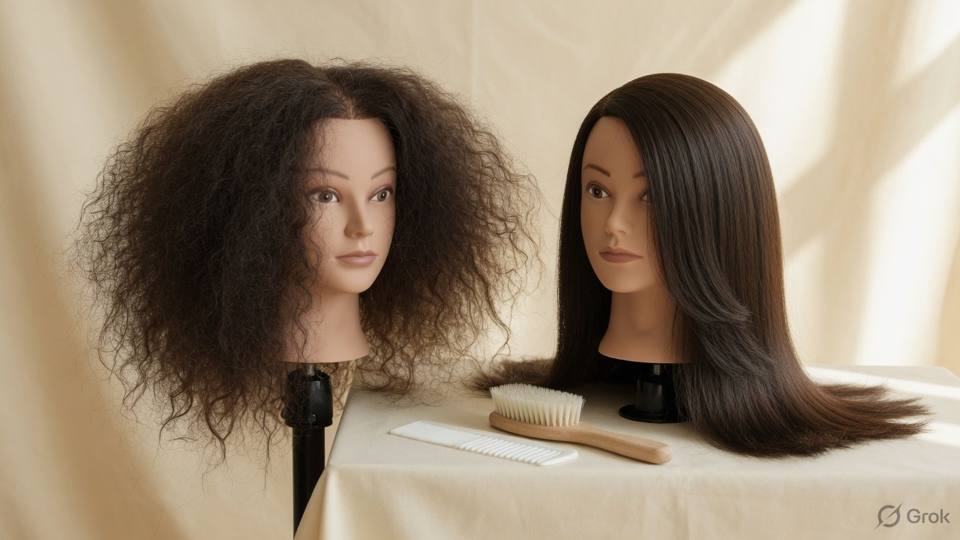
Humidity, frizz and honest promises
Humidity is the normal condition of most Indian salon work, not an exception. Hair that looks smooth in an air-conditioned salon can lift at the door within minutes, especially if the cuticle is porous or the perimeter is soft. Frizz is not a styling failure; it is the hair taking moisture from the air. The cut can reduce it by keeping a clean perimeter, removing weight inside the shape and avoiding a razor on the surface. The finish can reduce it with a heat protectant, a nozzle pointed down the shaft and a cool shot. What the cut cannot do is make porous hair behave like low-porosity hair in the rain.
The cut changes frizz in two ways. First, the perimeter: a ragged or thinned edge has more ends that curl in different directions, so the outline looks fuzzy. A solid perimeter with weight removed inside keeps the outline clean. Second, the surface: a razor or an aggressive thinner opens the cuticle and creates a halo that grows out as the hair grows. On frizz-prone hair, use sharp shears, point cut only the ends and remove bulk with internal layers. Do not promise a sleek finish that depends on a daily blow-dry the client will not do. Promise a shape that looks intentional when it dries on its own.
The honest promise is specific. Say what the cut will do, what the finish will do and what the client must do at home. 'The shape will hold its line after a wash. The smooth finish will last until the next wash in this humidity. At home, use a heat protectant and point the dryer down the shaft.' Do not say 'this will stop frizz' or 'this will last all week'. A client who is told the truth about the weather trusts you when you say the cut will work. A client who is promised a miracle and gets a halo does not come back, and tells three friends why.
The procedure is to plan for the weather before the client sits down. Ask whether the salon is air-conditioned, how the client travels and whether the event is indoors or outdoors. If the client is going outdoors, keep the perimeter clean, use a light serum on the ends and avoid a heavy spray that will collapse in the heat. If the client is going to a wedding, book the cut ten to fourteen days before and the blow-dry on the day. If the hair is very porous, plan a repair course rather than a stronger finish. Write the weather plan on the card so the next appointment starts from the same understanding.
- Ask whether the event is indoors or outdoors and how the client will travel.
- Keep a clean perimeter and remove weight inside on frizz-prone hair.
- Avoid a razor and aggressive thinning on porous or curly hair.
- Use sharp shears and point cut only the last 1 to 2 cm.
- Promise a shape that works air-dried, not a finish that needs a daily blow-dry.
- Use a heat protectant, a downward nozzle and a cool shot for the finish.
- Book the cut 10 to 14 days before a wedding and the blow-dry on the day.
- Write the weather plan and the home routine on the card.
Salon example: Shalini's outdoor wedding
Shalini is attending an outdoor wedding in September and wants a sleek blow-dry that will last through the ceremony. Her hair is medium density, wavy and coloured, and the mid-lengths are porous. She has booked the cut for the day before the wedding. I explain that a cut the day before leaves no time to adjust and that the humidity will lift the surface by the time she reaches the venue. She moves the cut to ten days before and keeps the blow-dry for the morning of the wedding. I cut a collarbone shape with a clean perimeter and long internal layers, no razor. On the day, I use a heat protectant, dry the roots fully, point the nozzle down the shaft and finish with a cool shot. I tell her the finish will hold indoors and soften outdoors, and I give her a light serum for the ends. She appreciates the honesty and books her next cut for eight weeks later. She also asks what to do if the hair lifts at the venue, and I show her how to smooth the surface with a light serum on the ends.
Caution: Do not promise a frizz-free finish in humidity or a blow-dry that will last a week. Say what the cut will do, what the finish will do, and what the weather will do to both.
Keeping length while changing shape
Most clients who ask for a change do not want to lose length. They want the shape to feel different: lighter, softer, more shaped around the face, less heavy at the back. The mistake is to remove fifteen centimetres to make the shape easier to cut. The better approach is to keep the perimeter and change what happens inside it. Internal layers remove weight without shortening the outline. A face frame changes the front without touching the back. A change of parting changes the volume at the root. A fringe changes the whole face without removing length. These are real changes, and the client can see them.
Show the length before you cut it. Hold the comb at the current length and at the planned length, in centimetres, against the shoulder or the collarbone. Say the number out loud. If the client says 'just a trim', take one to two centimetres and show the comb again before the second cut. If the client says 'take off the damage', ask how much damage they can see and show where the healthy hair starts. A client who sees the number is far less likely to feel robbed when the hair is dry. A client who hears 'I took off a little' and sees ten centimetres gone will not trust the next appointment.
The technique for keeping length is to cut the perimeter last or not at all. Start with the internal layers, dry the hair and check the volume, then decide whether the perimeter needs a dusting. On dense hair, remove weight with long internal layers that start below the jaw. On fine hair, keep the layers long and few, and use a face frame to create movement. On wavy hair, cut the layers in the wave shape and leave the perimeter soft. On curly hair, the shape can change completely with a dry cut inside the perimeter and no change to the visible length. The perimeter is the promise; the inside is the design.
Close with a review. Dry the hair, show the client the back and the front, and ask what feels different. If the client wanted less volume and the shape is still heavy, remove a little more from inside, not from the ends. If the client wanted more movement and the hair is still flat, add a long layer, not a short one. If the client is happy, write the exact lengths and the internal layer plan on the card. The next visit should not start with 'what did we do last time?' The card should answer that in one line: 'perimeter kept, internal layers from the jaw, face frame at the cheekbone.'
- Ask what the client wants to feel different, not only what to remove.
- Show the current length and the planned length in centimetres with a comb.
- Keep the perimeter and change the weight inside it with long internal layers.
- Use a face frame or a fringe to change the front without shortening the back.
- Cut the perimeter last, or only dust it, when the client wants to keep length.
- Dry the hair and check the volume before you decide on more cutting.
- Remove more from inside, not from the ends, if the shape is still heavy.
- Write the exact lengths and the internal layer plan on the card.
Salon example: Preeti's long hair
Preeti has thick, straight hair to her waist and wants a change for a new job. She is afraid of losing length because her hair has taken years to grow. I ask what she wants to feel different, and she says the hair feels heavy and flat at the top. I show her the current length at the waist and a planned two-centimetre dusting, and she agrees. I keep the perimeter and cut long internal layers starting at the jaw, removing weight from the inside rather than the ends. I add a face frame at the cheekbone and change her parting slightly to lift the root. The cut takes seventy minutes because the hair is dense. When I dry it, the top has movement and the ends still reach her waist. She sees the back in the mirror and says it feels lighter without looking shorter. I write 'waist length kept, internal layers from jaw, face frame at cheekbone' on her card. She also asks whether the layer will grow out badly, and I show her the line at the jaw so she knows what to expect in eight weeks.
Caution: Do not remove more than the client agreed to in order to make the shape easier to cut. Show the length in centimetres with a comb and stop at that number.
When to refuse the cut
Refusing a service is part of professional judgement, not a failure of hospitality. Refuse when the scalp has an active infection, ringworm, impetigo, lice, weeping patches or open wounds. Refuse when the hair is gummy, stretches and does not return, or snaps when wet, because a cut will remove more than the client can afford. Refuse when the client wants a major change on the day of an event, or when the client will not allow a consultation and a wet check. Refuse when there is sudden patchy hair loss with no clear cause, and refer first. In each case, the reason is safety or honesty, and both are more important than the slot.
The refusal has to be clear and kind. Name what you see, say what you will not do, and offer the next step. 'I can see a red, scaly patch on your scalp. I am not going to cut or colour today because the skin is inflamed. Please see a dermatologist, and come back when they say it is settled.' Do not apologise for the decision, do not offer a discount instead, and do not let the client talk you into a smaller version of the same unsafe service. If the client is angry, stay calm and repeat the same three sentences. The decision is not personal, and the client should hear that in your voice.
Offer an alternative when one exists. If the scalp is inflamed but the ends are healthy, offer a dry dusting away from the patch. If the hair is gummy, offer a trim of the very ends and a repair plan. If the client wants a big change before an event, offer the smallest version now and the full change after. If the client refuses the consultation, do not cut; offer a consultation appointment instead. An alternative shows that you are trying to help, not refusing for the sake of it. It also keeps the relationship alive for the next visit, when the hair may be ready.
Record the refusal and the advice. Write the date, what you saw, what you declined, what you offered and what the client said. If the client declined the referral, write that in their words. Clean the station, the tools and the linen, and wash your hands. If the client has an infection that may spread, follow the salon's cleaning rule before the next client. Tell the salon owner or the senior stylist if a client needs medical care, so the team gives the same advice. A refusal that is documented and explained is a professional act; a refusal that is whispered and forgotten is a risk.
- Refuse if the scalp has an active infection, lice, weeping patches or open wounds.
- Refuse a full cut if the hair is gummy or snaps when wet; dust the ends only.
- Refuse a major change on the day of an event, or offer the smallest version.
- Refuse to cut if the client will not allow a consultation and a wet check.
- Refer sudden patchy hair loss before you design a shape around it.
- Say what you see, what you will not do and what the client should do next.
- Offer a safe alternative: a dry dusting, a repair plan or a later date.
- Record the refusal, the advice and the client's response, then clean the station.
Salon example: the client who wanted it all
A client, Ms Joseph, comes in on a Friday evening for a full head of highlights and a short cut before a Saturday wedding. Her hair is gummy at the ends and snaps when I stretch a wet strand. She has also scratched her scalp, and there are two small scabs at the crown. I explain that I will not colour or cut short today because the hair is too fragile and the scalp is broken. She is upset and says she will go elsewhere. I offer a dry dusting of one centimetre, a leave-in treatment and a simple blow-dry, with no colour and no short layers. She accepts the dusting but refuses the blow-dry. I do the dusting away from the scabs, dry the ends and show her the mirror. I write the refusal, the advice and her response on the card, and I clean the station. She returns three months later with healthier hair and books the colour then. She also asks whether the dusting will make the ends look thin, and I show her the mirror before and after so she can see the line is still full.
Caution: Do not cut or colour over an active scalp infection, open wounds, lice or weeping patches, and do not let a client talk you into a smaller version of the same unsafe service. Refer and record.
This is a Nandu Nai textbook. It is a private brand book, not a government licence, and it does not give the right to give medical treatment.