
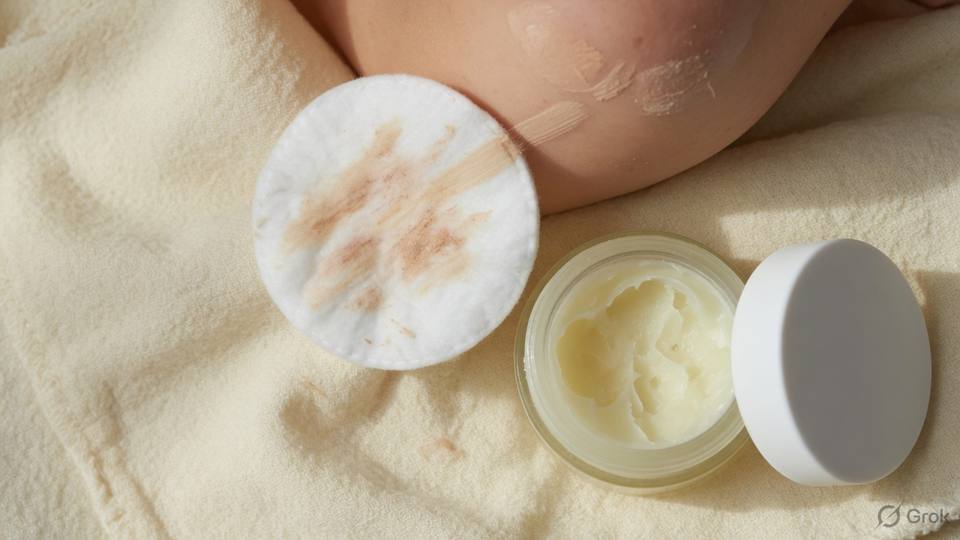
Oil or balm first if it is long-wear
Long-wear makeup does not come off with water alone. Waterproof mascara, long-wear foundation, lip stain, and many sunscreens are designed to resist water and oil, and a foaming cleanser will not dissolve them. An oil or a balm dissolves the product so that it can be lifted without friction. Use it first, on dry skin, with dry hands. Massage it over the face for about a minute, keeping the eyes closed, then add a little water to emulsify it and remove everything with a soft damp cloth. The product should slide off; if you are rubbing, you are not using enough oil or you have not waited long enough.
The eye area needs its own care. Apply the balm with the eyes closed and let it sit for thirty seconds before you wipe. Wipe downward, in the direction the lashes grow, with a damp pad and a light hand. Do not drag the pad across the lid from side to side, and do not use a dry tissue, which pulls the lashes and the thin skin. For waterproof mascara, a second pass with a clean pad is better than pressing harder on the first. If a lash is stuck, apply a little more balm and wait; pulling a lash out takes weeks to grow back and hurts more than the client expects.
Not every makeup needs an oil. A light, non-waterproof face can come off with a gentle cleanser or micellar water on a fresh pad, followed by a second cleanse. The test is simple: if the product does not lift with light pressure, it needs oil, not more scrubbing. Sunscreen is the exception that surprises people, because many high-protection formulas are designed to stay on the skin and need an oil-based step even when the makeup is light. If the client has worn a long-wear lip, use a balm on the lips too, and let it sit before wiping, because a stain that has been on for ten hours will not come off with a tissue.
The common errors in removal are all forms of force. Rubbing the eyes with a tissue, using hot water that strips the skin, pulling a strip lash off dry, and scrubbing a stubborn mascara with soap are the four that cause the most damage. None of them is necessary, and all of them make the next appointment harder because the client arrives with irritated skin or fewer lashes. If the client is tired after a long event, the removal still cannot be rushed. A minute of oil and a minute of gentle wiping is faster than a week of irritation, and the skin that is treated well will hold makeup better at the next booking.
- 1. Wash your hands and tie back your hair before you start.
- 2. Apply an oil or balm to dry skin with dry hands.
- 3. Massage for about a minute, keeping the eyes closed.
- 4. Let the balm sit on the eyes for thirty seconds before wiping.
- 5. Add a little water to emulsify, then remove with a soft damp cloth.
- 6. Wipe the eyes downward with a clean pad and light pressure.
- 7. Use a second clean pad rather than pressing harder.
- 8. Follow with a gentle cleanser to remove the last of the oil.
Salon example
Divya, thirty-three, came back to the salon at one in the morning after her reception, still in her outfit and very tired. She asked me to take the makeup off quickly because she wanted to sleep. I explained that a quick removal with a wipe would leave the waterproof mascara and the long-wear base behind, and that her skin would feel tight in the morning. We used a balm on dry skin, left it on the eyes for half a minute, and wiped downward with a damp pad. The mascara came off in two passes without a single lash on the pad. The base lifted with a soft cloth, and a gentle cleanser removed the last of the oil. She said her face felt clean rather than stripped, and she was asleep within twenty minutes. The next morning she sent a message saying her skin was calm, which is not always the case after a wedding. She has since booked a removal-only appointment after every family wedding, and she says it is the best hour she spends all week. Her sister has started doing the same after late functions.
Caution: Do not scrub waterproof mascara off with soap and a tissue; it pulls out lashes and irritates the eye, and the product will still be there.
Cleanse, then moisturise
The second step is a gentle cleanse. An oil or balm removes makeup, but it leaves a film on the skin, and that film can clog pores if it stays. Use a mild gel or cream cleanser with lukewarm water, massage it for thirty seconds, and rinse thoroughly. Do not use a foaming cleanser with a high pH, a scrub with particles, or a strong acid toner straight after a long event, because the skin is tired and the barrier is already under stress. Pat the skin dry with a clean towel, and do not drag the towel across the face. The goal is clean skin, not squeaky skin, and a face that feels tight after cleansing has been stripped.
Moisturise while the skin is still slightly damp, because that is when a cream holds water in most effectively. Use a simple night cream or a barrier cream, and add a little more on the cheeks if they feel dry. The eye area needs a small amount of a product made for it, patted gently with the ring finger, not rubbed. The lips need a balm, especially if they have worn a stain or a matte lipstick for hours. If the client has oily skin, do not skip moisturiser; choose a light gel instead, because dehydrated oily skin produces more oil and breaks down makeup faster the next day.
The advice you give at the end of a service is part of the service. Tell the client to remove her makeup every night, to keep a balm and a cleanser for late nights, and to use a clean towel. Tell her not to sleep in makeup, not even after a wedding, because the product traps oil and bacteria and the skin has no chance to recover. If she travels, a small balm and a gentle cleanser are enough; she does not need ten products. If she has a skin concern that persists after removal, such as redness, dryness, or a rash, tell her to see a skin therapist or a doctor rather than trying another product from a shop.
There are limits to what aftercare can fix, and it is honest to name them. A late night, a hot hall, and ten hours of makeup will leave most skin looking tired the next day, even with a perfect removal. A client who removes her makeup properly will recover faster than one who sleeps in it, but she will not look as if nothing happened. If the skin is irritated, stop using actives for a few days, keep the routine simple, and let the barrier recover. If the irritation is severe or does not settle, refer. The removal is not a treatment, and the client should not expect it to undo the event.
- 1. Use a mild gel or cream cleanser with lukewarm water.
- 2. Massage for thirty seconds and rinse thoroughly.
- 3. Do not use a scrub, a high-pH foam, or a strong acid toner.
- 4. Pat the skin dry with a clean towel.
- 5. Apply moisturiser while the skin is still slightly damp.
- 6. Add a small amount of eye cream with the ring finger.
- 7. Apply a lip balm after a stain or a matte lipstick.
- 8. Use a light gel moisturiser if the skin is oily.
Salon example
Anjali, thirty-eight, had been removing her makeup with facial wipes for years and could not understand why her skin felt tight and looked dull. She booked a makeup appointment and asked me to show her a better routine. After the event we removed the makeup with a balm, cleansed with a mild cream cleanser, and moisturised while her skin was still damp. She was surprised that her face did not feel tight afterwards. I explained that the wipes had been leaving a film and that the tight feeling she thought was clean was actually stripped skin. She changed her routine at home: a balm for the eyes, a cream cleanser, and a simple moisturiser. Three weeks later she sent me a photograph of her bare face and said it looked calmer. The makeup had not changed her skin; the removal had. She now keeps a balm beside her bed for the nights when she is too tired to stand at the basin, and she has stopped buying wipes in bulk. Her daughter, who is sixteen, uses the same routine after a party, which is a better lesson than any advertisement.
Caution: Do not finish a removal with a scrub or a strong toner; the skin is already stressed after a long event and the barrier needs calm, not another active.
Glitter, lashes, and the advice you give
Glitter needs patience rather than force. The particles are small and sharp, and scrubbing them across the eye can scratch the surface and leave fragments in the lashes. Use a balm or an oil, apply it generously over the glitter, and let it sit for a minute so that the adhesive softens. Then lift the glitter with a damp pad in one direction, and use a damp cotton bud for the pieces near the lash line. Do not use a dry tissue, and do not use sticky tape near the eye, which can pull the skin and the lashes. If a piece remains in the lash, soften it with more balm and lift it with the bud, not with a fingernail.
Lash glue needs a proper remover. A strip lash should be loosened with a lash glue remover or an oil-based product, worked gently from the outer corner, and lifted without pulling the natural lashes. Never pull a lash off dry, and never pick at the glue along the lash line, because that is how a stye or a small infection starts. If the client had individual lashes, the removal is slower: soften the glue with a remover, and slide each lash off rather than pulling it. If the lash does not move, leave it and ask the client to return; a lash that stays for another day is better than a natural lash that comes out with it. Patch test any glue before use, and never share a lash applicator.
The advice you give the client should be the advice you follow yourself. Do not tell a client to remove her makeup every night while you sleep in yours, and do not recommend a product you have never used on your own skin. Keep the routine simple: remove, cleanse, moisturise. Do not make the client feel that she needs a ten-step routine to be clean, and do not sell her a product for a problem she does not have. If she asks whether she can use a makeup wipe on a late night, say that a wipe is better than nothing but not as good as a balm and a cleanser, and that it should not become the routine.
The last piece of advice is about the tools. Brushes that are used on a client should be washed before they touch another face, and the client's own brushes need washing regularly too. Pillowcases should be changed after a heavy makeup night, because product transfers to the fabric and then back to the skin. If the client wears makeup most days, tell her to give her skin a bare day now and then, not as a punishment but as a chance to check what is actually happening on her face. The removal is where the artist's care continues after the client leaves, and the advice is part of the work.
- 1. Apply a balm or oil over glitter and let it sit for a minute.
- 2. Lift the glitter with a damp pad in one direction.
- 3. Use a damp cotton bud for pieces near the lash line.
- 4. Never scrub glitter, and never use tape near the eye.
- 5. Soften lash glue with a remover before lifting the lash.
- 6. Slide individual lashes off rather than pulling them.
- 7. Tell the client what you actually do at home.
- 8. Wash brushes and change the pillowcase after a heavy makeup night.
Salon example
Preeti, twenty-four, came home from a party with glitter shadow on both lids and a strip lash on each eye. Her friend told her to scrub the glitter off with a face wash, which she tried, and her eyes were red and stinging when she called me. I asked her to stop and come over. We used a balm on dry skin, left it on the lids for a minute, and lifted the glitter with a damp pad. The strip lashes came off after a little remover at the outer corner, with no natural lashes on the pad. I rinsed her eyes with cool water, checked that nothing was left in the lash line, and used a simple moisturiser. The redness settled within an hour. She said she had no idea that glitter needed oil rather than soap, and she now keeps a small balm in her bathroom for party nights. The lesson cost her an hour, not an eye. She now messages me before a party to ask which remover to keep ready, and she has stopped borrowing other people's makeup at the end of the night.
Caution: Never scrub glitter off the eye or pull a lash off dry; soften the product first and lift it gently, or refer the client if the eye is irritated.
This is a Nandu Nai textbook. It is a private brand book, not a government licence, and it does not give the right to give medical treatment.