
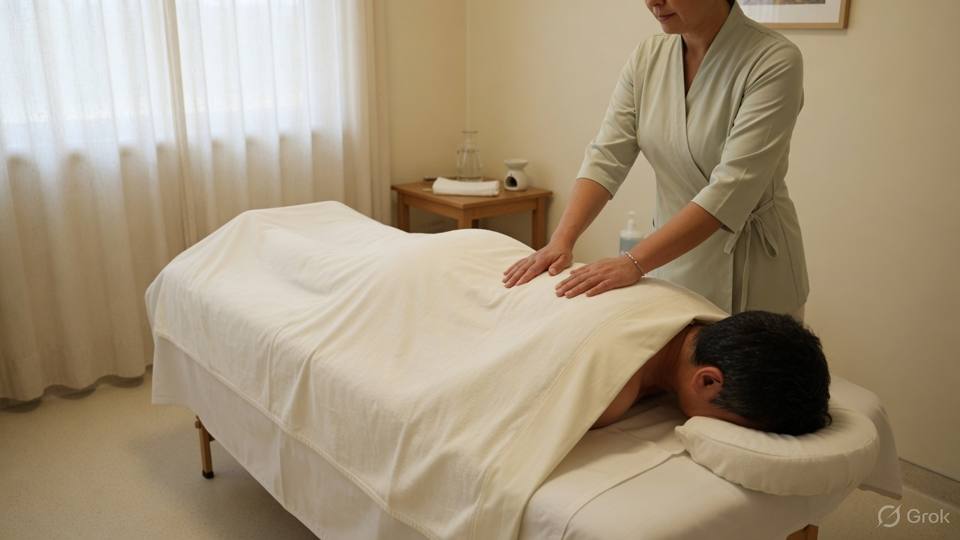
The conversation before the first touch
A session starts in the waiting area, not on the table. Greet the client by name, check how to pronounce it, and lead them to a private room rather than discussing their body in a corridor. Ask an open question about what brought them in, then let them finish without interrupting. The reason behind the booking matters more than the service name on the screen: a stiff neck after a long journey, a month of broken sleep, a shoulder that aches by four in the afternoon. Repeat back what you heard in one sentence so the client can correct you. Silence while they think is useful, so resist filling it with a list of techniques.
Explain the plan in ordinary words before anything is removed. Name the areas you intend to work, the order you will work them in, and how long each part will take. Say that the client keeps their underwear on and that a sheet covers them throughout, with only the area being worked left uncovered. Set out the pressure scale from one to ten and say that five is firm and comfortable. Ask what pressure they usually like and whether they have had a massage before. If they have, ask how they felt the next day, because that answer tells you more than any form.
Consent is a conversation that continues for the whole session, not a signature collected at the desk. A signed form records that information was given; it does not tell you how the client feels ten minutes later, when a hand moves to a new area or the pressure rises. Check again at each transition, before turning the client over, and before any work on the abdomen, the face, the feet, or the front of the shoulder. Silence is not agreement. If the client hesitates, offer a smaller choice: keep the area covered, use lighter pressure, or skip it and spend the time elsewhere.
Say the limits out loud, once, at the start. This is a professional massage service: no breast massage, no genital massage, and no work under the underwear. The client stays draped, and the drape is not moved to save time. If a client asks for anything sexual, refuse in one short sentence, stop the session, and do not negotiate, joke, or explain at length. If they withdraw consent for an area, stop that part at once and continue only with what is still agreed. Write down what was agreed, including any area the client asked you to avoid, so the next therapist respects it too.
- 1. Greet the client, confirm the booking and the length, and take them to a private room.
- 2. Ask what they want from the session, in their own words, and let them finish.
- 3. Ask about health conditions, injuries, medicines, allergies, pregnancy, and recent surgery.
- 4. Explain which areas you will work, in what order, and roughly how long each will take.
- 5. Explain that underwear stays on and that the sheet covers them except for the area being worked.
- 6. Define the one-to-ten pressure scale, with five as firm and comfortable, and ask what they prefer.
- 7. Ask where they do not want to be touched, and write the answer on the record.
- 8. State the fixed limits: no breast massage, no genital massage, no work under the underwear.
- 9. Say that they can stop, skip an area, or ask for less pressure at any moment, without explaining why.
- 10. Get a clear yes before you leave the room, and check again whenever the plan changes.
Salon example
Meera books sixty minutes after a week of long office days. At the counter she mentions a sore shoulder and says little else. In the room the therapist asks what she hopes to feel when she leaves and whether a doctor has looked at the shoulder. Meera explains that she fell two months ago, that an X-ray showed no fracture, and that the ache has been steady since. The therapist repeats the plan: back, shoulders, and neck first, then legs, arms, and a quiet finish, with the undergarments kept on and the sheet covering everything except the part being worked. Meera asks to skip her feet and to avoid the left side of her neck. The therapist writes both on the intake sheet, reads them back, and explains the pressure scale. Meera chooses five. The therapist leaves the room so she can undress in private and knocks before returning. Halfway through, when the work moves to the neck, the therapist repeats the note about the left side and stays on the right. Meera leaves relaxed and books again with the same two requests on file.
Caution: A signature on a form records information; it never replaces asking again when the area, the pressure, or the plan changes.
Draping that keeps the client covered
Draping is consent made visible. The client stays covered by a sheet or a large towel for the whole session, and only the area being worked is uncovered. Breasts and genitals are never exposed and never massaged. Use fabric wide enough to cover the whole body with something to spare, tuck it under the far side of the mattress, and fold it back in a clean straight line instead of dragging it across the client. When you work a leg, expose that leg only, from hip to foot, and re-cover it before you move to the other side. If the client shivers, add a blanket before continuing rather than rubbing harder to warm them.
Good draping is also a matter of movement. Ask the client to turn while the sheet is held, or hold the sheet yourself and let them roll beneath it. Never ask a client to move a towel for you or to hold fabric in place. Work around the sheet rather than pushing it aside, and position your own body so you are not leaning across exposed skin that you are not working. Keep the drape over the chest when you work the abdomen, the hip, or the upper leg. The gluteal area is worked only if it has been agreed, only through the sheet, and never under the underwear. If the sheet slips, stop, replace it, and carry on without a comment that draws attention to the mistake.
Offer clothing choices rather than assuming one. Some clients are comfortable with underwear; others prefer shorts, a gown, or a full set of loose clothes. A client who keeps more clothes on can still receive excellent work on the back, shoulders, neck, arms, hands, feet, and scalp. Say this clearly, because many first-time clients worry that refusing to undress means refusing the massage. Have clean shorts and gowns available in more than one size, and mention them before the client undoes anything. The choice belongs to the client, and it can change between sessions or halfway through one. Clients notice this preparation even when they cannot name it, and it removes the small anxiety that makes a first session feel unsafe.
Draping fails in small, ordinary ways: a sheet that is too short, a room that is too cold, a therapist who reaches across the body, a towel that is thin when the light is bright. Check the linen before the client arrives, and check the room temperature. Keep a spare sheet and a blanket within reach. When the client turns over, hold the sheet up as a screen and look away until they are settled. None of this is fussy. A client who feels covered stops monitoring the drape and starts to relax, and relaxation is the whole point of the service.
- 1. Put a clean, wide sheet on the table before the client enters, with a spare sheet and blanket within reach.
- 2. Explain the drape and the clothing choice before the client undoes anything.
- 3. Leave the room while the client undresses, and knock before you return.
- 4. Fold the sheet back only as far as the area you are working, and never further.
- 5. Expose one limb at a time, and re-cover it before starting the next area.
- 6. Tuck the sheet under the far edge of the mattress at the shoulder, the hip, and the feet.
- 7. Hold the sheet as a screen when the client turns over, and look away until they are settled.
- 8. Keep the chest covered during abdominal, hip, and upper-leg work.
- 9. Work the gluteal area only if agreed, only through the sheet, and never under the underwear.
- 10. Replace a slipped drape at once, without commentary, and continue only when the client is covered.
Salon example
Ravi comes for his first massage and admits at the door that he is nervous about undressing. The therapist explains that he can keep his shorts on, that his chest will stay covered, and that only his back will be uncovered at first. Ravi lies face down and the therapist folds the sheet to the base of his spine, tucking the upper edge firmly under the far side. When it is time for his legs, the therapist covers his back again before folding the sheet down from the waist, and works one leg at a time. Ravi turns over beneath the sheet while the therapist holds it as a screen. At no point are his chest or groin exposed. During the neck work the sheet slips from his shoulder; the therapist stops, replaces it, tucks it again, and resumes without making him feel awkward. Afterwards Ravi says the covering was the reason he could relax enough to notice the effect. The therapist records his preference for shorts and a warm room. He also asks for a warmer blanket on the legs, which the therapist notes for next time.
Caution: No breast massage and no genital massage. These are fixed professional limits, not preferences that a booking, a tip, or a request can change.
The pressure scale from one to ten
Pressure is described on a scale from one to ten, and the numbers only work when both people mean the same thing. One is a light touch that barely moves the skin. Three is comfortable and calming. Five is firm, the pressure most clients call good during a full-body massage. Seven is strong and may suit a tight shoulder for a short period. Nine or ten is sharp, breath-taking pressure that has no place in a relaxation session. Explain these anchors before you begin and ask for a number once your hands are working, not while the client is still standing in their coat.
Pressure is not a test of endurance. Some clients believe they must ask for ten to get their money's worth, and some therapists believe deeper is always better. Neither is true. Different areas tolerate different pressure: the upper back may accept a seven while the front of the neck accepts a two, and the shin accepts less than the thigh. Slow, broad pressure often feels deeper than fast, sharp pressure, so adjust speed and contact area before you add force. Watch the breath, the jaw, the hands, and the feet. If the breath becomes shallow or the fingers curl around the edge of the table, reduce at once and ask what changed.
Ask for a number at the start of each new area and after the first minute of deeper work. Repeat the number back so the client knows you heard, and then act on it. If they ask for more, increase gradually and check again rather than jumping two levels. If they ask for less, reduce immediately and do not ask twice whether they are sure. A client who says the pressure is fine while holding their breath is not giving useful information; the body is answering a different question. Trust the body, and give the client credit for noticing the difference when you name it.
The scale also covers what you will not do. You will not go deeper than the agreed number because the tissue feels tight, because the client is quiet, or because you think they can take it. You will not use elbows, knees, or body weight to deliver a ten when the booking asked for a relaxing five. If a client wants work that is beyond your training or beyond what the tissue safely accepts, say so plainly and offer what you can do. Pressure is a service the client chooses, not a performance the therapist wins. A number is a request, not a challenge, and the therapist who treats it that way keeps the client's trust for years.
- 1. Define the anchors before the session: one is light, three is calming, five is firm, seven is strong, ten is sharp.
- 2. Ask for a starting number before your hands touch the skin, and note it.
- 3. Begin one level below the requested number and build up over the first minute.
- 4. Check the number at the start of every new area, and after any change of stroke.
- 5. Repeat the client's number back so they know you heard it.
- 6. Change speed and contact area before you change force.
- 7. Reduce pressure at once if the breath shortens, the jaw tightens, or the hands grip.
- 8. Use different numbers on different areas of the same body, and say so.
- 9. Refuse to exceed the agreed number just because the tissue feels tight.
- 10. End every area at a lower number than you used in the middle of it.
Salon example
Anjali asks for deep pressure because she sits at a desk all day. The therapist explains the scale and starts at four on her upper back. Anjali says it feels good and asks for more, so the therapist moves to five, then six, checking after each change. At six she is quiet and breathing slowly. When the therapist moves to the front of her neck, the same pressure makes her lift her chin and hold her breath. The therapist drops to two without being asked and says what she noticed. Anjali admits that the lighter touch is comfortable and the stronger one felt sharp rather than satisfying. The therapist stays at two for the neck, returns to six on the upper back, and finishes the shoulders at four. At the end, Anjali says she had assumed deep pressure everywhere was the goal. The therapist explains that the goal is useful pressure the body accepts, not the highest number on the scale. She adds that the neck is a place where the same number always feels stronger, and that this is normal rather than a failure of nerve. Anjali says she will ask for two on the neck next time from the start.
Caution: Sharp, burning, numb, or tingling sensations are not signs of good work. Stop, change the stroke, and reassess before continuing.
This is a Nandu Nai textbook. It is a private brand book, not a government licence, and it does not give the right to give medical treatment.