
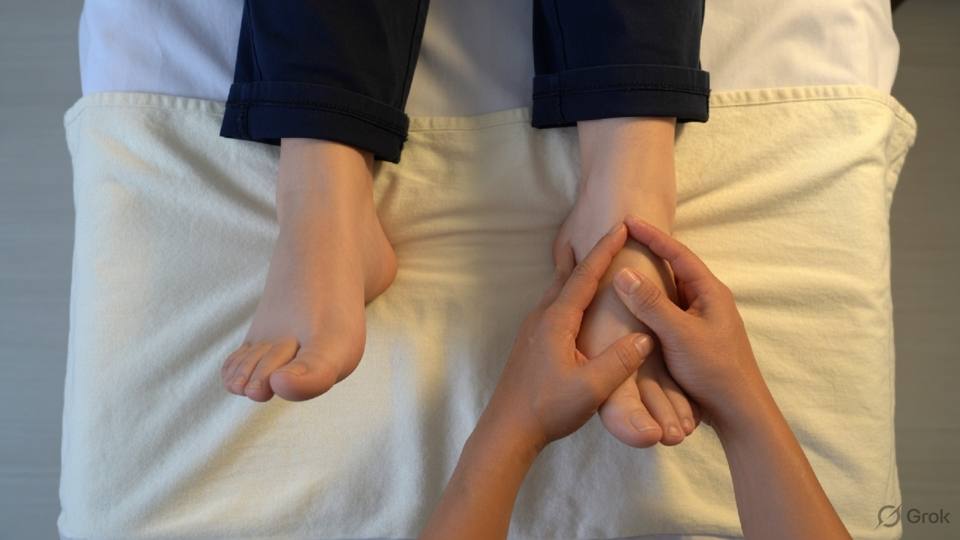
A twenty-minute foot and lower-leg sequence
A twenty-minute foot and lower-leg session is a complete service when it is planned, and a rushed one when it is not. Use two minutes to settle the client, check the skin, and agree the pressure, then fourteen minutes of hands-on work, and four minutes to finish, wipe the feet, and give aftercare. Seat the client in a chair with the leg supported on a stool or a padded rest, or use the table with a bolster under the knees if the client prefers to lie down. The leg should be supported so the calf is not hanging, and the knee should be slightly bent rather than locked straight.
Begin with the lower leg. Apply a small amount of oil to your hands and use effleurage from the ankle to the knee, moving toward the heart, for about three minutes. Then use petrissage on the calf, lifting and squeezing the muscle with both hands, keeping away from the shin bone and the back of the knee. Give the calf four minutes, working the inner and outer sides, and check the pressure. Then move to the foot: effleurage over the top and the sole, thumb circles along the arch, and gentle work between the bones of the foot with the pads of your fingers. Give the foot five minutes, then finish with slow effleurage up the leg.
The sequence should have a clear shape: settle, warm, work, settle again. Do not spend the whole twenty minutes on the soles, because the calf is usually the part that carries the day's standing. Do not ignore the ankle, but do not force it into a stretch; gentle circles around the ankle bone are enough unless the client has asked for more and has no injury. Work the heel with the palm rather than a thumb point, and use both hands so the foot feels held rather than prodded. If the client is ticklish, keep the contact broad and slow, and avoid the arch until they are used to the touch.
Finish by wiping the feet with a clean towel so the client does not slip when they stand. Put their footwear within reach, and ask them to stand slowly, because the calf work can leave a light-headed client unsteady. Give the aftercare: water, no long walk in tight shoes straight away, and a note that mild soreness in the calf for a day is normal. Record the areas worked, the pressure, the skin check, and anything the client reported. If the client has come because of a specific pain, ask whether it changed, and write the answer down rather than relying on memory.
- 1. Confirm consent for the foot and lower leg, and check the skin before touching.
- 2. Support the leg on a stool or bolster so the calf is not hanging and the knee is soft.
- 3. Settle with two minutes of still contact and broad effleurage from ankle to knee.
- 4. Agree the pressure number, and keep the first pass below it.
- 5. Give the calf four minutes of petrissage, avoiding the shin bone and the back of the knee.
- 6. Give the foot five minutes, with thumb circles along the arch and work between the bones.
- 7. Work the heel with the palm rather than a thumb point, and keep both hands in contact.
- 8. Use broad, slow contact for a ticklish client, and avoid the arch until they settle.
- 9. Finish with slow effleurage up the leg and wipe the feet with a clean towel.
- 10. Ask the client to stand slowly, give aftercare, and record the pressure and skin check.
Salon example
A client named Naveen works on his feet in a kitchen for ten hours a day and books twenty minutes for his feet and calves. The therapist seats him with his right leg on a padded stool, checks both feet for broken skin and nail problems, and agrees a pressure of five. She begins with effleurage from the ankle to the knee for three minutes, then works the calf with petrissage, keeping away from the shin and the back of the knee. Naveen says the calf feels tight but the pressure is right. She spends four minutes on the calf, then moves to the foot: thumb circles along the arch, gentle work between the bones, and the heel worked with the palm. Naveen flinches once when she reaches the arch, so she slows down and broadens the contact. The foot gets five minutes, and she finishes with slow strokes up the leg. She wipes both feet, puts his shoes within reach, and tells him to stand slowly. Naveen says he can feel his feet again, and books the same slot for the following week.
Caution: Do not work on broken skin, an infected nail, or a new wound on the foot. Cover it, avoid the area, or reschedule.
Pressure, bones, and broken skin
The foot is a small area with a lot of bone, so pressure needs to be precise. Use the pads of the thumbs and fingers rather than the tips, and keep the pressure broad enough that you are moving tissue rather than digging. The arch tolerates a medium pressure, the heel tolerates more through the palm, and the top of the foot tolerates very little because the bones sit close to the skin. The ankle bones are not pressure points to be pressed; work around them, not on them. If the client says the pressure is sharp, it is too much, whatever the number they chose earlier.
Broken skin changes the plan. A cut, a blister, a cracked heel that is bleeding, an infected toenail, or a new wound means you do not work that area. Cover a small clean graze and work elsewhere, or reschedule if the area is the reason for the booking. Do not apply oil to broken skin, and do not pick at a callus or cut a nail; that is not within the role. If the skin is hot, red, and spreading, think infection and refer. If there is a foul smell, discharge, or dark discolouration, refer the same day, especially in a client with diabetes.
Athlete's foot is common and easy to miss. Look for peeling, itching, and redness between the toes, and for a powdery or moist patch on the sole. It is contagious, so do not work on the affected area, wash your hands afterwards, and clean the stool, the towel, and anything the foot has touched. Wear gloves if you have a cut on your hand. Tell the client plainly what you have seen and suggest a pharmacist or doctor, without diagnosing. Reschedule if the area is extensive or weeping, and note the finding so the next appointment starts with a check.
Pressure also has to respect the structures. Avoid pressing into the front of the ankle where the tendons and vessels are close to the surface. Avoid strong pressure on the top of the foot over the bones. Avoid pulling on the toes or cracking them. Do not use your body weight through a thumb on the sole, and do not lean on the foot with your forearm. The foot is small enough that a little force goes a long way, and the difference between a satisfying massage and a bruise is often a few degrees of pressure and a change of contact area.
- 1. Look at both feet before touching, including between the toes and around the nails.
- 2. Do not work on cuts, blisters, cracked bleeding heels, infected nails, or new wounds.
- 3. Cover a small clean graze and work elsewhere, or reschedule if the area is the reason for the visit.
- 4. Do not apply oil to broken skin, pick at calluses, or cut nails.
- 5. Treat hot, red, spreading skin as a possible infection and refer.
- 6. Check for athlete's foot, avoid the area, and clean everything the foot has touched.
- 7. Use the pads of the thumbs and fingers, not the tips, and keep the contact broad.
- 8. Avoid the ankle bones, the front of the ankle, and strong pressure on the top of the foot.
- 9. Do not pull or crack the toes, and do not lean body weight through a thumb.
- 10. Record the skin findings, the areas avoided, and the referral made.
Salon example
A client named Rekha asks for a foot massage after a wedding season of standing in new shoes. Before she sits down, the therapist looks at both feet and sees a blister on the back of her right heel and a patch of peeling skin between the toes of her left foot. The therapist explains what she has seen, says she will avoid both areas, and asks whether Rekha has noticed itching. Rekha says she has, and that she has been treating it with a powder from the pharmacy. The therapist works the calves and the parts of the feet that are clear, keeps her hands washed, and uses a fresh towel. She does not apply oil near the blister and does not work between the toes. At the end she suggests Rekha see a pharmacist if the peeling spreads, and notes both findings on the file. She also wipes the stool and the floor where the foot rested, and puts the towel straight into the bin. She leaves the peeling patch alone for the rest of the session and does not comment on it again, because the client is already embarrassed about her feet.
Caution: Athlete's foot is contagious. Do not work the affected area, and clean the stool, towel, and floor before the next client.
Diabetes, numb feet, and when to refer
Diabetes changes how you work on feet. Reduced sensation means a client may not feel pressure accurately, so they cannot tell you when it is too much. Circulation may be poorer, so skin heals slowly and minor damage matters more. Ask every client with diabetes whether they have numbness, tingling, or a history of foot ulcers, and look carefully at the skin, the nails, and between the toes before you begin. If sensation is reduced, keep the pressure light, avoid heat, and check the skin during the session rather than only at the start. Refer any wound, ulcer, or area of unusual colour to a doctor.
Numb feet need a different conversation. If the client cannot feel a light touch, they cannot give you reliable feedback, so the usual pressure scale is not enough. Use your eyes and your judgement: keep the work broad, light, and short, and stop at the first sign of redness that does not fade. Do not use a hot towel, a heated boot, or a warm stone on a numb foot, because the client may not feel a burn. Do not work on a foot with an ulcer, even a small one, and do not attempt to remove hard skin. Refer to a podiatrist or the client's diabetes team.
Circulation is the other concern. A foot that is cold, pale, or blue, with shiny skin and hair loss, may have poor blood supply, and strong massage is not the answer. A foot that is hot, red, and swollen may be infected. A calf that is hot and swollen may be a clot, which is an emergency and not a foot problem at all. Ask about recent flights, bed rest, and previous clots, and compare both legs before you start. When in doubt, do not rub; refer, and write down what you saw. That is a judgement you make with your eyes, not a number the client gives you.
Being honest about the limits is part of the service. A foot massage can help a tired client feel better, and it can be a pleasant part of a longer session, but it does not treat neuropathy, cure poor circulation, or replace a podiatrist. Say that plainly if a client asks. Offer what you can do safely, and refer what you cannot. A client with diabetes who trusts your honesty will come back for the care you can give, and they will be safer for the questions you asked. A short session that ends with a clear referral is better than a long one that ends with a problem you did not name.
- 1. Ask every client with diabetes about numbness, tingling, ulcers, and poor healing.
- 2. Inspect the skin, nails, and spaces between the toes before starting.
- 3. Keep pressure light and broad if sensation is reduced, and check the skin during the session.
- 4. Avoid heat on a numb foot: no hot towels, heated boots, or warm stones.
- 5. Stop at the first sign of redness that does not fade, and refer.
- 6. Do not work on an ulcer, a wound, or hard skin, and do not attempt to remove callus.
- 7. Compare both legs for heat, colour, and swelling before any leg work.
- 8. Treat a hot, swollen calf as a possible clot and send the client to urgent care.
- 9. Do not claim that massage treats neuropathy or poor circulation.
- 10. Record the findings, the pressure used, and the referral made.
Salon example
A client named Bashir has had diabetes for fifteen years and books a foot massage because his feet feel heavy. The therapist asks about numbness and ulcers, and Bashir says he has some numbness in both feet and once had a small ulcer that took months to heal. The therapist looks at both feet, checks between the toes, and finds the skin intact but dry, with a callus on the right heel. She explains that she will keep the pressure light and will not use heat or work on the callus. Bashir agrees. She works the calves with broad effleurage and the feet with gentle palm strokes and light thumb circles, checking the skin every few minutes. She avoids the heel callus entirely. At the end she suggests he ask his diabetes team about the callus and about footwear, and notes the numbness and the advice on his file. She does not promise that the massage will improve his circulation, and Bashir says he appreciates being told the truth. He books again for the following month and asks for the same therapist, who adds a note to check the callus before each session and to keep the room warm without using heat on the feet.
Caution: Do not use heat on a numb foot. A client who cannot feel a burn will not tell you before the skin is damaged.
This is a Nandu Nai textbook. It is a private brand book, not a government licence, and it does not give the right to give medical treatment.