
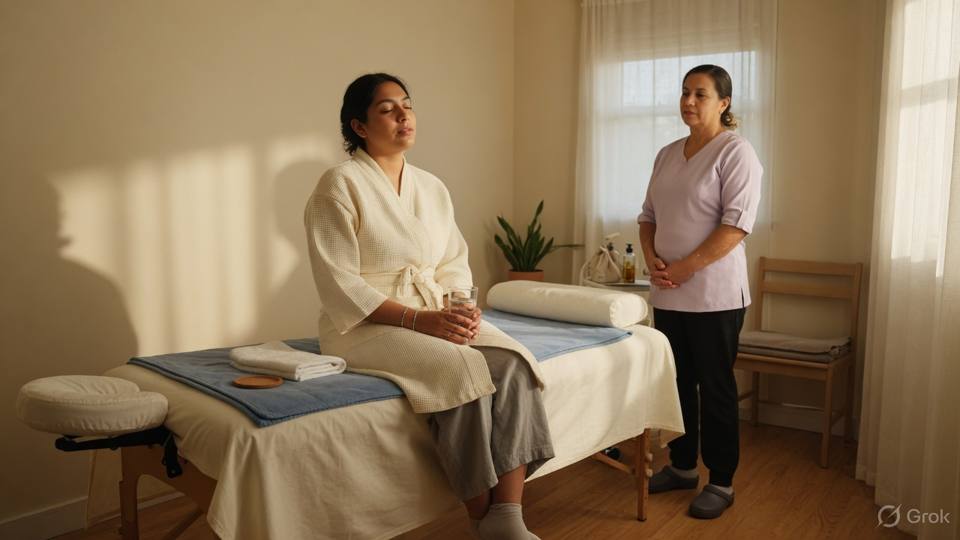
Normal soreness and warning signs
Mild soreness for a day after a massage is common, especially after work on tight shoulders or calves. It usually feels like the muscle has been used, similar to the day after unaccustomed exercise, and it eases with gentle movement. It should not be sharp, it should not stop the client from doing ordinary things, and it should not get worse over the following days. Tell the client this before they leave, so they are not alarmed by a familiar feeling, and so they know what would be unusual. A short explanation prevents most worried phone calls. That also protects the salon from a client who assumes the therapist damaged them because nobody explained what was expected.
Sharp pain is different. A pain that makes the client catch their breath, that shoots down a limb, or that is worse when they move in a particular direction is not normal soreness. Neither is numbness, tingling, pins and needles, or weakness in an arm or a leg. These can be signs of nerve irritation and need assessment rather than another massage. If a client reports them during the session, stop the area and reassess. If they report them the next day, advise a medical review and do not offer to work on the area until it has been checked.
A calf that swells is a red flag. So is a calf that becomes hot, red, or tender after a session, particularly if the client has had a long flight, recent surgery, or a previous clot. Do not massage it, do not tell the client to walk it off, and do not wait to see whether it settles. Send them to urgent care the same day, and call emergency services if there is chest pain or breathlessness. The same caution applies to a leg that swells after a period of bed rest or a long car journey. A massage can be the thing that draws attention to a clot, and the right response is referral, not rubbing.
Other warning signs are less specific but still matter: a fever, a spreading rash, a feeling of faintness, a severe headache, or a new pain that does not fit the work you did. Ask the client to contact the salon if any of these appear, and record the call. If they describe something urgent, tell them to seek medical care rather than booking another appointment. The salon's job after the session is to be reachable and honest, not to keep the client in the treatment room because the next booking is available. A short, calm conversation at that point is worth more than a defensive one later.
- 1. Tell the client before they leave that mild soreness for a day can happen.
- 2. Describe the soreness as a used-muscle feeling that eases with gentle movement.
- 3. Name the warning signs: sharp pain, numbness, tingling, weakness, and a swollen calf.
- 4. Stop the area during a session if any warning sign appears, and reassess.
- 5. Advise a medical review for symptoms reported the following day.
- 6. Treat a hot, swollen, tender calf as a possible clot and send the client to urgent care.
- 7. Call emergency services for chest pain or breathlessness with a swollen calf.
- 8. Ask the client to contact the salon for fever, spreading rash, faintness, or a severe headache.
- 9. Do not book another massage for an area that has not been assessed.
- 10. Record every after-session report and the advice given.
Salon example
The morning after a deep calf session, a client named Meenakshi calls the salon to say her right calf is sore and slightly swollen. The therapist who took the call asks whether the swelling is on one side, whether the calf is warm, and whether she has had a flight or a period of bed rest. Meenakshi says the calf is warmer than the other one and that she flew home from a conference two days ago. The therapist does not book her in for another massage. She explains that these signs need checking today and gives her the address of the urgent care clinic. She also asks her to call back afterwards so the salon knows the outcome. Meenakshi is scanned that afternoon and the clinic finds no clot, but advises rest and a review. The therapist records the call, the advice, and the outcome, and notes that the next leg session should be lighter and should start with a question about recent travel. The clinic confirms that the calf is clear and that the soreness is muscular, and the therapist passes the message to Meenakshi the same evening.
Caution: A calf that is hot, swollen, and painful after a massage is not a reason for more massage. Send the client for medical assessment.
Aftercare: water, no sauna, and the day after
Water is the simplest aftercare advice and the easiest to overstate. Offer water after the session, and suggest the client drinks normally through the rest of the day. There is no need to force litres or to promise that water flushes out toxins, because that claim is not true and it makes the salon sound like it is selling something. If the client is thirsty, water is welcome. If they are not, a glass is still a reasonable offer. The point is comfort and hydration after an hour of lying down, not a detox programme. A glass of water and a calm few minutes are the whole of the advice, and they are enough.
A sauna, a steam room, or a very hot bath straight after deep work is a bad idea for most clients. Heat can make a client feel dizzy, can increase soreness, and can leave someone who is already relaxed feeling faint. Suggest waiting until the next day and using gentle warmth instead. The same applies to a heavy gym session, a long run, or a hot yoga class. A walk, some light stretching, and an early night are better choices. If the client has a medical condition that affects blood pressure or balance, be firmer about the heat advice. If the client has been drinking alcohol, the heat advice matters more, and the session should not have started in the first place.
The day after is when the client decides whether the massage helped. Mild soreness that eases by the afternoon is a good sign. A shoulder that moves more easily, a neck that turns further, or a calf that feels lighter are all worth noting. A pain that is worse, a new numbness, or a feeling of being bruised all over are reasons to call. Ask the client to report either way, because the report shapes the next session. A therapist who never hears the day-after result is working blind, and the client who is never asked learns that the follow-up does not matter.
Aftercare also includes the next booking. Do not book the client in sooner than the work needs, and do not promise a fixed number of sessions for a medical problem. If the client wants weekly sessions because the first one felt good, agree a plan and review it after a few visits. If the soreness lasts more than a couple of days, wait longer before the next deep session. The interval is part of the treatment, not a sales target, and a client who is given time to recover trusts the advice more than one who is booked in before they have stopped aching.
- 1. Offer water after the session, and suggest normal drinking rather than forced litres.
- 2. Do not claim that water flushes out toxins or that massage needs a detox.
- 3. Advise against a sauna, steam room, or very hot bath straight after deep work.
- 4. Advise against a heavy gym session, a long run, or hot yoga on the same day.
- 5. Suggest a walk, light stretching, and an early night instead.
- 6. Be firmer about heat advice for clients with blood pressure or balance problems.
- 7. Ask the client to report how they feel the next day, good or bad.
- 8. Treat worsening pain, new numbness, or all-over bruising as reasons to call.
- 9. Do not promise a fixed number of sessions for a medical problem.
- 10. Review the interval after a few visits rather than booking on a sales target.
Salon example
After a deep shoulder session, a client named Ayesha asks whether she can go to the sauna at her gym that evening. The therapist explains that a sauna straight after deep work can leave her dizzy and more sore, and suggests waiting until the next day. Ayesha is disappointed because the sauna is part of her routine. The therapist offers an alternative: a warm shower, a walk, and some water, with the sauna the following evening if she feels well. Ayesha agrees. The next morning she messages to say her shoulders feel looser but a little sore, and that she slept well. The therapist replies that this is the expected pattern and asks her to keep the area warm. At the next booking they agree to leave two weeks between deep sessions rather than one, because Ayesha's training schedule is heavy. The therapist records the advice about the sauna and the agreed interval, and notes that Ayesha responds well to a clear explanation rather than a list of rules. Ayesha keeps the sauna for the following evening and says the delay was worth it, because the soreness had settled by then.
Caution: Do not send a client from deep work straight into a sauna, a steam room, or a hot bath. Heat after deep work can cause dizziness and more soreness.
What massage does not cure
Massage can ease muscular tension, support relaxation, and help a client feel more comfortable in their body. It does not cure a slipped disc, infertility, cancer, diabetes, or any other disease. It does not move a disc back into place, reset a joint, or remove toxins from the body. Those claims are false, and repeating them damages trust and can lead clients to delay proper care. A massage therapist is not a doctor and should not diagnose, prescribe, or advise a client to stop medical treatment or skip a recommended test. The distinction between comfort and cure is the most important sentence a therapist learns to say.
The slipped disc is a good example. A client may arrive with a scan, a diagnosis, and a belief that deep pressure can push the disc back. Explain that the disc is a structure inside the spine, that massage works on the muscles around it, and that no external pressure can move it back into place. Massage may reduce the surrounding tightness and help the client feel more comfortable, but it cannot change the disc itself. Suggest they discuss the scan with their doctor or physiotherapist, and keep your work gentle and within what has been cleared. That explanation is usually a relief, because it gives the client a realistic reason to keep coming without expecting a miracle.
Infertility is another area where claims run ahead of evidence. Some clients are told that a particular massage, oil, or technique will help them conceive, and they arrive hopeful and vulnerable. Do not promise that massage will improve fertility, unblock tubes, or balance hormones. You can offer a relaxing session that helps them feel cared for during a difficult time, and you can say honestly that this is what you are offering. If they ask medical questions, refer them to their fertility team. Hope is not something to trade on. A gentle session can still be a good session, and it does not need a medical claim attached to it.
The general rule is simple: describe benefits in modest, specific terms, and refuse to make medical promises. Say that massage may help you feel more relaxed, that it may ease muscular tightness for a while, and that it is not a treatment for disease. If a client asks whether massage can replace their medicine, their physiotherapy, or their scan, the answer is no. If they ask whether it can help alongside those things, the answer is that it may help with comfort and relaxation, and that their treating team should know. That answer is honest, defensible, and kind. If the treating team has advice, follow it, and if there is none, work within the limits of a relaxation service.
- 1. Describe benefits in modest, specific terms: relaxation, comfort, temporary easing of muscular tightness.
- 2. Do not claim that massage cures a slipped disc, infertility, cancer, or diabetes.
- 3. Explain that massage works on muscles around the spine, not on the disc itself.
- 4. Do not promise that any technique moves a disc back or resets a joint.
- 5. Do not claim that massage improves fertility, unblocks tubes, or balances hormones.
- 6. Offer relaxation and care during fertility treatment without promising an outcome.
- 7. Do not diagnose, prescribe, or advise stopping medical treatment.
- 8. Refer medical questions to the client's doctor, physiotherapist, or specialist team.
- 9. Do not claim that massage removes toxins or replaces a scan.
- 10. Record the conversation and the referral in the client's notes.
Salon example
A client named Anil asks whether regular massage can cure the slipped disc shown on his scan. The therapist explains that massage may reduce the muscular tightness around his lower back and help him feel more comfortable, but it cannot change the disc itself. Anil says a friend told him that deep pressure could push the disc back. The therapist corrects the claim and suggests he discuss the scan with his doctor or physiotherapist. She offers a gentle session focused on relaxation, keeps the pressure at three, and avoids the areas the scan report mentions. Anil books again, and the therapist notes the conversation and the referral in his record. He later says the honest answer helped him trust the salon more, because two other places had promised a cure. At his next visit he brings a note from his physiotherapist with exercises, and the therapist reads it and works within those limits rather than inventing a plan of her own. The physiotherapist later calls the salon to confirm the plan, and the therapist is glad the file already records what was said and what was refused.
Caution: Never claim that massage cures a disease or replaces medical care. False claims are harmful, and they are also unprofessional.
This is a Nandu Nai textbook. It is a private brand book, not a government licence, and it does not give the right to give medical treatment.