
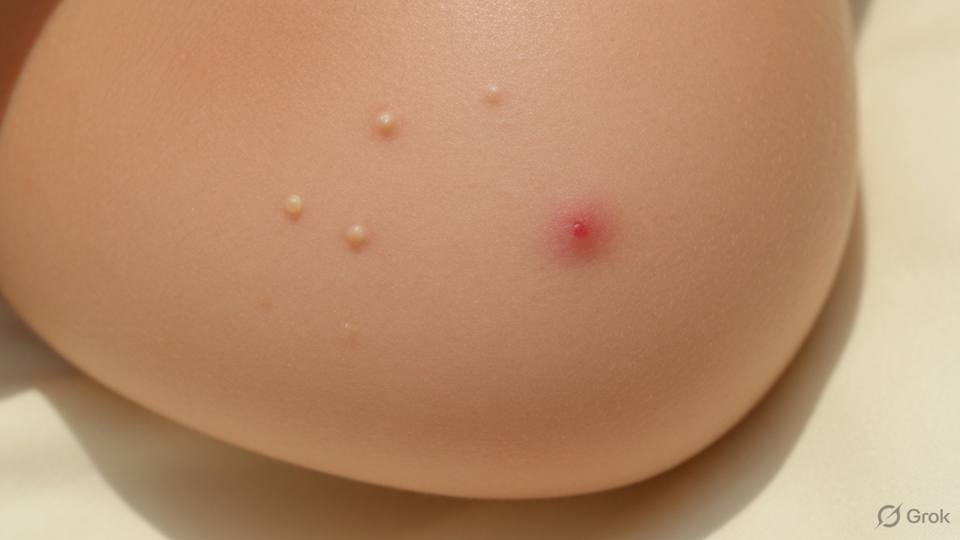
Reading the lesions
Acne produces several kinds of lesions, and they do not all behave the same way. A comedone is a blocked pore. It can be open, with a dark top, or closed, with a small white bump beneath the surface. A papule is a small, red, raised bump without visible pus. A pustule is a red bump with a visible white or yellow centre. These four types can often be supported in a salon with gentle care, sensible products, and honest expectations. The therapist should describe what is visible, where it sits, and how many lesions are present, rather than inventing a severity score. The name of the lesion decides whether extraction is appropriate, whether an active is safe, and whether the client needs a doctor.
Deeper lesions are a different category. A nodule is a firm, painful lump under the skin, and a cyst is a larger, deeper swelling that may be tender and may leave a mark or a scar. Neither should be squeezed, needled, or forced with heat. A pustule that looks ready may release easily with gentle pressure, but a nodule has no opening and pressure only pushes inflammation sideways. The salon should not attempt extraction on these lesions, and should not use a hot compress to bring them to a head. A client with nodules or cysts needs a dermatologist even when the visible count is small. The same applies when acne is painful, leaves scars, or appears suddenly in an adult.
A good examination is systematic. Clean the skin gently, use bright light, and look at the forehead, nose, cheeks, jaw, chin, neck, chest, and back if the client is comfortable. Note the type, the number, the depth, and whether marks or scars are already present. Ask how long the lesions last, whether they change with the monthly cycle, and what the client has used. Photographs with written consent help track change over weeks, but they are not a diagnosis. Do not name a disease or tell the client what caused the acne. Describe the pattern in plain words, such as blocked pores with a few inflamed bumps, and keep the language kind. Acne carries shame for many people, and a calm explanation is part of care.
The lesion type also sets the pace. Comedones may respond to a steady routine and a few months of patience. A handful of papules and pustules may settle with gentle home care and a supportive facial every three to four weeks. Nodules, cysts, widespread inflammation, and scarring need medical treatment, and the salon should not compete with it. If the client is already on a prescription product, support the basics and avoid adding strong actives without advice. Record what you saw and what you advised. The next clinician, whether a doctor or another therapist, should be able to read the note and understand the decision. Clear records protect the client and make the salon's limits visible.
- 1. Cleanse the skin gently and examine it in bright, even light.
- 2. Look at the forehead, nose, cheeks, jaw, chin, neck, chest, and back.
- 3. Name each lesion as a comedone, papule, pustule, nodule, or cyst.
- 4. Record the number, depth, location, and whether marks or scars are present.
- 5. Ask how long the lesions have been there and what makes them worse.
- 6. Ask what the client uses now, including prescription products.
- 7. Photograph the area only with written consent and a clear purpose.
- 8. Decide from the lesion type whether the salon can help or must refer.
Salon example
A fictional client, Priya, age twenty-two, booked a cleanup for bumps on her jaw. She had open comedones on her nose and a few small red papules on one cheek. On the other side of her jaw there was a firm, tender lump that had been present for ten days. The therapist examined the skin in daylight and wrote the findings by type. She extracted only the open comedones on the nose, using gentle pressure, and stopped when the skin became pink. The lump was not touched and no heat was applied. The therapist explained that it felt deeper than a surface spot and advised a dermatology appointment within the week. Priya was given a simple routine with a mild cleanser, a non-comedogenic moisturiser, and sunscreen, and was told not to squeeze the lump. She returned after the medical visit with a treatment plan. The salon continued only gentle care and sunscreen support while the doctor managed the deeper lesions. Priya also brought the pharmacy wash she had used, so the next plan would not repeat an ingredient that had already failed, and the therapist added it to the note.
Caution: Never squeeze, needle, or force a deep, painful lump that has no visible opening.
Support for comedones and mild papules
For comedones and a few mild papules, the salon can support a consistent routine without promising a cure. Cleansing twice a day with a mild product is enough for most adults, and a non-comedogenic moisturiser keeps the skin comfortable while treatment continues. Broad-spectrum sunscreen prevents the dark marks that follow inflammation, especially on deeper skin. Salicylic acid can help loosen blocked pores, and a cosmetic product is typically used a few nights a week rather than every night for a beginner. Benzoyl peroxide can help inflamed spots, but it can bleach towels and clothing, so the client must hear that warning before the first application. Improvement takes weeks, not days, and the plan should say so.
The home habits around acne matter as much as the bottle. Hair products can transfer oil to the forehead and jaw, especially with a fringe or long hair worn loose. A phone held against the cheek, a helmet strap, and a pillowcase washed rarely all add friction and oil. Sweat should be rinsed off after exercise rather than left to dry. The client should avoid gritty scrubs, strong toners, and kitchen pastes made from lemon, baking soda, or turmeric, because these irritate the skin and can deepen a mark. None of these habits is a moral failure, and the therapist should say that plainly. The aim is a routine the client can follow on a busy day, not a perfect life.
Extraction is a small part of care, not the main event. Only ready comedones should be considered, and only after the skin has been cleansed and softened with a warm, damp cloth if needed. Use gentle pressure, work on one area at a time, and stop when the skin becomes red or the client feels pain. Do not extract inflamed papules or pustules, because pressure spreads inflammation and increases the chance of a scar. Do not use a metal tool aggressively or dig into a pore. After extraction, apply a calming product and sunscreen, and tell the client to keep the area clean and avoid makeup for the rest of the day. If the skin reacts, the next visit goes gentler, not stronger.
A realistic acne plan has three parts: a simple daily routine, one active matched to the lesion type, and a review date. Start the active slowly. Salicylic acid a few nights a week suits oily, comedonal skin; benzoyl peroxide suits inflamed papules and pustules but dries the skin and bleaches fabric. Do not stack both on the same night at the start, and do not add a retinoid in the same week. Ask the client to hold everything else steady for two weeks so a reaction can be traced. At the review, count new lesions rather than judging the whole face by mood. If there is no change by six to eight weeks, change one thing or refer. Do not keep adding products to a plan that is not working.
- 1. Cleanse twice a day with a mild product and rinse after heavy sweating.
- 2. Use a non-comedogenic moisturiser and broad-spectrum sunscreen daily.
- 3. Start salicylic acid a few nights a week, not every night.
- 4. Warn that benzoyl peroxide can bleach towels, pillowcases, and clothing.
- 5. Do not use a scrub, a strong toner, or a kitchen paste on inflamed skin.
- 6. Keep hair products away from the forehead and jaw where possible.
- 7. Extract only ready comedones, with gentle pressure, and stop if the skin reddens.
- 8. Hold the rest of the routine steady for two weeks and review at six to eight weeks.
Salon example
A fictional client, Neha, age twenty-seven, had open comedones on her forehead and a few papules near the hairline. She used a strong scrub every morning and a heavy hair oil at night. The therapist moved the hair oil away from the scalp edge, stopped the scrub for two weeks, and kept a mild cleanser and a non-comedogenic moisturiser. Salicylic acid was introduced later, three nights a week, on the forehead only. Neha was asked to change her pillowcase twice a week and to rinse her face after the gym. She wanted the spots gone before a holiday in ten days, and the therapist said that was not realistic. At the six-week review the forehead was smoother and the papules were fewer, though not gone. The plan continued at the same pace, with no new product added. Neha said the slower approach was easier to keep than the scrub routine. She also stopped applying the hair oil to her parting and used it only on the ends, which reduced the transfer to her forehead. The therapist wrote both changes on the card so the next visit could tell which one helped.
Caution: Do not promise clear skin by a specific date, and do not add a second active to speed it up.
When a client must see a dermatologist
Referral is part of good salon care, not a failure of it. Send the client to a dermatologist when there are nodules or cysts, when acne is painful, when scars are forming, or when the chest and back are heavily affected. Also refer when acne appears suddenly in an adult, when it comes with fever or joint pain, or when a person is pregnant and needs treatment advice. A client who has tried sensible cosmetic care for six to eight weeks without change may also need medical help. The salon can continue gentle support alongside medical treatment, but it should not compete with it or suggest that a facial can replace it.
The conversation should be direct and kind. Say what you can see, what you can safely do, and why the deeper lesions need a doctor. Avoid guessing at a diagnosis or naming a medicine. Write the referral in the client record, including the date, the location, and the reason. If the client is worried about cost or time, do not argue; explain that early treatment can reduce scarring and that waiting often makes the course longer. A salon that refers well earns trust. A salon that keeps extracting painful lesions to keep a booking loses it. The boundary protects both the client and the business, and it is easier to hold when it is explained before a treatment begins.
Some situations need speed. A rapidly growing, hot, swollen area with spreading redness may be an infection, and it should not wait for a facial appointment. A client with a fever and widespread skin lesions needs medical care. A client who has taken a prescription acne medicine and developed severe dryness, headache, or vision changes should speak to their doctor promptly. A pregnant or breastfeeding client who asks for a retinoid or a strong acid should be sent to their doctor for advice on a specific product. The salon does not adjust a prescription, stop a medicine, or suggest a substitute. It supports cleansing, moisturising, and sunscreen, and it keeps the note factual.
Follow-up keeps the referral honest. If the client does not go, ask again at the next contact without pressure. If they do go, ask what the doctor advised and record it with permission. Do not change the medical plan, and do not add a strong active because the client is impatient. If the doctor prescribes a product, the salon can help with the order of steps and the amount used, but it should not invent a schedule. When the acne is calmer, the salon may return to gentle maintenance. The record should show the whole arc: what was seen, what was advised, when the client was referred, and what happened next. That record is the difference between a professional service and a hopeful guess.
- 1. Refer nodules, cysts, painful acne, and any acne that is leaving scars.
- 2. Refer sudden adult acne and acne with fever, joint pain, or feeling unwell.
- 3. Refer a pregnant or breastfeeding client who wants an active the label warns against.
- 4. Refer a client whose skin is not settling after six to eight weeks of sensible care.
- 5. Do not extract, needle, or apply heat to a deep or painful lesion.
- 6. Write the reason, location, and date of the referral in the client record.
- 7. Give the client the safe basics: cleanser, moisturiser, and sunscreen.
- 8. Ask about the outcome at the next contact and record it with permission.
Salon example
A fictional client, Karan, age thirty, asked for a deep cleansing facial because of painful lumps on his back and jaw. He had tried a medicated wash from a pharmacy and a salon scrub without improvement. The therapist saw several nodules, some with dark marks around them, and no open comedones that needed extraction. She did not perform the facial. She explained that the lumps were deeper than surface pores and that squeezing could worsen the scars. She recommended a dermatology appointment within the week and gave him a simple cleansing and sunscreen routine for the meantime. Karan was initially disappointed and said the facial was cheaper than a doctor. The therapist did not argue; she said the lumps needed a medical plan and that the salon would still be there afterwards. He returned a month later with a treatment plan and said the lumps were less painful. The salon booked only gentle care while he continued treatment. Karan also stopped using the pharmacy wash on his back, because the doctor wanted to see the skin without another active in the way, and he changed his gym towel twice a week.
Caution: Do not treat a painful, deep lesion as a cosmetic problem or promise that a facial will clear it.
This is a Nandu Nai textbook. It is a private brand book, not a government licence, and it does not give the right to give medical treatment.