
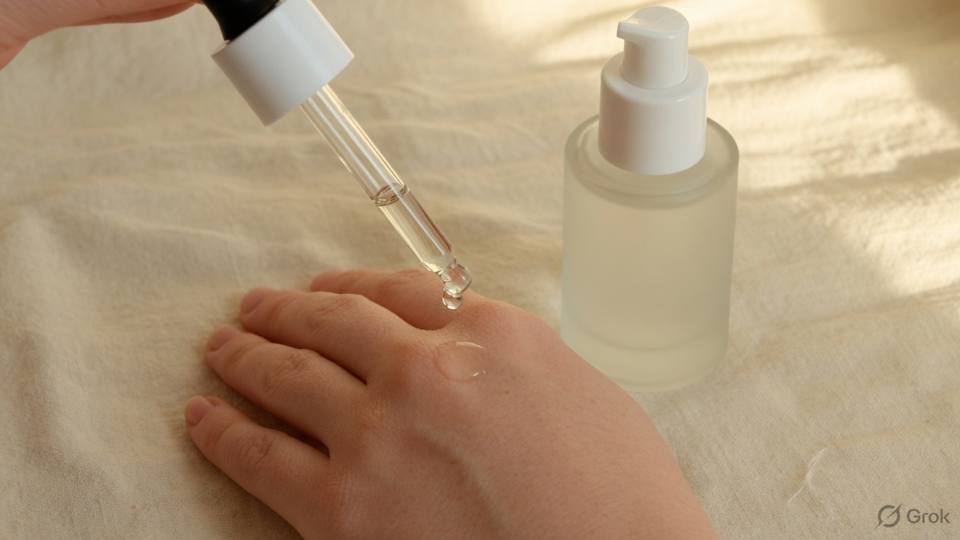
Humectants and niacinamide
Glycerin is the workhorse humectant, usually at 3 to 8 percent in a cream or lotion. It draws water into the upper layers of the skin and it also helps disperse xanthan. Above about 10 percent it feels sticky, and in very dry air it can pull water from the skin rather than from the room. Propanediol and butylene glycol at 2 to 5 percent are alternative humectants and solvents, useful when a formula needs to dissolve a poorly soluble active. Panthenol at 0.5 to 2 percent is a mild humectant with a soothing reputation, and it is sticky above about 2 percent. None of these is a drug, and none of them repairs a barrier on its own.
Hyaluronic acid is a humectant, not a preservative. High molecular weight grades at about 0.1 to 0.5 percent form a surface film and hold water at the skin surface. Low molecular weight grades at similar levels feel less filmy and are marketed as deeper, though the claim outruns the evidence. Both can gel a batch if overused, and both can sting on broken skin. A hyaluronic serum with no preservative grows microbes exactly like any other water product. The percent is small, which makes it easy to forget that the water around it is still a growth medium. The dose is small, so write it as a percentage of the batch and weigh it on a balance that can see it.
Niacinamide is commonly used at 2 to 5 percent in a leave-on, and some products go to 10 percent. It supports the barrier and improves the look of tone over time, and it is generally well tolerated. It flushes some faces, especially at higher levels, and it can sting on a compromised barrier. Niacinamide is a cosmetic active; it is not an acne treatment, and a product that claims to treat acne with it is making a drug claim. Start at 2 to 3 percent in a new formula, keep a base sample without it, and compare the two after four weeks before deciding that a higher level is worth the irritation risk.
The rule for all humectants is the same: dose for comfort, not for the story. A humectant that makes a product tacky or that stings will not be used by the client, and an unused product cannot deliver anything. Build the base first, confirm that it is stable and preserved, then add the active and compare. Keep the active's lot number and weight in the record, because the active is the line most likely to be questioned later. A base you trust plus one active is a test. A base and three actives changed at once is a guess with a label on it.
- 1. Set glycerin at 3 to 8 percent, and stay below about 10 percent unless the brief justifies more.
- 2. Use propanediol or butylene glycol at 2 to 5 percent when a solvent is also needed.
- 3. Add panthenol at 0.5 to 2 percent, and expect tack above 2 percent.
- 4. Use hyaluronic acid at about 0.1 to 0.5 percent, and never count it as a preservative.
- 5. Set niacinamide at 2 to 5 percent, starting at the lower end for a new formula.
- 6. Keep a base sample with no active, and compare colour, smell, pH and feel at week four.
- 7. Record the active's lot number and actual weight in the batch record.
- 8. Write only cosmetic claims for these ingredients, and keep acne and repair language off the label.
Bench example: a 100 g niacinamide gel-cream
A light gel-cream for oily-looking skin is built on the lotion base, with the oil phase reduced and the water raised. Water to 100 82.20; glycerin 4.00; niacinamide 4.00; xanthan 0.30; disodium EDTA 0.10; panthenol 1.00; cetearyl alcohol 2.00; glyceryl stearate 1.50; PEG-100 stearate 1.50; caprylic/capric triglyceride 2.00; dimethicone 0.50; phenoxyethanol at the supplier dose 0.80; ethylhexylglycerin 0.10. The lines total 100.00, the emulsifier plus fatty alcohol is 5.00 percent, and the oil phase is 7.50 percent, which is light for a lotion but workable with the gum. Niacinamide sits at 4.00 percent, inside the 2 to 5 percent band. Add it to the water phase if the supplier allows heat, or to phase C if not, and check the pH at 5.2. Hold a base sample without niacinamide beside it, and compare the two at week four before the salon commits. If the niacinamide flushes a tester at 4 percent, drop to 2 percent and repeat, because comfort is part of the formula. A product that stings is a product that stays on the shelf, and the base jar stays on the bench for comparison.
Caution: Do not call niacinamide an acne treatment or a repair ingredient. It is a cosmetic active, and the claim decides whether the product is a drug.
Acids and retinoids
Salicylic acid is used for exfoliation and for the look of pores, often at or below 2 percent in a leave-on cosmetic. It needs a solvent, usually a glycol or an alcohol, and an acidic pH to stay dissolved and active. Many markets cap leave-on cosmetics at 2 percent, and an acne treatment claim can make the product a drug, which changes the rules entirely. Do not use it on a large broken area, do not put it in a product for children, and confirm the current local limit before a salon uses it. A 2 percent product that also claims to treat acne is not a cosmetic in most markets, whatever the bottle says.
L-ascorbic acid is an antioxidant and a cosmetic active for the look of tone. It is used at 5 to 15 percent at a pH near or under 3.5, because the acid form is the active form. It is unstable in water and air: it yellows, loses strength, and can turn a clear serum brown within weeks. A workshop serum therefore needs a low-oxygen pack, a chelator, and a short shelf life, or a more stable derivative at a lower percent. Do not mix fresh ascorbic acid into a high-pH cream and call it stable; the pH is wrong and the oxygen is already in the jar.
Retinol is used at 0.1 to 0.3 percent to start in a consumer leave-on, for the look of tone and texture over time. It is sensitive to air and light and is usually packed in an airless or opaque container with a chelator. Irritation, peeling and redness are common at the start, so a lower level for a shorter contact time is a reasonable beginning. On pregnancy, do not recommend it: tell the client to ask their doctor. This text does not cover tretinoin, which is a prescription drug and not a cosmetic ingredient, and no formula here includes it.
Acids and retinoids change the formula around them. Salicylic acid needs a solvent and an acid pH. Ascorbic acid needs a low pH and a low-oxygen pack. Retinol needs an airless or opaque pack, and often a chelator. Build the base for the active, not the other way round, and check the supplier's pH and temperature limits before you weigh. A product that contains one of these at the wrong pH is not a weaker version of the product; it is a different, unstable product with the same label. The supplier sheet is the first check, and the finished pH is the second.
- 1. Confirm the current local limit for salicylic acid before writing the line, and stay at or below 2 percent.
- 2. Decide the claim first: an acne treatment claim can make the product a drug, not a cosmetic.
- 3. Give salicylic acid a solvent and an acid pH, and check that it stays in solution at week four.
- 4. Set L-ascorbic acid at 5 to 15 percent at a pH near or under 3.5, in a low-oxygen pack.
- 5. Add a chelator with ascorbic acid, and expect yellowing as a sign of loss, not a style choice.
- 6. Start retinol at 0.1 to 0.3 percent, in an airless or opaque pack, with a chelator.
- 7. Tell the client to ask a doctor about retinol in pregnancy, and keep no pregnancy advice in the salon.
- 8. Recheck pH, colour and smell at week one and week four, and record what changed.
Bench example: a 100 g vitamin C serum, and its limits
Water to 100 78.30; L-ascorbic acid 10.00; propanediol 5.00; glycerin 4.00; sodium hyaluronate 0.20; disodium EDTA 0.10; polysorbate 20 0.50; phenoxyethanol at the supplier dose 0.80; ethylhexylglycerin 0.10; citric acid 10 percent solution 1.00. The lines total 100.00. The target pH is 3.2 to 3.5, which is why the serum goes into an airless pump and not a dropper bottle that is opened twice a day. Make 200 g, fill four 30 g pumps, and keep one at room temperature, one at about 40 C and two in the light. Read colour and pH at day one, week two and week four. If the sample browns early, the pack or the chelator is not doing its job. Do not add fragrance to cover a change in smell; a change in smell is a result, not a marketing problem. Record every reading against the batch. A serum that is 10 percent ascorbic acid and smells of hot plastic should be discarded, not sold at a discount. The batch record and the retained sample are the only evidence of what it was.
Caution: No steroid, hydroquinone, mercury or tretinoin belongs in a salon formula. If a client asks for one, refuse and refer to a doctor.
Barrier ingredients and prohibited substances
Barrier ingredients are lipids and humectants that support the outer skin. Ceramides are used well under 1 percent, usually with cholesterol and fatty acids in a ratio that mimics the skin's own lipid mix. A ceramide at a pinch in water does nothing; it needs a lipid system, a fatty alcohol and a proper emulsion around it. Panthenol, glycerin and a modest occlusive such as dimethicone or a triglyceride do more for comfort at cosmetic levels than a long list of exotic extracts. The barrier is a structure, and a structure needs the right materials in the right phase, not a longer ingredient list.
Some substances are simply out of scope. Steroids, hydroquinone, mercury compounds and tretinoin are drugs or prohibited ingredients, and none of them belongs in a salon formula. A cream that lightens skin by suppressing pigment with a steroid or hydroquinone can cause thinning, streaks and rebound pigment, and mercury can cause serious systemic harm. A salon that buys a base from an unknown supplier and adds a lightening powder does not know what it is selling. If a client asks for a strong lightening product, the answer is a referral, not a formula. The same applies to any injectable or oral product.
Ingredient safety review is a separate step from formula design. The Cosmetic Ingredient Review publishes independent assessments of many cosmetic ingredients, and the supplier safety data sheet carries the handling information. Neither is a licence to use a material at any level. The market's own rules set the ceilings and the labelling duties, and the supplier sheet sets the use level for the grade you bought. When a new active arrives with a glossy brochure and no data sheet, do not weigh it. Ask for the INCI name, the safety data, the recommended level and the pH window, and keep the reply in the file.
Patch testing and claim discipline finish the job. A patch test on a client is a screening tool, not a guarantee, and it belongs with the service record. A product that passes a patch test on ten clients can still irritate the eleventh. Keep the formula simple, keep the fragrance low or absent on a barrier product, and keep the claims to what the product does at the percent in the jar. A short ingredient list with a tested preservative and an honest claim is a better product than a long list with a dramatic claim and no evidence behind it.
- 1. Use ceramides well under 1 percent, with cholesterol and fatty acids in a supporting lipid system.
- 2. Do not put a ceramide into a water-only serum and expect a barrier effect.
- 3. Choose a modest occlusive or emollient for comfort before adding a long list of extracts.
- 4. Refuse steroids, hydroquinone, mercury compounds and tretinoin in any salon formula.
- 5. Check the INCI name and safety data for every new raw material before it is weighed.
- 6. Read the Cosmetic Ingredient Review assessment where one exists, and the supplier sheet always.
- 7. Patch test on the client, record the result, and treat a pass as a screen, not a guarantee.
- 8. Keep fragrance low or absent on a barrier product, and keep the claim to a cosmetic one.
Bench example: a barrier cream with a short ingredient list
Water to 100 72.30; glycerin 6.00; panthenol 1.00; xanthan 0.20; disodium EDTA 0.10; cetearyl alcohol 2.50; glyceryl stearate 1.50; PEG-100 stearate 1.50; caprylic/capric triglyceride 8.00; squalane 4.00; dimethicone 1.00; ceramide NP 0.20; cholesterol 0.30; phenoxyethanol at the supplier dose 0.80; ethylhexylglycerin 0.10; citric acid 10 percent solution 0.50. The lines total 100.00. The emulsifier plus fatty alcohol is 5.50 percent, inside the lotion band, and the oil phase is 19.00 percent, inside the lotion band. The ceramide is supported by cholesterol, a fatty alcohol and an oil blend, which is the only way it makes sense. There is no fragrance and no essential oil. Test at pH 5.0 to 5.5, pack in a pump, run a challenge test, and keep the claim to moisturising dry-looking skin. If the ceramide is dropped to save cost, the cream still moisturises, but the barrier claim should go with it. Keep a 20 g sample at about 40 C for four weeks, because a lipid system can separate slowly, and label the pump with the batch number and the fill date. A short list is easier to trace when a client reacts.
Caution: A banned substance does not become safe because the label calls it natural or professional. Refuse it and refer the client.
This is a Nandu Nai textbook. It is a private brand book, not a government licence, and it does not give the right to give medical treatment.