
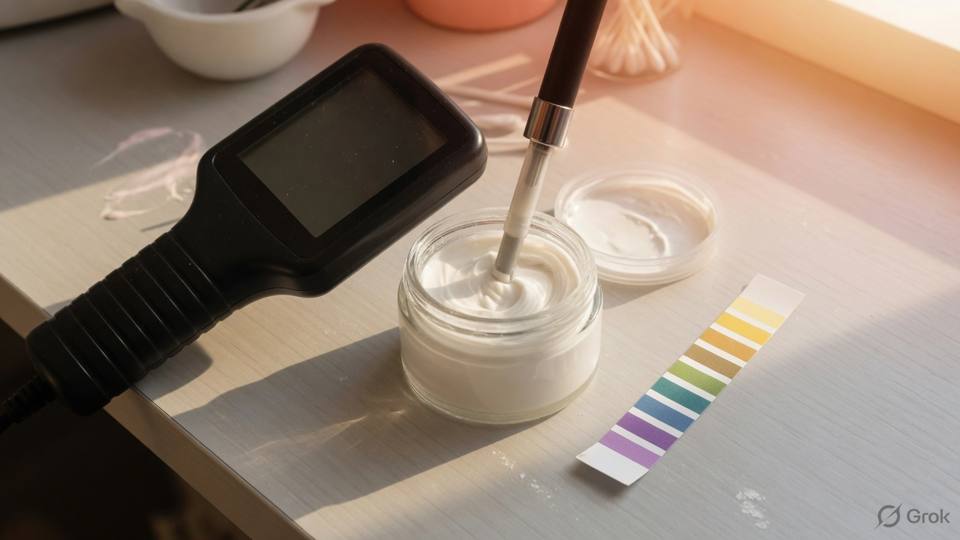
What pH means in a formula
pH is a scale for the concentration of hydrogen ions, and it is logarithmic. A pH of 4 is ten times more acidic than a pH of 5, and a hundred times more acidic than a pH of 6. That is why a shift from 5.2 to 5.6 matters: it is not a small move on a linear scale, it is a large change in the chemistry that preservatives and actives depend on. The scale runs from 0 to 14, with 7 neutral, below 7 acidic and above 7 alkaline. Skin sits on the acid side, and most leave-on cosmetics are built to sit there with it.
The pH of a formula decides which form of an acid or a base is present. Organic acid preservatives such as sodium benzoate and potassium sorbate work in the acid form, so they need a product pH under about 5.5. As the pH rises, more of the acid is neutralised and the preservative effect falls, even though the same weight of material is in the jar. Ascorbic acid needs a low pH because the acid form is the active form. Salicylic acid needs an acid pH to stay dissolved and to work. A formula at the wrong pH is not a weaker version of the formula; it is a different one. The same weight of citric acid in two creams at different pH is not the same amount of free acid, and the labels do not show the difference.
Hair and skin respond to pH physically. Hair fibre swells and the cuticle lifts when the product is alkaline, which makes hair feel rough and look dull. A shampoo at about 5.0 to 6.5 keeps the cuticle calmer than a soap-based product at 9 or 10, and the difference is visible on bleached hair within a few washes. A conditioner at about 3.5 to 5.0 helps the cuticle lie flatter, which is why conditioners are more acidic than shampoos. On skin, a leave-on moisturiser at about 4.5 to 5.5 supports comfort and the barrier, and it sits inside the working window of many preservative systems.
pH is also a moving target during making. A hot batch reads differently from a cool one, and a batch that has just been adjusted needs time to equilibrate. Measure on a sample cooled to room temperature, adjust the main batch in drops, and recheck after 24 hours. If the reading drifts, the formula is still reacting or the buffer is weak. Record both readings and the grams of adjuster used. A single number written on a sheet without a temperature, a method and a time is not a measurement; it is an impression. The impression is usually made by the person who wants the batch to pass.
- 1. Treat pH as a log scale, and remember that 0.4 of a unit is a large chemical change.
- 2. Decide the target from the product type and the active, not from a habit.
- 3. Check the preservative's pH window before choosing the target.
- 4. Measure on a sample cooled to room temperature, with a calibrated probe.
- 5. Adjust with a dilute acid or alkali in drops, stirring and rechecking after each addition.
- 6. Record the grams of adjuster and the batch weight after adjustment.
- 7. Recheck after 24 hours and record any drift.
- 8. Write the pH, the temperature and the method on the batch record.
Bench example: a drift that changed the preservative
A 200 g lotion is adjusted to pH 5.20 with a 10 percent citric acid solution, and the record notes 0.80 g of solution. The next morning the reading is 4.90. The operator is tempted to write 5.20 because that was the target. The honest reading is 4.90, and the drift is information: the formula may be slowly hydrolysing, the citric acid may not be buffered, or the batch may have been measured warm the first time. At 4.90 the phenoxyethanol system is still inside its window, but the organic acid booster, if there were one, would be working differently. The batch is held, the sample is re-read at 48 hours, and the next version carries a small buffer or a different adjustment. A drift of 0.30 of a unit is worth a note, not a quiet correction in the file. A second reading at 48 hours decides whether the batch is held or released. If the reading moves again at 72 hours, the batch is held for a new formula rather than patched at the bench. The client never sees the batch number, but the salon should be able to.
Caution: Do not pH a hot batch and do not record the target as if it were the reading. A drifting pH is a formula problem, not a clerical one.
Target ranges by product
A leave-on moisturiser usually sits at about 4.5 to 5.5. That band is comfortable for skin, it supports the barrier, and it sits inside the working window of many preservative systems. A gel or serum built around ascorbic acid often sits near or under 3.5, because the acid form is the active form and the low pH is part of the product. A shampoo usually sits at about 5.0 to 6.5: low enough to keep the cuticle calmer than soap, high enough for foam and for the surfactants to behave. A conditioner usually sits at about 3.5 to 5.0, because the cuticle lies flatter in a more acidic product.
A soap-based bar or cleanser often sits at about 9 to 10. That is soap chemistry, not a mistake, but it is not a skin-friendly pH for a leave-on product and it is not where a preservative designed for an acid product will work. Do not carry a pH from one product type to another because the texture looks similar. A cream and a conditioner can look alike in a jar, and their targets are different for different reasons: the cream is built for skin, the conditioner for hair. The target follows the substrate and the chemistry, not the appearance.
The target must also fit the pack and the use. A rinse-off product at pH 6.0 has a shorter contact time and a different microbial risk from a leave-on at pH 5.0. A product in a jar that fingers enter is a harder case than a sealed pump at the same pH. If two products share a formula but not a pack, they do not necessarily share a pH target or a preservative dose. The differences are small in words and large in outcome, which is why the pack and the use belong on the formula card beside the pH.
Write the target as a band, with a lower and an upper limit, and state what happens outside it. A lotion at 4.2 may still be stable and preserved, but it may sting; a lotion at 5.8 may feel fine and still be outside the comfort band. The band is a specification, and a batch outside it is a deviation that needs a decision. Do not write a single number with no tolerance, because no bench can hit one decimal place every time, and a specification that cannot be met is not a specification. Set the band from a trial that passed, not from a supplier brochure or a competitor's jar.
- 1. Set the moisturiser target at about 4.5 to 5.5 and check it against the preservative window.
- 2. Set an ascorbic acid serum near or under 3.5, and accept the lower comfort band as part of the product.
- 3. Set a shampoo at about 5.0 to 6.5 and check the organic acid preservative at that pH.
- 4. Set a conditioner at about 3.5 to 5.0, and keep it below the shampoo's pH.
- 5. Do not use a soap pH of about 9 to 10 for a leave-on skin product.
- 6. Match the pH target to the pack and the use, not only to the texture.
- 7. Write the target as a band with a tolerance, and state the action outside it.
- 8. Record the pH of every batch against the band before filling.
Bench example: one base, two products, two targets
A salon makes a light base cream at pH 5.2 and wants to sell it as a face moisturiser and as a leave-in hair cream. The face product stays at 5.2, inside the 4.5 to 5.5 band, in a 50 g pump. The hair product is adjusted down to 4.2, still inside the conditioner band of 3.5 to 5.0, because the cuticle lies flatter and the combing is easier. The adjustment uses 0.60 g of a 10 percent citric acid solution on a 500 g batch, which brings the batch to 500.60 g, and the water line in the next version falls by 0.54 g. The preservative is checked at both pH values, because the same dose is not automatically right at both. The two products share a base and a batch number prefix, but they do not share a specification. The record shows the split, the weights and the two readings. If the hair cream is later raised back to 5.0, that is a new version with its own pH check, because the preservative window and the feel both move with it. A base is a starting point, not a permanent answer.
Caution: Do not copy a pH target from one product to another because the texture is similar. The substrate and the chemistry set the band.
Measuring properly
Calibrate the meter before the batch, against fresh pH 4 and pH 7 buffers, and record the calibration. Rinse the probe with purified water between reads and blot it gently; wiping a glass probe with a tissue can scratch it and slow the response. Let the probe stabilise before reading, and stir the sample gently so the reading is representative. A meter that has not been calibrated for a month is a random number generator, especially at the acid end where the slope error is largest. A paper strip is a rough screen only; it cannot tell 5.2 from 5.6, and that gap decides whether an organic acid preservative works.
Measure a sample, not the whole batch. Take about 5 g into a small beaker, cool it to room temperature, and measure that. The main batch stays covered and warm, and the sample is discarded or returned according to the batch record. Measuring the hot batch gives a drifting reading and risks damage to the probe. If the sample is thick, dilute it with a stated amount of purified water and record the dilution, or use a probe designed for semi-solids. An unrecorded dilution is a reading that cannot be repeated. Rinse the probe in the same purified water every time, because tap water at pH 7.8 can shift a reading by a tenth on a sensitive probe.
Adjust in drops with a dilute solution. A 10 percent citric acid solution is gentler than glacial acid and easier to add in controlled amounts. For a 200 g batch reading 5.90 with a target of 5.20, add the solution in 0.20 g drops; each drop carries 0.02 g of acid. Suppose 1.20 g of solution is needed, which is 0.12 g of citric acid and 1.08 g of water. The batch is now 201.20 g, and the water line in the next version falls by 1.08 g. Write all three numbers: the solution weight, the acid weight and the new batch weight.
Record more than the number. The record should carry the temperature, the meter or method, the calibration date, the sample weight if diluted, the adjuster strength, the grams added, and the reading after 24 hours. That is what lets another person repeat the batch or investigate a complaint. A record that says pH 5.2 with nothing else is a claim, not a measurement. The difference matters most when something goes wrong, because that is the moment when memory is least reliable and the file is most useful. A pH record with the temperature and the meter beside it takes ten seconds to write and can save a batch. A strip with a colour and no note saves nothing.
- 1. Calibrate the meter with fresh pH 4 and pH 7 buffers and record the calibration date.
- 2. Rinse the probe with purified water between reads and blot it gently, never wipe it hard.
- 3. Take a small sample, cool it to room temperature, and measure that rather than the hot batch.
- 4. Stir the sample gently and wait for the reading to stabilise before writing it down.
- 5. If the sample is thick, use a semi-solid probe or record the dilution and its water weight.
- 6. Prepare a 10 percent citric acid solution for adjustment, and add it in measured drops.
- 7. Recheck after each addition, record the grams, and note the new batch weight.
- 8. Recheck after 24 hours, record the drift, and keep the calibration and sample notes with the batch.
Bench example: adjusting 200 g from 5.90 to 5.20
A 200 g batch reads 5.90 at 24 C after calibration against fresh buffers. The target band is 5.0 to 5.5, and the aim is 5.20. A 10 percent citric acid solution is added in 0.20 g portions with stirring, and the pH is checked after each portion. After the first portion the reading is 5.72, after the second 5.51, after the third 5.34, after the fourth 5.24 and after the fifth 5.16. The operator stops at the fourth portion, which is 0.80 g of solution and 0.08 g of acid, and accepts 5.24 as inside the band. The batch is now 200.80 g, and the water line in the next version falls by 0.72 g. The following day the reading is 5.22, which is recorded as stable. If the fifth portion had been added, the batch would need a base to come back, and each correction adds weight and another variable. If the target is 5.20 and the reading lands at 5.24, stop; the difference is inside the band and the batch is closer to the middle than a second correction would make it.
Caution: A meter without a calibration record is not evidence. Do not adjust a batch twice in one day without a stabilised reading between.
This is a Nandu Nai textbook. It is a private brand book, not a government licence, and it does not give the right to give medical treatment.