
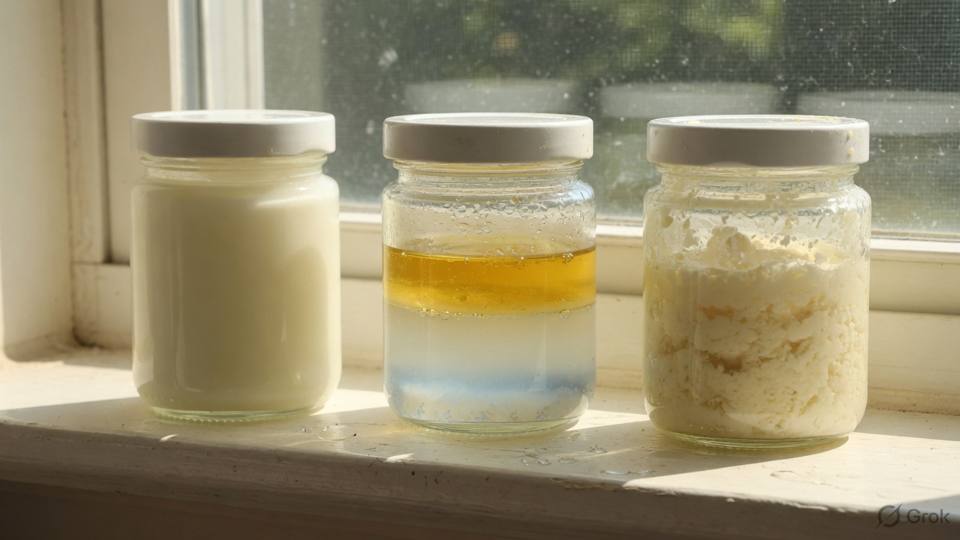
Stability screens
A stability screen is a set of samples held under defined conditions and read on a schedule. The usual set is a warm sample at about 40 to 45 C in the final pack, a fridge sample at about 4 C, three freeze-thaw cycles from about minus 10 C to 25 C and back, and a room-temperature control in the dark. Read them at day one, week one, week two and week four where the schedule allows. The warm sample accelerates some changes, the freeze-thaw sample tests the emulsion against expansion and contraction, and the control tells you what happens with no stress at all.
Look for specific changes, not a general impression. A water layer at the top means the emulsion is losing its structure. Oil droplets on the surface mean the emulsion inverted or was never properly homogenised. A grainy texture means a fatty alcohol or a wax crystallised during cooling. A colour change, especially yellowing or browning, points to oxidation. A smell change can mean oxidation or microbial growth. A viscosity drop, a pH drift, grittiness, or a pack that swells, softens or stains are all results. Write the reading, not the opinion: pH 5.18, no split, viscosity unchanged, faint colour is a result; stable is an opinion.
The pack is part of the test. A formula that is stable in glass can fail in a thin PET jar, because some oils and actives stain plastic and some ingredients lose strength under light. Fill the stability samples into the jar, tube or pump you will actually sell, with the same closure and the same label. Keep one clear sample near a window if the pack is clear, because light is a stress that a dark cupboard does not reproduce. A cream that yellows in a clear jar on a shop shelf is a product that will be returned, even if the lab sample in a brown bottle is perfect.
A screen is not a proof. It catches many failures early and it is cheap, but it cannot clear a product for sale on its own. A passed screen sits beside a pH recheck, a microbial count and a challenge test. Stability can run in parallel with the challenge test, on samples from the same batch, so the two reports describe the same product. A centrifuge spin can show a weak emulsion quickly, and it is useful for comparing two trials, but it is not a substitute for time in the pack. A screen with four samples and a written schedule costs almost nothing and finds most early failures before a client does.
- 1. Fill the stability samples in the final pack, with the final closure and label.
- 2. Hold one set at about 40 to 45 C, one at about 4 C, and one at room temperature in the dark.
- 3. Run three freeze-thaw cycles from about minus 10 C to 25 C, and check after each cycle.
- 4. Read at day one, week one, week two and week four, and record numbers rather than opinions.
- 5. Check for a water layer, oil droplets, graininess, colour, smell, pH and viscosity.
- 6. Inspect the pack for swelling, softening, staining and closure damage.
- 7. Keep one control sample untouched, so a change can be compared with the original.
- 8. Treat a fail as information: change one variable, remake, and run the screen again.
Bench example: a four-week screen on the lotion
A 500 g lotion batch at pH 5.24 is filled into eight 50 g pumps. Two go to the warm shelf at 42 C, two to the fridge at 4 C, two to the freeze-thaw cycle and two stay at room temperature in a cupboard. At day one the readings are pH 5.24, viscosity 4200 centipoise at 25 C, white, no split, faint odour. At week one the warm samples read pH 5.19, viscosity 4000, a thin ring of water at the pump shoulder on one of them. At week two the ring is visible on both warm samples, and the room-temperature control is unchanged. At week four the warm samples have a clear water layer and the control is still white and smooth. The screen has answered a question in four weeks: the emulsifier level is marginal at 42 C. The next version raises the emulsifier by 1.00 percent, lowers water by the same, and repeats the screen before any sale. The destroyed warm sample is kept in the file as a photograph with the date, because the next person will ask what a marginal emulsion looked like. The control sample stays on the shelf beside the new batch, so a change is visible in a glance.
Caution: Do not call a product stable because it looked fine on the day it was made. Time and the final pack are part of the test.
Microbial test and challenge test
A microbial count tells you what is in the batch now. A challenge test tells you how the preservative system behaves when microbes are introduced. Both matter, and they answer different questions. The count is a hygiene check on the batch: total aerobic count, yeast and mould, and a check for specified organisms. The challenge test is a performance test on the system. A batch with a low count and a weak preservative system can still fail after the client opens the jar, and a batch with a good system and a dirty process can still carry a high starting load. You need the process and the system to be right together.
Run the count on the finished product and on the water if the workshop makes its own purified water. Sample aseptically, send the sample promptly, and keep a retained sample from the same batch. A result of no growth is good; a result with a count needs a decision about the batch, the process and the cleaning record. Do not sell a batch with a count that has not been explained. Do not assume that a high preservative dose will fix a dirty process, because a high load can overwhelm a system that would otherwise pass. A count above the action level is a reason to stop, not a reason to add more preservative. The batch is quarantined while the process is checked, and the decision is written down with the date.
The challenge test follows a standard method, commonly ISO 11930, and uses a defined set of organisms. The lab inoculates the product, takes samples at set intervals, and counts survivors. The report should give the organism, the inoculum, the counts at each interval and the log reduction, not just a pass. Read the category and the criteria the lab applied. A report that says pass with no numbers cannot be used to compare two formulas or to argue a margin. Ask for the numbers, and keep them with the batch record. A pass with a thin margin against mould is a warning for a product that a client keeps in a warm bathroom.
Plan the tests before the launch, not after the first complaint. A challenge test takes weeks, and a remake after a failure takes longer. Make the batch that will be sold, fill it in the final pack, send the samples, and keep the retained sample. If the formula changes, the report no longer applies. A new fragrance, a new preservative supplier or a pH change can move the result, and the only safe assumption is that a test on a different formula says nothing about this one. That discipline is what separates a product from a trial. A salon that tests every new formula spends money once; one that skips the test spends it again on a recall.
- 1. Take an aseptic sample from the finished batch and send it for a total count, yeast and mould.
- 2. Sample the process water as well if the workshop purifies its own supply.
- 3. Keep a retained sample from the same batch, labelled with the batch number.
- 4. Send the challenge test sample in the final pack, with the actual preservative dose and pH.
- 5. Ask the lab for the method, the organisms, the counts and the log reductions, not only a verdict.
- 6. Hold the batch until both results are in, and do not sell on a verbal result.
- 7. Re-test after any change to the formula, the preservative, the pH or the pack.
- 8. File both reports with the batch record, and keep them for the market's retention period.
Bench example: a count that stopped a batch
A 2 kg batch of the lotion is filled into 40 pumps. The challenge test on a previous version passed, so the operator plans to ship. The microbial count on the new batch comes back with a total aerobic count above the lab's action level and a mould count that should not be there at all. The batch is quarantined. The cleaning record shows that the mixer was rinsed but not sanitised after a batch containing a plant extract, and the water filter had passed its change date. The batch is destroyed, the mixer is cleaned and sanitised, the filter is changed, and the next batch is tested again. The preservative dose is not raised, because the system was not the problem; the process was. The record of the destroyed batch and the reason is kept, because a failure that is written down is a lesson, and one that is hidden is a repeat. The lesson is that preservation and hygiene are two controls, and one cannot cover for the other. A batch record that shows both is worth more than a clean-looking jar.
Caution: Do not release a batch on the strength of an old challenge test. A test belongs to one formula, one pack and one process.
Claims and records
A cosmetic claim describes what the product does for appearance or cleanliness. A drug claim describes treating, preventing or curing a disease, or affecting the structure or function of the body. The line between them is not a matter of tone. A cream can say it moisturises and helps the look of dry skin; it cannot say it cures eczema or treats acne. A shampoo can say it cleans and leaves hair easier to comb; it cannot say it kills bacteria as a product claim unless it is registered for that claim. The words decide the category, and the category decides the rules.
The United States Food and Drug Administration sets out the labelling duties for cosmetics on its cosmetics pages and in its summary of cosmetics labelling requirements. For a retail cosmetic, the label carries the identity of the product, the net quantity, the ingredient list in descending order of predominance, and the name and place of business of the firm. Warnings are added where the product needs them, for example for an aerosol or a product with a hazard in normal misuse. The FDA also explains that a product intended to treat or prevent disease, or to affect structure or function, is a drug as well as a cosmetic, and must meet both sets of rules.
Some words are best left off a cosmetic label entirely. Whitening, lightening, bleaching and permanent are claims that promise a change the product cannot lawfully deliver as a cosmetic. Chemical-free and toxin-free are meaningless when the product contains water and a synthesised ingredient, and they invite a challenge that the salon cannot answer. Antibacterial as a product claim needs a registration that most salons do not have. A softer word does not make a drug claim legal. If the owner wants a medical claim, the answer is no, with one sentence of explanation, and a referral to a clinician for the client's actual problem.
Records are the other half of the claim. A label that says 2 percent salicylic acid should match a batch record that shows 2.00 percent, a pH that suits the acid, and a test report for that formula. A label that lists ingredients in descending order should match the percent column, with the small lines at the end. A claim that the product is preserved should match a challenge test on the same batch family. The record is what turns a statement on a jar into something the salon can defend. Without it, every claim is a guess with good typography.
- 1. Write the claim first and decide whether it is cosmetic or a drug claim.
- 2. Keep the label to cosmetic wording: moisturises, softens, helps the look of, cleans.
- 3. Put the product identity and the net quantity on the principal display panel.
- 4. List ingredients in descending order of predominance, with small lines at the end.
- 5. Put the firm's name and place of business on the information panel, and add warnings where needed.
- 6. Remove whitening, chemical-free, permanent and cure language before printing.
- 7. Match every claim to the batch record, the pH, the dose and the test report.
- 8. Keep the batch record, the label proof and the test reports together for the retention period.
Bench example: rewriting a label before print
A salon drafts a jar label for the niacinamide gel-cream. The front says Brightening and acne treatment, and the back says chemical-free, cures breakouts in two weeks. The formula contains niacinamide at 4.00 percent, water, glycerin, xanthan, an emulsifier pair, a triglyceride, dimethicone, phenoxyethanol at the supplier dose and a chelator. The label is rewritten. The front says Moisturising gel-cream for oily-looking skin. The back says Helps the look of uneven tone and keeps skin comfortable. The ingredient list follows the percent column, with water first and the preservative near the end. The name and place of business go on the information panel, with the net quantity of 50 g on the front. The words chemical-free, cure and treatment are gone. The batch record, the pH of 5.20 and the challenge test report are filed with the label proof, and the salon can now answer a question about any line on the jar. The label proof, the batch record and the test report sit in one folder, and the folder is kept for as long as the product could still be on a shelf. That is what makes the claim safe to print.
Caution: A cosmetic claim that promises a cure is a drug claim with a softer word. Remove it before print, not after a complaint.
This is a Nandu Nai textbook. It is a private brand book, not a government licence, and it does not give the right to give medical treatment.