
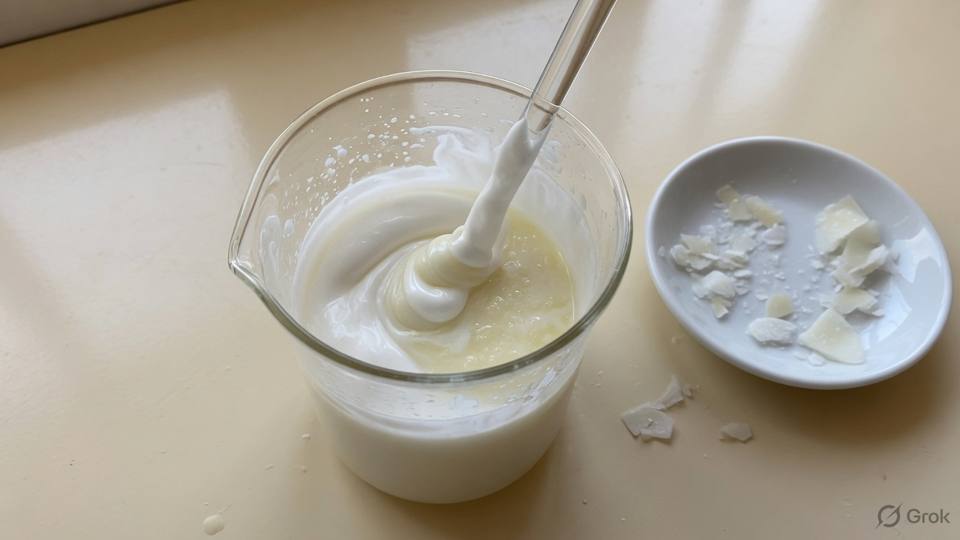
What an emulsifier does
An emulsion is two liquids that do not mix, held together by a third material. In an oil-in-water lotion, oil is broken into small droplets and those droplets are suspended in water. The emulsifier sits at the boundary, one end in the water and the other in the oil, and it lowers the tension between them. That film also keeps droplets from running into each other and merging. Without the film, the droplets coalesce, the oil rises, and the product separates into a layer you can see. The emulsifier is therefore not a thickener and not a perfume; it is the structure that makes the product a lotion at all.
Oil-in-water, O/W, is the usual cream and lotion. Water is the continuous phase, so the product spreads easily, absorbs, and rinses from the hands. Water-in-oil, W/O, has oil as the continuous phase, so it feels rich, water-resistant and heavy. W/O is harder to preserve because the water sits in isolated droplets, and a small breach in the film can let microbes into a pocket that the preservative reaches slowly. For a first formula, choose O/W unless the brief genuinely needs a barrier balm. Most failures on a small bench come from choosing a W/O system because it sounded more luxurious, then discovering that it splits in the jar.
HLB is a number that describes how water-loving or oil-loving an emulsifier is. The blend of emulsifiers must match the blend of oils, so a heavier oil usually needs a lower HLB and a lighter oil a higher one. Use the supplier's HLB guide for the named oil and the named emulsifier; do not invent a value from memory. A common workshop pair is glyceryl stearate with PEG-100 stearate, both supplied with a stated HLB. Another is cetearyl alcohol with ceteareth-20. A third is cetearyl olivate with sorbitan olivate. Each pair behaves differently, and the supplier sheet is the map.
A fatty alcohol is not a complete emulsifier. Cetearyl alcohol, cetyl alcohol and stearyl alcohol give body, consistency and a smooth feel, and they support the interface that the true emulsifier has built. They do not form a stable O/W emulsion on their own at normal use levels. This is the commonest confusion in small-scale cream making: a formula with 6 percent cetearyl alcohol and no primary emulsifier will look like a cream while it is warm and separate within days. The fatty alcohol is the scaffolding. The emulsifier is the wall. Read the card and count the two functions separately before deciding that a cream is under-emulsified; often it is simply missing its primary pair.
- 1. Decide the emulsion type from the brief: O/W for most lotions and creams, W/O only for a barrier product.
- 2. List the oils and their percents, and total them to find the oil load before choosing an emulsifier.
- 3. Look up the supplier HLB value for each named oil and for each emulsifier in the pair.
- 4. Pick an emulsifier pair whose blend HLB matches the oil blend, and keep both names on the card.
- 5. Add a fatty alcohol at about 2 to 3 percent for body, and count it as support, not as emulsifier.
- 6. Keep the emulsifier plus fatty alcohol near the stated range, about 3 to 6 percent for a lotion.
- 7. Combine phases at the same temperature, about 70 to 75 C, with steady stirring.
- 8. Check the batch after 24 hours and again at week one for a water layer or oil droplets.
Bench example: reading a pair on a supplier sheet
Two suppliers quote the same pair, glyceryl stearate and PEG-100 stearate. One sells a flake with a stated HLB near 11, intended for a light lotion. The other sells a self-emulsifying grade with a different ratio and a stated HLB near 7, intended for a richer cream. The trade name may look identical on both bags. If the bench copies a 5 percent total from one sheet to the other without reading the grade, the lotion may be thin at one extreme or heavy and waxy at the other. Write the grade, the HLB and the supplier beside the weight on the batch record. Then make a 100 g trial, hold it at room temperature for a week, and look for a ring of water at the jar edge. The supplier guide chooses the starting pair; the trial decides whether that pair works in this formula, with this oil load, at this pH. Keep the trial jar labelled with the pair, the grade and the HLB, because a cream that fails can teach you something only if you know what was in it.
Caution: Never treat a fatty alcohol as the emulsifier. If the pair is missing, the cream will look right warm and separate cold.
Choosing the level
The level of emulsifier follows the oil load, not a habit. A lotion usually carries about 10 to 20 percent oil phase and about 3 to 6 percent emulsifier plus fatty alcohol. A cream usually carries about 20 to 35 percent oil phase and about 5 to 8 percent emulsifier plus fatty alcohol. Within those bands, a higher oil load needs more emulsifier and often a lower HLB. A very light lotion can sit at the bottom of both ranges, and a rich night cream can sit at the top of both. The numbers are a starting point for a trial, not a guarantee of stability.
Build the oil phase first and let the emulsifier follow. If the oils total 15 percent, an emulsifier system at 5 percent is a reasonable start, as the sample card below shows. If the oils total 25 percent, a 5 percent system is thin and a 7 percent system is more likely to hold. When the oil load changes, the water line takes the difference, so the total stays at 100.00. Adding 10 g of oil to a 100 g batch is not a matter of adding 10 g and stirring; it means 10 g more oil, probably 1 to 2 g more emulsifier, and 11 to 12 g less water.
Stability is the test of the choice, not the appearance on the day of making. A lotion that looks glossy in the beaker can grow a water layer at week two if the emulsifier is marginal or the HLB is wrong for the oil blend. A cream that feels heavy and rich on day one can turn grainy by week four if the fatty alcohol crystallised during a slow cool. Judge the level by what the sample does in the pack you will actually sell, at room temperature and in a warm cupboard, not by the look in the mixing bowl.
Cost and label also shape the level, within reason. A higher emulsifier total costs more per kilogram and can feel heavier or soapier on the skin. A lower total saves material and feels lighter but leaves less margin for a process mistake. The right choice is the lowest level that holds the oil load through the stability screen with a margin, not the lowest level that survived one batch. Margin is what protects you when a supplier changes a grade or an operator combines two phases a few degrees apart. A formula with no margin is a formula that works only on the day it was written.
- 1. Total the oil phase first, including the emulsifier and the fatty alcohol, and write the number down.
- 2. Choose a starting emulsifier total from the band: about 3 to 6 percent for a lotion, 5 to 8 percent for a cream.
- 3. Match the emulsifier blend HLB to the oil blend using the supplier guide for each named oil.
- 4. Set the fatty alcohol at about 2 to 3 percent for body, and count it inside the emulsifier total.
- 5. Recalculate the water line so the sheet still totals 100.00 after any change.
- 6. Make a 100 g trial before scaling, and keep a control with no active for comparison.
- 7. Hold the trial at room temperature and at about 40 to 45 C, and read it at week one and week four.
- 8. Raise the emulsifier only if the trial shows separation, and change one variable at a time.
Bench example: the 100 g lotion card and a richer version
The 100 g lotion card reads water to 100 at 77.20; glycerin 5.00; xanthan 0.20; disodium EDTA 0.10; panthenol 1.00; cetearyl alcohol 2.00; glyceryl stearate 1.50; PEG-100 stearate 1.50; caprylic/capric triglyceride 6.00; isopropyl myristate 3.00; dimethicone 1.00; phenoxyethanol 0.80; ethylhexylglycerin 0.10; tocopherol 0.10; citric acid 10 percent solution 0.50. The lines total 100.00, the emulsifier plus fatty alcohol is 5.00 percent, and the oil phase is 15.10 percent. To make a richer cream, add 9.90 g of oil, raise the fatty alcohol from 2.00 to 4.00 g so the emulsifier plus fatty alcohol total becomes 7.00 percent, and let water fall by 11.90 g to 65.30 g. Check the new column: 65.30 plus 5.00 plus 0.20 plus 0.10 plus 1.00 plus 4.00 plus 1.50 plus 1.50 plus 6.00 plus 3.00 plus 1.00 plus 9.90 plus 0.80 plus 0.10 plus 0.10 plus 0.50 equals 100.00. The oil phase is now 27.00 percent, inside the 20 to 35 percent cream band, and the water absorbed the whole change. The emulsifier plus fatty alcohol is 7.00 percent, inside the 5 to 8 percent cream band. Then make 100 g and hold it for four weeks before you commit the salon to a larger batch, because a card that balances on paper can still fail in a jar.
Caution: Do not raise the oil load without raising the emulsifier and lowering the water. A cream built by addition alone will not total 100.
Thickeners and feel
Xanthan gum at about 0.1 to 0.4 percent thickens the water phase and slows separation. It also holds the oil droplets in place while the batch cools, which is why a lotion with a little xanthan is more forgiving than one without. Above about 0.5 percent it can feel slimy and stringy, and it can leave a tacky film that clients notice. Disperse it in glycerin or in a small portion of water before it meets the bulk, because dry gum in water forms lumps that survive heating. Xanthan is a helper, not a substitute for a correct emulsifier level.
Fatty alcohols and consistency agents build the body of a cream. Cetearyl alcohol at about 2 to 3 percent gives a smooth, non-greasy structure. A small amount of a wax, such as beeswax or a synthetic wax, can add firmness, but wax also raises the melting point and can make the cream feel heavy or draggy. Too much fatty alcohol gives a waxy, soap-like feel and a cream that balls up under the fingers. The goal is a product that spreads in a thin film without dragging, and that is a matter of total solids, not of one ingredient. If the cream balls up under the fingers, reduce the fatty alcohol or the wax before you touch the emulsifier.
Emollients change the after-feel. Caprylic/capric triglyceride is light and stable. Isopropyl myristate spreads well and can feel dry rather than oily. Dimethicone at about 1 percent adds slip and reduces tack, and it can make a cream feel smoother without adding much oil. Glycerin at 3 to 8 percent draws water into the upper skin, but above about 10 percent it feels sticky and can sting on a broken surface. Every one of these is a sensory decision as much as a chemical one, and the client is the final judge, provided the stability and preservation are already sound. Ask a colleague to use the sample for a week and describe the feel in their own words.
Measure texture rather than describing it. Viscosity on a rotating spindle at a stated speed and temperature is a number that can be compared between batches. Spreadability on a glass plate is a rough but useful bench check. A texture that changes between batch one and batch four is a process signal: the emulsifier level, the cool-down rate or the homogeniser time has drifted. Keep the numbers with the sample, and describe the feel in plain words that a colleague can repeat. Smooth, tacky, draggy, waxy and grainy mean something specific, and each points to a different line on the card.
- 1. Disperse xanthan at about 0.1 to 0.4 percent in glycerin before adding bulk water.
- 2. Keep the fatty alcohol near 2 to 3 percent and count it inside the emulsifier total.
- 3. Add a wax only if the brief needs firmness, and expect a higher melt point and a heavier feel.
- 4. Adjust emollients for after-feel, not for claims: light esters, a little dimethicone, a stable triglyceride.
- 5. Keep glycerin between 3 and 8 percent and stay below about 10 percent unless the brief demands more.
- 6. Measure viscosity at a stated temperature and spindle speed, and record the number.
- 7. Compare texture at day one, week one and week four, using the same method each time.
- 8. Change one texture variable at a time, or you will not know which one worked.
Bench example: thickening a thin lotion without breaking it
A 200 g trial lotion comes off the bench thin, almost watery, and the operator wants to add xanthan. The emulsifier total is 5.00 percent and the oil phase is 15.10 percent, so the emulsifier is not obviously the problem. Before changing it, check the pH, the combine temperature and the cool-down rate. Suppose the batch was combined at 60 C because the oil phase was not hot enough. The emulsion formed poorly and the thickness never developed. Raising xanthan from 0.20 to 0.40 percent would make the lotion feel slimy without fixing the emulsion. Instead, remake the batch with both phases at 72 C and the same emulsifier level, and hold a 0.30 percent xanthan trial beside it. Compare viscosity at week one. The likely answer is the process, not the gum, and the record shows which change was made. A second trial with xanthan at 0.30 percent tells you whether the gum helps or merely hides the fault; without the first trial you would never know. Keep both jars on the same shelf for four weeks and compare them at the end, because a fault that appears at week three is still a fault.
Caution: Do not thicken a separated emulsion with gum. Gum hides the water layer for a week and then the product fails in the client's bathroom.
This is a Nandu Nai textbook. It is a private brand book, not a government licence, and it does not give the right to give medical treatment.