
Phase A: the water side
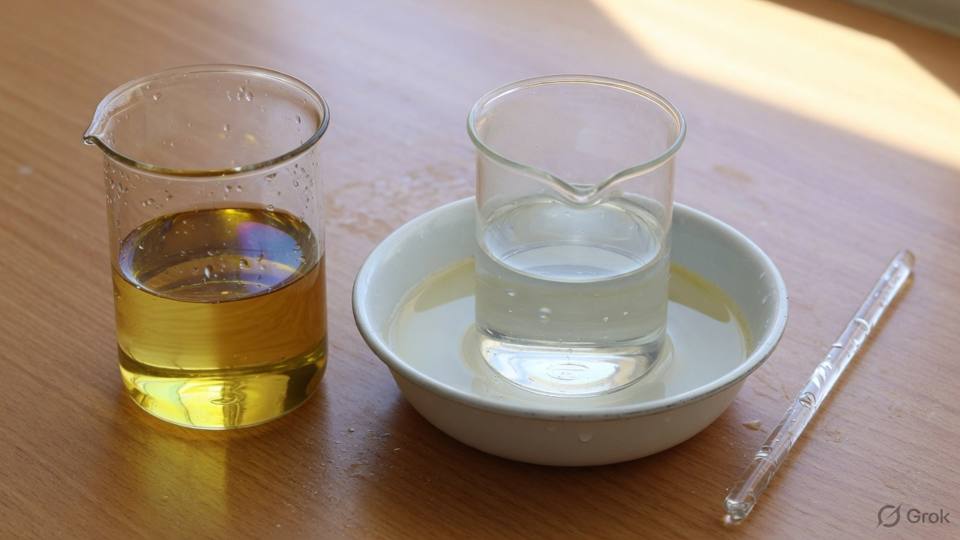
Phase A is everything that dissolves or disperses in water, plus the water itself. It usually carries the humectants, the chelator, the water-soluble gums, and any active that survives heat. Glycerin at 3 to 8 percent is common in a moisturiser, both as a humectant and as a dispersion aid for xanthan. A chelator such as disodium EDTA at about 0.10 percent binds the metal ions that can catalyse oxidation and weaken a preservative. Panthenol at 0.5 to 2 percent is a mild humectant and soothing agent. The to-100 water line lives here, and it is the line that absorbs every other change on the sheet.
The order inside phase A matters more than the order between phases for one common fault: lumps. Xanthan gum at about 0.1 to 0.4 percent thickens the water and slows separation, but if it is tipped dry into water it forms fish-eye lumps that no amount of stirring will fully remove. Disperse the gum in the glycerin first, or in a small portion of water, then add the rest of the water with agitation. The same rule applies to other hydrocolloids. A lumpy water phase will show up as a grainy cream even when the emulsion itself is sound, and the fault will be blamed on the emulsifier that had nothing to do with it.
Phase A is heated with phase B to about 70 to 75 C, not because the water needs it but because the oil phase does. Heating both phases to the same band avoids a thermal shock when they meet, and a shock is one of the usual causes of a split. Hold the heat only as long as it takes to melt the oil phase. A long hot hold drives off volatiles, oxidises oils, and wastes energy. Use a probe thermometer rather than a hand: a beaker that feels comfortable can still be 55 C, and a batch at 55 C is not at 72 C no matter how it feels.
Water quality is part of phase A and is often ignored. Tap water carries hardness, chloride and whatever the building pipes contribute, and those change from day to day. A workshop should use purified or at least filtered water for anything that will be sold, and should record which water was used. Water is also the largest single line in most formulas, so a change in its mineral content changes the product more than a change in a 0.10 percent active. If a batch behaves oddly for no visible reason, the water is a reasonable suspect and an easy one to rule out.
- 1. Weigh the water to 100 last in phase A, after the small water-soluble lines are in the vessel.
- 2. Disperse xanthan at about 0.1 to 0.4 percent in glycerin before it meets the bulk water.
- 3. Add the chelator, usually disodium EDTA at about 0.10 percent, to the water before heating.
- 4. Add glycerin at 3 to 8 percent and panthenol at 0.5 to 2 percent, and stir until clear.
- 5. Heat phase A with phase B to about 70 to 75 C, using a probe thermometer, not a hand.
- 6. Hold the temperature only until the oil phase is fully melted, then combine promptly.
- 7. Check that no gum sits undispersed at the bottom of the vessel before you combine.
- 8. Record the water source, the phase A weights and the temperature at combining.
Bench example: phase A for a 500 g lotion
For 500 g of the lotion, phase A holds water 386.00 g, glycerin 25.00 g, xanthan 0.20 percent which is 1.00 g, disodium EDTA 0.10 percent which is 0.50 g, and panthenol 1.00 percent which is 5.00 g. The small lines together weigh 6.50 g. Weigh the glycerin into a beaker, sprinkle the 1.00 g of xanthan into it while stirring, and let it wet out before adding water. Add the EDTA and panthenol, then the 386.00 g of water, and stir slowly. Heat to about 72 C with phase B. If the xanthan forms lumps, strain the phase through a coarse sieve before heating and note the loss, because a lump in the finished cream is a complaint waiting to happen. Check the total of phase A against the sheet before you apply heat, not after. If the phase is short by more than the tolerance, find the missing line before heating, because heat hides nothing and makes every correction harder. Keep a spare beaker of hot water at the same temperature so the combine is not delayed by a cold vessel.
Caution: Do not add a gum dry to the full water charge. The lumps that form will survive heating and show up in the finished product.
Phase B: the oil side
Phase B is the oil-soluble group: emollient oils, butters, waxes, the fatty alcohol, the emulsifier pair, and an oil-soluble antioxidant such as tocopherol. In a lotion the oil phase commonly sits at about 10 to 20 percent; in a cream it is more often about 20 to 35 percent. The emulsifier plus fatty alcohol usually totals about 3 to 6 percent in a lotion and about 5 to 8 percent in a cream. Those ranges are starting points, not rules: a high-oil cream needs more emulsifier, and a very light lotion can sit at the bottom of both ranges and still be stable.
Melt the oil phase completely before it meets water. Wax specks and fatty alcohol crystals that survive the combine will not melt out later; they will be suspended in the emulsion as grit. Stir the oil phase gently while it melts, and keep the temperature uniform. A double boiler is safer than a direct flame because it cannot spike, and a controlled hot plate with a probe is better still. Check the phase by looking for the last translucent speck, not by trusting the clock. Different waxes melt at different temperatures, and a blend melts when its highest-melting component has melted.
The oil phase is also where an antioxidant belongs. Tocopherol at about 0.05 to 0.50 percent, or a similar oil-soluble antioxidant, slows rancidity in the oils while the product sits on the shelf. It does nothing about microbes, and it is not a preservative. Add it to the oil phase so it is distributed before the emulsion forms. An antioxidant added after the fact sits in the droplets it landed in and protects only part of the oil. If the formula carries a fragile oil such as a seed oil rich in linoleic acid, the antioxidant matters more, not less.
Choose the oils for the feel you want and the label you can defend, then let the emulsifier follow the oil load. Caprylic/capric triglyceride is a light, stable emollient. Isopropyl myristate is light and spreads well. Dimethicone at about 1 percent adds slip and reduces tack without much occlusion. A butter adds richness and weight, and it also raises the emulsifier demand. Every oil you add changes the required HLB of the blend and the texture of the finished product. The oil phase is not a place to add an ingredient because it sounds good in a brochure. If an oil is added only for the story, it still has to be emulsified, preserved and tested.
- 1. Weigh the oils, butter and wax into a second clean beaker, not into phase A.
- 2. Add the fatty alcohol and the emulsifier pair at the totals the sheet states.
- 3. Add tocopherol at about 0.05 to 0.50 percent to protect the oil blend from rancidity.
- 4. Heat phase B alongside phase A to about 70 to 75 C, with gentle stirring.
- 5. Hold until the last wax speck has melted and the phase is uniform, then stop heating.
- 6. Check the temperature of both phases and confirm they are within about 10 C of each other.
- 7. Pour the oil phase into the water phase in a steady stream while stirring, or as the sheet directs.
- 8. Record the melt temperature, the combine temperature and any oil that had to be replaced.
Bench example: phase B for a 500 g lotion
For 500 g, phase B carries cetearyl alcohol 2.00 percent which is 10.00 g, glyceryl stearate 1.50 percent which is 7.50 g, PEG-100 stearate 1.50 percent which is 7.50 g, caprylic/capric triglyceride 6.00 percent which is 30.00 g, isopropyl myristate 3.00 percent which is 15.00 g, dimethicone 1.00 percent which is 5.00 g, and tocopherol 0.10 percent which is 0.50 g. The phase totals 15.10 percent, or 75.50 g, and the emulsifier plus fatty alcohol is 5.00 percent, inside the 3 to 6 percent lotion range. Heat to about 72 C and stir until the cetearyl alcohol has fully melted and no specks remain. If a speck is still visible at 72 C, raise the temperature by two or three degrees rather than pouring early. Check the weight of the phase before combining, and record the actual melt temperature. If a butter is substituted, check its melting point and adjust the hold temperature, because a butter that melts at 45 C will not be fully liquid at 40 C. Tare the beaker with the stirrer already in place, so the stirrer is not weighed as oil.
Caution: A partially melted oil phase will leave grit that no later stirring can remove. Melt completely, then combine within the same temperature band.
Phase C cool-down and phase D pH
Phase C is added under about 40 C, with slow stirring, one ingredient at a time. It holds the heat-sensitive materials, including some preservatives, fragrance, essential oils, volatile silicones, vitamin C, retinol, and any active whose supplier sheet states a temperature limit. Adding phase C to a hot batch is one of the quiet failures of small-scale work, because the product may look and smell fine while the active has been destroyed or a volatile preservative has flashed off. The ingredient is still on the sheet, but it is no longer in the jar at the dose the sheet claims. A thermometer beside the vessel, read at every addition, is the cheapest control in the workshop.
Cooling is an active step, not a pause. Stir slowly and steadily while the batch cools, because that keeps the oil droplets small and stops a skin forming at the surface. Fast stirring whips in air, which shows up as foam and as a fill weight that is lighter than the scale suggests. Forced cooling in a fridge is usually a mistake unless the supplier allows it, because uneven cooling makes a skin and can crystallise a fatty alcohol early. A batch cooled too fast can also thicken before every line has been added, trapping phase C near the surface.
Phase D is the adjustment: acid, alkali, salt, or a small premix. Add it in drops with stirring, and recheck after each addition. A pH adjuster added too fast overshoots, and the correction back is another addition that shifts the batch weight again. Measure pH at room temperature on a cooled sample, not on the hot batch, because the reading drifts with temperature. Record the grams of adjuster used, not just the final pH. A line that reads pH adjusted without a weight is an incomplete record, and the next batch will not repeat it. Write the strength of the adjuster solution too, because 0.50 g of a 10 percent acid is not 0.50 g of acid.
A pH adjuster changes the batch weight, and the percent column moves with it. A 100.00 g batch plus 0.50 g of a 10 percent citric acid solution is 100.50 g, and every percentage drops slightly. That is acceptable, but it must be written down, and the water line in the next version of the card should be reduced by the water that came in with the acid. The same logic applies to a salt premix for viscosity and to any small addition made after the batch was balanced. The formula is a living account, not a fixed poster. When the next version is written, the water line carries the correction and the record explains why.
- 1. Cool the combined batch with slow, steady stirring until it is under about 40 C.
- 2. Check the temperature with a probe before the first phase C addition, and write it down.
- 3. Add the preservative at the temperature its supplier sheet allows, usually in phase C.
- 4. Add fragrance or essential oil last in phase C, below the supplier temperature limit.
- 5. Add one phase C ingredient at a time and stir until it is fully dispersed before the next.
- 6. Take a small sample, cool it to room temperature, and measure pH before adjusting the batch.
- 7. Add phase D in drops with stirring, rechecking pH after every addition, and record the grams.
- 8. Recheck pH after 24 hours and record the drift, because a drifting formula is not yet stable.
Bench example: cool-down and pH adjustment on 500 g
A 500 g lotion batch is combined at about 72 C, then cooled with slow stirring. At 38 C the operator adds phenoxyethanol at 0.80 percent, which is 4.00 g, and ethylhexylglycerin at 0.10 percent, which is 0.50 g, stirring after each. At 35 C comes the fragrance, if the formula has one. The batch is then held at room temperature and a 5 g sample is cooled further for pH. The reading is 5.80 and the target is 5.0 to 5.5. A 10 percent citric acid solution is added in 0.20 g drops; each drop carries 0.02 g of acid. Suppose 1.00 g of solution is needed, so the batch becomes 501.00 g and every percent falls by about 0.2 percent relative. Record the 1.00 g, note the new batch weight, and reduce the water line by 0.90 g in the next version of the card. Recheck the pH the following day and record both readings. If the pH keeps falling between readings, the formula is still reacting, and the batch should not be filled until the reading holds steady for a day.
Caution: Do not measure pH on a hot batch and do not write pH adjusted without the weight. Both habits hide a formula that will not repeat.
This is a Nandu Nai textbook. It is a private brand book, not a government licence, and it does not give the right to give medical treatment.