
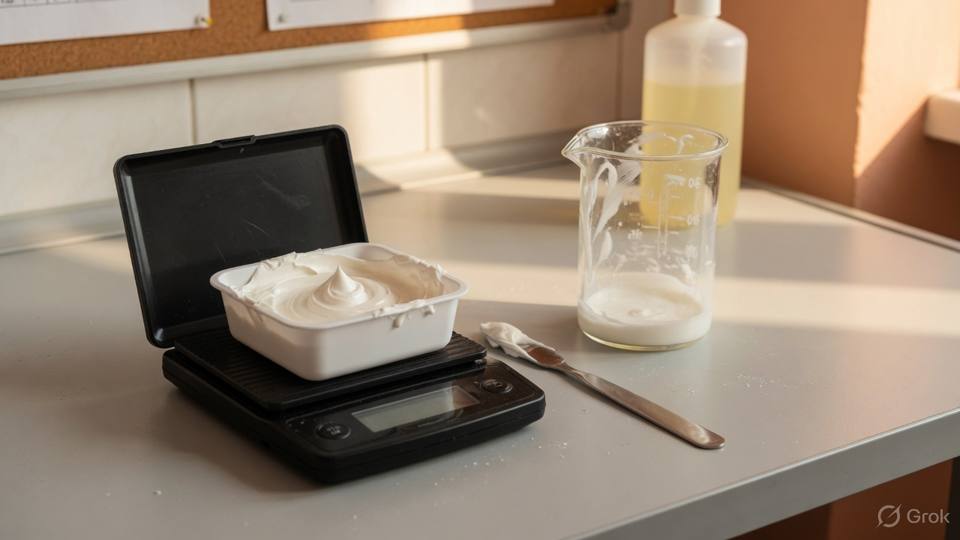
Why weight, not volume
A cosmetic formula is a list of weights that share one basis. When a sheet says glycerin 4.00 percent, it means 4.00 grams of glycerin in every 100.00 grams of finished product, not 4.00 millilitres in 100 millilitres of liquid. The difference matters because oils, glycols, alcohols and water do not weigh the same per millilitre, and their density shifts as the bench warms or cools. A recipe written in millilitres quietly changes its composition whenever a supplier changes the grade of an oil. A recipe written in grams does not. Percent w/w, weight by weight, is the basis that labels, batch records and regulators expect, and it is the only basis on which a small line such as a preservative can be discussed honestly.
The basis is 100.00, and every line must add to it. Water is usually written as water to 100, or q.s. to 100, which means water fills whatever the other lines leave. That single convention absorbs small changes without rewriting the whole sheet: raise the preservative by 0.10 and water falls by 0.10. It also exposes arithmetic errors quickly, because a sheet that totals 99.20 or 100.80 is telling you that a line was dropped or counted twice. A formula that does not close at 100.00 is a draft, not a working document. Nobody should weigh from a draft. A formula that closes at 100.00 has passed its first check, and it has passed it before a single gram is on the scale.
The balance decides how honest the decimal places are. A scale that reads 0.1 g cannot weigh 0.08 g of anything; it can only round, and rounding a preservative or a dye is not a small matter. Choose the balance by the smallest line in the batch, not by the batch size. A 0.10 percent line in a 100 g batch is 0.10 g, which needs a balance reading 0.01 g. A 0.10 percent line in a 1000 g batch is 1.00 g, which the coarser balance can handle. When the smallest line is below the readability of the scale, make a stock solution, weigh the solution, and state the strength on the card.
Write the basis on every page. A percent without a stated basis is a number without a meaning, and the same figure can describe a weight fraction, a volume fraction, or a fraction of the active matter inside a raw material. The bench master should carry the version date, the batch size, the basis, the phase of each line, and the name of the person who approved it. When a client asks why a cream feels different after a supplier change, the version history answers faster than memory. Percent w/w is not red tape; it is the grammar that lets two people make the same product on different days.
- 1. State the basis first: percent w/w means grams per 100.00 grams of finished product.
- 2. List every raw material by INCI name with its as-supplied strength beside it.
- 3. Enter the percent for each line, two decimals for small lines, and never a range.
- 4. Add the lines without water and subtract that total from 100.00 to get the water line.
- 5. Check that the full column, water included, totals 100.00 before any weighing starts.
- 6. Pick the balance by the smallest line, and make a stock solution if that line is too small.
- 7. Scale to the batch with grams equal to batch grams times percent divided by 100.
- 8. Print the batch size, the factor and the version date on the sheet you carry to the bench.
Bench example: scaling a 100 g lotion sheet to 250 g
A 100 g lotion sheet reads water to 100 at 77.20; glycerin 5.00; xanthan gum 0.20; phenoxyethanol 0.80; all remaining lines together 16.80. The lines close at 100.00. Multiply every number by 2.5 for a 250 g batch. Water becomes 193.00 g, glycerin 12.50 g, xanthan 0.50 g, phenoxyethanol 2.00 g, and the remaining lines 42.00 g. Check the new column: 193.00 plus 12.50 plus 0.50 plus 2.00 plus 42.00 equals 250.00 g. Weigh xanthan and phenoxyethanol on the 0.01 g balance, the oils on the 0.1 g balance, and water last, so a small overshoot can be trimmed against the water line rather than against an active. Record the factor, the batch number, and the weight of every line before heating. If the final total reads 249.60 g, the missing 0.40 g is water, not a mystery, and it belongs in the record as a correction. Weigh the water into a vessel large enough for the whole batch, and mark the fill level before heating so a boil-over is visible early. If the sheet is later revised, the factor changes but the percent column does not, which is why the two are kept apart on the page.
Caution: Never top up a batch by eye and call it water to 100. Weigh the correction and write it down.
Reading a formula sheet
A formula sheet is read in phases, not as a shopping list. Phase A holds the water-soluble lines: water, glycerin, chelating agents, some gums and salts. Phase B holds the oil-soluble lines: oils, butters, waxes, emulsifiers and fatty alcohols. Phase C is the cool-down group, where preservatives, fragrance and heat-sensitive actives belong. Phase D is the adjustment: pH, salt for viscosity, or a small premix. Each line should carry an INCI name and, where it matters, the as-supplied strength. A trade name alone is not enough, because two suppliers can sell the same trade name at different concentrations and different pH windows.
The numbers also carry a meaning that is easy to miss. A line written as Sodium Laureth Sulfate 70 percent is not 70 percent active matter in the finished product; it is the strength of the raw material. A line written as water to 100 is a remainder, not a weighed target. A line written q.s. means add enough to reach the stated value, usually a pH. A line written as citric acid, 10 percent solution, means the weight of the solution, not the weight of the acid inside it. Read the version date at the top before you trust any figure, and read the notes under the table, because that is where the supplier dose and the temperature limit usually live.
Phase labels tell you the order of work, and order explains most failures. A gum added dry to water forms lumps that will not dissolve later. An emulsifier added to a cold oil phase leaves wax specks in the cream. A preservative added to a hot batch can flash off and leave the product underdosed while the sheet still reads correctly. None of these faults are visible on the paper, which is why the phase column deserves as much attention as the percent column. If a sheet has no phase column, group the lines yourself and write the groups on your copy before you start.
Finally, mark the copy you use as the bench master and keep it with the batch record. A sheet that lives in three phones and two notebooks is not controlled, and the version that gets weighed is whichever one someone opened first. When a formula is revised, give it a new number, date it, and retire the old copy rather than editing it in place. Old batches then remain traceable to the sheet that made them. This is the difference between a workshop that can repeat a good result and one that can only remember it. A retired sheet stays in the file, marked superseded, because the batch it made may still be on a shelf.
- 1. Read the version date and the batch size before any other number on the page.
- 2. Check that every line carries an INCI name rather than a marketing name.
- 3. Read the as-supplied strength of pastes, solutions and blends, and write it beside the weight.
- 4. Sort each line into phase A, B, C or D and confirm the phase makes chemical sense.
- 5. Find the water to 100 line and treat it as a remainder, never as a fixed weight.
- 6. Check that the percent column totals 100.00 including water and any q.s. adjustment.
- 7. Read the notes under the table for supplier dose, temperature limit and grade.
- 8. Mark your printed copy as the bench master, date it, and file it with the batch record.
Bench example: reading two similar sheets
Sheet one lists Sodium Laureth Sulfate 70 percent paste at 14.30 g and water to 100. Sheet two lists a diluted Sodium Laureth Sulfate at 20.00 g and water to 100. Both can make a shampoo, but they do not carry the same active matter. In sheet one the paste contributes 14.30 times 0.70, which is 10.01 g of anionic active in a 100 g batch. In sheet two the diluted raw material might be 28 percent active, which gives 5.60 g, or it might be 50 percent, which gives 10.00 g. The name is similar; the number that matters is different. If you copy the weight from one sheet to the other without reading the strength, the finished shampoo will be either harsh or thin, and the pH and salt curve will behave differently as well. Write the strength beside the weight on your own copy. If neither sheet states a strength, ask the supplier for the technical data sheet before weighing, because a guess here is a batch wasted rather than a lesson learned. Keep both sheets side by side for the comparison, and note on the batch record which one you actually used.
Caution: Never substitute a raw material at the same weight when its as-supplied strength differs. Recalculate the line and let water absorb the change.
Grams for a batch
The arithmetic is one multiplication per line. Grams to weigh equals batch size in grams multiplied by the percent on the sheet, divided by 100. For a 400 g batch, a 4.00 percent line needs 16.00 g. The same factor applies to every line, so a 100 g sheet can be scaled by four to make 400 g. Write the calculated weight beside the percent before you start, not during weighing, because the bench is a poor place to do division. At the end, add the calculated weights; the sum should equal the batch size exactly, and any difference is a mistake to find rather than a rounding to ignore.
Process loss is real and belongs in the record. Some product stays on the mixer, some stays in the beaker, and some is lost to the filling line. A 500 g batch may yield 492 g of filled product. That is a yield figure, not a reason to add water. If the batch is short because a line was under-weighed, the product is not the formula any more; if it is short because of hold-up, the formula is intact and the yield is lower. Recording both numbers, theoretical and actual, keeps the two reasons apart. A batch that is outside the agreed tolerance is a deviation and needs a note, not a quiet stir.
Small batches are harder than large ones for one reason: the small lines. A 50 g batch with a 0.20 percent preservative needs 0.10 g, which is at the edge of a 0.01 g balance and beyond a kitchen scale. Rather than guessing, weigh a stock solution. Ten grams of preservative made up to 100 g with water gives a 10 percent solution, and 1.00 g of that solution carries 0.10 g of preservative. The solution itself must be recorded as a line, and the water it carries counts against the water to 100. This is how a small sample stays honest without pretending the scale is finer than it is.
The record is the product of the whole exercise. It should show the batch number, the formula version, the theoretical weights, the actual weights, the pH, the yield, the date, and the person who signed it. If someone later asks whether the batch that caused a reaction contained fragrance at 0.30 or 0.50 percent, the record answers in seconds. Without it, the answer is a guess dressed as memory. A salon that keeps clean batch records can investigate a complaint, repeat a good batch, and hand a formula to a lab without rewriting history. Keep the sheet for at least as long as the product could still be on a shelf, and longer where the market requires it.
- 1. Write the batch size in grams at the top of the sheet before any calculation.
- 2. Calculate each weight as batch grams times percent divided by 100, and write it down.
- 3. Recalculate the water line as the remainder after every other line is fixed.
- 4. Add the calculated weights and confirm the total equals the batch size.
- 5. Weigh the smallest lines first on the finer balance, then the oils, then the water.
- 6. Tare each vessel and check the reading before the material goes in, not after.
- 7. Add the actual weights and compare them with the theoretical set, noting any gap.
- 8. Record the yield, pH and signature, and file the sheet with the retained sample.
Bench example: a 400 g batch of the lotion
Use the 100 g sheet from the earlier example: water 77.20, glycerin 5.00, xanthan 0.20, phenoxyethanol 0.80, and the remaining lines 16.80. The factor is 400 divided by 100, which is 4. Multiply every line: water 308.80 g, glycerin 20.00 g, xanthan 0.80 g, phenoxyethanol 3.20 g, and the remaining lines 67.20 g. Check the sum: 308.80 plus 20.00 plus 0.80 plus 3.20 plus 67.20 equals 400.00 g. Weigh xanthan and phenoxyethanol on the 0.01 g balance, the oils on the 0.1 g balance, and water last. Heat phases A and B separately to about 70 to 75 C, combine, and cool with slow stirring. If a 0.50 g sample is taken for pH, the batch is now 399.50 g, and the percent column has shifted by about 0.13 percent relative, which is small but worth a note. Report the yield as filled weight, not as the weight you wished for. Write the factor on the sheet in ink, because a factor remembered from an earlier batch is the commonest source of a doubled water line. A batch scaled by doubling every line, water included, totals 200 percent and cannot be rescued by stirring.
Caution: Rounding every line upward can push a batch past 100 percent. Round the display, keep the weighed values, and never let the total drift silently.
This is a Nandu Nai textbook. It is a private brand book, not a government licence, and it does not give the right to give medical treatment.