
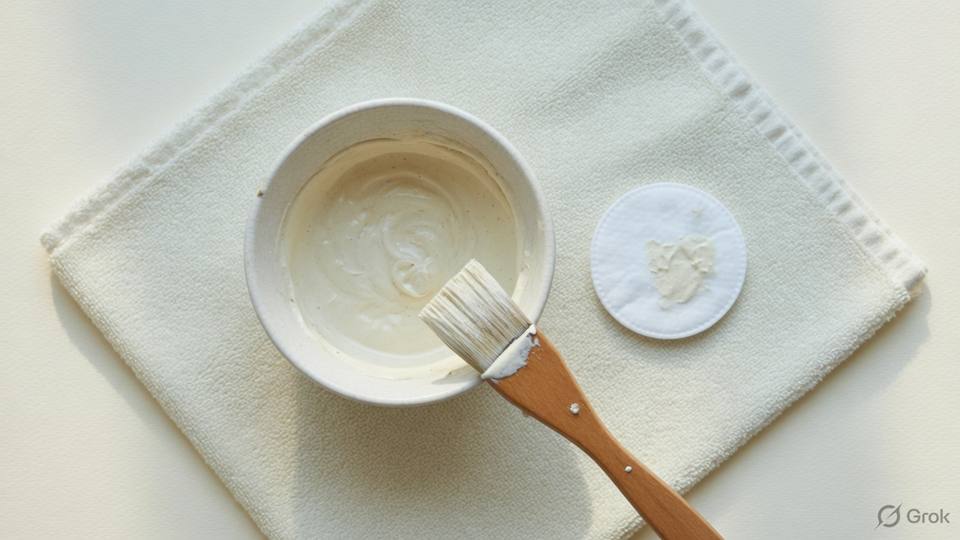
What facial bleach can and cannot do
Facial bleach is not hair bleach. They are different products, mixed to different strengths, and used on different tissue. Hair bleach is designed for keratin, the protein in hair, and applying it to the face can burn the skin. Never substitute one for the other, never borrow a sachet from the hair station, and never let a client bring a product from home without reading its label. Facial bleach is a cosmetic preparation that lightens the fine hair on the face. It is not a medical treatment, and it does not reach the pigment cells that give skin its colour.
The visible result is temporary. Fine facial hair catches light, and lightening it can make the face look brighter for a short time. The effect fades as the hair grows and as the skin renews. Facial bleach does not permanently change the natural colour of the skin, and it does not make dark skin light. It does not remove a dark patch, a melasma mark, or a scar. Saying this before the service is not negative selling; it is the only way to prevent a client from judging the result against a promise nobody can keep, and it gives the client a reason to trust the next suggestion.
Detan products work on a different principle. They are cosmetic preparations that help reduce the look of surface discolouration after sun exposure, usually over several days. They do not remove pigment from deeper layers, and they do not stop the skin from tanning again. A detan can make a face look more even for a while, especially after a holiday. It cannot undo years of sun, and it cannot replace daily sunscreen. A client who wants a lasting change in pigmentation needs a longer plan with a skin therapist or a dermatologist, not a stronger detan or a longer application.
The script belongs at the start, in plain English and in the client's own language if possible. 'This is a cosmetic service. It lightens the fine hair and can make the skin look brighter for a short time. It does not change your natural skin colour, and it will not remove a mark permanently.' Say it once, calmly, and check that the client understands. If the client says they want fairness, correct the word without shaming them: the service can brighten the look, not change the colour. Write the consent on the card, including the words you used, so the next esthetician can repeat the same limit without contradicting you.
- 1. Confirm that the product is a facial bleach and not a hair bleach.
- 2. Read the label, including the patch-test instruction and the maximum time.
- 3. Explain that the service lightens fine hair and brightens the look for a short time.
- 4. Explain that it does not change natural skin colour or remove a mark permanently.
- 5. Use the same explanation for detan: it reduces the look of surface tan, not deep pigment.
- 6. Ask what result the client expects and correct an impossible expectation before starting.
- 7. Record the product, the batch, and the consent words on the card.
- 8. Do not proceed if the client expects a permanent colour change.
Salon example
Pooja, twenty-eight, books a facial bleach before her engagement. She tells the esthetician that she wants her face two shades lighter and shows a photograph of a cousin whose skin looks paler. The esthetician explains that facial bleach lightens the fine hair and can make the face look brighter, but it does not change the skin's natural colour, and the cousin's photograph may have been taken in different light or edited. Pooja is quiet, then asks whether a stronger mix would work better. The esthetician says no, that a stronger mix burns rather than lightens, and that the result she wants is not a salon bleach result. She offers the bleach for the fine hair, with an honest explanation of the short-lived effect, and suggests a dermatologist for pigmentation. Pooja chooses the bleach but changes her expectation. She leaves with a brighter look, not a different colour, and the card records the conversation, including the fact that she was told the change would be temporary and cosmetic. Pooja reads the card before she pays and asks no further questions about lightening.
Caution: A stronger mix does not lighten more; it burns, and no event is worth a facial burn.
Patch test, mix, timing, and removal
A patch test is the cheapest safety step in the salon. Test twenty-four to forty-eight hours before the service when the brand requires it, and always for a first-time client or a client with any history of reaction. Use the same product and the same mix, on a small area behind the ear or on the inner forearm. Clean the area, apply a thin layer, and leave it as the label directs. Record the date, the product, the batch, and the result. If the client cannot confirm a patch test and the brand requires one, do not proceed. A client's memory of a test five years ago is not a test for today's product.
Mix exactly as the label says. More activator is not more result; it is a burn. Use a clean spatula or brush, a clean bowl, and the measured proportions the label gives. Do not mix a larger batch to save time, because the product may become stronger or unstable while it sits. Do not add essential oil, lemon, or a home remedy to the mix. Do not use a metal bowl if the label says not to. Keep the product away from the eyes, the eyelids, and the eyebrows unless the label explicitly allows use there. If the label does not allow it, the answer is no.
Apply evenly and thinly, away from the eyes, with a clean spatula or brush. Time it by the label, and check at the shortest time the label gives rather than the longest. Set a timer; do not rely on memory. Ask the client to tell you at once if the stinging becomes more than mild. Stinging that builds, burning, or a spreading warmth is a reason to remove the product immediately, not to wait it out. Remove completely with lukewarm water and the product's remover if it has one. Check the hairline, the sides of the nose, and the jaw, where residue hides.
Finish with a calming moisturiser and sunscreen if it is daytime. Do not apply a strong acid, a scrub, or a retinoid after a bleach. Give the aftercare card: no sun today, no heat, no scrub for forty-eight hours, and no repeat bleach for the interval the label gives. Look at the skin before the client leaves, and note any redness. If the skin is red beyond a light flush, treat it as a reaction and follow the salon's incident steps. Record the timing, the product, and the result. A calm service with an honest record is better than a strong result with a hidden risk.
- 1. Patch test twenty-four to forty-eight hours before when the brand requires it, and for any first-time or reactive client.
- 2. Record the patch-test date, product, batch, and result.
- 3. Do not proceed if the client cannot confirm a required patch test.
- 4. Mix exactly to the label with a clean spatula and bowl.
- 5. Never add extra activator, essential oil, lemon, or a home remedy.
- 6. Apply evenly and thinly, away from the eyes, eyelids, and eyebrows unless the label allows it.
- 7. Time by the label and check at the shortest stated time, using a timer.
- 8. Remove at once if the client reports burning or more than mild stinging.
- 9. Remove completely, apply a calming moisturiser and sunscreen, and record the result.
Salon example
A client, Simran, brings her own bleach sachet because she used it last year and liked the result. The esthetician reads the label, sees that it requires a patch test, and asks when the last test was. Simran cannot remember. The esthetician explains that the product may have changed or that her skin may have changed, and offers a patch test behind the ear that day with a booking two days later. Simran agrees. The test is calm, and she returns. The esthetician mixes exactly the label proportions, applies a thin layer away from the eyes, and sets a timer for the shortest stated time. After four minutes Simran says the area is stinging more than mild, so the product is removed at once with lukewarm water. The skin is pink but not blistered. The esthetician applies a calming moisturiser, gives the aftercare card, and records the reaction. She does not repeat the bleach on the next visit, and she tells Simran to bring the sachet again only if the label and the patch test are both current and the skin has had a full week to settle.
Caution: Mild tingling can be expected; burning, spreading warmth, or pain is a reason to remove the product at once, not to wait for the timer.
Detan, claims, and consent
Detan is a cosmetic service, and its name promises more than the product can do. It can help reduce the look of surface discolouration after sun exposure, and it can make the skin feel cleaner and look more even for a few days. It does not remove deep pigment, it does not treat melasma, and it does not stop the skin from tanning again. The result depends on the product, the time on the skin, the client's baseline colour, and the sun exposure that follows. A detan without daily sunscreen is a temporary clean-up that the next weekend undoes, which is why the sunscreen line belongs on the card.
Claims are where cosmetic services get into trouble. Do not say that a product cures acne, removes pigmentation, treats melasma, or makes skin fair. Do not use the word treatment for a cosmetic service if it implies a medical result. Do not compare one client's skin with another's or promise a shade. Do not show a filtered before-and-after as proof. A cosmetic product may clean, moisturise, brighten the look, or temporarily reduce the appearance of surface discolouration. Those are the claims the label can support, and they are enough for an honest service. Anything beyond that belongs to a medical professional.
Consent is more than a signature. The client should know what the product is, what it can and cannot do, how long the result may last, and what the risks are. Ask about pregnancy, allergy, a previous reaction, and any active skin condition. Read the label for warnings about pregnancy or broken skin. If the client is unsure, do the shorter, simpler service or postpone. Do not let an event create pressure for a stronger mix or a longer time. A client who understands the limit is less likely to complain and more likely to return for the service that actually helps.
For pigmentation that is patchy, deep, or persistent, refer. Melasma, post-inflammatory marks, and sun damage need a plan that includes daily sunscreen, gentle care, and often a prescription from a dermatologist. The salon can support that plan with cleansing, moisturising, and cosmetic detan, but it cannot replace it. Say that in one sentence and write it on the card. A referral is not a lost sale; it is the reason the client trusts the next recommendation. The same applies to a mark that has changed, a lesion that bleeds, or skin that reacts to every product; those are medical questions, not menu choices.
- 1. Explain that detan reduces the look of surface tan for a short time.
- 2. Explain that it does not remove deep pigment, treat melasma, or stop future tanning.
- 3. Do not claim that a product cures acne, removes pigmentation, or makes skin fair.
- 4. Do not promise a shade or compare the client with another person.
- 5. Ask about pregnancy, allergy, previous reaction, and active skin conditions.
- 6. Read the label warnings and choose the shorter, simpler service when unsure.
- 7. Recommend daily sunscreen as the step that protects the result.
- 8. Refer persistent or patchy pigmentation to a skin therapist or dermatologist, and record it.
Salon example
A client, Rohan, comes after a beach holiday with a clear tan line on his forehead and asks for a detan that will remove it in one visit. The esthetician explains that the detan can reduce the look of the surface tan for a few days, but it will not remove the colour, and the sun on his drive to work will bring it back. Rohan asks whether a stronger mix or a longer time would work faster. The esthetician says no, that the label time is the limit, and that a longer time risks irritation rather than a better result. She performs the detan at the label time, applies a calming moisturiser and sunscreen, and gives a card that says sunscreen every morning and a hat outdoors. She suggests a skin therapist for a longer pigment plan. Rohan books a repeat detan before a wedding, with realistic expectations and a sunscreen habit. The esthetician writes the sunscreen advice on the card and asks him to bring the same product next time so the patch test can be repeated before the service.
Caution: Do not let the word detan become a promise to remove pigment; the product works on the surface look, and the label time is the limit.
This is a Nandu Nai textbook. It is a private brand book, not a government licence, and it does not give the right to give medical treatment.