
French crop

The French crop is a short men's cut with a straight fringe that sits forward on the forehead, usually 3 to 5 cm long, over tapered sides and back. It suits straight to slightly wavy hair, a strong jaw, and a client who wants a neat shape without using much product. The fringe line is the whole point: it should be level or gently rounded, never jagged. On a round face, keep the fringe slightly shorter so the forehead still shows; on a long face, allow a fuller fringe. Ask whether the man wears his hair forward already, because a client who pushes it back will fight the shape every morning.
Cut the fringe on damp straight hair, because wet hair shows the true line, but leave 2 to 3 mm longer than the mark, dry it, and refine. Comb the fringe straight down from the crown, section a triangle from the temples to the centre, and cut the guide at the middle, then work outward to each corner. Taper the sides and back with clippers or scissor-over-comb, but keep the blending soft, with no heavy shelf above the temples. Cross-check the fringe with the head upright. Fringe grows about 1 cm a month, so rebook the fringe in 3 to 4 weeks and the full cut in 5 to 6 weeks. Allow 20 to 40 minutes.
- 1. Consult with the hair dry, ask how he wears it now, and agree the fringe line and the side taper before the cape goes on.
- 2. Show the fringe length with a comb held at the brow, mark 3 to 5 cm, and confirm that he is happy with the front forward and straight.
- 3. Section the front into a triangle from the temples to the crown, clip the rest away, and keep the partings clean so no stray hair enters the fringe guide.
- 4. Cut the fringe guide at the centre, leave 2 to 3 mm beyond the mark, then follow the guide to each corner without lifting the hair.
- 5. Taper the sides and back with a clipper guard or scissor-over-comb, and blend the corners into the fringe with the tips of the shears.
- 6. Cross-check both corners at eye level with the head straight, then tilt the head down and compare the two sides again.
- 7. Dry the hair, refine the fringe, and check that the line sits level and the sides show no step or ridge.
- 8. Rebook the fringe in 3 to 4 weeks and the full cut in 5 to 6 weeks, and tell him to comb the fringe forward after washing.
Salon example: Arun's first French crop
Arun, thirty-four, works in a bank and wanted a short cut that looked neat on video calls. His hair is straight and medium density, and he already wears it forward. I showed the fringe at 4 cm with the comb on his brow and agreed a soft taper on the sides. I cut the fringe wet, left 2 mm, dried it and refined the line, then blended the corners. The full cut took 30 minutes. He rebooked the fringe for three weeks and the full cut for five. At the next visit the line still sat level and needed only a small trim.
Caution: Do not leave a French crop fringe 2 to 3 mm long after a wet cut without a dry check, because it will lift and show a gap at the brow.
Textured crop
A textured crop keeps the top short, usually 3 to 5 cm, and cuts the ends into small points so the surface looks broken and light instead of solid. It is not a spiky style: the points lie down, and the shape stays close to the head. Thick straight hair and loose waves both work, because point cutting removes weight without making holes. Fine hair needs a gentler hand, since too much point cutting leaves the top looking thin. Ask how much time he will spend in the morning; a textured crop needs little product, but it does need a quick rub of the fingers through dry hair to show the texture.
Cut the top to 3 to 5 cm first, working from a centre guide, then point cut vertically into the ends at small intervals, about 1 cm apart, and take no more than the last 5 mm. Keep the fringe soft rather than jagged. Taper the sides and back, and blend the corners so the top does not sit like a cap. On straight hair, cut the fringe wet, leave 2 to 3 mm, dry it, and refine. Cross-check both sides. Fringe grows about 1 cm a month, so rebook the fringe in 3 to 4 weeks and the full cut in 5 to 6 weeks. Allow 20 to 40 minutes.
- 1. Consult with the hair dry, ask how he wears it now, and agree the top length and the side taper before the cape goes on.
- 2. Show the fringe length with a comb held at the brow, mark 3 to 5 cm, and confirm that he is happy with the front soft and broken.
- 3. Section the front into a triangle from the temples to the crown, clip the rest away, and keep the partings clean so no stray hair enters the fringe guide.
- 4. Cut the fringe guide at the centre, leave 2 to 3 mm beyond the mark, then follow the guide to each corner without lifting the hair.
- 5. Taper the sides and back with a clipper guard or scissor-over-comb, and blend the corners into the fringe with the tips of the shears.
- 6. Cross-check both corners at eye level with the head straight, then tilt the head down and compare the two sides again.
- 7. Dry the hair, refine the fringe, and check that the line sits level and the sides show no step or ridge.
- 8. Rebook the fringe in 3 to 4 weeks and the full cut in 5 to 6 weeks, and tell him to rub the dry top with his fingers, not a comb.
Salon example: Vikram's wash-and-go crop
Vikram, twenty-eight, plays sport most evenings and wanted a cut that survived sweat without styling. His hair is thick and straight, with enough density for a textured top. I cut the top to 4 cm, point cut the ends at 1 cm intervals and kept the fringe soft. The sides were tapered with a clipper and blended at the corners. Drying took a few minutes with the fingers, and the texture showed without product. The cut took 25 minutes. I told him the fringe would grow about 1 cm a month and rebooked him in three weeks for the fringe and six weeks for the full cut.
Caution: Do not point cut a textured crop too deeply on fine hair, because the top will look sparse instead of textured.
Caesar cut
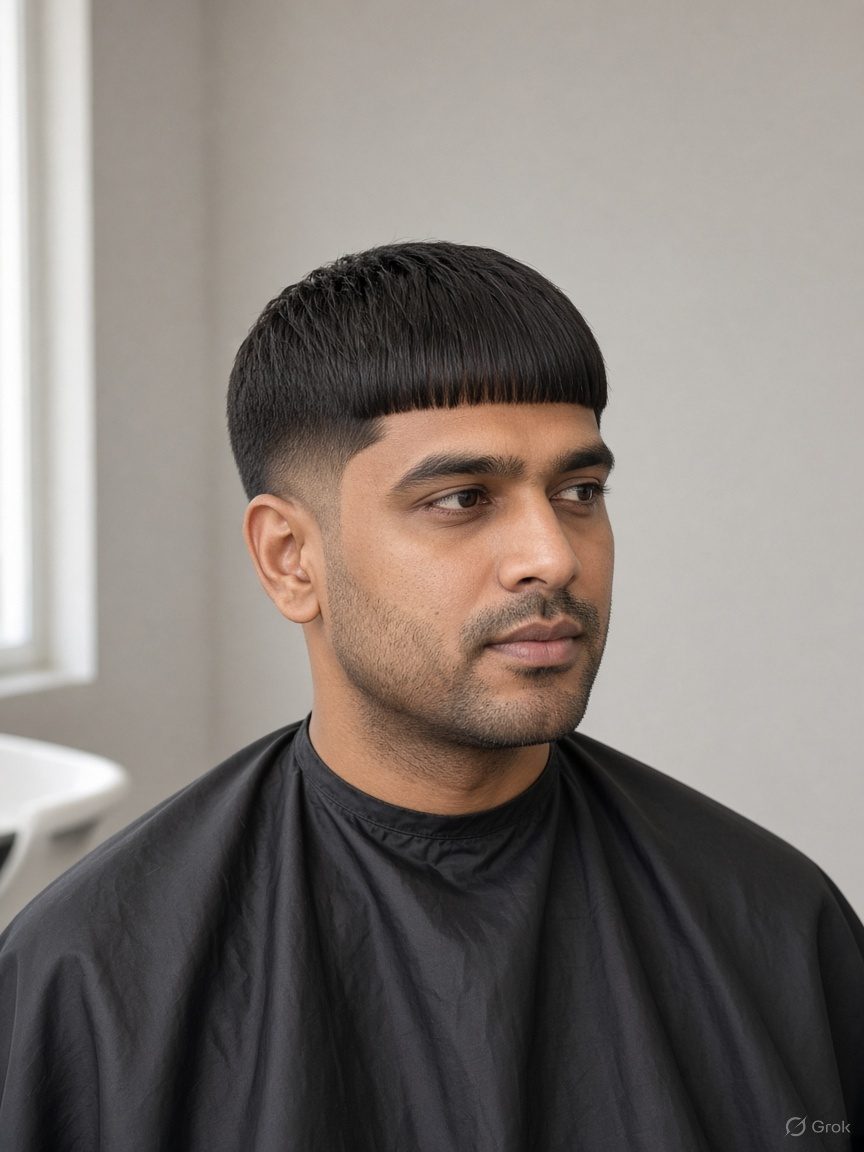
The Caesar cut is a short, blunt fringe worn flat and low on the forehead, with short sides and a short back. The fringe is usually 2 to 3 cm and follows the curve of the head rather than hanging straight down, which is what separates it from a blunt fringe crop. It suits straight hair and a strong jaw, and it is one of the easiest short cuts to maintain. It also works well on a man whose hairline is thinning at the front, because the short fringe hides the edge without pretending it is full. Ask whether he wants a visible fringe line or a softer, brushed finish.
Cut the fringe dry or barely damp, because at this length a few millimetres change the whole line. Comb the front hair down, take a horizontal guide across the forehead at 2 to 3 cm, and cut it blunt with the head tilted slightly forward. Keep the corners soft so the fringe does not look like a straight ruler. Shorten the sides and back with clippers or scissor-over-comb, and blend into the fringe. Cross-check the line with the head upright. Fringe grows about 1 cm a month, so rebook the fringe in 3 to 4 weeks and the full cut in 4 to 5 weeks. Allow 20 to 40 minutes.
- 1. Consult with the hair dry, ask how he wears it now, and agree the fringe line and the side taper before the cape goes on.
- 2. Show the fringe length with a comb held at the brow, mark 2 to 3 cm, and confirm that he is happy with the front flat and slightly forward.
- 3. Section the front into a triangle from the temples to the crown, clip the rest away, and keep the partings clean so no stray hair enters the fringe guide.
- 4. Cut the fringe guide at the centre, leave 1 to 2 mm beyond the mark, then follow the guide to each corner without lifting the hair.
- 5. Taper the sides and back short with a clipper or scissor-over-comb, and blend the corners into the fringe with the tips of the shears.
- 6. Cross-check both corners at eye level with the head straight, then tilt the head down and compare the two sides again.
- 7. Dry the hair, refine the fringe, and check that the line sits level and the sides show no step or ridge.
- 8. Rebook the fringe in 3 to 4 weeks and the full cut in 4 to 5 weeks, and tell him to comb the fringe flat after washing.
Salon example: Sameer's Caesar cut
Sameer, forty-one, asked for a Caesar cut after years of wearing his hair longer. His hair is straight and his hairline is thinning at the front, so the short fringe worked well. I cut the fringe dry at 3 cm, following the curve of his head, and kept the corners soft. The sides went short with scissor-over-comb and the back was tapered. The line looked level when he stood up. The cut took 20 minutes. I warned him that a few millimetres change the shape, so the fringe needs a trim every three to four weeks. He booked the full cut for five weeks.
Caution: Do not cut a Caesar fringe too short on a man with a strong cowlick, because it will stand up and break the flat line.
Blunt fringe crop
A blunt fringe crop gives a full, straight fringe that sits just above the brows, with tapered sides and a short back. The fringe is the feature, so the line must be solid and level, not broken or thinned. It suits straight, medium to thick hair and a man who wants a clean, modern shape. On a round or wide face the straight line can make the face look wider, so keep the fringe slightly shorter and leave a little space at the temples. On a long face a fuller fringe balances the length. Ask whether he minds hair touching the brows, because that decides the final length.
Cut the fringe wet on straight hair, leave 2 to 3 mm longer than the agreed mark, dry the hair, and refine the line. Section a triangle from the temples to the crown, comb the fringe straight down, and cut a centre guide just above the brows. Work outward to each corner with zero elevation, and do not thin the fringe, because a see-through line defeats the style. Taper the sides and back and soften the corners. Cross-check both sides. Fringe grows about 1 cm a month, so rebook the fringe in 3 to 4 weeks and the full cut in 5 to 6 weeks. Allow 20 to 40 minutes.
- 1. Consult with the hair dry, ask how he wears it now, and agree the fringe line and the side taper before the cape goes on.
- 2. Show the fringe length with a comb held at the brow, mark just above the brows, and confirm that he is happy with the front straight down.
- 3. Section the front into a triangle from the temples to the crown, clip the rest away, and keep the partings clean so no stray hair enters the fringe guide.
- 4. Cut the fringe guide at the centre, leave 2 to 3 mm beyond the mark, then follow the guide to each corner without lifting the hair.
- 5. Taper the sides and back with a clipper guard or scissor-over-comb, and blend the corners into the fringe with the tips of the shears.
- 6. Cross-check both corners at eye level with the head straight, then tilt the head down and compare the two sides again.
- 7. Dry the hair, refine the fringe, and check that the line sits level and the sides show no step or ridge.
- 8. Rebook the fringe in 3 to 4 weeks and the full cut in 5 to 6 weeks, and tell him not to thin or brush the fringe against the line.
Salon example: Rohit's brow line
Rohit, twenty-six, wanted a blunt fringe just above his brows. His hair is straight and thick, so the solid line was possible. I cut the fringe wet, left 3 mm, dried it and refined the edge. The sides were tapered and the corners softened so the fringe did not look like a ruler. He was unsure about the length, so I showed it with the comb first and cut 2 mm shorter than his first request. The cut took 30 minutes. I rebooked the fringe in three weeks, because after four weeks the line would reach his brows and start to look heavy.
Caution: Do not thin a blunt fringe, because a see-through line removes the whole reason for the cut.
Textured fringe
A textured fringe is a fringe cut into separate pieces so the front looks soft and movable rather than like one solid block. The length stays around the brow, but the ends are point cut at different depths, which breaks the line and lets the hair sit naturally. It suits thick straight hair and loose waves, and it is a good choice for a man who finds a blunt fringe too severe. Very fine or sparse hair needs a lighter version, because too many points can make the fringe look thin. Ask whether he wants the pieces to sit forward or slightly to one side.
Cut the fringe to the agreed length first, then point cut vertically into the ends with the shears almost parallel to the hair, taking only the last 5 mm and spacing the points about 1 cm apart. Do not chop across the fringe, and do not make the points spiky. On straight hair, cut wet, leave 2 to 3 mm, dry, and refine. Taper the sides and back, and blend the corners so the fringe joins the sides softly. Cross-check with the head upright and tilted down. Fringe grows about 1 cm a month, so rebook the fringe in 3 to 4 weeks and the full cut in 5 to 6 weeks. Allow 20 to 40 minutes.
- 1. Consult with the hair dry, ask how he wears it now, and agree the fringe length and the side taper before the cape goes on.
- 2. Show the fringe length with a comb held at the brow, mark at the brow, and confirm that he is happy with the front soft and piecey.
- 3. Section the front into a triangle from the temples to the crown, clip the rest away, and keep the partings clean so no stray hair enters the fringe guide.
- 4. Cut the fringe guide at the centre, leave 2 to 3 mm beyond the mark, then follow the guide to each corner without lifting the hair.
- 5. Taper the sides and back with a clipper guard or scissor-over-comb, and blend the corners into the fringe with the tips of the shears.
- 6. Cross-check both corners at eye level with the head straight, then tilt the head down and compare the two sides again.
- 7. Dry the hair, refine the fringe, and check that the line sits level and the sides show no step or ridge.
- 8. Rebook the fringe in 3 to 4 weeks and the full cut in 5 to 6 weeks, and tell him to dry the fringe with his fingers so the pieces separate.
Salon example: Imran's lighter front
Imran, thirty, has thick straight hair and a blunt fringe he found too heavy. I cut the fringe to the brow, then point cut the ends at different depths so the front broke into soft pieces. I kept the points 1 cm apart and removed only the last 5 mm, which kept the fringe full. The sides were tapered and the corners blended. The cut took 25 minutes. He said the front felt lighter and easier to push aside. I told him the fringe grows about 1 cm a month and booked the fringe in three weeks and the full cut in five.
Caution: Do not chop across a textured fringe with the shears, because the pieces will look jagged rather than soft.
Curtain fringe

A curtain fringe is parted in the middle and falls away to both sides, longer in the centre and open toward the cheekbones. It frames the face and softens a strong forehead, and it suits straight or gently wavy hair with enough density at the front. The centre needs roughly 8 to 10 cm of length to open properly, so a man with a short front has to grow it before the shape can work. On a narrow face, keep the sides of the fringe closer to the cheek; on a wide face, let them swing a little further out. Ask whether he will part it in the middle every day.
Find the natural centre part first, because a curtain fringe that fights the parting will split all day. Comb the centre section straight down, cut a guide at the agreed length, then angle the following sections down toward the cheekbone. On straight hair, cut wet, leave 2 to 3 mm, dry, and refine the ends with point cutting so they are not heavy. Keep the sides tapered and the back short. Cross-check both sides for symmetry. Fringe grows about 1 cm a month, so rebook the fringe in 3 to 4 weeks and the full cut in 5 to 6 weeks. Allow 20 to 40 minutes.
- 1. Consult with the hair dry, ask how he wears it now, and agree the centre length and the side taper before the cape goes on.
- 2. Show the fringe length with a comb held at the brow, mark 8 to 10 cm at the centre, and confirm that he is happy with the front parted in the middle.
- 3. Section the front into a triangle from the temples to the crown, clip the rest away, and keep the partings clean so no stray hair enters the fringe guide.
- 4. Cut the fringe guide at the centre, leave 2 to 3 mm beyond the mark, then follow the guide to each corner without lifting the hair.
- 5. Taper the sides and back with a clipper guard or scissor-over-comb, and blend the corners into the fringe with the tips of the shears.
- 6. Cross-check both corners at eye level with the head straight, then tilt the head down and compare the two sides again.
- 7. Dry the hair, refine the fringe, and check that the line sits level and the sides show no step or ridge.
- 8. Rebook the fringe in 3 to 4 weeks and the full cut in 5 to 6 weeks, and tell him to find the same centre part every morning.
Salon example: Karan grows into the part
Karan, twenty-two, wanted a curtain fringe but his front hair was only 6 cm long. I explained that the centre needed about 9 cm to open properly, so we agreed to leave the front alone and trim only the sides and back. I showed him how the centre would part and where the fringe would sit on his cheekbones. The cut took 20 minutes. He rebooked in five weeks to check the growth before we cut the fringe. At that visit the centre had reached 8 cm, so I cut a soft guide and pointed the ends. The shape opened well.
Caution: Do not cut a curtain fringe against the natural centre part, because it will split all day and the client will blame the cut.
Side-swept fringe
A side-swept fringe is cut to fall across the forehead in one direction, usually about 6 cm long at the heavy side and shorter toward the opposite temple. It suits most face shapes and most straight or wavy hair, and it is a practical choice for a man who does not want hair in his eyes. The direction should follow the natural part and the way the hair already falls; forcing it the other way creates a fight every morning. A cowlick at the front decides everything, so check it before agreeing the length. Ask whether he wants a soft sweep or a sharper diagonal line.
Comb the fringe in its natural direction and cut a diagonal guide from the heavy side toward the opposite temple, keeping about 6 cm at the longest point. On straight hair, cut wet, leave 2 to 3 mm, dry, and refine; if a cowlick sits at the front, cut that area dry so the true fall shows. Point cut the ends lightly so the sweep looks soft. Taper the sides and back, and blend the short side into the fringe. Cross-check from the front and both sides. Fringe grows about 1 cm a month, so rebook the fringe in 3 to 4 weeks and the full cut in 5 to 6 weeks. Allow 20 to 40 minutes.
- 1. Consult with the hair dry, ask how he wears it now, and agree the sweep length and the side taper before the cape goes on.
- 2. Show the fringe length with a comb held at the brow, mark 6 cm at the heavy side, and confirm that he is happy with the front swept to one side.
- 3. Section the front into a triangle from the temples to the crown, clip the rest away, and keep the partings clean so no stray hair enters the fringe guide.
- 4. Cut the fringe guide at the centre, leave 2 to 3 mm beyond the mark, then follow the guide to each corner without lifting the hair.
- 5. Taper the sides and back with a clipper guard or scissor-over-comb, and blend the corners into the fringe with the tips of the shears.
- 6. Cross-check both corners at eye level with the head straight, then tilt the head down and compare the two sides again.
- 7. Dry the hair, refine the fringe, and check that the line sits level and the sides show no step or ridge.
- 8. Rebook the fringe in 3 to 4 weeks and the full cut in 5 to 6 weeks, and tell him to follow the natural cowlick instead of forcing it.
Salon example: Ajay works with the cowlick
Ajay, thirty-eight, has a cowlick at the front left and wanted a side-swept fringe. I cut the rest of the fringe wet, then cut the cowlick area dry so I could see its true direction. The longest point sat at 6 cm on the heavy side and the line ran diagonally to the opposite temple. The ends were point cut lightly and the sides tapered. The cut took 25 minutes. He said the fringe now falls the way he already pushes it. I rebooked the fringe in three weeks and told him not to fight the cowlick with a hairdryer.
Caution: Do not force a side-swept fringe against a strong cowlick, because the sweep will lift and the line will break within a day.
Rounded crop
A rounded crop follows the curve of the head with a soft, round outline and no hard horizontal line. It is close to a bowl cut in silhouette, but the corners are broken and the sides are tapered, so it does not look like a cap sitting on the head. It suits straight and slightly wavy hair and most face shapes, and it is a good option for a man who wants a short cut with a softer edge. The danger is cutting a heavy line around the head, which turns the shape into a bowl. Ask whether he wants the outline tight or a little fuller.
Work with a round guide that travels around the head, following the curve from the front hairline to the nape, and keep the tension even so the outline stays smooth. Cut the top to the agreed length, then blend the sides into the round shape with scissor-over-comb. Break the corners with light point cutting, taking only the last 2 to 3 mm. On straight hair, cut the fringe wet, leave 2 to 3 mm, dry, and refine. Cross-check the outline from the front, sides and back. Fringe grows about 1 cm a month, so rebook the fringe in 3 to 4 weeks and the full cut in 5 to 6 weeks. Allow 20 to 40 minutes.
- 1. Consult with the hair dry, ask how he wears it now, and agree the round outline and the side taper before the cape goes on.
- 2. Show the fringe length with a comb held at the brow, mark 2 to 4 cm at the front, and confirm that he is happy with the front soft and rounded.
- 3. Section the front into a triangle from the temples to the crown, clip the rest away, and keep the partings clean so no stray hair enters the fringe guide.
- 4. Cut the fringe guide at the centre, leave 2 to 3 mm beyond the mark, then follow the guide to each corner without lifting the hair.
- 5. Taper the sides and back with scissor-over-comb following the round outline, and blend the corners into the fringe with the tips of the shears.
- 6. Cross-check both corners at eye level with the head straight, then tilt the head down and compare the two sides again.
- 7. Dry the hair, refine the fringe, and check that the line sits level and the sides show no step or ridge.
- 8. Rebook the fringe in 3 to 4 weeks and the full cut in 5 to 6 weeks, and tell him to dry the sides down so the round outline stays smooth.
Salon example: Deepak's soft round shape
Deepak, forty-five, wanted a short round shape without a bowl line. His hair is straight and slightly wavy at the crown. I cut a round guide from the front hairline to the nape, kept the tension even and blended the sides with scissor-over-comb. I broke the corners with light point cutting, taking 2 mm only. The outline looked soft from every side. The cut took 30 minutes. He rebooked the full cut for five weeks. At the next visit the shape had held and needed only a clean-up, which was quicker than the first cut.
Caution: Do not cut a hard horizontal line around a rounded crop, because it turns the shape into a bowl.
Soft bowl cut

A bowl cut is a rounded shape with a continuous line around the head, and it is one of the most requested and most regretted short cuts. Offer a French crop first, because it gives a similar soft front without the heavy outline, and explain the difference with the comb in your hand. If he still wants a bowl, agree the exact line above the ears and across the forehead before you cut. Thick straight hair holds the shape best. Fine hair can look flat, and wavy hair can lift at the corners, so say what the hair will really do.
Cut an even round guide around the head, section by section, and keep the tension identical so the line does not wobble. Do not cut a step above the ears. Once the shape is level, point cut the last 2 mm around the perimeter so the edge is soft rather than blunt. On straight hair, cut wet, leave 2 to 3 mm, dry, and refine the line. Cross-check with the head upright and tilted down. Fringe grows about 1 cm a month, so rebook the fringe in 3 to 4 weeks and the full cut in 4 to 5 weeks. Allow 20 to 40 minutes.
- 1. Consult with the hair dry, ask how he wears it now, and agree the round line and the side taper before the cape goes on.
- 2. Show the fringe length with a comb held at the brow, mark 1 to 2 cm below the crown line, and confirm that he is happy with the front straight down.
- 3. Section the front into a triangle from the temples to the crown, clip the rest away, and keep the partings clean so no stray hair enters the fringe guide.
- 4. Cut the fringe guide at the centre, leave 2 to 3 mm beyond the mark, then follow the guide to each corner without lifting the hair.
- 5. Taper the sides and back evenly around the head with scissor-over-comb, and blend the corners into the fringe with the tips of the shears.
- 6. Cross-check both corners at eye level with the head straight, then tilt the head down and compare the two sides again.
- 7. Dry the hair, refine the fringe, and check that the line sits level and the sides show no step or ridge.
- 8. Rebook the fringe in 3 to 4 weeks and the full cut in 4 to 5 weeks, and tell him to comb the shape down and book the first trim early.
Salon example: Manoj chooses the bowl
Manoj, nineteen, asked for a bowl cut. I offered a French crop first and showed him both outlines with the comb, but he wanted the bowl. I agreed the line above his ears and across his forehead before cutting. I cut an even round guide, kept the tension identical and point cut the last 2 mm so the edge was soft. The sides were not stepped. The cut took 35 minutes. I told him the fringe would grow about 1 cm a month and that the shape needs a trim every four to five weeks. He booked the first trim for four weeks.
Caution: Do not agree to a bowl cut without offering a French crop first and explaining the heavy outline and the upkeep.
Mushroom cut

A mushroom cut has a rounded top that sits over clearly shorter sides, so the silhouette widens at the top and narrows at the ears. It is a stronger look than a rounded crop and needs a confident client. Thick straight hair holds the shape, while fine hair collapses and wavy hair lifts at the corners. The shelf where the top meets the sides can be soft or crisp, and that choice changes the whole style. Ask about his workplace and how much attention he wants, because this cut is noticed. Agree the height of the shelf before cutting.
Cut the top to a round guide first, following the curve of the head and keeping the length even. Then shorten the sides to the agreed height, leaving the shelf where you marked it, and blend the edge only as much as he asked. Point cut the top so it does not look like a solid cap. On straight hair, cut the fringe wet, leave 2 to 3 mm, dry, and refine. Cross-check the shelf on both sides at eye level. Fringe grows about 1 cm a month, so rebook the fringe in 3 to 4 weeks and the full cut in 4 to 5 weeks. Allow 20 to 40 minutes.
- 1. Consult with the hair dry, ask how he wears it now, and agree the shelf height and the side taper before the cape goes on.
- 2. Show the fringe length with a comb held at the brow, mark at the brow, and confirm that he is happy with the front rounded over the shelf.
- 3. Section the front into a triangle from the temples to the crown, clip the rest away, and keep the partings clean so no stray hair enters the fringe guide.
- 4. Cut the fringe guide at the centre, leave 2 to 3 mm beyond the mark, then follow the guide to each corner without lifting the hair.
- 5. Taper the sides and back to the agreed shelf height with a clipper or scissor-over-comb, and blend the corners into the fringe with the tips of the shears.
- 6. Cross-check both corners at eye level with the head straight, then tilt the head down and compare the two sides again.
- 7. Dry the hair, refine the fringe, and check that the line sits level and the sides show no step or ridge.
- 8. Rebook the fringe in 3 to 4 weeks and the full cut in 4 to 5 weeks, and tell him to use a little product to keep the top round.
Salon example: Suresh's clean shelf
Suresh, twenty-four, wanted a mushroom cut with a clear shelf. His hair is thick and straight, so the top held its round shape. I cut the top first with a round guide, then shortened the sides to the agreed height and kept the shelf crisp because he asked for it. I point cut the top so it did not look solid. The cut took 35 minutes. I checked the shelf on both sides at eye level before I dried it. He rebooked the full cut for five weeks and said he would use a little product to keep the top rounded.
Caution: Do not make a mushroom shelf tighter than agreed, because the line is noticed and a small change alters the whole shape.
Mod crop
A mod crop pairs a heavy, straight fringe with a tapered nape and short sides, a shape drawn from the mod look of the nineteen sixties. The fringe is the strongest part: it sits low, stays solid, and is cut straight across rather than broken into points. It suits thick straight hair and a man who likes a graphic, retro shape. Fine hair cannot carry the weight of the fringe, and very wavy hair will break the line. Ask whether he wants the fringe to the brow or slightly above it, and whether the nape should be clean or soft.
Cut the fringe first, because the rest of the shape follows it. Comb the front down, cut a straight centre guide at the agreed mark, and carry it to both corners with zero elevation. On straight hair, cut wet, leave 2 to 3 mm, dry, and refine the line. Keep the fringe solid, with no thinning. Taper the nape close and keep the sides short, but leave enough length at the temple to support the fringe. Cross-check the line at eye level. Fringe grows about 1 cm a month, so rebook the fringe in 3 to 4 weeks and the full cut in 4 to 5 weeks. Allow 20 to 40 minutes.
- 1. Consult with the hair dry, ask how he wears it now, and agree the fringe line and the side taper before the cape goes on.
- 2. Show the fringe length with a comb held at the brow, mark at the brow, and confirm that he is happy with the front heavy and straight.
- 3. Section the front into a triangle from the temples to the crown, clip the rest away, and keep the partings clean so no stray hair enters the fringe guide.
- 4. Cut the fringe guide at the centre, leave 2 to 3 mm beyond the mark, then follow the guide to each corner without lifting the hair.
- 5. Taper the sides and back close at the nape with a clipper, and blend the corners into the fringe with the tips of the shears.
- 6. Cross-check both corners at eye level with the head straight, then tilt the head down and compare the two sides again.
- 7. Dry the hair, refine the fringe, and check that the line sits level and the sides show no step or ridge.
- 8. Rebook the fringe in 3 to 4 weeks and the full cut in 4 to 5 weeks, and tell him to comb the fringe straight down and keep the nape clean.
Salon example: Nitin's graphic line
Nitin, thirty-two, wanted a mod crop with a heavy fringe and a clean nape. His hair is straight and thick at the front, so the solid line was realistic. I cut the fringe first at the brow with a straight centre guide, kept it blunt and did not thin it. Then I tapered the nape close and kept the sides short but left enough at the temple. The cut took 35 minutes. The line sat level when I checked it dry. I rebooked the fringe in three weeks and the full cut in five, because the heavy line drops quickly.
Caution: Do not thin a mod crop fringe, because the heavy solid line is the style and thinning makes it look weak.
Long straight fringe
A long straight fringe reaches the brow with a solid line, while the sides stay longer than a crop, about ear length, and the back is lightly tapered. The shape references the early nineteen sixties bands, but it works as a modern cut when the sides are kept clean. It suits straight, medium to thick hair and a man willing to wear a fringe every day. The front needs enough density to look solid; sparse hair shows gaps and the style fails. Ask whether the ears should be covered or left clear, because that changes the side length and the whole balance.
Cut the sides and back to the agreed length first, then set the fringe. Comb the front straight down, cut a centre guide at the brow, and take the line to both corners without lifting. On straight hair, cut wet, leave 2 to 3 mm, dry, and refine so the fringe is solid, not see-through. Point cut the side ends lightly so they move, but keep the fringe itself blunt. Cross-check both sides at eye level. Fringe grows about 1 cm a month, so rebook the fringe in 3 to 4 weeks and the full cut in 5 to 6 weeks. Allow 20 to 40 minutes.
- 1. Consult with the hair dry, ask how he wears it now, and agree the side and fringe length and the side taper before the cape goes on.
- 2. Show the fringe length with a comb held at the brow, mark at the brow, and confirm that he is happy with the front solid and straight.
- 3. Section the front into a triangle from the temples to the crown, clip the rest away, and keep the partings clean so no stray hair enters the fringe guide.
- 4. Cut the fringe guide at the centre, leave 2 to 3 mm beyond the mark, then follow the guide to each corner without lifting the hair.
- 5. Taper the sides and back lightly at the back with scissor-over-comb, and blend the corners into the fringe with the tips of the shears.
- 6. Cross-check both corners at eye level with the head straight, then tilt the head down and compare the two sides again.
- 7. Dry the hair, refine the fringe, and check that the line sits level and the sides show no step or ridge.
- 8. Rebook the fringe in 3 to 4 weeks and the full cut in 5 to 6 weeks, and tell him to keep the ears clear of product and trim the fringe early.
Salon example: Ravi's ear-length sides
Ravi, twenty-seven, wanted a long straight fringe with the sides at ear length. His hair is straight and dense, and the front was already long enough. I cut the sides and back first, leaving the ears partly covered, then set the fringe at the brow with a straight guide. I kept the fringe solid and point cut only the side ends so they moved. The cut took 35 minutes. He said the shape felt like the reference photo. I warned him that the fringe needs a trim every three to four weeks and booked the first one for three weeks.
Caution: Do not cut the sides too short on a long straight fringe, because the ears will look exposed and the balance will fail.
Spiky textured crop
A spiky textured crop keeps the top short, about 2 to 4 cm, and point cuts it so the ends can be lifted into small spikes with a little product. It is not a messy crop: the shape is tight, and the spikes are short and controlled. It suits thick straight hair and a man who will use wax or paste most days. If he says he will not use product, cut a crew instead, because without product the points lie flat and look untidy. Ask how strong he wants the spikes and whether he works somewhere that limits them.
Cut the top to 2 to 4 cm with a centre guide, then point cut into the ends at close intervals, taking only the last 5 mm and keeping the points even. Do not thin the sides of the top too much or the spikes will collapse. Taper the sides and back, and blend the corners. On straight hair, cut the fringe wet, leave 2 to 3 mm, dry, and refine. Cross-check the top by lifting it with the fingers. Fringe grows about 1 cm a month, so rebook the fringe in 3 to 4 weeks and the full cut in 4 to 5 weeks. Allow 20 to 40 minutes.
- 1. Consult with the hair dry, ask how he wears it now, and agree the top length and the side taper before the cape goes on.
- 2. Show the fringe length with a comb held at the brow, mark 2 to 4 cm, and confirm that he is happy with the front point cut, not jagged.
- 3. Section the front into a triangle from the temples to the crown, clip the rest away, and keep the partings clean so no stray hair enters the fringe guide.
- 4. Cut the fringe guide at the centre, leave 1 to 2 mm beyond the mark, then follow the guide to each corner without lifting the hair.
- 5. Taper the sides and back with a clipper guard or scissor-over-comb, and blend the corners into the fringe with the tips of the shears.
- 6. Cross-check both corners at eye level with the head straight, then tilt the head down and compare the two sides again.
- 7. Dry the hair, refine the fringe, and check that the line sits level and the sides show no step or ridge.
- 8. Rebook the fringe in 3 to 4 weeks and the full cut in 4 to 5 weeks, and tell him to use a small amount of paste and lift the points with his fingers.
Salon example: Farhan's controlled spikes
Farhan, twenty-three, wanted a spiky crop and used wax every day. His hair is thick and straight. I cut the top to 3 cm, point cut the ends closely and kept the points even, then tapered the sides and blended the corners. I dried the top and lifted it with my fingers to check the spikes. The cut took 25 minutes. He was happy with the shape and said he would use paste, not a heavy wax. I told him the fringe grows about 1 cm a month and rebooked the fringe in three weeks and the full cut in five.
Caution: Do not cut a spiky crop for a man who refuses product, because the points will lie flat and look untidy; cut a crew instead.
Messy crop
A messy crop leaves the top at 4 to 6 cm and cuts it so the hair can dry on its own into a soft, untidy shape. The length is longer than a standard crop, the ends are point cut, and the sides stay tapered but not tight. It suits straight, wavy and slightly curly hair, and it is the easiest short cut for a man who does not want to style. The risk is removing too much bulk, which makes the top flat and the mess disappears. Ask whether he wants it to look naturally untidy or deliberately textured.
Cut the top to 4 to 6 cm, then remove bulk inside the shape with point cutting and a little slide cutting, keeping the outline soft. Do not over-thin the ends, because the air-dry look needs some weight. Taper the sides and back, and blend the corners so the top falls over them. On straight hair, cut the fringe wet, leave 2 to 3 mm, dry, and refine. Cross-check by rough-drying the hair with the fingers. Fringe grows about 1 cm a month, so rebook the fringe in 3 to 4 weeks and the full cut in 5 to 6 weeks. Allow 20 to 40 minutes.
- 1. Consult with the hair dry, ask how he wears it now, and agree the top length and the side taper before the cape goes on.
- 2. Show the fringe length with a comb held at the brow, mark at the brow, and confirm that he is happy with the front soft and untidy.
- 3. Section the front into a triangle from the temples to the crown, clip the rest away, and keep the partings clean so no stray hair enters the fringe guide.
- 4. Cut the fringe guide at the centre, leave 2 to 3 mm beyond the mark, then follow the guide to each corner without lifting the hair.
- 5. Taper the sides and back with a clipper guard or scissor-over-comb, and blend the corners into the fringe with the tips of the shears.
- 6. Cross-check both corners at eye level with the head straight, then tilt the head down and compare the two sides again.
- 7. Dry the hair, refine the fringe, and check that the line sits level and the sides show no step or ridge.
- 8. Rebook the fringe in 3 to 4 weeks and the full cut in 5 to 6 weeks, and tell him to rough-dry the top with his fingers and use no comb.
Salon example: Anil's air-dry shape
Anil, thirty-six, wanted a cut he could wash and leave. His hair is wavy and medium density, with enough length on top. I cut the top to 5 cm, removed bulk inside the shape and kept the ends soft, then tapered the sides. I rough-dried the hair with my fingers and checked that it fell into a natural messy shape without product. The cut took 30 minutes. He said it looked tidy enough for work and loose enough for the weekend. I rebooked the full cut for six weeks and the fringe check for four weeks.
Caution: Do not over-thin a messy crop, because the air-dry texture needs weight and the top will fall flat.
Short textured top
A short textured top, sometimes called a men's pixie, keeps the top at about 4 cm and cuts the sides very short so the ears are fully visible. The contrast between the textured top and the clean sides is the point of the cut. It suits straight and thick hair, a strong jaw and a man who wants a low-maintenance shape. Fine hair can look sparse on top if the sides are taken too short, so leave a little more length there. Ask whether he wants the sides clipper short or scissor short, and agree the top length in centimetres.
Cut the sides and back first with the clipper or scissor-over-comb, leaving the ears clear and the neckline clean. Then cut the top to about 4 cm and point cut the ends so it sits textured. Blend the top into the sides at the corners, but keep the contrast he asked for. On straight hair, cut the fringe wet, leave 2 to 3 mm, dry, and refine. Cross-check the side length on both sides and the top balance from the front. Fringe grows about 1 cm a month, so rebook the fringe in 3 to 4 weeks and the full cut in 4 to 5 weeks. Allow 20 to 40 minutes.
- 1. Consult with the hair dry, ask how he wears it now, and agree the top length and the side taper before the cape goes on.
- 2. Show the fringe length with a comb held at the brow, mark about 4 cm, and confirm that he is happy with the front textured and short.
- 3. Section the front into a triangle from the temples to the crown, clip the rest away, and keep the partings clean so no stray hair enters the fringe guide.
- 4. Cut the fringe guide at the centre, leave 2 to 3 mm beyond the mark, then follow the guide to each corner without lifting the hair.
- 5. Taper the sides and back very short so the ears stay visible, and blend the corners into the fringe with the tips of the shears.
- 6. Cross-check both corners at eye level with the head straight, then tilt the head down and compare the two sides again.
- 7. Dry the hair, refine the fringe, and check that the line sits level and the sides show no step or ridge.
- 8. Rebook the fringe in 3 to 4 weeks and the full cut in 4 to 5 weeks, and tell him to keep the sides clean between visits.
Salon example: Pankaj's clear ears
Pankaj, twenty-nine, wanted a short textured top with the ears clear. His hair is straight and thick. I cut the sides and back first with a clipper, leaving the ears fully visible, then cut the top to 4 cm and point cut the ends. I kept the contrast he asked for and blended only the corners. The cut took 25 minutes. He said the shape felt light and easy to dry. I told him the sides would show growth first, so he booked the full cut for four weeks and the fringe trim for three weeks.
Caution: Do not take the sides too short on fine hair with a short textured top, because the top will look sparse by contrast.
Forward crop
A forward crop combs all the top hair forward, from the crown to the brow, so the fringe becomes the front edge of one smooth shape. It is a simple, modern cut with a soft front and tapered sides, and it suits straight and slightly wavy hair. The key is that the hair really does fall forward: a strong cowlick at the crown or the front will make the shape lift. Ask how he dries his hair and whether he uses a comb or his fingers. If he pushes his hair back out of habit, this cut will not last.
Comb the whole top forward before you cut, find the natural fall, and cut a centre guide at the brow. Work from the crown toward the front so every section lands on the fringe guide, and keep the elevation low so the top does not gain height. Point cut the ends lightly for movement. Taper the sides and back, and blend the corners forward. On straight hair, cut the fringe wet, leave 2 to 3 mm, dry, and refine; if a cowlick is present, cut that part dry. Cross-check the front from both sides. Fringe grows about 1 cm a month, so rebook the fringe in 3 to 4 weeks and the full cut in 5 to 6 weeks. Allow 20 to 40 minutes.
- 1. Consult with the hair dry, ask how he wears it now, and agree the forward length and the side taper before the cape goes on.
- 2. Show the fringe length with a comb held at the brow, mark at the brow, and confirm that he is happy with the front combed forward.
- 3. Section the front into a triangle from the temples to the crown, clip the rest away, and keep the partings clean so no stray hair enters the fringe guide.
- 4. Cut the fringe guide at the centre, leave 2 to 3 mm beyond the mark, then follow the guide to each corner without lifting the hair.
- 5. Taper the sides and back with a clipper guard or scissor-over-comb, and blend the corners into the fringe with the tips of the shears.
- 6. Cross-check both corners at eye level with the head straight, then tilt the head down and compare the two sides again.
- 7. Dry the hair, refine the fringe, and check that the line sits level and the sides show no step or ridge.
- 8. Rebook the fringe in 3 to 4 weeks and the full cut in 5 to 6 weeks, and tell him to comb the whole top forward from the crown.
Salon example: Rajesh's forward fall
Rajesh, thirty-one, wears his hair forward already and wanted a clean forward crop. His hair is straight with a small cowlick at the crown. I combed the whole top forward, cut a centre guide at the brow and worked from the crown to the front. I point cut the ends lightly and tapered the sides. The cut took 30 minutes. When I dried it, the cowlick lifted one corner, so I cut that small area again with the hair dry and the corner settled. I rebooked the fringe in three weeks and the full cut in five.
Caution: Do not cut a forward crop on hair that naturally falls back, because the shape will lift at the crown within a day.
Grown-out crop
A grown-out crop is six to eight weeks old, with the top puffed up, the sides losing their shape and the fringe past the brow. The job is to reshape it, not to restart from skin, unless the client asks for that. Many men arrive wanting a full clipper cut because the growth feels untidy, but the length on top is exactly what makes the next shape look good. Check where the old guide sits, how the sides have collapsed and whether the fringe has split. Then agree how much length to keep.
Start by combing the hair into its natural fall and looking at the old lines. Lift the fringe back to the agreed length, reshape the top with a light point cut, and rebuild the sides with scissor-over-comb, keeping as much length as possible. Do not shave to skin unless he asks, and say what the regrowth will look like if he does. On straight hair, cut the fringe wet, leave 2 to 3 mm, dry, and refine; cut a cowlick dry. Cross-check the whole shape. Fringe grows about 1 cm a month, so rebook the fringe in 3 to 4 weeks and the full cut in 5 to 6 weeks. Allow 20 to 40 minutes.
- 1. Consult with the hair dry, ask how he wears it now, and agree how much length to keep and the side taper before the cape goes on.
- 2. Show the fringe length with a comb held at the brow, mark at the brow, and confirm that he is happy with the front reshaped, not restarted.
- 3. Section the front into a triangle from the temples to the crown, clip the rest away, and keep the partings clean so no stray hair enters the fringe guide.
- 4. Cut the fringe guide at the centre, leave 2 to 3 mm beyond the mark, then follow the guide to each corner without lifting the hair.
- 5. Taper the sides and back with scissor-over-comb, keeping as much length as possible, and blend the corners into the fringe with the tips of the shears.
- 6. Cross-check both corners at eye level with the head straight, then tilt the head down and compare the two sides again.
- 7. Dry the hair, refine the fringe, and check that the line sits level and the sides show no step or ridge.
- 8. Rebook the fringe in 3 to 4 weeks and the full cut in 5 to 6 weeks, and tell him to book before the sides collapse again.
Salon example: Sunil keeps the top
Sunil, forty, came in eight weeks after his last crop. The top was puffed and the sides had lost their shape. He asked for a skin fade, but I suggested reshaping instead and showed him how much length he would lose. He agreed. I rebuilt the top with a light point cut, reshaped the sides with scissor-over-comb and trimmed the fringe back to the brow. The cut took 35 minutes. He said it looked sharper than a fresh clipper cut. I rebooked the full cut for six weeks and the fringe for four weeks.
Caution: Do not shave a grown-out crop to skin by habit, because the top length is the value and a full reset loses it.
Crop around a cowlick
A cowlick is a patch at the front hairline or crown where the hair grows in a different direction and stands up or parts itself. A crop around a cowlick has to work with that pattern instead of fighting it: leave 1 to 2 cm extra length on the fringe over the cowlick and cut that area dry, because wet hair hides the true direction. The extra length gives the hair somewhere to go. It suits straight and wavy hair, and it is common in men with a strong front swirl. Ask him to show you how the hair dries without product.
Dry the fringe area first and watch which way the cowlick throws the hair. Cut the rest of the fringe to the agreed length, then leave 1 to 2 cm extra directly over the cowlick and point cut it so the weight drops. Do not cut the cowlick short to force it down, because it will stand up again the next day. Taper the sides and blend around the swirl. Cross-check with the hair dry and with the head tilted down. Fringe grows about 1 cm a month, so rebook the fringe in 3 to 4 weeks and the full cut in 5 to 6 weeks. Allow 20 to 40 minutes.
- 1. Consult with the hair dry, ask how he wears it now, and agree the extra fringe length and the side taper before the cape goes on.
- 2. Show the fringe length with a comb held at the brow, mark 1 to 2 cm longer over the cowlick, and confirm that he is happy with the front left long over the cowlick.
- 3. Section the front into a triangle from the temples to the crown, clip the rest away, and keep the partings clean so no stray hair enters the fringe guide.
- 4. Cut the fringe guide at the centre, leave 1 to 2 cm extra over the cowlick, then follow the guide to each corner without lifting the hair.
- 5. Taper the sides and back with a clipper guard or scissor-over-comb, and blend the corners into the fringe with the tips of the shears.
- 6. Cross-check both corners at eye level with the head straight, then tilt the head down and compare the two sides again.
- 7. Dry the hair, refine the fringe, and check that the line sits level and the sides show no step or ridge.
- 8. Rebook the fringe in 3 to 4 weeks and the full cut in 5 to 6 weeks, and tell him not to cut the cowlick short at home.
Salon example: Harish stops fighting the swirl
Harish, thirty-five, has a strong cowlick at the front right and always fights it. I cut the fringe dry so I could see the direction, left 1.5 cm extra over the cowlick and point cut that part so the weight dropped. The rest of the fringe sat at the brow. I tapered the sides around the swirl and checked the result dry. The cut took 30 minutes. He said the front finally stayed down without gel. I told him not to cut the cowlick short and rebooked the fringe in three weeks and the full cut in five.
Caution: Do not cut a cowlick short to force it flat or cut it wet, because it will stand up again as soon as it dries.
Crop for receding temples
A crop for receding temples keeps weight at the temple instead of taking the sides high, so the hairline looks softer and the sides do not expose a hard line of skin. A high skin fade is the wrong choice here, because it removes the hair that could cover the recession and makes the forehead look longer. The top stays short but not tight, and the fringe can be soft and slightly forward. It suits straight and wavy hair and works for men of any age. Ask how he feels about the hairline and what he wants it to look like.
Cut the top to the agreed length and keep the fringe soft, with a light point cut rather than a hard line. Work the sides with scissor-over-comb, keeping weight at the temple and tapering only the lower edge. If he wants a clipper, use a longer guard and stop the fade low. Blend the temple into the top so there is no shelf. On straight hair, cut the fringe wet, leave 2 to 3 mm, dry, and refine. Cross-check both temples at eye level. Fringe grows about 1 cm a month, so rebook the fringe in 3 to 4 weeks and the full cut in 5 to 6 weeks. Allow 20 to 40 minutes.
- 1. Consult with the hair dry, ask how he wears it now, and agree the temple weight and the side taper before the cape goes on.
- 2. Show the fringe length with a comb held at the brow, mark at the brow, soft at the temples, and confirm that he is happy with the front soft and slightly forward.
- 3. Section the front into a triangle from the temples to the crown, clip the rest away, and keep the partings clean so no stray hair enters the fringe guide.
- 4. Cut the fringe guide at the centre, leave 2 to 3 mm beyond the mark, then follow the guide to each corner without lifting the hair.
- 5. Taper the sides and back low with scissor-over-comb and weight kept at the temple, and blend the corners into the fringe with the tips of the shears.
- 6. Cross-check both corners at eye level with the head straight, then tilt the head down and compare the two sides again.
- 7. Dry the hair, refine the fringe, and check that the line sits level and the sides show no step or ridge.
- 8. Rebook the fringe in 3 to 4 weeks and the full cut in 5 to 6 weeks, and tell him to keep the temple weight and avoid a high fade.
Salon example: Mohan keeps the temple weight
Mohan, fifty-two, has receding temples and wanted a short cut that did not expose them. I kept weight at both temples with scissor-over-comb and stopped the taper low instead of taking a high fade. The top went to 4 cm with a soft fringe, and I point cut the front lightly. The cut took 30 minutes. He said the hairline looked softer and the forehead shorter. I explained that the fringe grows about 1 cm a month and rebooked the fringe in four weeks and the full cut in six weeks.
Caution: Do not use a high skin fade on receding temples, because it removes the weight that softens the hairline.
Heavy fringe crop
A heavy fringe crop is built around a thick, solid fringe that sits low on the forehead and does not let light through. The sides are tapered and the back is short, so the weight of the cut stays at the front. It suits thick straight hair and a man who wants a strong, graphic shape. Fine or sparse hair cannot carry it, because the fringe separates and looks thin. It also needs regular trims, since the line drops quickly. Ask whether he wants the fringe to the brow or just above it, and whether the sides should be tight.
Cut the fringe first, with a straight centre guide at the agreed mark, and carry it to both corners at zero elevation. Keep the fringe solid: do not thin it, and do not point cut the front edge unless he asks for softness. On straight hair, cut wet, leave 2 to 3 mm, dry, and refine the line. Taper the sides and back, and blend the corners so the fringe sits on the shape. Cross-check the line and the weight from the front. Fringe grows about 1 cm a month, so rebook the fringe in 3 to 4 weeks and the full cut in 5 to 6 weeks. Allow 20 to 40 minutes.
- 1. Consult with the hair dry, ask how he wears it now, and agree the fringe weight and the side taper before the cape goes on.
- 2. Show the fringe length with a comb held at the brow, mark at the brow, and confirm that he is happy with the front solid and thick.
- 3. Section the front into a triangle from the temples to the crown, clip the rest away, and keep the partings clean so no stray hair enters the fringe guide.
- 4. Cut the fringe guide at the centre, leave 2 to 3 mm beyond the mark, then follow the guide to each corner without lifting the hair.
- 5. Taper the sides and back with a clipper guard or scissor-over-comb, and blend the corners into the fringe with the tips of the shears.
- 6. Cross-check both corners at eye level with the head straight, then tilt the head down and compare the two sides again.
- 7. Dry the hair, refine the fringe, and check that the line sits level and the sides show no step or ridge.
- 8. Rebook the fringe in 3 to 4 weeks and the full cut in 5 to 6 weeks, and tell him not to thin the fringe at home.
Salon example: Dev's solid front
Dev, twenty-five, wanted a heavy fringe crop with a solid front. His hair is thick and straight, so the weight held. I cut the fringe first at the brow with a straight guide, kept it solid and did not thin it. The sides were tapered and the corners blended so the fringe sat on the shape. The cut took 35 minutes. I checked the line dry and it was level. He said the front felt bold without looking flat. I rebooked the fringe in three weeks and the full cut in five, because the line grows out fast.
Caution: Do not point cut or thin a heavy fringe, because the solid front is the style and any lightening makes it look thin.
This is a Nandu Nai textbook. It is a private brand book, not a government licence, and it does not give the right to give medical treatment.