
Textured quiff
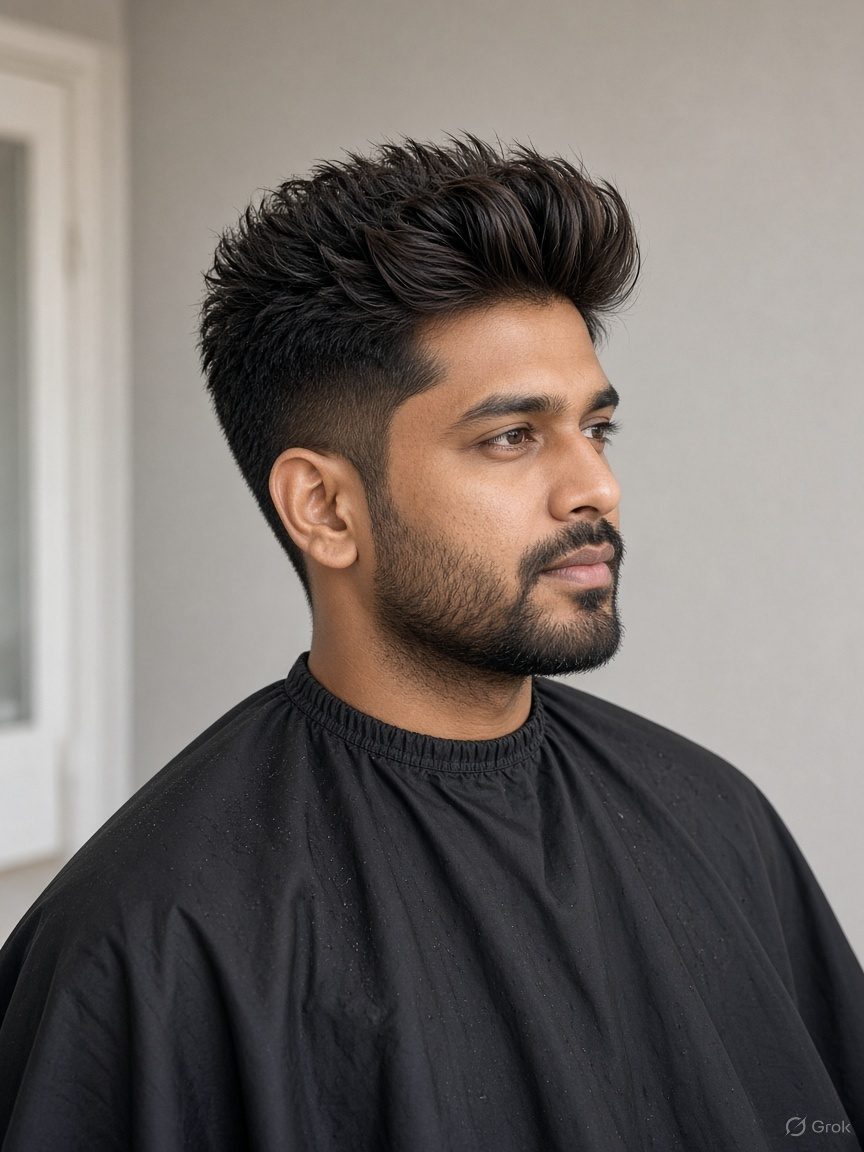
A textured quiff is a short top pushed up and slightly forward, with the ends cut so they break into visible pieces instead of sitting as one solid block. On an adult man the top runs 6 to 10 cm, longest at the front hairline and shorter toward the crown, while the sides are tapered but never tight. It suits straight to wavy hair with medium density, and it softens an uneven hairline because the pieces sit at different angles and the eye reads texture rather than the line. Consult with the hair dry, lift the top with your fingers, show the 6 to 10 cm range and agree one number. This shape needs a dryer; if he has 5 minutes and no dryer in the morning, say so before the cape comes off and offer a crew instead. The service runs 20 to 40 minutes.
Shampoo twice if he arrives with overnight oil, because oil is not a heat protectant and it keeps the root from standing. Towel dry to damp, then put heat protectant on the mid-lengths, not on the scalp. Rough-dry the roots upward with the fingers until the hair is 80 percent dry, keeping the dryer moving and never parking it on one spot. Match the heat to the hair: fine 120 to 140 C, medium 150 to 170 C, coarse 175 to 190 C, and never above 200 C. Then take a small round brush, lift the front up and lean it forward, and point-cut any heavy corner that the dry ends expose. Finish with a small amount of paste, a cool shot, and a mirror check.
- 1. Consult with the hair dry, lift the top with the fingers, agree a number between 6 and 10 cm, and ask whether he owns a dryer and uses it in the morning.
- 2. Taper the sides with scissor over comb, leave 2 to 3 cm above the ear, and blend the corner into the top so no shelf shows.
- 3. Leave the top length at the agreed number, take the crown 1 to 2 cm shorter, and point-cut the last 1 to 2 cm only.
- 4. Dry up and slightly forward with the fingers, put heat protectant on the mid-lengths first, use 120 to 140 C on fine hair, 150 to 170 C on medium and 175 to 190 C on coarse, never above 200 C, and never park the dryer.
- 5. Set the direction with a small amount of paste worked from the roots to the front, so the top stands and leans forward.
- 6. Give a cool shot for 10 to 15 seconds to lock the lift, then separate the pieces with the fingertips.
- 7. Mirror check from the front, both sides and above, with the client standing and then seated, and show him the forward lean.
- 8. Rebook in 3 to 4 weeks, because the sides grow past the taper first and the top starts to look heavy.
Salon example: Arjun's forward textured top
Arjun, thirty-two, booked a cut before a wedding and brought a photo of a textured quiff with the top leaning forward. His hair was straight, medium density and 7 cm on top, and he had an overnight oil he had not washed out. I shampooed twice, towel dried, and put heat protectant on the mid-lengths. His hair was medium, so I set the dryer to 160 C, rough-dried the roots up with my fingers, then used a small brush to lift the front and lean it forward. I point-cut the front corner that looked heavy when dry, took the sides down with scissor over comb, and finished with a pea-sized amount of paste and a cool shot. The service took 30 minutes. He rebooked in three weeks and said he would wash the oil out before his next visit.
Caution: Do not point-cut the top so heavily that the front loses density, because thin ends separate and the quiff looks sparse after two weeks; keep the front section solid and texture only the last 1 to 2 cm.
Classic quiff
A classic quiff is one smooth roll that leaves the front hairline, rises above the forehead and sweeps back into the crown, with no visible piece-y ends. The top is about 8 cm on an adult man, enough to build height without needing a long drying routine, and the sides are tapered so the top reads as the only volume. It suits straight and medium-density hair best, and it works on a round or oval face because the height lengthens the face. Agree 8 cm at the front, measured dry with the hair lifted, and check that the crown is not shorter than 5 cm or the roll will break. This shape needs a dryer; if he has 5 minutes and no dryer, offer a crew before you start, because a classic quiff cannot be combed into place from wet hair.
Wash twice if there is overnight oil in the hair, since oil is not a heat protectant and it weighs the front down. Towel dry, apply heat protectant through the mid-lengths, and rough-dry the hair up and back with the fingers, lifting at the root and following with the nozzle. Keep the dryer moving and never park it, and match the heat: fine 120 to 140 C, medium 150 to 170 C, coarse 175 to 190 C, never above 200 C. Once the hair is 80 percent dry, use a medium round brush at the front, roll it up and back, and follow with the nozzle to set the curve. Finish with a light pomade, a cool shot, and a mirror check from the side, where the roll is easiest to judge.
- 1. Consult with the hair dry, lift the front, agree about 8 cm on top, and ask whether he owns a dryer and uses it in the morning.
- 2. Taper the sides with scissor over comb and keep the taper below the temple so the top stays the widest part of the shape.
- 3. Leave the top length at the agreed 8 cm, keep at least 5 cm at the crown, and do not thin the front.
- 4. Dry up and back with a brush and nozzle, heat protectant on the mid-lengths, 120 to 140 C on fine hair, 150 to 170 C on medium and 175 to 190 C on coarse, never above 200 C, and keep the dryer moving.
- 5. Set the direction by rolling the front up and back with the brush, then combing the roll into the crown.
- 6. Give a cool shot for 10 to 15 seconds, then press the sides flat with the palm.
- 7. Mirror check from both sides and the front, standing and seated, and confirm the roll is level across the forehead.
- 8. Rebook in 3 to 4 weeks, because the taper loses its edge and the front starts to fall to one side.
Salon example: Rohan's single roll
Rohan, forty, wanted the quiff he wore in college but shorter, and he brought a photo of a smooth roll with tapered sides. His hair was straight, medium density and 9 cm at the front, with 6 cm at the crown. I agreed 8 cm at the front and explained that the crown had to keep 5 cm for the roll to sit. He had no oil that day, so I shampooed once, towel dried, and put heat protectant on the mid-lengths. I set the dryer to 160 C, rough-dried up and back, then used a medium brush to roll the front and a nozzle to set the curve. The sides went down with scissor over comb below the temple, and I pressed them flat with my palm after a cool shot. The cut and finish took 35 minutes. He rebooked in four weeks and asked me to keep the same numbers on his card.
Caution: Do not taper the sides above the temple, because the top will look like a separate block sitting on a shaved band; keep the taper low and blend the corner.
Short quiff
A short quiff keeps the same lift at the front but leaves only 5 to 6 cm on top, so it stands with a small amount of product and dries in a few minutes. It suits an adult man who wants shape without a long routine, and it is the safest quiff for a first visit because the length is easy to control. Straight and wavy hair both work, and medium to coarse hair holds the lift better than fine hair, which may need a lower heat and a lighter product. Consult dry, agree 5 or 6 cm, and show how the front will sit above the forehead. This shape still needs a dryer; if he has 5 minutes and no dryer, say so and offer a crew, because 5 cm of hair will lie flat without heat.
If he comes with overnight oil, shampoo twice before the cut and dry, because oil is not a heat protectant and it stops the root from lifting. Towel dry and apply heat protectant to the mid-lengths, then rough-dry the roots up with the fingers, keeping the dryer moving and never parking it. Use fine hair at 120 to 140 C, medium at 150 to 170 C, coarse at 175 to 190 C, and never above 200 C. With only 5 to 6 cm there is little room for error, so dry up and slightly back, then pinch the front between the fingers and lift it once more with the nozzle. Finish with a small amount of paste, a cool shot, and a mirror check to confirm the height is even across the front.
- 1. Consult with the hair dry, agree 5 to 6 cm on top, and ask whether he owns a dryer and uses it in the morning.
- 2. Taper the sides with scissor over comb, keep 2 cm above the ear, and blend the corner so the short top does not look like a cap.
- 3. Leave the top at 5 to 6 cm, keep the front square, and do not thin it, because short hair loses density quickly.
- 4. Dry the roots up and slightly back, heat protectant on the mid-lengths, 120 to 140 C on fine hair, 150 to 170 C on medium and 175 to 190 C on coarse, never above 200 C, with the dryer always moving.
- 5. Set the direction with a small amount of paste, lifting the front and pressing the crown down.
- 6. Cool shot for 10 seconds, then pinch the front tips to sharpen the line.
- 7. Mirror check from the front and both sides, standing and seated, and show him how little product the shape needs.
- 8. Rebook in 3 to 4 weeks, because at this length the taper and the front line both disappear quickly.
Salon example: Kabir's first short quiff
Kabir, twenty-six, had always worn a side part and wanted a quiff without a long morning routine. His hair was wavy, medium density and 6 cm on top after two months without a cut. I consulted dry, lifted the front and agreed 5 cm, leaving 2 cm above the ear on the sides. He had used hair oil the night before, so I shampooed twice and explained that oil is not a heat protectant. I put heat protectant on the mid-lengths, set the dryer to 160 C, and rough-dried the roots up and slightly back with my fingers. A small brush lifted the front, and a pea-sized amount of paste set the direction. The cool shot held the shape, and the mirror check showed an even front. The service took 20 minutes. He rebooked in four weeks and said he could repeat the finish in 5 minutes at home.
Caution: Do not cut the top below 5 cm to make it easier to style, because the quiff will turn into a flat crop and the front will not lift even with heat.
Long quiff
A long quiff carries 10 to 14 cm on top, so the front can rise high and fold back with weight instead of standing like a short brush. It suits adult men with straight, wavy or coarse hair and enough density to support the length, and it gives a soft, swept silhouette rather than a tight one. The sides stay tapered but not tight, because a heavy top over a tight side looks unbalanced. Consult dry and agree the top number at the front, then check the crown: it needs at least 8 cm or the fold will collapse. This shape needs a dryer and more time; if he has 5 minutes and no dryer, say so and offer a crew, because long hair will not hold this shape without heat and direction. The service runs 30 to 40 minutes.
Shampoo twice when overnight oil is present, since oil is not a heat protectant and it makes long hair fall heavily. Towel dry, apply heat protectant generously to the mid-lengths and ends, and rough-dry the roots up with the fingers, keeping the dryer moving and never parking it. Match the heat to the hair: fine 120 to 140 C, medium 150 to 170 C, coarse 175 to 190 C, never above 200 C. Dry the front up and back in two stages, using a brush to lift the root and a nozzle to smooth the length, and let each stage cool for a few seconds before the next. Finish with a light pomade on the ends, a cool shot, and a mirror check from the side to see the fold.
- 1. Consult with the hair dry, agree 10 to 14 cm at the front, check that the crown keeps 8 cm, and ask whether he owns a dryer.
- 2. Taper the sides with scissor over comb, keep 2 to 3 cm above the ear, and leave enough corner weight to support the top.
- 3. Leave the top length at the agreed number, remove weight from the interior only, and do not thin the front section.
- 4. Dry up and back in two stages with a brush and nozzle, heat protectant on the mid-lengths, 120 to 140 C on fine hair, 150 to 170 C on medium and 175 to 190 C on coarse, never above 200 C, and never park the dryer.
- 5. Set the direction by lifting the front and folding it back, then pressing the sides close to the head.
- 6. Cool shot for 15 seconds on the front, then smooth the ends with a light pomade.
- 7. Mirror check from both sides and the back, standing and seated, and confirm the fold sits at the same height on both sides.
- 8. Rebook in 3 to 4 weeks, because long quiffs lose their shape at the sides before the top looks long.
Salon example: Vikram's two-stage fold
Vikram, thirty-five, had 13 cm on top and wanted a long quiff that folded back instead of standing straight up. His hair was coarse and dense, with 9 cm at the crown. I agreed 13 cm at the front and kept the crown at 9 cm so the fold had support. He arrived with overnight oil, so I shampooed twice and applied heat protectant to the mid-lengths. Coarse hair takes more heat, so I set the dryer to 180 C, rough-dried the roots up, then used a brush and nozzle in two stages: first the root, then the length. I let the front cool for a few seconds between stages and never parked the dryer on the fold. The sides went down with scissor over comb, and a light pomade smoothed the ends. The service took 40 minutes. He rebooked in three weeks and said the fold lasted three days.
Caution: Do not thin the top to make long hair easier to dry, because the fold needs weight to sit; remove interior weight only and leave the front section solid.
Side quiff
A side quiff takes the same front lift and sweeps it to one side, so the volume sits above one temple and the parting becomes part of the shape. The top is usually 7 to 10 cm on an adult man, longer on the heavy side and shorter on the side it sweeps from, and the sides are tapered with the heavier side left slightly fuller. It suits straight and wavy hair and flatters a long or oval face, because the diagonal line breaks the length. Consult dry, find his natural parting, and agree which side carries the volume before you cut. This shape needs a dryer; if he has 5 minutes and no dryer, say so and offer a crew, because the sweep will not sit without heat and direction.
Wash twice if he arrives with overnight oil, because oil is not a heat protectant and it drags the sweep down. Towel dry, apply heat protectant to the mid-lengths, and rough-dry the hair against the intended direction first, lifting the root on the light side so it can cross over. Keep the dryer moving and never park it, and use fine hair at 120 to 140 C, medium at 150 to 170 C, coarse at 175 to 190 C, never above 200 C. Then dry up and across with a brush, following the parting, and press the light side flat with the palm. Finish with a small amount of paste, a cool shot, and a mirror check from the front to confirm the volume is on the agreed side.
- 1. Consult with the hair dry, find the natural parting, agree 7 to 10 cm on top and which side carries the volume, and ask whether he owns a dryer.
- 2. Taper the sides with scissor over comb, leave the heavy side slightly fuller, and blend both corners into the top.
- 3. Leave the top length at the agreed number, keep the heavy side 1 to 2 cm longer, and do not thin the front.
- 4. Dry against the direction first, then up and across, heat protectant on the mid-lengths, 120 to 140 C on fine hair, 150 to 170 C on medium and 175 to 190 C on coarse, never above 200 C, and never park the dryer.
- 5. Set the direction with paste, sweeping from the parting across the forehead and pressing the light side down.
- 6. Cool shot for 10 to 15 seconds, then press the light side flat with the palm.
- 7. Mirror check from the front and both sides, standing and seated, and confirm the high point sits above the agreed temple.
- 8. Rebook in 3 to 4 weeks, because the parting shifts as the sides grow and the sweep starts to fall forward.
Salon example: Sahil's left sweep
Sahil, twenty-nine, wanted a quiff with the volume on his left, away from a cowlick at the right temple. His hair was straight, medium density and 9 cm on top, and the cowlick had made every previous quiff fall right. I consulted dry, found that his natural parting was on the left, and agreed to keep the left 1 cm longer and sweep the top to the left. He had no oil, so I shampooed once, towel dried and applied heat protectant to the mid-lengths. I rough-dried against the sweep first, lifting the right root so it could cross, then dried up and across with a brush at 160 C. The sides went down with scissor over comb and the right side was pressed flat after a cool shot. The service took 30 minutes. He rebooked in four weeks and said the sweep now stays on the left all day.
Caution: Do not fight a strong cowlick by sweeping into it, because the hair will lift at the temple within an hour; sweep with the growth and take the heavy side 1 to 2 cm longer.
Quiff with a taper
A quiff with a taper keeps a full quiff on top and takes the sides down with a low scissor taper, so the transition above the ear is soft rather than a hard fade line. The top is 6 to 9 cm on an adult man and the taper starts about 2 cm above the ear, leaving a visible gradient of length. It suits straight, wavy and coarse hair, and it is a good choice for a man who works in an office because the shape is neat without looking shaved. Consult dry, agree the top number and show where the taper will start. This shape needs a dryer; if he has 5 minutes and no dryer, say so and offer a crew, because the taper looks flat without lift on top.
Shampoo twice if overnight oil is in the hair, because oil is not a heat protectant and it makes the tapered sides sit flat. Towel dry, apply heat protectant to the mid-lengths, and rough-dry the roots up with the fingers, keeping the dryer moving and never parking it. Use fine hair at 120 to 140 C, medium at 150 to 170 C, coarse at 175 to 190 C, and never above 200 C. Dry up and back with a brush, then use the edge of the comb to press the taper flat while the top keeps its height. Finish with a small amount of paste on the top only, a cool shot, and a mirror check that compares the taper on both sides.
- 1. Consult with the hair dry, agree 6 to 9 cm on top, show where the taper starts, and ask whether he owns a dryer.
- 2. Cut the taper with scissor over comb from about 2 cm above the ear, keep it low, and never use a clipper line that cuts a hard band.
- 3. Leave the top at the agreed length, keep the front square, and remove weight only from the interior.
- 4. Dry up and back, heat protectant on the mid-lengths, 120 to 140 C on fine hair, 150 to 170 C on medium and 175 to 190 C on coarse, never above 200 C, and never park the dryer.
- 5. Set the direction with a small amount of paste on the top, then press the taper flat with the comb edge.
- 6. Cool shot for 10 to 15 seconds, then re-press the taper with the palm.
- 7. Mirror check both sides at eye level, standing and seated, and confirm the taper starts at the same height on each side.
- 8. Rebook in 3 to 4 weeks, because the taper grows into a shelf and the top starts to outweigh the sides.
Salon example: Aditya's low taper
Aditya, thirty-three, asked for a quiff but did not want the tight fade his last salon had given him. His hair was wavy, medium density and 8 cm on top, with the sides at 4 cm. I agreed 8 cm on top and showed him that the taper would start 2 cm above the ear, leaving a soft gradient. He had no oil that day, so I shampooed once and applied heat protectant to the mid-lengths. I cut the taper with scissor over comb, checked both sides at eye level, and then dried the top up and back at 160 C with a brush. A small amount of paste set the direction, and I pressed the taper flat with the comb edge after a cool shot. The service took 30 minutes. He rebooked in four weeks and said the soft taper was the part he liked most.
Caution: Do not start the taper higher than 2 cm above the ear, because the sides will lose the soft gradient and the quiff will look like a separate block on a shaved base.
Pompadour
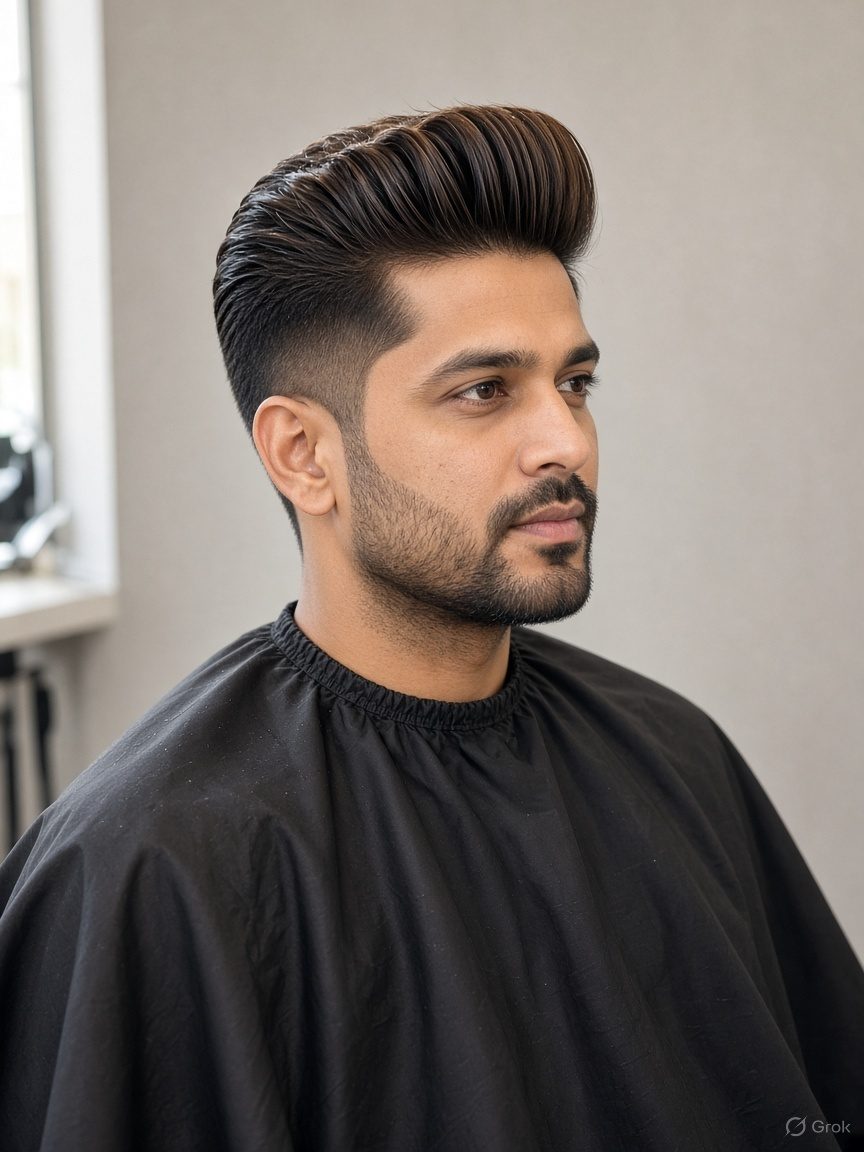
A pompadour builds its height at the front, above the forehead, and sweeps the length back over the crown, so the silhouette rises and then falls toward the nape. The top is 8 to 12 cm on an adult man, with the front the longest section and the crown slightly shorter, and the sides are tapered to keep the height visible from the front. It suits straight and wavy hair with medium to coarse density, and it lengthens a round face because the volume sits high rather than wide. Consult dry, push the front up, and agree the number at the hairline. This shape needs a dryer; if he has 5 minutes and no dryer, say so and offer a crew, because a pompadour cannot be built from wet hair. The service runs 30 to 40 minutes.
Wash twice if overnight oil is present, because oil is not a heat protectant and it pulls the front down. Towel dry, put heat protectant on the mid-lengths, and rough-dry the front up with the fingers while the back is dried flat, keeping the dryer moving and never parking it. Use fine hair at 120 to 140 C, medium at 150 to 170 C, coarse at 175 to 190 C, never above 200 C. Set the front with a round brush, rolling it up and then back, and follow the brush with the nozzle so the height sets before the length falls. Finish with a light pomade, a cool shot on the front, and a mirror check from the side, where the rise and the fall are easiest to see.
- 1. Consult with the hair dry, push the front up, agree 8 to 12 cm at the hairline, and ask whether he owns a dryer.
- 2. Taper the sides with scissor over comb, keep the taper low, and leave enough corner weight to frame the height.
- 3. Leave the top at the agreed length, keep the front the longest section, and take the crown 1 to 2 cm shorter.
- 4. Dry the front up and the back flat, heat protectant on the mid-lengths, 120 to 140 C on fine hair, 150 to 170 C on medium and 175 to 190 C on coarse, never above 200 C, and never park the dryer.
- 5. Set the direction with a round brush, rolling the front up and back, then follow with the nozzle.
- 6. Cool shot for 15 seconds on the front, then press the sides flat with the palm.
- 7. Mirror check from the side and front, standing and seated, and confirm the highest point is above the forehead, not the crown.
- 8. Rebook in 3 to 4 weeks, because the sides grow out and the front begins to fall before the top loses length.
Salon example: Manish's front rise
Manish, thirty-eight, wanted a pompadour for a family function and brought a photo with a high front and short sides. His hair was straight, medium density and 10 cm at the front, with 7 cm at the crown. I agreed 10 cm at the hairline and kept the crown at 7 cm so the sweep would sit. He had used oil the night before, so I shampooed twice and applied heat protectant to the mid-lengths. I rough-dried the front up and the back flat, then set the front with a round brush at 165 C, rolling it up and back and following with the nozzle. The sides went down with scissor over comb, and a light pomade held the front after a cool shot. The service took 40 minutes. He rebooked in three weeks and asked for the same height on his card.
Caution: Do not build the height by over-directing the front straight up, because the hair will fall forward in one block; roll it up and then back so the height has a direction.
Short pompadour
A short pompadour keeps the front rise and the swept-back direction but leaves only about 6 cm on top, so the shape is compact and quick to finish. It suits an adult man who likes the pompadour line but not the length, and it is the easiest version to maintain between visits. Straight and wavy hair work well, while fine hair needs a light product and a lower heat to avoid collapse. Consult dry, agree about 6 cm at the front and 4 cm at the crown, and show how the rise will read from the side. This shape still needs a dryer; if he has 5 minutes and no dryer, say so and offer a crew, because 6 cm will lie flat without heat and direction.
Shampoo twice if he comes with overnight oil, because oil is not a heat protectant and it makes short hair cling to the scalp. Towel dry, apply heat protectant to the mid-lengths, and rough-dry the front up and the sides down, keeping the dryer moving and never parking it. Match the heat: fine 120 to 140 C, medium 150 to 170 C, coarse 175 to 190 C, never above 200 C. Use a small round brush at the front, roll it up and back, and keep the crown flat so the short length does not puff. Finish with a small amount of pomade, a cool shot, and a mirror check from the side to confirm the rise is clean.
- 1. Consult with the hair dry, agree about 6 cm at the front and 4 cm at the crown, and ask whether he owns a dryer.
- 2. Taper the sides with scissor over comb, keep 2 cm above the ear, and blend the corner into the top.
- 3. Leave the top at about 6 cm at the front, keep the crown at 4 cm, and do not thin it.
- 4. Dry the front up and the sides down, heat protectant on the mid-lengths, 120 to 140 C on fine hair, 150 to 170 C on medium and 175 to 190 C on coarse, never above 200 C, and never park the dryer.
- 5. Set the direction with a small round brush and a little pomade, rolling the front up and back.
- 6. Cool shot for 10 to 15 seconds, then press the crown flat with the palm.
- 7. Mirror check from the side and front, standing and seated, and confirm the rise is even across the forehead.
- 8. Rebook in 3 to 4 weeks, because at 6 cm the shape changes within days once the sides grow.
Salon example: Harsh's compact pomp
Harsh, twenty-seven, wanted a pompadour for his new job but did not want to spend ten minutes in front of the mirror. His hair was straight, medium density and 7 cm at the front, with 5 cm at the crown. I agreed 6 cm at the front and 4 cm at the crown, and explained that the shorter length would hold the rise with less product. He had no oil, so I shampooed once, towel dried and applied heat protectant to the mid-lengths. I rough-dried the front up and the sides down, then used a small round brush at 160 C to roll the front up and back. The sides went down with scissor over comb, and a small amount of pomade and a cool shot finished the shape. The service took 25 minutes. He rebooked in four weeks and said the compact version was easy to repeat.
Caution: Do not leave the crown longer than the front on a short pompadour, because the volume will move to the back and the shape will read as a quiff instead of a pompadour.
Long pompadour
A long pompadour carries 12 to 16 cm on top, with the front rising high and the length sweeping back in a heavy, rounded fall. It suits adult men with dense, straight or coarse hair, and it needs a strong crown because the weight is real. The sides are tapered but not tight, and the taper should stay low so the top keeps its width. Consult dry, agree 12 to 16 cm at the front and at least 10 cm at the crown, and be honest that the finish takes time and a dryer. If he has 5 minutes and no dryer, say so and offer a crew, because long hair will not hold this shape without heat, direction and a cool set. The service runs 35 to 40 minutes.
Shampoo twice when overnight oil is present, since oil is not a heat protectant and it makes the long fall heavy and flat. Towel dry, apply heat protectant through the mid-lengths and ends, and rough-dry the roots up with the fingers, keeping the dryer moving and never parking it. Use fine hair at 120 to 140 C, medium at 150 to 170 C, coarse at 175 to 190 C, and never above 200 C. Dry in two stages: lift the front root with a brush and nozzle, let it cool, then roll the length back over the crown and set it with the nozzle. Finish with a light pomade on the ends, a cool shot, and a mirror check from the side to see the fall.
- 1. Consult with the hair dry, agree 12 to 16 cm at the front and at least 10 cm at the crown, and ask whether he owns a dryer and uses it regularly.
- 2. Taper the sides with scissor over comb, keep the taper low, and leave corner weight to support the long top.
- 3. Leave the top at the agreed length, remove interior weight only, and do not thin the front or the outer edge.
- 4. Dry in two stages, front root then length, heat protectant on the mid-lengths, 120 to 140 C on fine hair, 150 to 170 C on medium and 175 to 190 C on coarse, never above 200 C, and never park the dryer.
- 5. Set the direction with a brush, rolling the front up and the length back over the crown.
- 6. Cool shot for 15 seconds at the front, then smooth the ends with a light pomade.
- 7. Mirror check from the side and back, standing and seated, and confirm the fall is even on both sides.
- 8. Rebook in 3 to 4 weeks, because long pompadours lose their clean edge at the sides first.
Salon example: Nitin's heavy fall
Nitin, forty-two, had 15 cm on top and wanted a long pompadour for a reunion. His hair was coarse and dense, with 11 cm at the crown, and the sides had grown into a soft wedge. I agreed 15 cm at the front and kept the crown at 11 cm, then explained that the finish would take 40 minutes. He had overnight oil, so I shampooed twice and applied heat protectant to the mid-lengths and ends. Coarse hair needs more heat, so I set the dryer to 185 C and dried in two stages, lifting the front root first and letting it cool before rolling the length back. I never parked the dryer on the fall. The sides went down with scissor over comb, and a light pomade smoothed the ends after a cool shot. He rebooked in three weeks and said the height lasted through the evening.
Caution: Do not over-load long hair with pomade to control the fall, because the weight will pull the front down; use a light amount on the ends and let the cool shot do the holding.
Pompadour with a low fade
A pompadour with a low fade keeps the height at the front and takes the sides down to the skin at the bottom, but the fade line stays at or below the top of the ear so the transition remains gentle. The top is 8 to 12 cm on an adult man, and the low fade gives a clean edge without turning the shape into a tight modern crop. It suits straight and coarse hair best, because the top needs to stand while the sides stay short, and it works on a round face because the height adds length. Consult dry, agree the top number and show where the fade will stop. This shape needs a dryer; if he has 5 minutes and no dryer, say so and offer a crew, because the short sides make a flat top look like a bad fade.
Wash twice if overnight oil is in the hair, because oil is not a heat protectant and it leaves the faded sides looking dull. Towel dry, put heat protectant on the mid-lengths, and rough-dry the top up with the fingers while the sides are pressed down, keeping the dryer moving and never parking it. Use fine hair at 120 to 140 C, medium at 150 to 170 C, coarse at 175 to 190 C, and never above 200 C. Set the front with a round brush, rolling it up and back, and press the fade flat with the comb edge. Finish with a light pomade on the top only, a cool shot, and a mirror check from both sides to confirm the fade line is level.
- 1. Consult with the hair dry, agree 8 to 12 cm on top, show where the fade will stop, and ask whether he owns a dryer.
- 2. Cut the fade low, keep the line at or below the top of the ear, and blend it into the longer hair above with scissor over comb.
- 3. Leave the top at the agreed length, keep the front square, and do not thin it to match the short sides.
- 4. Dry the top up and press the fade down, heat protectant on the mid-lengths, 120 to 140 C on fine hair, 150 to 170 C on medium and 175 to 190 C on coarse, never above 200 C, and never park the dryer.
- 5. Set the direction with a round brush and a small amount of pomade, rolling the front up and back.
- 6. Cool shot for 15 seconds, then press the fade flat with the comb edge.
- 7. Mirror check both sides at eye level, standing and seated, and confirm the fade line is level and the top is even.
- 8. Rebook in 3 to 4 weeks, because a low fade shows regrowth at the line before the top changes.
Salon example: Aman's low fade
Aman, thirty, wanted a pompadour with a fade but was worried about looking too sharp for his office. His hair was straight, coarse and 9 cm on top, with 5 cm on the sides. I agreed 9 cm on top and showed him that the fade would stop just below the top of the ear. He had no oil, so I shampooed once, towel dried and applied heat protectant to the mid-lengths. I cut the fade low and blended it with scissor over comb, then rough-dried the top up at 180 C and set the front with a round brush, rolling it up and back. A small amount of pomade went on the top only, and a cool shot held the front. The service took 35 minutes. He rebooked in three weeks and said the low line kept the cut comfortable for work.
Caution: Do not take the fade above the top of the ear, because the top will look isolated and the pompadour will lose the soft transition that makes it wearable.
Slick pompadour
A slick pompadour keeps the same front height and swept-back length, but the finish is smooth and closed instead of piece-y, with the strands lying together in one polished surface. The top is 8 to 12 cm on an adult man, and the sides are tapered so the smooth top has a clean edge. It suits straight and medium-density hair, and it is the version to choose for a formal occasion or a man who dislikes visible texture. Consult dry, agree the top number, and tell him the finish needs a brush and a dryer, not just product. This shape needs a dryer; if he has 5 minutes and no dryer, say so and offer a crew, because a slick finish cannot be combed into wet hair without losing the rise.
Shampoo twice if he comes with overnight oil, because oil is not a heat protectant and it makes a smooth finish greasy at the root. Towel dry, apply heat protectant to the mid-lengths, and rough-dry the hair up and back with the fingers, keeping the dryer moving and never parking it. Match the heat: fine 120 to 140 C, medium 150 to 170 C, coarse 175 to 190 C, never above 200 C. Use a medium brush to roll the front up and back, then a comb to close the strands while the hair is still warm, and follow with the nozzle to set the surface. Finish with a small amount of light pomade, a cool shot, and a mirror check for stray strands.
- 1. Consult with the hair dry, agree 8 to 12 cm at the front, and ask whether he owns a dryer and uses it in the morning.
- 2. Taper the sides with scissor over comb, keep the taper low, and blend the corner so the smooth top has a clean edge.
- 3. Leave the top at the agreed length, keep the front square, and do not thin it, because a slick finish shows every gap.
- 4. Dry up and back with a brush, heat protectant on the mid-lengths, 120 to 140 C on fine hair, 150 to 170 C on medium and 175 to 190 C on coarse, never above 200 C, and never park the dryer.
- 5. Set the direction with a comb while the hair is warm, closing the strands into one smooth surface.
- 6. Cool shot for 15 seconds, then comb once more from root to tip.
- 7. Mirror check from the side and front, standing and seated, and look for stray strands near the parting.
- 8. Rebook in 3 to 4 weeks, because the smooth edge at the sides is the first part to go.
Salon example: Rahul's smooth finish
Rahul, thirty-six, needed a formal look for a reception and asked for a slick pompadour rather than the textured quiff he usually wore. His hair was straight, medium density and 10 cm at the front, with 7 cm at the crown. I agreed 10 cm at the front and kept the crown at 7 cm. He had no oil, so I shampooed once, towel dried and applied heat protectant to the mid-lengths. I rough-dried up and back, then used a medium brush to roll the front at 165 C. While the hair was warm I combed it from root to tip to close the surface, followed with the nozzle, and repeated once. A small amount of light pomade and a cool shot gave the finish. The service took 35 minutes. He rebooked in four weeks and said the smooth version photographed better than his usual quiff.
Caution: Do not use a heavy pomade on a slick pompadour, because it will collapse the rise and leave the front looking wet; use a light amount and set the shape with heat first.
Messy quiff
A messy quiff keeps the front lift but leaves the top piece-y and deliberately uneven, with the ends pointing in slightly different directions. The top is 6 to 10 cm on an adult man, cut with point cutting and a little freehand texture, and the sides are tapered but soft. It suits wavy and medium-density hair best, because the natural movement does most of the work, and it flatters a square or oval face by breaking the hard lines. Consult dry, agree a top number and show him that the finish is meant to look undone, not untidy. This shape needs a dryer; if he has 5 minutes and no dryer, say so and offer a crew, because the lift still needs heat even when the finish looks casual.
Shampoo twice if he arrives with overnight oil, since oil is not a heat protectant and it makes the pieces clump. Towel dry, apply heat protectant to the mid-lengths, and rough-dry the roots up with the fingers, keeping the dryer moving and never parking it. Use fine hair at 120 to 140 C, medium at 150 to 170 C, coarse at 175 to 190 C, never above 200 C. Dry up and slightly forward, then use the fingers rather than a brush so the texture stays open, and pinch a few ends in different directions. Finish with a small amount of paste, a cool shot, and a mirror check to make sure the mess is balanced and not heavier on one side.
- 1. Consult with the hair dry, lift the top, agree 6 to 10 cm, and ask whether he owns a dryer and will use it in the morning.
- 2. Taper the sides with scissor over comb, keep 2 to 3 cm above the ear, and soften the corner so the messy top does not look like a cap.
- 3. Leave the top at the agreed length, point-cut the ends for texture, and do not thin the front section heavily.
- 4. Dry up and slightly forward with the fingers, heat protectant on the mid-lengths, 120 to 140 C on fine hair, 150 to 170 C on medium and 175 to 190 C on coarse, never above 200 C, and never park the dryer.
- 5. Set the direction with a small amount of paste, using the fingers to pinch the ends instead of combing them flat.
- 6. Cool shot for 10 to 15 seconds, then break the pieces apart once more with the fingertips.
- 7. Mirror check from the front and both sides, standing and seated, and balance any heavy patch by pinching it the other way.
- 8. Rebook in 3 to 4 weeks, because the texture closes up as the ends grow and the shape starts to look flat.
Salon example: Karan's undone top
Karan, twenty-eight, wanted a quiff that looked like he had not tried, and he brought a photo with the ends pointing in several directions. His hair was wavy, medium density and 8 cm on top, with a strong growth pattern at the front. I agreed 8 cm, point-cut the ends for texture, and kept the front section solid so the lift would hold. He had oil in his hair from the night before, so I shampooed twice and applied heat protectant to the mid-lengths. I rough-dried the roots up and slightly forward with my fingers at 160 C, then pinched the ends rather than brushing them. A small amount of paste set the direction, and a cool shot held the lift. The service took 25 minutes. He rebooked in four weeks and said the undone finish was easier to repeat than a smooth one.
Caution: Do not point-cut the whole top into thin ends, because the quiff will collapse in the middle; keep the base solid and texture only the outer ends.
Quiff for fine hair
A quiff for fine hair keeps a solid top and lifts only at the root, so the shape gains height without the ends turning thin and see-through. The top is 6 to 9 cm on an adult man, cut with a square front and very little internal texture, while the sides are tapered to make the top look denser. It suits fine straight or lightly wavy hair, and it is the version that protects what density he has instead of removing it. Consult dry and look at the scalp under a light before you agree the number, because a wide parting or a visible crown changes the plan. This shape needs a dryer; if he has 5 minutes and no dryer, say so and offer a crew, because fine hair will not lift without root heat.
Shampoo twice if overnight oil is present, because oil is not a heat protectant and it weighs fine hair down immediately. Towel dry, apply a small amount of heat protectant to the mid-lengths only, and rough-dry the roots up with the fingers, keeping the dryer moving and never parking it. Fine hair takes the lowest heat: 120 to 140 C, never above 200 C, and never park the dryer on the scalp. Lift the front root with a small brush, set it with the nozzle, and let it cool before touching it again. Use a light paste, not a heavy pomade, and finish with a cool shot and a mirror check that looks at density as well as height.
- 1. Consult with the hair dry, check density at the front and crown, agree 6 to 9 cm, and ask whether he owns a dryer.
- 2. Taper the sides with scissor over comb, keep them short enough to contrast with the top, and blend the corner without taking bulk from the top.
- 3. Leave the top at the agreed length, keep a square front, and do not thin it or point-cut the interior.
- 4. Lift only at the root with a small brush, heat protectant on the mid-lengths, 120 to 140 C only, never above 140 C on fine hair, and never park the dryer.
- 5. Set the direction with a light paste on the ends, keeping the root lift and the surface solid.
- 6. Cool shot for 10 to 15 seconds, then lift the front once more with the fingertips.
- 7. Mirror check from the front and above, standing and seated, and look for scalp showing through the top.
- 8. Rebook in 3 to 4 weeks, because fine hair loses its clean edge quickly and a small trim keeps the top solid.
Salon example: Sandeep's solid top
Sandeep, thirty-one, had fine hair and a quiff that kept collapsing by lunchtime. His top was 8 cm, his density was low at the crown, and he had been asking for texture at the ends, which made the problem worse. I agreed 8 cm but kept the front square and stopped point-cutting the interior. He had no oil, so I shampooed once, towel dried, and applied a small amount of heat protectant to the mid-lengths. I rough-dried the roots up with my fingers, set the dryer to 130 C, and lifted the front with a small brush, letting it cool before I touched it. A light paste went on the ends only, and a cool shot held the root. The service took 25 minutes. He rebooked in three weeks and said the top looked fuller without any extra product.
Caution: Do not thin fine hair to create texture, because the top will look sparse under light; keep the interior solid and lift only at the root.
Quiff that must work without paste
A quiff that must work without paste depends on the cut and the blow-dry, not on product, so the shape has to be short enough to stand on its own and balanced enough to fall back into place. The top is usually 6 to 8 cm on an adult man, cut square at the front with a little texture at the ends, and the sides are tapered. It suits straight and wavy hair with medium density, and it is the right brief for a man who dislikes the feel of product or works in a place where it is not practical. Consult dry, agree the number, and test the shape with a dry blow-dry before you cut. This shape needs a dryer; if he has 5 minutes and no dryer, say so and offer a crew, because without heat it will simply lie flat.
Shampoo twice if he comes with overnight oil, because oil is not a heat protectant and it leaves the hair too soft to hold. Towel dry, apply heat protectant to the mid-lengths, and rough-dry the roots up with the fingers, keeping the dryer moving and never parking it. Use fine hair at 120 to 140 C, medium at 150 to 170 C, coarse at 175 to 190 C, and never above 200 C. Dry up and slightly back, then use the cool shot to set the root before you touch the hair again. If the front collapses once it is cool, do not promise a no-product finish: cut the top shorter into a crew, usually 3 to 5 cm, so the shape can stand without help.
- 1. Consult with the hair dry, agree 6 to 8 cm, and ask whether he owns a dryer and will use it daily without product.
- 2. Taper the sides with scissor over comb, keep the contrast clear, and blend the corner into the top.
- 3. Leave the top at the agreed length, keep a square front, and cut a crew instead of a quiff if the hair cannot stand.
- 4. Dry up and slightly back with the fingers, heat protectant on the mid-lengths, 120 to 140 C on fine hair, 150 to 170 C on medium and 175 to 190 C on coarse, never above 200 C, and never park the dryer.
- 5. Set the direction with heat alone, using the nozzle at the root and the fingers at the ends.
- 6. Cool shot for 15 seconds, then let go and check whether the front stays up without touching it.
- 7. Mirror check from the front and side, standing and seated, and confirm the shape holds after he runs a hand through it.
- 8. Rebook in 3 to 4 weeks, because a no-product quiff depends on clean, freshly cut edges to stand.
Salon example: Deepak's no-product test
Deepak, thirty-four, worked in a kitchen and wanted a quiff but refused to use paste during service. His hair was straight, medium density and 8 cm on top. I agreed 8 cm and told him I would test the shape before finishing. He had no oil, so I shampooed once, towel dried and applied heat protectant to the mid-lengths. I rough-dried the roots up at 160 C, set the front with a small brush and the nozzle, and gave it a cool shot. When I let go, the front fell forward within a minute. I did not promise a no-product quiff; I cut the top down to 4 cm into a crew, kept the sides tapered, and dried it up and back. It stood without product. The service took 30 minutes. He rebooked in four weeks and said the crew was the right call for his shift.
Caution: Do not promise a quiff without paste before you have dried the hair and watched it cool, because soft or long fronts collapse and the client will blame the cut.
Fohawk
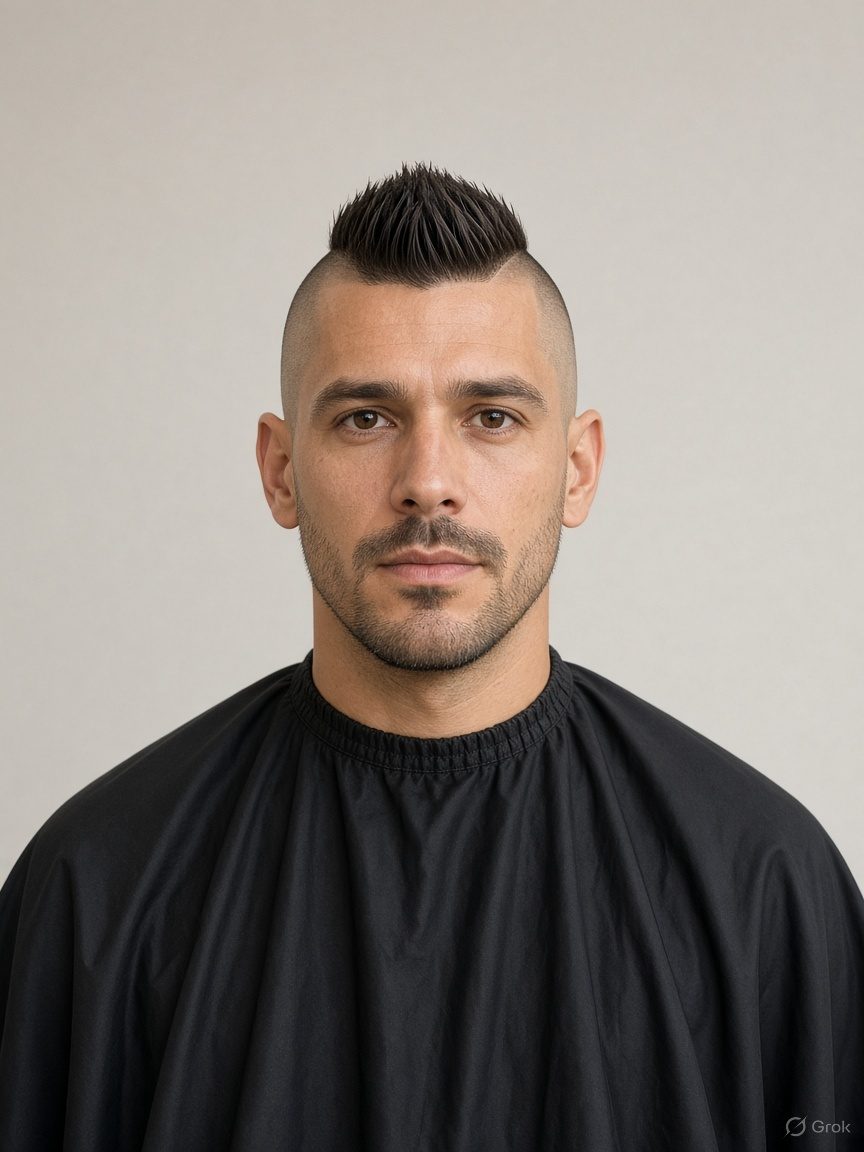
A fohawk is a soft hawk: the centre of the head keeps enough length to lift into a low ridge, while the sides are cut short, with no shaved line and no hard separation between the two. The centre runs 5 to 8 cm on an adult man and narrows toward the crown, and the sides are short but blended, so the shape reads as a haircut rather than a statement. It suits straight and wavy hair with medium density, and it flatters a long or oval face because the ridge adds height without width. Consult dry, agree the centre length and show that the sides will be short but not shaved. This shape needs a dryer; if he has 5 minutes and no dryer, say so and offer a crew, because the ridge will not stand without root heat.
Shampoo twice if overnight oil is present, because oil is not a heat protectant and it makes the short sides look flat. Towel dry, apply heat protectant to the mid-lengths of the centre strip, and rough-dry the centre up with the fingers while the sides are pressed down, keeping the dryer moving and never parking it. Use fine hair at 120 to 140 C, medium at 150 to 170 C, coarse at 175 to 190 C, never above 200 C. Dry the centre up and slightly back, pinch the ridge between the fingers, and press the sides flat with the palm. Finish with a small amount of paste on the centre only, a cool shot, and a mirror check from the front and above to confirm the ridge is straight.
- 1. Consult with the hair dry, agree 5 to 8 cm in the centre, explain that the sides will be short but blended, and ask whether he owns a dryer.
- 2. Cut the sides short with scissor over comb, keep them blended into the centre, and do not shave a line or a gap.
- 3. Leave the centre at the agreed length, narrow it toward the crown, and do not thin the ridge.
- 4. Dry the centre up and the sides down, heat protectant on the mid-lengths, 120 to 140 C on fine hair, 150 to 170 C on medium and 175 to 190 C on coarse, never above 200 C, and never park the dryer.
- 5. Set the direction with a small amount of paste on the centre, pinching the ridge instead of flattening it.
- 6. Cool shot for 10 to 15 seconds, then press the sides flat with the palm.
- 7. Mirror check from the front, above and both sides, standing and seated, and confirm the ridge is centred and even.
- 8. Rebook in 3 to 4 weeks, because the short sides grow into the ridge and the shape loses its line.
Salon example: Yash's soft ridge
Yash, twenty-five, wanted a fohawk but was clear that he did not want a shaved line or a hard mohawk. His hair was straight, medium density and 7 cm in the centre, with 5 cm on the sides. I agreed 7 cm in the centre, showed him how the sides would be blended, and confirmed there would be no line. He had no oil, so I shampooed once, towel dried, and applied heat protectant to the mid-lengths of the centre. I cut the sides with scissor over comb and blended them into the ridge, then rough-dried the centre up at 160 C while pressing the sides down. A small amount of paste and a cool shot set the ridge, and the mirror check showed it centred. The service took 25 minutes. He rebooked in four weeks and said the soft version suited his office.
Caution: Do not shave a line beside the ridge to make it look sharper, because the fohawk becomes a mohawk and the soft blend that makes it wearable is lost.
Short mohawk
A short mohawk leaves a centre strip a little longer than the rest of the head and cuts the sides very short, so the shape has a clear ridge without any shaved design. The centre is 4 to 7 cm on an adult man, narrow at the front and slightly wider toward the crown, while the sides are taken down close with scissor over comb or a short clipper guard. It suits straight and coarse hair best, because the ridge needs firm hair to stand, and it flatters a long face that can carry the height. Consult dry, agree the centre length, and confirm that he wants no lines or patterns. This shape needs a dryer; if he has 5 minutes and no dryer, say so and offer a crew, because the ridge will not stand without heat.
Shampoo twice if he arrives with overnight oil, because oil is not a heat protectant and it makes a short ridge lie down. Towel dry, apply heat protectant to the centre strip only, and rough-dry the centre up with the fingers while the sides stay flat, keeping the dryer moving and never parking it. Use fine hair at 120 to 140 C, medium at 150 to 170 C, coarse at 175 to 190 C, never above 200 C. Dry the centre up and slightly back, pinch it into a soft ridge, and press the sides down with the palm. Finish with a small amount of paste on the centre, a cool shot, and a mirror check from the front and above to confirm the ridge is straight.
- 1. Consult with the hair dry, agree 4 to 7 cm in the centre, confirm no lines or patterns, and ask whether he owns a dryer.
- 2. Cut the sides very short with scissor over comb or a short guard, keep the transition blended, and cut no design.
- 3. Leave the centre at the agreed length, narrow the front, and do not thin the strip.
- 4. Dry the centre up and the sides down, heat protectant on the centre only, 120 to 140 C on fine hair, 150 to 170 C on medium and 175 to 190 C on coarse, never above 200 C, and never park the dryer.
- 5. Set the direction with a small amount of paste on the centre, pinching the strip into a soft ridge.
- 6. Cool shot for 10 to 15 seconds, then press the sides flat with the palm.
- 7. Mirror check from the front, above and both sides, standing and seated, and confirm the strip is straight and centred.
- 8. Rebook in 3 to 4 weeks, because the short sides grow back fastest and the ridge starts to look wide.
Salon example: Abhishek's clean strip
Abhishek, twenty-nine, wanted a short mohawk for a music festival but needed it to look normal at work on Monday. His hair was coarse, dense and 6 cm in the centre, with 3 cm on the sides. I agreed 6 cm in the centre and explained that I would blend the sides rather than shave a line, and he confirmed he wanted no design. He had oil from the night before, so I shampooed twice and applied heat protectant to the centre only. I cut the sides very short with scissor over comb, blended the transition, then rough-dried the centre up at 180 C and pinched it into a soft ridge. A small amount of paste and a cool shot held it, and I pressed the sides flat. The service took 25 minutes. He rebooked in three weeks and said the ridge could be flattened for work with a little water.
Caution: Do not shave the sides to the skin or cut a line beside the strip, because the cut stops being a short mohawk and becomes a design that will not grow out comfortably.
Textured faux hawk
A textured faux hawk builds a soft ridge from point-cut centre hair and faded sides, so the shape suggests a hawk without the hard edges of a mohawk. The centre is 5 to 8 cm on an adult man and heavily textured at the ends, while the sides are faded but kept blended into the top. It suits straight and wavy hair with medium density, and it works on a round or square face because the ridge adds height and the faded sides keep the width down. Consult dry, agree the centre number, and show him that the texture is cut in, not styled in. This shape needs a dryer; if he has 5 minutes and no dryer, say so and offer a crew, because the ridge needs root heat to stand.
Shampoo twice if overnight oil is present, since oil is not a heat protectant and it closes the texture. Towel dry, apply heat protectant to the mid-lengths, and rough-dry the centre up with the fingers while the faded sides are pressed down, keeping the dryer moving and never parking it. Use fine hair at 120 to 140 C, medium at 150 to 170 C, coarse at 175 to 190 C, never above 200 C. Dry the centre up and back, pinch the ends into points, and press the fade flat with the comb edge. Finish with a small amount of paste on the centre, a cool shot, and a mirror check from the front and above to confirm the ridge is centred and the points are even.
- 1. Consult with the hair dry, agree 5 to 8 cm in the centre, explain the point-cut texture, and ask whether he owns a dryer.
- 2. Fade the sides low, keep them blended into the centre, and do not cut a hard line beside the ridge.
- 3. Leave the centre at the agreed length, point-cut the ends, and keep the base solid enough to support the ridge.
- 4. Dry the centre up and back, heat protectant on the mid-lengths, 120 to 140 C on fine hair, 150 to 170 C on medium and 175 to 190 C on coarse, never above 200 C, and never park the dryer.
- 5. Set the direction with a small amount of paste, pinching the point-cut ends into a soft ridge.
- 6. Cool shot for 10 to 15 seconds, then press the fade flat with the comb edge.
- 7. Mirror check from the front, above and both sides, standing and seated, and confirm the ridge is straight and the points are even.
- 8. Rebook in 3 to 4 weeks, because the fade and the point-cut ends both lose their definition quickly.
Salon example: Tarun's textured ridge
Tarun, twenty-seven, wanted a faux hawk that looked textured rather than sharp, and he brought a photo with point-cut ends and a low fade. His hair was wavy, medium density and 7 cm in the centre, with 4 cm on the sides. I agreed 7 cm in the centre, point-cut the ends, and kept the base solid so the ridge would hold. He had no oil, so I shampooed once, towel dried, and applied heat protectant to the mid-lengths. I faded the sides low and blended them into the centre, then rough-dried the centre up and back at 160 C and pinched the ends into points. A small amount of paste and a cool shot set the ridge, and I pressed the fade flat with the comb edge. The service took 30 minutes. He rebooked in four weeks and said the texture survived a full day.
Caution: Do not point-cut the centre so deeply that the base loses density, because the ridge will split into thin sections and fall apart by midday.
Spiky quiff
A spiky quiff lifts the front into separated points while keeping the overall direction of a quiff, so the tips stand but the shape still sweeps up and slightly back instead of fanning out in all directions. The top is 6 to 9 cm on an adult man, cut with point cutting at the ends and a square base at the front, and the sides are tapered. It suits straight and coarse hair with medium density, because fine hair struggles to hold the points. Consult dry, agree the number, and show him a modest version of the points, not a costume spike. This shape needs a dryer; if he has 5 minutes and no dryer, say so and offer a crew, because points need root lift and a cool set.
Shampoo twice if he comes with overnight oil, because oil is not a heat protectant and it makes the points collapse. Towel dry, apply heat protectant to the mid-lengths and ends, and rough-dry the roots up with the fingers, keeping the dryer moving and never parking it. Use fine hair at 120 to 140 C, medium at 150 to 170 C, coarse at 175 to 190 C, never above 200 C. Dry the front up and back, then pinch small sections between the fingers and twist them slightly to form points. Finish with a small amount of paste on the tips, a cool shot, and a mirror check from the front and side to confirm the points sit at different heights without looking wild.
- 1. Consult with the hair dry, agree 6 to 9 cm on top, show a modest point size, and ask whether he owns a dryer.
- 2. Taper the sides with scissor over comb, keep 2 to 3 cm above the ear, and blend the corner into the top.
- 3. Leave the top at the agreed length, point-cut the ends for separation, and keep the front base square.
- 4. Dry the roots up and back, heat protectant on the mid-lengths and ends, 120 to 140 C on fine hair, 150 to 170 C on medium and 175 to 190 C on coarse, never above 200 C, and never park the dryer.
- 5. Set the direction with paste on the tips, pinching and twisting small sections into points that follow the quiff.
- 6. Cool shot for 10 to 15 seconds, then pinch the tips once more so they stay separated.
- 7. Mirror check from the front and both sides, standing and seated, and confirm the points are uneven but balanced.
- 8. Rebook in 3 to 4 weeks, because the point-cut ends blunt off and the spikes lose their definition.
Salon example: Gaurav's lifted tips
Gaurav, twenty-four, wanted a spiky quiff for a night out but did not want it to look like a school photo. His hair was straight, medium density and 8 cm on top, with 5 cm on the sides. I agreed 8 cm, point-cut the ends, and kept the front base square so the lift would hold. He had no oil, so I shampooed once, towel dried and applied heat protectant to the mid-lengths and ends. I rough-dried the roots up and back at 165 C, then pinched small sections and twisted them slightly to form points, following the quiff direction rather than fanning them out. A small amount of paste and a cool shot set the tips. The service took 25 minutes. He rebooked in three weeks and said the tips still looked like a quiff, not a costume.
Caution: Do not twist large sections into tall spikes, because the shape stops being a quiff and the points will fall into clumps; keep the sections small and the height modest.
Swept-back quiff
A swept-back quiff lifts the front and then sends the whole top backward, so the direction of the hair is toward the crown and the nape rather than forward over the forehead. The top is 8 to 10 cm on an adult man, longest at the front and shorter toward the crown, and the sides are tapered to keep the backward flow clean. It suits straight and wavy hair with medium density, and it flatters a long face because the height sits above the forehead and the length moves away from it. Consult dry, push the front back, and agree the number. This shape needs a dryer; if he has 5 minutes and no dryer, say so and offer a crew, because the backward direction will not hold from wet hair.
Wash twice if overnight oil is present, because oil is not a heat protectant and it makes the backward sweep heavy. Towel dry, apply heat protectant to the mid-lengths, and rough-dry the front up and back with the fingers, keeping the dryer moving and never parking it. Use fine hair at 120 to 140 C, medium at 150 to 170 C, coarse at 175 to 190 C, and never above 200 C. Set the front with a brush, lifting it up and then pushing it back, and follow the brush with the nozzle so the direction sets at the root. Finish with a light pomade, a cool shot, and a mirror check from the side to confirm the flow goes back and not forward.
- 1. Consult with the hair dry, push the front back, agree 8 to 10 cm, and ask whether he owns a dryer and uses it daily.
- 2. Taper the sides with scissor over comb, keep the taper low, and blend the corner so the backward flow stays clean.
- 3. Leave the top at the agreed length, keep the front the longest section, and take the crown 1 to 2 cm shorter.
- 4. Dry the front up and back, heat protectant on the mid-lengths, 120 to 140 C on fine hair, 150 to 170 C on medium and 175 to 190 C on coarse, never above 200 C, and never park the dryer.
- 5. Set the direction with a brush and a light pomade, lifting the front and pushing it toward the crown.
- 6. Cool shot for 15 seconds, then press the sides flat so the flow reads clearly.
- 7. Mirror check from the side and front, standing and seated, and confirm no front section falls forward.
- 8. Rebook in 3 to 4 weeks, because the front grows forward again and the sweep starts to break.
Salon example: Sumit's backward flow
Sumit, thirty-seven, had worn his hair forward for years and wanted a quiff that moved back from his face. His hair was straight, medium density and 9 cm on top, with 6 cm at the crown. I agreed 9 cm at the front and kept the crown at 6 cm so the flow had a destination. He had no oil, so I shampooed once, towel dried and applied heat protectant to the mid-lengths. I rough-dried the front up and back with my fingers, then used a brush at 160 C to lift the front and push it toward the crown, following with the nozzle. A light pomade set the direction, and a cool shot held it while I pressed the sides flat. The service took 35 minutes. He rebooked in four weeks and said the backward direction kept the hair off his forehead at work.
Caution: Do not sweep the hair back without lifting the front root first, because the top will lie flat against the crown and the quiff will lose its height.
Front-heavy pompadour
A front-heavy pompadour puts the tallest point at the front hairline and keeps the crown flatter, so the height is concentrated above the forehead and the back of the head stays close to the skull. The top is 8 to 12 cm at the front on an adult man, with the crown 2 to 3 cm shorter, and the sides are tapered to keep the front dominant. It suits straight and coarse hair with good density, and it flatters a round face because the height is narrow and forward rather than spread across the top. Consult dry, agree the front number and the crown number separately. This shape needs a dryer; if he has 5 minutes and no dryer, say so and offer a crew, because the front-heavy lift cannot be built without root heat and a cool set.
Shampoo twice if he arrives with overnight oil, because oil is not a heat protectant and it pulls the front down. Towel dry, apply heat protectant to the mid-lengths, and rough-dry the front up with the fingers while the crown is dried flat, keeping the dryer moving and never parking it. Use fine hair at 120 to 140 C, medium at 150 to 170 C, coarse at 175 to 190 C, never above 200 C. Set the front with a brush, rolling it up and barely back, and press the crown down with the palm and nozzle. Finish with a light pomade on the front only, a cool shot, and a mirror check from the side to confirm the front is the highest point.
- 1. Consult with the hair dry, agree 8 to 12 cm at the front and a crown 2 to 3 cm shorter, and ask whether he owns a dryer.
- 2. Taper the sides with scissor over comb, keep the taper low, and leave the corner weight that frames the front.
- 3. Leave the front at the agreed length, take the crown 2 to 3 cm shorter, and do not thin the front section.
- 4. Dry the front up and the crown flat, heat protectant on the mid-lengths, 120 to 140 C on fine hair, 150 to 170 C on medium and 175 to 190 C on coarse, never above 200 C, and never park the dryer.
- 5. Set the direction with a brush, rolling the front up and barely back, while the crown stays flat.
- 6. Cool shot for 15 seconds on the front, then press the crown down with the palm.
- 7. Mirror check from the side and front, standing and seated, and confirm the front hairline is the highest point.
- 8. Rebook in 3 to 4 weeks, because the crown grows into the height and the front-heavy shape flattens.
Salon example: Prateek's forward crown
Prateek, thirty-nine, wanted a pompadour with the height at the front and nothing bulky at the back. His hair was straight, dense and 11 cm at the front, with 10 cm at the crown. I agreed 11 cm at the front and took the crown to 8 cm, so the front would stay the highest point. He had overnight oil, so I shampooed twice and applied heat protectant to the mid-lengths. I rough-dried the front up and the crown flat, then set the front with a brush at 170 C, rolling it up and barely back, and pressed the crown down with the palm and nozzle. The sides went down with scissor over comb, and a light pomade went on the front only. The service took 40 minutes. He rebooked in three weeks and said the shape no longer looked heavy at the back.
Caution: Do not leave the crown at the same length as the front, because the back will rise and the shape will become a centred pompadour; keep the crown 2 to 3 cm shorter and dry it flat.
This is a Nandu Nai textbook. It is a private brand book, not a government licence, and it does not give the right to give medical treatment.