
Curly crop, dry cut

A curly crop is planned around where the curls sit when they are finished, not where they hang when wet, because wet hair lies longer and straighter than the same hair ten minutes later. On a 3C to 4C head the spring back is 30 to 50 percent of the visible length, so a curl that reaches the jaw wet can sit at the temple once it dries. That is the reason this whole family of cuts is done on dry hair, client after client. Before the first cut, lift one curl at the front, stretch it straight beside its spring length and show the two ends in the mirror, so the 30 to 50 percent is a number the client has seen and not a word he has heard. On a crop the curls finish around the temple, and the sideburn and the ear line stay clean.
Consult with the hair dry and clean, agree the finished line at the temple, and check texture and density before any section is taken. Run the stretch test on a wet strand: it should extend and spring back at about 30 percent, and hair that stays stretched or snaps before 20 percent gets no razor and no chemical. Divide the head into four with a centre part and an ear-to-ear part, then work in sections no wider than the comb, cutting curl by curl to the same guide and lifting each curl to follow its own direction instead of pulling it into a straight line. No razor on the curly perimeter, no relaxer and no texturiser. Cross-check dry, finish with leave-in on wet hair, scrunch, diffuse on low or air-dry, never towel-rub, and rebook in 6 to 8 weeks. Curly work takes 60 to 90 minutes.
- 1. Consult with the hair dry and clean, agree the finished temple line in the mirror, and confirm the client is an adult man before the cape is fastened.
- 2. Lift one front curl, stretch it beside its spring length and show the 30 to 50 percent shrinkage before any section is taken.
- 3. Run the stretch test on a wet strand, and stop at the razor and at any chemical if it stays stretched or snaps before 20 percent.
- 4. Divide into four with a centre part and an ear-to-ear part, then cut curl by curl in sections no wider than the comb.
- 5. Keep the razor off the curly perimeter and use scissors only, following each curl instead of pulling it straight.
- 6. Cross-check dry from the front, both sides and the back, and trim only the curl that stands proud of the line.
- 7. Finish with leave-in on wet hair, scrunch, diffuse on low or air-dry, and never towel-rub the curls.
- 8. Rebook in 6 to 8 weeks and explain that the dry line is the reference, so the next cut starts from the same place.
Salon example: Rohit's dry curly crop
Rohit, twenty-nine, works in a bank and wanted a short curly shape that he could wash at night and leave alone in the morning. His curls were 3C at the front and tighter at the crown, and the wet length at the temple measured 11 cm while the same curl sat at 6 cm once dry, which is about 45 percent shrinkage. I showed him the two ends side by side before I cut anything, then agreed a finished line at the temple. The sides went in with scissors, the top was cut curl by curl in sections no wider than the comb, and I left the front 1 cm longer because that curl shrank hardest. When it was dry the line sat at the temple, the top still coiled, and the leave-in and scrunch finish took him four minutes at home. He rebooked for seven weeks.
Caution: Never cut a curly crop to a temple line on wet hair, because the same curl will spring up 30 to 50 percent and leave the line short and uneven.
Curly taper
A curly taper takes the sides and the back in with clippers or scissors while the curl on top keeps its length and its coil. It suits a man with 3A to 4C hair who wants a clean edge at the sideburn and around the ear but does not want the top flattened or scraped. The taper line is the part that has to respect the curl, because a guard that is too low climbs into the curly perimeter and leaves a hard band where the hair can no longer coil. Agree where the taper stops, usually at the temple and the occipital bone, and show that place on the dry head with the comb before the clippers start. The top is judged by where the curl sits when dry, not by how long it looks when wet.
Work in this order: consult dry, stretch test, taper, top, cross-check, finish. Run the clipper up to the agreed line with a guard that leaves enough length for the curl to form, then blend the taper with scissors so there is no step under the full top. Change to dry cutting on top, take sections no wider than the comb and follow each curl to the same guide rather than combing it out straight. No razor on the curly perimeter, and no relaxer or texturiser at any point. Cross-check dry with the head straight and then tilted, finish with leave-in on wet hair, scrunch, diffuse on low or air-dry and never towel-rub. Rebook in 6 to 8 weeks and look at the taper line first, because that is what moves.
- 1. Consult with the hair dry, agree where the taper stops at the temple and the occipital bone, and show the line with the comb.
- 2. Stretch one wet curl beside its spring length and check the 30 to 50 percent before the clippers move.
- 3. Section into four, then take the taper in three bands so the blend has somewhere to sit.
- 4. Run the clipper to the agreed line, blend with scissors, and cut the top dry curl by curl.
- 5. Use no razor on the curly perimeter, and no guard so low that the curl cannot form above the line.
- 6. Cross-check dry with the head straight and tilted, and look for a step between the taper and the top.
- 7. Finish with leave-in on wet hair, scrunch, diffuse on low or air-dry, and never towel-rub.
- 8. Rebook in 6 to 8 weeks and check that the taper line has not climbed above the temple.
Salon example: Kabir's taper and kept curl
Kabir, thirty-four, works in sales and wears a shirt and tie, so he wanted the sides neat without losing the curl on top. He had been to a barber who ran a 1 guard above the ear, and the result was a hard shaved band with a shelf of curl sitting above it. His hair was 3B, and a wet strand stretched and sprang back at about 30 percent, so the curl was healthy. I set the line a finger above the ear, used a 3 guard up to that line, and blended the last 2 cm with scissors. The top was cut dry, in sections no wider than the comb, and I took only 1 cm off the longest curl because he wanted length for the coat collar. The dry cross-check showed no step. He rebooked in seven weeks.
Caution: A taper that climbs above the temple on a curly head leaves a band the curl cannot cover, so keep the line where the client agreed and blend with scissors rather than a lower guard.
Short coily shape
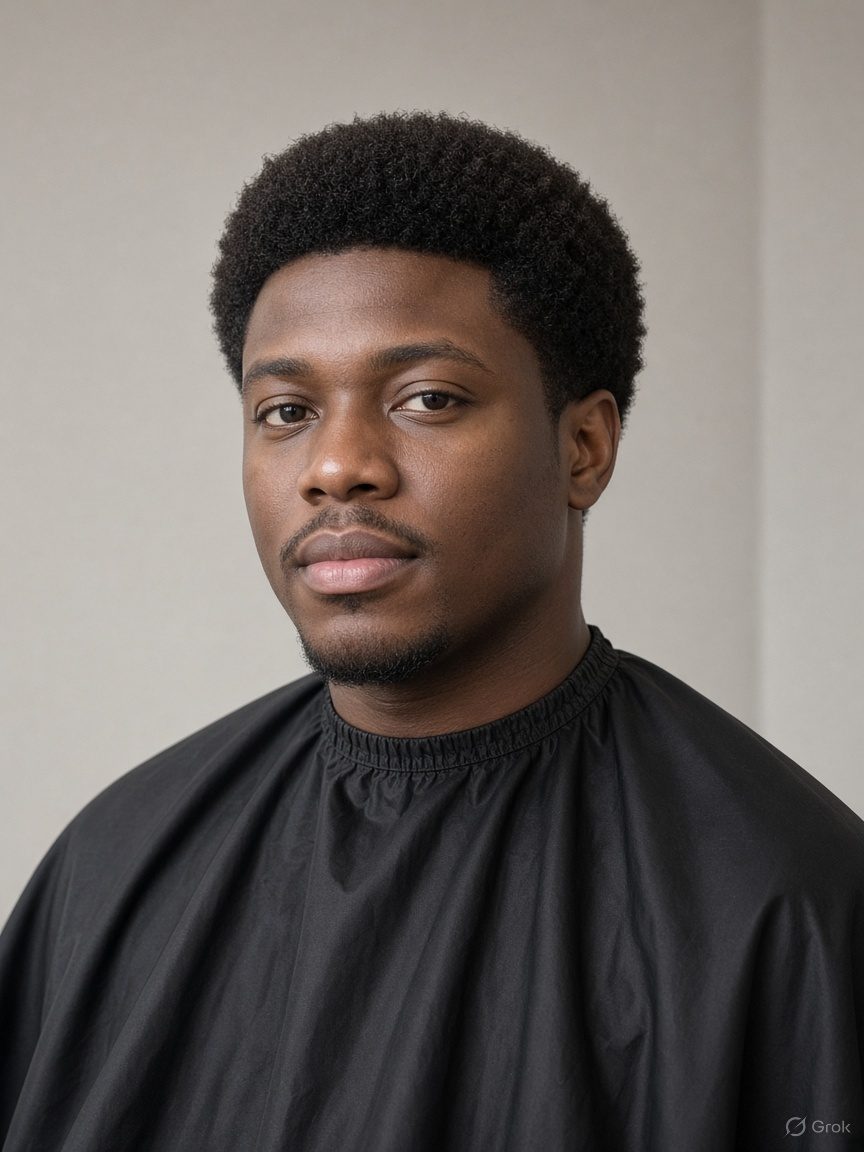
A short coily shape is cut dry, in small sections, so the silhouette stays rounded instead of squared off. It suits 4A to 4C hair on a man who wants the head neat, the hair low maintenance and the outline soft at the crown, the temple and the nape. Coily hair lifts away from the scalp, so the shape is read as an outline in the mirror, not as a length at the shoulder. Take sections no wider than 1 to 2 cm, lift each coil with the comb and cut where the coil sits dry. Work the same plan all around the head, because a rounded shape needs every side to finish at the same height. The whole cut stays dry from the first section to the last, and the shrinkage of 30 to 50 percent is already inside the length that is left.
Consult dry, show the rounded outline from the front, the side and the back, and agree the height at the crown before the first section. Run the stretch test on a wet strand, and if it stays stretched or snaps before 20 percent, plan a trim only and no chemical. Divide into four, then split each quarter into small sections of 1 to 2 cm, clipping every section out of the way so the cut is never judged against loose hair. Cut each coil in its own direction to the guide, never brushing a 4C section out to measure it. No razor on the perimeter and no relaxer or texturiser. Cross-check dry around the whole outline, finish with leave-in on wet hair, scrunch, diffuse on low or air-dry and never towel-rub. Curly work takes 60 to 90 minutes, so rebook in 6 to 8 weeks and keep the appointment long.
- 1. Consult with the hair dry, show the rounded outline from three angles and agree the crown height before the cape is fastened.
- 2. Stretch one wet coil beside its spring length and check the 30 to 50 percent shrinkage on the crown, the temple and the nape.
- 3. Divide into four, then split each quarter into sections of 1 to 2 cm and clip every section clear of the working area.
- 4. Cut each coil in its own direction to the guide, and never brush a 4C section out before cutting it.
- 5. Use scissors only on the perimeter, with no razor, no relaxer and no texturiser anywhere in the service.
- 6. Cross-check dry all round the outline with the head upright, then tilted forward and back.
- 7. Finish with leave-in on wet hair, scrunch, diffuse on low or air-dry, and never towel-rub.
- 8. Rebook in 6 to 8 weeks and write the crown height on the card so the next shape starts from it.
Salon example: Imran's short coily shape
Imran, forty-one, is a site supervisor and wanted a short shape he could keep under a hard hat without it looking flat at the end of the day. His hair was 4B, dense at the crown, and the wet length at the top measured 9 cm against 5 cm dry, which is about 45 percent shrinkage. I agreed a rounded outline at the crown and kept the nape slightly lower so the hat would not crush a hard edge. Every section was 1 to 2 cm, cut dry and clipped away as I went, and I never combed a section out straight. The whole cut took 80 minutes. At the dry check the outline was even all round, and the leave-in and scrunch finish held under the hat. He rebooked in seven weeks.
Caution: Do not cut a short coily shape in large sections on dry hair, because one clump lifted from a wide section hides the shorter coils underneath and the outline finishes uneven.
Rounded afro
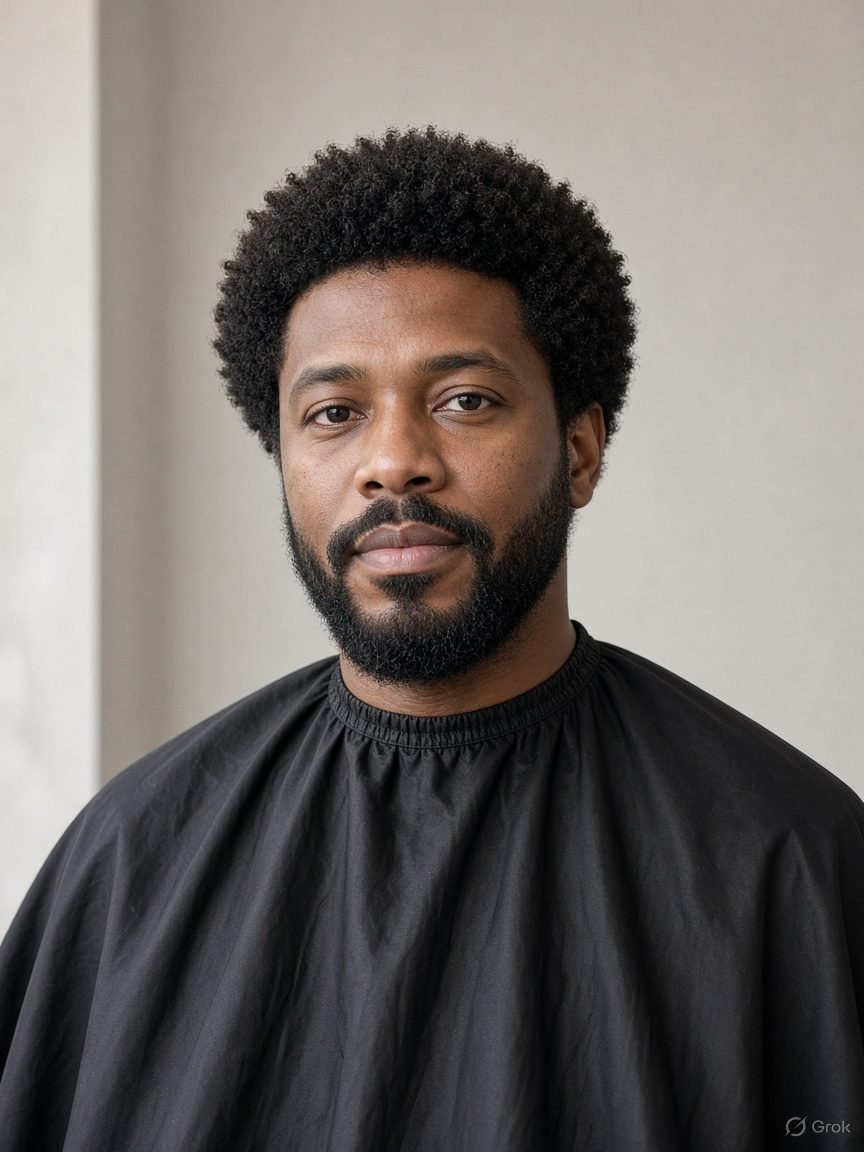
A rounded afro is cut dry in the shape the client will wear, so the outline is decided on the hair as it sits and not on hair that has been brushed into a cloud. A 4C section brushed out measures longer than the same section in its natural clump, and a guide taken from brushed hair is always too generous. Do not brush a 4C section out before cutting: mist it lightly if it is dusty, separate it with the fingers and cut the clump where it rests. Show the rounded outline from the front, the side and the back before the first cut, and mark the height at the crown with the comb. On 3C to 4C hair the finished shape can sit 30 to 50 percent shorter than the wet length, which is why the clump and not the stretch is the measure.
Consult dry and leave the hair in its own clumps for the whole service. Run the stretch test on a wet strand: a healthy strand springs back at about 30 percent, and hair that stays stretched or snaps before 20 percent gets no razor and no chemical. Section the head into four, then work in clumps of 1 to 2 cm, cutting each clump to the crown guide and following the natural direction of the coil. Keep the razor off the perimeter and use scissors only. Cross-check dry with the head upright and tilted, looking at the outline rather than at single curls. Finish with leave-in on wet hair, scrunch, diffuse on low or air-dry and never towel-rub, because rubbing breaks the clump apart. Curly work takes 60 to 90 minutes, and the rebook is 6 to 8 weeks.
- 1. Consult with the hair dry and in its natural clumps, and agree the crown height and the outline in the mirror.
- 2. Stretch one wet coil beside its spring length and show the 30 to 50 percent before the crown mark is set.
- 3. Divide into four, then work in clumps of 1 to 2 cm and clip each one clear of the section below.
- 4. Cut clump by clump to the crown guide, following the coil, and never brush a 4C section out first.
- 5. Keep the razor off the perimeter, use scissors only, and refuse any relaxer or texturiser request in this service.
- 6. Cross-check dry around the outline with the head upright and then tilted, and adjust only the clump that stands proud.
- 7. Finish with leave-in on wet hair, scrunch, diffuse on low or air-dry, and never towel-rub the clumps.
- 8. Rebook in 6 to 8 weeks and explain that the outline is the reference, not the stretched length.
Salon example: Dev's rounded afro
Dev, twenty-seven, a graphic designer, came in with a 4C afro that had been brushed into a wide cloud and measured 14 cm across at the top. He wanted a rounded shape and had been told by a friend that the length would have to go. I separated one clump at the crown and let it sit: the same hair measured 8 cm, so the brushed measurement was misleading by 6 cm. I did not brush the hair out again. We agreed a crown height of 8 cm and a soft outline at the temple and the nape. I cut in 1 to 2 cm clumps, dry, to one guide, and cross-checked the outline from three sides. Leave-in, scrunch and a low diffuse finished it. He rebooked in eight weeks.
Caution: Never take an afro guide from brushed-out hair, because a 4C section stretches several centimetres under the brush and the finished shape will be short by that same amount.
Tapered afro
A tapered afro keeps the top and the crown full and brings the sides and the nape in, so the head reads as one full shape with a clean edge under it. It suits 3C to 4C hair on a man who wants volume where the head is seen from the front and a tidy line around the ears for work. The risk is bringing the sides in so far that the full top looks like a separate block, so the taper has to step down in stages rather than in one band. Agree the height of the taper at the temple and the occipital bone, and agree that the top stays full, then show both marks on the dry head with the comb. The top is shaped in its clumps and the shrinkage of 30 to 50 percent is left inside the length.
Consult dry, agree the two marks, and check the texture before the clippers move. Run the stretch test on a wet strand, and if it stays stretched or snaps before 20 percent, keep the service to a dry trim and refuse the razor and any chemical. Divide into four, take the taper up in three bands so each band blends into the next, and blend the last band with scissors rather than closing the clipper on the curl. The top is cut dry, clump by clump, to a crown guide, with no brushing out of a 4C section. Cross-check dry from the front, the sides and the back, and look at the outline rather than single curls. Finish with leave-in on wet hair, scrunch, diffuse on low or air-dry and never towel-rub. Curly work takes 60 to 90 minutes, and the rebook is 6 to 8 weeks.
- 1. Consult with the hair dry, agree the taper height at the temple and the occipital bone, and confirm that the top stays full.
- 2. Stretch one wet curl beside its spring length and check the 30 to 50 percent before the clippers start.
- 3. Section into four, then take the taper up in three bands so each band has room to blend.
- 4. Blend the top band with scissors, then cut the top dry, clump by clump, to the crown guide.
- 5. Keep the razor off the perimeter and refuse any relaxer or texturiser, whatever the client has been told elsewhere.
- 6. Cross-check dry from the front, both sides and the back, and look at the outline, not at single curls.
- 7. Finish with leave-in on wet hair, scrunch, diffuse on low or air-dry, and never towel-rub.
- 8. Rebook in 6 to 8 weeks and check that the taper has not widened under the full top.
Salon example: Sameer's tapered afro
Sameer, thirty-one, an accountant, wanted the afro full on top and tidy at the ears for the office. His hair was 4A, and the wet strand stretched and returned at about 30 percent, so the clumps were healthy. We agreed the top at 7 cm dry and the taper line a finger above the ear, stepping down in three bands to a 2 guard at the skin line. I blended the top band with scissors so there was no shelf, then cut the top dry in 2 cm clumps to a guide at the crown. The cross-check from the back showed one clump standing proud, which I trimmed by 5 mm. Leave-in and a low diffuse finished it in ten minutes. He rebooked in eight weeks and said the shape held through two washes a week.
Caution: Do not close a clipper tightly on the band under a full afro top, because the step it leaves cannot be covered by the curl above it.
Coil top with tapered sides
A coil top keeps the coil pattern on top and takes the sides shorter, so the cut is divided into two clearly different zones. The coils are cut dry, in their own clumps, because a coil that is stretched or brushed loses the spring that decides its finished length. It suits 4A to 4C hair on a man who wants the top to stay curly and the sides to stay quiet under a cap or at a desk. Mark the boundary between the two zones with the comb, usually a finger above the ear, and keep that boundary level all the way round. The sides are shorter, but not so short that the coil above the line has nothing to sit on. The coil top carries the whole character of the cut, so its length is decided first.
Consult dry, agree the coil length at the crown and the boundary line, then check texture and density. Run the stretch test on a wet strand: at about 30 percent it springs back, and if it stays stretched or snaps before 20 percent, take off less and refuse the razor and the chemical. Divide into four, taper the sides in two bands to the boundary, blend the line with scissors, then cut the top dry in 1 to 2 cm clumps to a crown guide. No razor on the curly perimeter. Cross-check dry with the head upright and tilted, and look at the line from the front and the back. Finish with leave-in on wet hair, scrunch, diffuse on low or air-dry and never towel-rub. Curly work takes 60 to 90 minutes, and the rebook is 6 to 8 weeks.
- 1. Consult with the hair dry, agree the coil length at the crown and the boundary line a finger above the ear.
- 2. Stretch one wet coil beside its spring length and show the 30 to 50 percent before the sides are cut.
- 3. Section into four, taper the sides in two bands to the boundary, and clip the top out of the way.
- 4. Blend the boundary with scissors, then cut the top dry in 1 to 2 cm clumps to the crown guide.
- 5. Keep the razor off the perimeter and use no chemical, because the boundary is where a razor edge shows most.
- 6. Cross-check dry from the front and the back, and make sure the boundary sits level on both sides.
- 7. Finish with leave-in on wet hair, scrunch, diffuse on low or air-dry, and never towel-rub the coils.
- 8. Rebook in 6 to 8 weeks and check that the boundary has not crept up on one side.
Salon example: Farhan's coil top
Farhan, twenty-four, a delivery rider, wanted the coils on top and the sides short enough to sit under a helmet. His hair was 4B, and the coil at the crown measured 3 cm in its clump against 6 cm stretched, which is about 50 percent. I set the boundary a finger above the ear and kept it level by combing from the front and the back before I cut. The sides went in with a 2 guard in two bands, blended with scissors. The top was cut dry in 1 to 2 cm clumps to one guide, and I left 1 cm extra at the front, where the coil sat looser. Cross-check dry showed the boundary level. Leave-in and air-dry, no towel. He rebooked in six weeks.
Caution: Do not taper the sides above the agreed boundary on a coil top, because the shorter sides will expose the scalp and leave the top looking like a separate piece.
Short wash-and-go
A short wash-and-go is a shape planned for air-dry, so the cut has to look finished when the client does nothing more than leave-in and scrunch. It suits 2C to 4A hair on a man who has five minutes in the morning and no wish to own a round brush. The cut works when the perimeter is soft, the layers are short enough to lift but long enough to coil, and nothing on the head depends on tension to sit right. On a wash-and-go a layer that is too short stands up instead of falling, so length is kept where the wave needs weight. Agree the shape with the hair dry, then test it with water before the client leaves, because the wash-and-go is the only styling this cut will get.
Consult dry, agree the length at the front, the side and the crown, and check the wave pattern in three places. Run the stretch test on a wet strand: at about 30 percent it springs back, and hair that stays stretched or snaps before 20 percent is trimmed only, with no razor and no chemical. Divide into four and cut the perimeter soft, then point-cut the interior lightly so the ends break instead of sitting in a line. Cut dry where the shape is judged, and damp where the wave has to be seen. Cross-check dry and then with water, misting a small section and scrunching it to see where it lands. Finish with leave-in on wet hair, scrunch, diffuse on low or air-dry and never towel-rub. Curly work takes 60 to 90 minutes, and the rebook is 6 to 8 weeks.
- 1. Consult with the hair dry, agree the front, side and crown length, and ask how the client dries it at home.
- 2. Stretch one wet strand beside its spring length and check the 30 to 50 percent before any section is cut.
- 3. Section into four, cut the perimeter soft, then lighten the interior with a point cut so the ends break.
- 4. Cut dry wherever the shape is judged, and use a damp finish only where the wave has to be seen.
- 5. Use no razor on the curly perimeter and no chemical, because both change how the ends behave on air-dry.
- 6. Cross-check dry, then mist one section, scrunch it and check where it lands with no product beyond leave-in.
- 7. Finish with leave-in on wet hair, scrunch, diffuse on low or air-dry, and never towel-rub.
- 8. Rebook in 6 to 8 weeks and show the client the same scrunch and air-dry at the basin before he leaves.
Salon example: Nikhil's wash-and-go crop
Nikhil, twenty-two, a student, wanted a cut that looked the same on a Monday morning as it did in the chair. His hair was 3A at the front and 2C at the back, and the wet strand sprang back at about 30 percent. I agreed 4 cm at the front and 3 cm at the crown, cut the perimeter soft and point-cut the interior by 1 cm so the ends would break. Then I misted a section, scrunched it and let it dry while I finished the sides, and it fell into the same shape. I refused the razor he had seen in a video, because the ends would have looked thin on air-dry. Leave-in and scrunch took him three minutes. He rebooked in seven weeks.
Caution: Do not layer a wash-and-go cut short enough to need a round brush, because the client will not use one and the shape will stand up instead of falling.
Curly top, tapered sides
A curly top with tapered sides keeps the dry curl above and takes the sides in with scissors or a low guard that does not eat the curl. It suits 3A to 4C hair and a man who wants a neat ear line but still wants the top to look like hair rather than a shape cut into it. The guard choice is the whole decision: a guard short enough to leave a shaved band also removes the length the curl needs to form, so the taper should stop where the curl still has room. Agree the top length dry and the taper height at the temple, and state the guard number and the scissor line aloud so nothing is decided by habit. The top carries the curl and the shrinkage of 30 to 50 percent stays inside the length that is left.
Consult dry, agree the taper line and the top length, and check the curl pattern at the front and the crown. Run the stretch test on a wet strand: at about 30 percent it returns, and if it stays stretched or snaps before 20 percent, cut dry with scissors only and refuse the razor and the chemical. Divide into four, run the guard to the agreed line and blend with scissors, then cut the top dry in sections no wider than the comb, following each curl. No razor on the curly perimeter. Cross-check dry with the head upright and tilted, then check the join between the taper and the top. Finish with leave-in on wet hair, scrunch, diffuse on low or air-dry and never towel-rub. Curly work takes 60 to 90 minutes, and the rebook is 6 to 8 weeks.
- 1. Consult with the hair dry, agree the taper height at the temple and the top length, and state the guard number aloud.
- 2. Stretch one wet curl beside its spring length and check the 30 to 50 percent before the guard touches the head.
- 3. Section into four, run the guard to the agreed line, and blend the last 1 to 2 cm with scissors.
- 4. Cut the top dry in sections no wider than the comb, following each curl to the guide.
- 5. Keep the razor off the curly perimeter, and choose a guard that still leaves the curl room to form.
- 6. Cross-check dry, then look at the join between the taper and the top with the head straight and tilted.
- 7. Finish with leave-in on wet hair, scrunch, diffuse on low or air-dry, and never towel-rub.
- 8. Rebook in 6 to 8 weeks and check that the join has not become a visible band.
Salon example: Arjun's curly top and taper
Arjun, thirty, a software engineer, wanted a taper but was afraid of a shaved band around the curl. His hair was 3C on top and 3A at the sides, and the stretch test on a wet strand returned at about 30 percent. I showed him a 3 guard and a 2 guard on the dry head and we agreed the 3 guard, a finger above the ear, blended with scissors over the last 2 cm. The top was cut dry in sections no wider than the comb, following each curl, and I took 2 cm off the longest front curl. At the dry check the join was invisible and the curl still formed at the temple. Leave-in, scrunch and a low diffuse finished it. He rebooked in seven weeks and asked for the same numbers on the card.
Caution: Do not run a low guard up to the curl on a curly top, because the band it leaves is exactly where the curl needs length to form and it will not close over.
Men's 3C dry cut
A 3C dry cut is worked section by section, with each curl followed to the same guide instead of being pulled into a line. 3C hair coils tightly enough to shrink 30 to 50 percent and loosely enough that some sections hang while others spring, so the cut has to be read curl by curl rather than by one length at the back. It suits a man who wants the shape to hold on a wash-and-go and who is willing to sit for the full appointment. Show one curl stretched beside its spring length at the front and at the side, because the same head can shrink differently in two places. The cut is dry from the first section, and nothing is measured after a comb has been pulled through it.
Consult dry, agree the finished length at the front, the side and the crown, and check the pattern in three zones. Run the stretch test on a wet strand: at about 30 percent it returns, and if it stays stretched or snaps before 20 percent, cut less and refuse the razor and the chemical. Divide into four, then work in sections no wider than the comb, cutting each curl in its own direction to a guide that travels with you. No razor on the curly perimeter. Cross-check dry at the end, looking at the outline from the front, both sides and the back. Finish with leave-in on wet hair, scrunch, diffuse on low or air-dry and never towel-rub. Curly work takes 60 to 90 minutes, and the rebook is 6 to 8 weeks.
- 1. Consult with the hair dry, agree the length at the front, the side and the crown, and find the three shrinkage zones.
- 2. Stretch one wet curl beside its spring length at the front and the side, and show the 30 to 50 percent.
- 3. Divide into four, then work in sections no wider than the comb, clipping each one clear of the next.
- 4. Cut each curl in its own direction to a guide that travels with you, and never pull a section straight.
- 5. Use scissors only on the curly perimeter, with no razor, no relaxer and no texturiser.
- 6. Cross-check dry from the front, both sides and the back, and trim only the curl that stands proud.
- 7. Finish with leave-in on wet hair, scrunch, diffuse on low or air-dry, and never towel-rub.
- 8. Rebook in 6 to 8 weeks and note the three zone lengths on the card, because 3C shrinks unevenly.
Salon example: Aditya's 3C dry cut
Aditya, twenty-six, a teacher, had 3C hair that shrank more at the front than at the crown, so his old wet cuts always finished short at the temple. The wet length at the front was 12 cm and the same curl sat at 7 cm dry, about 40 percent, while the crown shrank by less. I cut the whole shape dry, in sections no wider than the comb, following each curl, and I set a separate guide for the front and the crown. No razor went near the perimeter. At the dry check the front and the crown sat level with each other, which had never happened on his wet cuts. Leave-in, scrunch and air-dry took him five minutes. He rebooked in seven weeks, and I wrote both zone lengths on his card.
Caution: Do not use one guide for the whole 3C head, because the front and the crown shrink at different rates and one guide will leave one zone short.
Men's 4C dry cut
A 4C dry cut is worked in very small sections, with length left for shrinkage of 30 to 50 percent. 4C hair packs many tight coils into a small area, so a section that looks narrow on the comb can still hold a dozen clumps, and a guide cut across all of them at once will finish uneven. Very small sections mean 1 to 2 cm, and every clump is cut where it rests, never brushed out to be measured. It suits a man who wants a defined shape and accepts that the appointment is long and quiet. Show the stretch beside the spring length at the crown, the temple and the nape, because the shrink differs by zone, and leave the difference inside the cut.
Consult dry and leave the hair in clumps for the whole service. Run the stretch test on a wet strand: at about 30 percent it returns, and if it stays stretched or snaps before 20 percent, take off less and refuse the razor and any chemical. Divide into four, then split each quarter into 1 to 2 cm sections, clipping each one away so the cut is never judged against loose hair. Cut clump by clump to a guide, following the coil, and keep the razor off the perimeter. Cross-check dry from three sides and look at the outline as a whole. Finish with leave-in on wet hair, scrunch, diffuse on low or air-dry and never towel-rub, because rubbing pulls the clump apart. Curly work takes 60 to 90 minutes, and the rebook is 6 to 8 weeks.
- 1. Consult with the hair dry and in clumps, agree the shape at the crown, the temple and the nape, and set a zone length for each.
- 2. Stretch one wet coil beside its spring length in each zone and show the 30 to 50 percent before cutting.
- 3. Divide into four, then split each quarter into 1 to 2 cm sections and clip every section clear.
- 4. Cut clump by clump to a guide, following the coil, and never brush a 4C section out before cutting it.
- 5. Use scissors only on the perimeter and refuse the razor, the relaxer and the texturiser without exception.
- 6. Cross-check dry from three sides, looking at the outline as a whole rather than at single clumps.
- 7. Finish with leave-in on wet hair, scrunch, diffuse on low or air-dry, and never towel-rub.
- 8. Rebook in 6 to 8 weeks with a long appointment, and keep the zone lengths on the card.
Salon example: Suraj's 4C dry cut
Suraj, thirty-five, a driver, had 4C hair that had not been cut in five months and was uneven at the crown. He wanted a clean shape but was worried about losing length. I separated clumps at the crown, the temple and the nape, and the wet lengths were 8, 6 and 7 cm against dry lengths of 4, 3 and 4 cm, so the shrink ran between 43 and 50 percent. I cut dry in 1 cm sections at the temple and 2 cm at the crown, leaving an extra 1 cm at the crown for the shrink. The whole service took 85 minutes. At the dry check the outline was even, and leave-in, scrunch and air-dry kept it. He rebooked in eight weeks and booked the longer slot.
Caution: Do not cut 4C hair in sections wider than 2 cm, because the clumps underneath the top layer are shorter and a wide guide cuts them twice.
Wavy crop, 2A to 2C
A wavy crop is cut damp or dry, with the layers kept long, because a short layer on a loose wave flips out instead of lying down. It suits 2A to 2C hair on a man who wants a soft, low shape across the forehead and a tidy nape without a hard line. The wave has little spring, so the shrinkage is small and the cut can be judged close to its finished length, but the ends still move, and a layer cut 2 to 3 cm too short will turn up at the temple. Cut the perimeter first and keep the top layers within 4 to 5 cm of it. Show the client the line with the hair damp, then confirm it dry, because a 2A head can look almost straight for an hour after washing.
Consult with the hair damp or dry, agree the front, the side and the nape length, and find where the wave turns. Run the stretch test on a wet strand: at about 30 percent it returns, and hair that stays stretched or snaps before 20 percent gets a trim only, with no razor and no chemical. Divide into four and cut the perimeter first, then take the layers long, within 4 to 5 cm of the hem, because a short layer on a loose wave flips out at the temple and cannot be corrected without cutting the whole layer again. Cut the sides and the nape with scissors to the agreed line. Cross-check dry from three sides, finish with leave-in on wet hair, scrunch, diffuse on low or air-dry and never towel-rub. Curly work takes 60 to 90 minutes, with a wavy crop usually near 60, and the rebook is 6 to 8 weeks.
- 1. Consult with the hair damp or dry, agree the front, side and nape length, and find where the wave turns on the head.
- 2. Stretch one wet strand beside its spring length, and note that 2A to 2C shrinks less than 3C, so the guide sits closer to the dry length.
- 3. Divide into four, cut the perimeter first, and keep the top layers within 4 to 5 cm of the hem.
- 4. Cut the sides and the nape with scissors to the agreed line, and check the layer length against the wave, not against the comb.
- 5. Use no razor and no chemical, because the loose wave shows a cut or a broken end more than a tight curl does.
- 6. Cross-check dry from the front, both sides and the back, and look for any layer that turns up at the temple.
- 7. Finish with leave-in on wet hair, scrunch, diffuse on low or air-dry, and never towel-rub.
- 8. Rebook in 6 to 8 weeks and warn that a short layer will flip for the first two weeks if one is cut too high.
Salon example: Varun's wavy crop
Varun, twenty-eight, a marketing analyst, had 2B hair and wanted a low crop that would not need styling. He had seen a photo with a short textured layer at the front, and I explained that on his wave that layer would flip up for a fortnight. We agreed a perimeter at 4 cm on the forehead and a top layer 4 cm behind the hem, which kept the wave lying flat. I cut the perimeter first, then the sides and the nape with scissors, and checked the top as it dried. The stretch test had returned at about 30 percent, so the hair was healthy, but I still kept the razor away because the ends were light. The cut took 60 minutes. He rebooked in seven weeks.
Caution: Do not cut a short textured layer into a 2A to 2C crop, because a loose wave has no weight to hold it down and the layer will flip at the temple for weeks.
Loose wave, medium length
A loose wave at medium length keeps the top falling to the brow and covering the ear, with a soft edge rather than a hard line. It suits 2A to 2C hair and a man who wants a shape that reads relaxed in a meeting and still looks deliberate. The marks are the brow at the front and the top of the ear at the side, and both are checked dry because a loose wave drops as it dries. The interior stays lightly layered so the wave has somewhere to turn, and the perimeter stays soft so nothing looks cut in. Length is kept through the crown, where a loose wave needs weight, and any lift comes from the way the hair is dried rather than from short layers.
Consult dry, agree the brow and ear marks, and check the density at the crown before any section is cut. Run the stretch test on a wet strand: at about 30 percent it returns, and hair that stays stretched or snaps before 20 percent is trimmed only, with no razor and no chemical. Divide into four and cut the perimeter soft at the agreed marks, then point-cut the interior lightly, no shorter than the jaw line at the front. Cut dry, because the medium length has to be judged where it falls, and mist only the sections that need to be seen as a wave. Cross-check dry from three sides and look at the ear coverage. Finish with leave-in on wet hair, scrunch, diffuse on low or air-dry and never towel-rub. Curly work takes 60 to 90 minutes, and the rebook is 6 to 8 weeks.
- 1. Consult with the hair dry, set the brow and ear marks, and check the crown density before the cape is fastened.
- 2. Stretch one wet strand beside its spring length and check the 30 to 50 percent band for the tighter sections.
- 3. Section into four, cut the perimeter soft at the brow and ear marks, and leave the crown length alone.
- 4. Point-cut the interior lightly, no shorter than the jaw at the front, and cut dry where the length falls.
- 5. Use no razor on the perimeter and no chemical, because a loose wave shows a broken end as a frizzy tip.
- 6. Cross-check dry from three sides, and look at whether the ear is covered on both sides to the same point.
- 7. Finish with leave-in on wet hair, scrunch, diffuse on low or air-dry, and never towel-rub.
- 8. Rebook in 6 to 8 weeks and show the client how the brow mark is kept with a simple forward dry.
Salon example: Manav's medium loose wave
Manav, thirty-eight, a consultant, wanted his hair to reach the brow at the front and cover the top of the ear, with no visible layer line. His hair was 2B and finer at the front than at the crown, and the wet strand sprang back at about 30 percent. I set the brow mark and the ear mark with the comb while the hair was dry, cut the perimeter soft, and point-cut the interior by 2 cm at the front and 3 cm at the crown so the wave had room to turn. At the dry check the ear was covered evenly and the front fell to the brow. Leave-in and a low diffuse kept it soft. He rebooked in eight weeks and asked for the same marks.
Caution: Do not lift the front of a medium loose wave above the jaw line, because the wave will lose the weight that keeps it falling forward and the brow mark will break.
Messy texture, medium
A messy texture at medium length keeps the overall shape and breaks only the ends, so the hair looks lived in without looking untidy at the outline. It suits 2B to 3C hair on a man who wants movement and does not want a visible layer line. The only texture tool is the point cut, worked into the last 1 to 2 cm of the ends, while the perimeter and the interior length are left alone. Point cutting removes weight at the tip without shortening the section, which is why it reads as texture rather than as a layer. Agree the overall length first and cut that cleanly, then break the ends, because texture cut before the length is settled cannot be put back.
Consult dry, agree the length at the front, the side and the crown, and check the wave pattern in two places. Run the stretch test on a wet strand: at about 30 percent it returns, and hair that stays stretched or snaps before 20 percent is trimmed and point-cut only, with no razor and no chemical. Divide into four, cut the perimeter clean at the agreed length, then take sections no wider than the comb and point-cut only the last 1 to 2 cm. Keep the razor off the head entirely, because this shape is made by the shears. Cross-check dry from three sides, and look at the outline before you look at the texture. Finish with leave-in on wet hair, scrunch, diffuse on low or air-dry and never towel-rub. Curly work takes 60 to 90 minutes, and the rebook is 6 to 8 weeks.
- 1. Consult with the hair dry, agree the front, side and crown length, and ask how much texture the client actually wants.
- 2. Stretch one wet strand beside its spring length and check the 30 to 50 percent before the ends are broken.
- 3. Section into four, cut the perimeter clean at the agreed length, and leave the interior length alone.
- 4. Point-cut only the last 1 to 2 cm of each section, with the shears at an angle and the section held where it falls.
- 5. Use no razor at all, because the point cut is the only texture tool this shape needs.
- 6. Cross-check dry from three sides, and look at the outline first so the texture has not hidden an uneven line.
- 7. Finish with leave-in on wet hair, scrunch, diffuse on low or air-dry, and never towel-rub.
- 8. Rebook in 6 to 8 weeks and tell the client that the texture softens with each wash, so the shape is the part that lasts.
Salon example: Yash's messy medium texture
Yash, twenty-five, a photographer, wanted a medium cut that looked unstructured without looking grown out. His hair was 2C at the front and 3A at the crown, and the wet stretch returned at about 30 percent. I cut the perimeter clean at 6 cm at the front and 7 cm at the crown, then point-cut only the last 2 cm in sections no wider than the comb, with the shears at a shallow angle. I did not use a razor, because his ends were already light from the sun. At the dry check the outline was even and the surface had movement without a visible layer. Leave-in and air-dry held it. He rebooked in seven weeks.
Caution: Do not point-cut above the last 2 cm on a medium messy shape, because the shorter pieces cannot reach the outline and the cut finishes with a fuzzy halo.
Piece-y crop
A piece-y crop is a short shape where the last 1 cm of the ends is point-cut, so the hair separates into small groups instead of sitting as one block. It suits 2A to 3C hair on a man who wants a short cut with visible texture and a soft front. The base shape is cut first and cut clean, then the point cut is worked only into the final centimetre, because a point cut further up removes length the shape still needs. On a crop the difference between texture and damage is that 1 cm, so mark it with the comb and work inside the mark. The front is the last place to texture, because it is the first place the client looks and the first place a mistake shows.
Consult dry, agree the top length and the front line, and check the crown pattern before the first section. Run the stretch test on a wet strand: at about 30 percent it returns, and if it stays stretched or snaps before 20 percent, cut the crop clean with no point cut and no razor. Divide into four, cut the base shape clean with scissors to one guide, then go back over the head and point-cut only the last 1 cm, section by section, with the shears at an angle. Use no razor, because a razor on a 3 cm crop takes weight the shape cannot spare. Cross-check dry, finish with leave-in on wet hair, scrunch, diffuse on low or air-dry and never towel-rub. Curly work takes 60 to 90 minutes, and the rebook is 6 to 8 weeks.
- 1. Consult with the hair dry, agree the top length and the front line, and show where the 1 cm texture band will sit.
- 2. Stretch one wet strand beside its spring length and check the 30 to 50 percent before the base shape is cut.
- 3. Section into four, cut the base shape clean to one guide, and leave the texture until the shape is finished.
- 4. Point-cut only the last 1 cm, section by section, with the shears at an angle and the section held where it falls.
- 5. Use no razor on the crop, because the hair is too short to lose the weight a razor takes.
- 6. Cross-check dry with the head upright and tilted, and trim any group that stands above the front line.
- 7. Finish with leave-in on wet hair, scrunch, diffuse on low or air-dry, and never towel-rub.
- 8. Rebook in 6 to 8 weeks and note the front line on the card, because a piece-y crop grows out of shape quickly.
Salon example: Rahul's piece-y crop
Rahul, twenty-three, a gym trainer, wanted a short cut that showed texture at the front without a fringe. His hair was 2B and thick at the crown, and the wet stretch returned at about 30 percent. I cut the base to 4 cm at the front and 3 cm at the crown, clean and to one guide, then point-cut only the last 1 cm across the top in sections no wider than the comb. I marked the centimetre with the comb first so the point cut could not travel upward. At the dry check the front line was level and the texture separated. I used leave-in and a low diffuse, no towel. He rebooked in six weeks, because his hair grows fast at the nape.
Caution: Do not point-cut a piece-y crop above 1 cm from the ends, because the shorter pieces cannot reach the front line and the crop finishes with a thin, uneven surface.
Razor texture on healthy hair
Razor texture is a soft, broken surface made by drawing a razor along the section, and on a short men's cut it is used sparingly because the razor removes weight and length at the same time. It belongs on healthy hair only: a wet strand must stretch and spring back at about 30 percent before a razor touches the head, and hair that stays stretched or snaps before 20 percent is point-cut instead. One razor pass, never two over the same section. The razor is for the interior and the ends, not the curly perimeter, where it leaves a ragged edge the curl cannot hide. On a textured cut the angle of the razor decides the result: a shallow angle skims the surface, a steep angle digs in and removes length.
Consult dry, agree the length and the amount of texture, and explain that razor texture is a decision made after the stretch test and not before it. Run the test on a wet strand: only a spring back at about 30 percent allows the razor, and anything that stays stretched or snaps before 20 percent is point-cut with the shears. Divide into four, cut the base shape clean with scissors, then take the interior sections and make one razor pass only, with the section held where it falls and the razor at a shallow angle. Keep the razor off the curly perimeter, and use no chemical. Cross-check dry from three sides, finish with leave-in on wet hair, scrunch, diffuse on low or air-dry and never towel-rub. Curly work takes 60 to 90 minutes, and the rebook is 6 to 8 weeks.
- 1. Consult with the hair dry, agree the length and the texture, and state plainly that the razor depends on the stretch test.
- 2. Stretch one wet strand beside its spring length, and allow the razor only if it springs back at about 30 percent.
- 3. Divide into four, cut the base shape clean with scissors, and take the interior in sections no wider than the comb.
- 4. Make one razor pass only per section, at a shallow angle, and never go back over the same section.
- 5. Keep the razor off the curly perimeter, and refuse the chemical whatever the client has read online.
- 6. Cross-check dry from three sides, and look for a thin patch where the razor passed before you look at the texture.
- 7. Finish with leave-in on wet hair, scrunch, diffuse on low or air-dry, and never towel-rub.
- 8. Rebook in 6 to 8 weeks, and write on the card whether the razor was used, so the next visit starts from the same decision.
Salon example: Karan's one razor pass
Karan, thirty-six, a lawyer, wanted a soft surface on a medium top and had read that a razor gives the best texture. His hair was 2B and healthy, and the wet strand stretched and sprang back at about 30 percent, so the razor was allowed. I cut the base shape clean first, then took the interior in sections no wider than the comb and made one shallow razor pass on each, stopping 2 cm above the perimeter. I did not go back over a single section. At the dry check there was no thin patch and the surface had a soft, broken look. Leave-in and a low diffuse finished it. He rebooked in eight weeks, and I wrote razor, one pass on his card.
Caution: Do not use a razor twice over one section or anywhere near the curly perimeter, because the second pass takes length that cannot be restored and a razor edge on a curl dries into a frizzy line.
Point-cut texture, no razor
A point cut is the safe texture method: the shears enter the section at an angle and cut only part of the end, so weight comes out and length stays. It suits every texture from 2A to 4C and every density, and it is the right choice whenever the hair is porous, fine or has been chemically treated. The cut is worked into the last 1 to 2 cm on dry hair, where the result can be seen, and the section is held where it falls rather than pulled straight. No razor is used, because a razor slices the cuticle and a point cut does not. The more open the angle of the shears, the softer the end, so the angle is chosen section by section rather than once for the whole head.
Consult dry, agree the length, and explain that this cut takes its texture from the shears alone. Run the stretch test on a wet strand: at about 30 percent it returns, and hair that stays stretched or snaps before 20 percent is point-cut very lightly and cut 1 cm longer than agreed, with no razor and no chemical. Divide into four, cut the perimeter clean at the agreed length, then point-cut only the last 1 to 2 cm of each section, opening the shears wider where the hair is denser. Keep the section where it falls and cut toward the end, never across the top of the section. Cross-check dry, finish with leave-in on wet hair, scrunch, diffuse on low or air-dry and never towel-rub. Curly work takes 60 to 90 minutes, and the rebook is 6 to 8 weeks.
- 1. Consult with the hair dry, agree the length, and explain that the texture will come from the shears and not a razor.
- 2. Stretch one wet strand beside its spring length and check the 30 to 50 percent before the ends are opened.
- 3. Divide into four, cut the perimeter clean at the agreed length, and leave the interior until the shape is settled.
- 4. Point-cut only the last 1 to 2 cm, opening the shears wider on dense hair and holding the section where it falls.
- 5. Use no razor at all, and no chemical, because the point cut is the whole method here.
- 6. Cross-check dry from three sides, and look at the outline before the texture, so an uneven line is not hidden.
- 7. Finish with leave-in on wet hair, scrunch, diffuse on low or air-dry, and never towel-rub.
- 8. Rebook in 6 to 8 weeks and show the client that the ends will soften with washing, not sharpen.
Salon example: Aman's point-cut texture
Aman, thirty-three, a teacher, had 3A hair that had been lightened by the sun and was porous at the ends, so a razor was out of the question. The wet strand sprang back at about 30 percent at the root but felt spongy at the tips, so I cut 1 cm longer than we agreed and point-cut only the last 2 cm. I worked dry, in sections no wider than the comb, with the shears open at a shallow angle on the front and a wider angle at the crown. At the dry check the outline was clean and the ends had movement without looking thin. Leave-in and air-dry finished it. He rebooked in seven weeks, and I noted the 1 cm allowance on his card.
Caution: Do not point-cut porous ends more than 2 cm from the tip, because the section loses its support and the hair dries into a frizzy, see-through surface.
Longer coily top
A longer coily top keeps the length on the crown and takes only the sides in, so the coil has weight to fall and the head still reads neat at the ear. It suits 3C to 4C hair on a man who wants the top to move and does not want a rounded cap. The sides are tapered, scissored or with a guard that does not eat the curl, and the top is left long and shaped dry in its own clumps. The risk is trimming the top to even it out, because coily length is never even, so shape it and leave the length. The perimeter of the top is the only line that needs to be deliberate, and the interior can stay soft, which is what keeps the shape looking long rather than cut.
Consult dry, agree the length at the crown and the taper height, and check where the coil sits in each zone. Run the stretch test on a wet strand: at about 30 percent it returns, and hair that stays stretched or snaps before 20 percent gets a dry trim only, with no razor and no chemical. Divide into four, taper the sides in two bands and blend the line with scissors, then shape the top dry in 1 to 2 cm clumps, following the coil and leaving 30 to 50 percent of the shrink inside the length. Do not brush a 4C section out before cutting it. Cross-check dry from three sides, finish with leave-in on wet hair, scrunch, diffuse on low or air-dry and never towel-rub. Curly work takes 60 to 90 minutes, and the rebook is 6 to 8 weeks.
- 1. Consult with the hair dry, agree the crown length and the taper height, and decide that the top will not be evened out.
- 2. Stretch one wet coil beside its spring length at the crown and the temple, and show the 30 to 50 percent.
- 3. Divide into four, taper the sides in two bands, and blend the line with scissors before the top is touched.
- 4. Shape the top dry in 1 to 2 cm clumps, following the coil, and leave the shrink inside the length.
- 5. Keep the razor off the perimeter and use no chemical, because the top is judged by its clumps.
- 6. Cross-check dry from three sides, and look at the top as a mass rather than at single clumps.
- 7. Finish with leave-in on wet hair, scrunch, diffuse on low or air-dry, and never towel-rub.
- 8. Rebook in 6 to 8 weeks and check the taper line and the crown mass together, because both drift.
Salon example: Taran's long coily top
Taran, twenty-nine, a musician, had 4A coils, a long top and short sides from a previous cut, and he wanted to keep the top length. The crown clump measured 10 cm dry against 18 cm stretched, about 45 percent, and the wet stretch test returned at 30 percent. I tapered the sides in two bands, blended the line with scissors, and shaped the top in 1 to 2 cm clumps without evening it out. I took no length from the crown, only the stray clumps that stood above the mass, and I did not brush any section out. The cut took 75 minutes. At the dry check the top fell and the sides read clean. Leave-in, scrunch and a low diffuse. He rebooked in eight weeks.
Caution: Do not even out a longer coily top to one length, because coily clumps grow and shrink at different rates and the attempt removes the mass that makes the shape look long.
Curly fringe, cut for shrinkage
A curly fringe is cut dry, and the length is left long enough that it still reaches the brow after the fringe springs up. The shrinkage on 3C to 4C hair is 30 to 50 percent, so a fringe that touches the brow wet will finish a third of the way up the forehead. The fringe is a separate section with its own guide, cut last and cut dry, and it is checked with the rest of the top already finished, because the fringe cannot be judged against wet hair. Leave the shrink in the plan rather than cutting to the wet length. A fringe on a curly head is also narrower than a straight one, because the curl spreads sideways as it dries and a wide fringe closes the temples.
Consult dry, agree the brow line, and separate the fringe section before the top is cut. Run the stretch test on a wet strand at the fringe: at about 30 percent it returns, and hair that stays stretched or snaps before 20 percent is cut 1 cm longer and left without a razor or a chemical. Take the fringe in sections no wider than the comb, cut curl by curl to the brow guide, and keep the sides of the fringe soft so the temple is not covered. Cut the fringe last, after the top is finished dry, so the two lengths can be compared. Cross-check dry with the head upright and the fringe shaken out. Finish with leave-in on wet hair, scrunch, diffuse on low or air-dry and never towel-rub. Curly work takes 60 to 90 minutes, and the rebook is 6 to 8 weeks.
- 1. Consult with the hair dry, agree the brow line, and separate the fringe section before the top is cut.
- 2. Stretch one wet fringe curl beside its spring length and show the 30 to 50 percent before the guide is set.
- 3. Section the fringe no wider than the comb, and keep the temple edges soft and narrow.
- 4. Cut the fringe dry, curl by curl, to the brow guide, and leave the shrink in the length.
- 5. Use no razor and no chemical on the fringe, because the ends are the part the client sees first.
- 6. Cross-check dry with the head upright and the fringe shaken out, and compare it with the finished top.
- 7. Finish with leave-in on wet hair, scrunch, diffuse on low or air-dry, and never towel-rub.
- 8. Rebook in 6 to 8 weeks and warn that the fringe will sit higher after a wash than it does in the chair.
Salon example: Jatin's curly fringe
Jatin, twenty-one, a college student, wanted a fringe that reached his brow but kept curling. His hair was 3C, and the fringe curl measured 10 cm wet against 6 cm dry, which is 40 percent. I cut the fringe last, dry, in sections no wider than the comb, to a brow guide set with the shrink already included, and left the temple edges soft so they did not close over his eyes. The top had been cut before, so I could compare the fringe with the finished crown. At the dry check the fringe sat at the brow and the curl showed. I finished with leave-in and air-dry, no towel. He rebooked in seven weeks and said the fringe sat higher on wash day, as I had warned.
Caution: Do not cut a curly fringe to the wet brow line, because it will spring up 30 to 50 percent and finish well above the forehead the client agreed.
Curly mullet, dry cut

A curly mullet keeps the back longer than the sides and cuts the whole shape dry, so the curl is never stretched into a line it will not hold. It suits 3A to 4C hair on a man who wants length at the nape, a shorter and tidier front, and the curl showing at the back. The back is shaped dry in its clumps, the sides and the top are cut shorter, and the transition between them is blended rather than stepped. The curls at the back are never combed straight to be measured, because they spring back and leave the line short. Agree the length at the nape first, since that is the mark the client will feel on the neck and the part that decides whether the shape reads as a mullet or as a grown-out crop.
Consult dry, agree the nape length and the front length, and check the curl pattern at the back and the sides. Run the stretch test on a wet strand: at about 30 percent it returns, and hair that stays stretched or snaps before 20 percent gets a smaller trim with no razor and no chemical. Divide into four, shape the back dry in clumps to the nape guide, cut the sides and the top shorter, and blend the join with scissors rather than clippers alone. Keep the razor off the curly perimeter and do not brush a 4C section out to measure it. Cross-check dry with the head upright and tilted. Finish with leave-in on wet hair, scrunch, diffuse on low or air-dry and never towel-rub. Curly work takes 60 to 90 minutes, and the rebook is 6 to 8 weeks.
- 1. Consult with the hair dry, agree the nape length first and then the front, and show both marks in the mirror.
- 2. Stretch one wet curl at the nape and one at the side beside their spring lengths, and show the 30 to 50 percent.
- 3. Divide into four, shape the back dry in clumps to the nape guide, and cut the sides and top shorter.
- 4. Blend the join between the back and the sides with scissors, and keep the curls at the back unstretched.
- 5. Keep the razor off the curly perimeter and use no chemical, because the nape edge is the part that shows.
- 6. Cross-check dry with the head upright and tilted, and look at the join from behind as well as the front.
- 7. Finish with leave-in on wet hair, scrunch, diffuse on low or air-dry, and never towel-rub.
- 8. Rebook in 6 to 8 weeks and check the nape length against the mark on the card.
Salon example: Omkar's curly mullet
Omkar, thirty-two, a chef, wanted a mullet with the curls showing at the back and a short, tidy front. His hair was 3B at the sides and 3C at the nape, and the nape curl measured 8 cm dry against 13 cm stretched, about 38 percent. I set the nape mark at 8 cm and the front at 4 cm, shaped the back dry in clumps, then cut the sides and the top shorter and blended the join with scissors instead of closing the clipper on it. The curls at the back were never combed straight. The cut took 70 minutes, and at the dry check the transition was smooth and the nape still curled. Leave-in and a low diffuse. He rebooked in seven weeks.
Caution: Do not blend a curly mullet with clippers alone, because the step at the join cannot be covered by the curl and will read as a band around the head.
Sparse curly cut
A sparse curly cut is planned around coverage first and shape second, because a short choppy layer on thin curly hair separates and shows the scalp. If the hair in a ponytail measures under 5 cm, the cut stays longer and softer, with no short choppy layers and no hard taper climbing into the top. It suits 2C to 4C hair with low density on a man who wants a shape that is neat without exposing the parting. The perimeter is kept soft, the interior is left alone, and the remaining length is shaped dry in its clumps. More of the scalp shows as the hair dries, so the cut is checked dry and from above, not only in the mirror at the front.
Consult dry, measure the ponytail, and if it is under 5 cm agree a longer, softer shape with no short layers. Run the stretch test on a wet strand: at about 30 percent it returns, and hair that stays stretched or snaps before 20 percent gets the ends dusted only, with no razor and no chemical. Divide into four, cut the perimeter soft at the agreed length, and leave the interior and the crown alone, because any layer there separates the clumps and opens the scalp. Shape the length dry, clump by clump, and keep the razor off the head entirely. Cross-check dry from the front, the sides, the back and above. Finish with leave-in on wet hair, scrunch, diffuse on low or air-dry and never towel-rub. Curly work takes 60 to 90 minutes, and the rebook is 6 to 8 weeks.
- 1. Consult with the hair dry, measure the ponytail, and if it is under 5 cm agree a longer shape with no short choppy layers.
- 2. Stretch one wet strand beside its spring length and check the 30 to 50 percent before the perimeter is set.
- 3. Divide into four, cut the perimeter soft at the agreed length, and leave the interior and the crown alone.
- 4. Shape the remaining length dry, clump by clump, without adding a layer that separates the hair.
- 5. Use no razor at all, because a razor thins the ends that are already doing the covering.
- 6. Cross-check dry from the front, both sides, the back and above, and look at the scalp at the parting.
- 7. Finish with leave-in on wet hair, scrunch, diffuse on low or air-dry, and never towel-rub.
- 8. Rebook in 6 to 8 weeks and keep a note of the ponytail measurement so the next decision has a baseline.
Salon example: Neel's sparse curly cut
Neel, forty-four, an office manager, had 3C hair and had been losing density at the crown for two years. His ponytail measured 4 cm, which is under the 5 cm mark, so I refused the short choppy crop he had seen and explained that the layers would separate and show the scalp. We agreed a soft perimeter at 5 cm on top and 3 cm at the sides, with no interior layer and no taper into the crown. I cut dry in clumps, took only 1 cm from the ends, and used no razor. At the dry check from above, the parting was covered and the outline was even. Leave-in and air-dry. He rebooked in seven weeks.
Caution: Do not put short choppy layers into sparse curly hair, because each layer separates the clumps and the scalp shows through at the crown and the parting.
This is a Nandu Nai textbook. It is a private brand book, not a government licence, and it does not give the right to give medical treatment.