
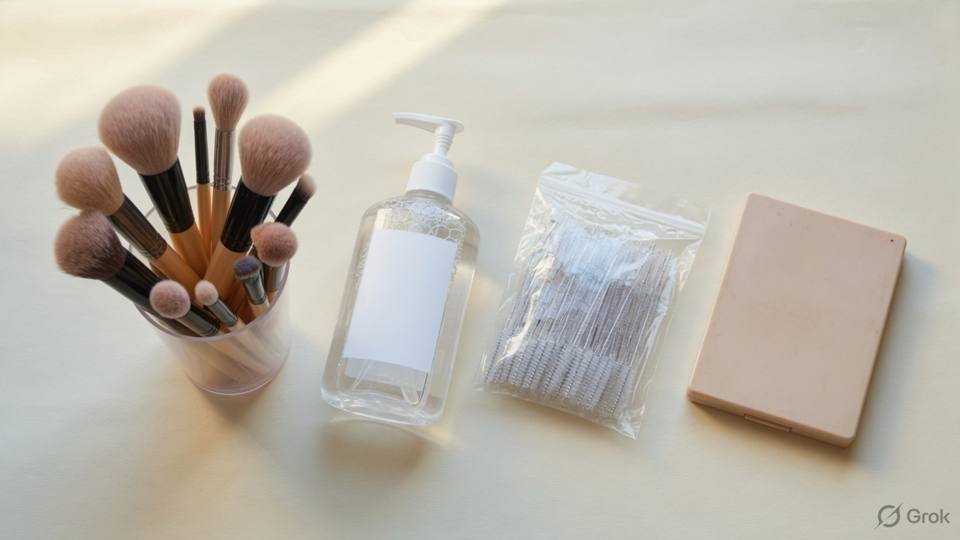
No double dipping
Double dipping is putting a used brush, sponge, or finger back into a product container. It transfers skin cells, oil, and whatever was on the skin into the product, and from there to the next client. A cream foundation that has been dipped into with a used sponge is no longer a clean product, even if it looks fine. A lip gloss that has touched a mouth is not safe for another mouth. The rule is simple: scrape or pump product onto a clean mixing plate, and work from the plate. If you need more, use a clean spatula, not the brush that has already touched a face.
Brushes should be washed after every client or set aside in a closed bin and washed before the next use. Deep-clean the face brushes weekly with a gentle soap, rinse until the water runs clear, and dry them flat with the bristles over the edge of a surface so water does not sit in the ferrule. A damp brush grows bacteria, so never put a brush away wet. Sponges are one per client, or a washable sponge that goes into a laundry bag immediately after use. Mascara wands are disposable, one per client, and never re-dipped. Eye and lip pencils are sharpened before each client, and the blade is wiped with an alcohol wipe.
Palettes and jars need the same discipline. Scrape powder onto a clean plate with a spatula, or use a clean brush that has not touched the face. For lip colour in a jar, take out what you need with a spatula and apply it with a disposable applicator. Do not let a client put her finger into a jar, and do not use the same applicator on two clients. Keep lids closed when a product is not in use, and keep the station free of open containers that collect dust and spray. If a product looks separated, smells different, or has changed texture, throw it away; cosmetics do have a shelf life after opening, and a product that has been in a warm kit for a year is not the same product.
Hygiene is also visible behaviour, and clients notice it. Wash your hands, then sanitise them in front of the client. Keep your hair tied back, your nails short, and your phone away from the face. Cover a cough or a sneeze away from the client and sanitise again. Do not touch your own face, hair, or phone during the service. Lay fresh paper on the station and put out only the products for this look. A crowded station collects contamination and makes it harder to keep track of what has been used. The client who sees you clean a brush and open a fresh wand relaxes, and that relaxation is part of the service.
- 1. Wash your hands and sanitise them in front of the client.
- 2. Lay fresh paper and put out only the products for this look.
- 3. Scrape cream and powder onto a clean mixing plate.
- 4. Use a clean spatula for jars and a disposable applicator for lips.
- 5. Use one sponge per client and a fresh mascara wand every time.
- 6. Sharpen pencils before each client and wipe the blade.
- 7. Set used brushes aside in a closed bin for washing.
- 8. Keep lids closed and discard anything that has changed smell or texture.
Salon example
Shreya, twenty-four, booked a party makeup and told me she had stopped going to a nearby salon because she had developed a stye after a makeup appointment there. She did not know what had caused it, and I did not speculate about the other salon. I showed her what we would do differently: fresh paper on the station, a clean brush for each product, a new sponge, a disposable mascara wand, and a lip colour taken out with a spatula onto a plate. She watched me sanitise my hands and sharpen the pencil. Halfway through, she said she had never seen an artist work this way and asked why the other salon had not. I explained that hygiene costs time and that some places cut it. The makeup took twenty minutes longer than usual, and she said it was the first appointment where she had felt safe. She has come back three times since, and she now asks every artist the same questions. The stye never returned, and she brings her own mascara wand to salons that do not offer one.
Caution: Never re-dip a mascara wand or a lip applicator that has touched a client; a fresh wand is not optional, and a shared one can spread infection.
Do not cover an infection
Some skin is not safe to cover. An active eye infection with redness, discharge, or a stye; conjunctivitis; a cold sore; broken skin; an open cut; a weepy rash; a fresh peel with raw skin; and any contagious skin condition are all reasons to stop. Makeup over an infection traps bacteria and moisture, delays healing, and can spread the infection to the other eye, the other lip, or the next client. It also looks worse than the infection itself once the product settles into the inflamed skin. The correct response is to explain, refer the client to a doctor, and reschedule. That conversation is uncomfortable for a minute; the alternative is a much longer problem.
An allergic reaction is a different situation and needs a different response. If the skin swells, develops hives, itches, or becomes hot and red during the service, remove the product with a gentle cleanser and cool water, do not scrub, and stop the service. Ask what the client has used before and whether she has had a reaction to a product. Do not diagnose the reaction or name a condition; say that this needs a doctor or a dermatologist. Write down the products used, the time they were applied, and what you saw, and give the client a copy. If the reaction is severe, or involves swelling around the mouth or throat, treat it as an emergency and call for medical help.
Contagious conditions need more than a stopped service. Isolate the tools that touched the skin, bag them, and clean them before they go back into the kit. Change the paper on the station, sanitise the chair and any surface that was touched, and wash your hands thoroughly. Do not use the same brush or sponge on yourself or anyone else until it has been cleaned. Patch tests reduce the risk of an allergic reaction but do not guarantee that a product will never cause one, so ask about previous reactions every time and keep a record. The FDA publishes consumer information about cosmetic safety and allergic reactions at https://www.fda.gov/cosmetics, which is useful reading for any artist who wants to understand what the labels can and cannot promise.
Say it plainly and without judgement. A sentence such as this is enough: I can see that the skin is inflamed, and I am not going to put makeup over it because that could make it worse; I would like you to see a doctor and we will reschedule. Offer an alternative if it is safe, such as makeup on the rest of the face while leaving the affected area bare, or a different date. Do not let a client insist, and do not let a tip or a wedding deadline change the answer. If the client is a bride and the wedding is close, help her find a medical appointment and offer a trial for the parts of the face that are not affected. Refusing to cover an infection is part of the job, not a failure of customer service.
- 1. Look at the skin before you open any product.
- 2. Stop if you see redness, discharge, a stye, a cold sore, or broken skin.
- 3. Do not apply product to the affected area, even to test it.
- 4. Remove any product already applied with a gentle cleanser.
- 5. Bag the tools that touched the area and clean them before reuse.
- 6. Refer the client to a doctor without naming a diagnosis.
- 7. Record what you saw, what you used, and what you advised.
- 8. Reschedule and offer a safe alternative for the rest of the face.
Salon example
Naina, twenty-five, arrived for a birthday party with a stye on her left upper lid and asked me to cover it with shadow and liner because the photographs would be taken in an hour. The lid was swollen and red, and there was a small discharge at the lash line. I explained that I would not put anything on that eye because it could make the infection worse and could spread to the other eye. She was upset and said she would go to another artist. I offered to do the rest of her face, including the other eye, and to keep the look balanced so that the stye was not the first thing people noticed. She agreed. We did the skin, the brows, the right eye, and the lip, and left the left eye bare apart from a little mascara on the outer lashes of the lower lid, which was away from the stye. She sent me a photograph from the party and said nobody had mentioned the eye. The infection cleared in four days with the treatment her doctor prescribed.
Caution: Never cover a cold sore with lip colour or base, and never work over a stye or conjunctivitis; refer the client and reschedule.
Makeup does not change bone structure
Makeup can even the skin tone, cover what the client wants covered, define the eyes and brows, and help a face hold up under event light for the hours booked. It can make a nose look a little narrower from the front, a jaw look a little sharper in a photograph, and a cheek look a little more defined. It can match a look to an outfit, a piece of jewellery, and an occasion. These are real results and they are worth promising. What makeup cannot do is change bone, and every artist will be asked to do exactly that at some point, usually by a bride who wants a different face for her wedding photographs.
It cannot change the shape of the face, the width of the nose, the height of the cheekbone, or the line of the jaw. It cannot remove texture, pores, or scars completely, and it cannot make a deep scar disappear in daylight. It cannot replace a skin treatment or a dermatologist's plan, and it cannot guarantee a photograph in every light. It cannot last through a full day of heat and tears without a touch-up. A face that has been promised these things will disappoint the client even when the makeup is excellent. The honest conversation at the trial is what protects both the artist and the client from that disappointment.
Say it in a way that is useful rather than blunt. Makeup can define the eyes and even the tone; it will not change the shape of the face. For the photograph this will read well; for ten hours we need the set and the touch-up kit. I can soften the redness, but I cannot treat it; a skin therapist or a doctor can look at that. These sentences are short, they are true, and they give the client a realistic picture without making her feel refused. Add what you can do in the same breath, so the conversation does not end on a no. A client who hears what is possible usually stops asking for what is not.
There is an ethical line here that is worth keeping clear. Do not retouch a client's photographs and present the result as your makeup. Do not use a filter on a before-and-after and call it a look. Do not tell a client that a product will change her face, and do not sell a treatment you are not qualified to provide. If a client wants a result that only a doctor can give, refer her. If she wants a shape she does not have, show her what you can do with her own shape and let her decide. The work is to make the face in front of you look like its best self, not to make it look like someone else.
- 1. Ask what the client wants to change and what she expects to see.
- 2. Separate what makeup can do from what only a doctor can do.
- 3. Say the limit in one clear sentence, then offer the alternative.
- 4. Show the effect on one side of the face before doing the other.
- 5. Photograph the trial so expectations are based on evidence.
- 6. Do not retouch or filter photographs and present them as makeup.
- 7. Refer skin concerns to a skin therapist or a doctor.
- 8. Write the agreed look and its limits on the client card.
Salon example
Rhea, thirty, came for a trial and asked me to make her nose narrower and her face longer for the wedding. She had brought a photograph of a model with a very different bone structure. I explained that makeup could not change the shape of her nose or the length of her face, but that I could make the bridge look a little narrower from the front and the cheek a little more defined. She was quiet for a moment and then asked what that would look like. I did one side of her face, turning her towards the window so she could see the difference in daylight, and then the other. The change was small and real. She said it was less than she had imagined and better than she had feared, because it still looked like her. We wrote the plan on the card, including the parts we would not do. On the wedding day she asked for the same version, and she did not mention the model's photograph again. Her mother later said she looked like the family, which was the point.
Caution: Do not retouch, filter, or edit a client's photographs and present the result as your makeup; it sells a face that makeup did not create.
This is a Nandu Nai textbook. It is a private brand book, not a government licence, and it does not give the right to give medical treatment.