
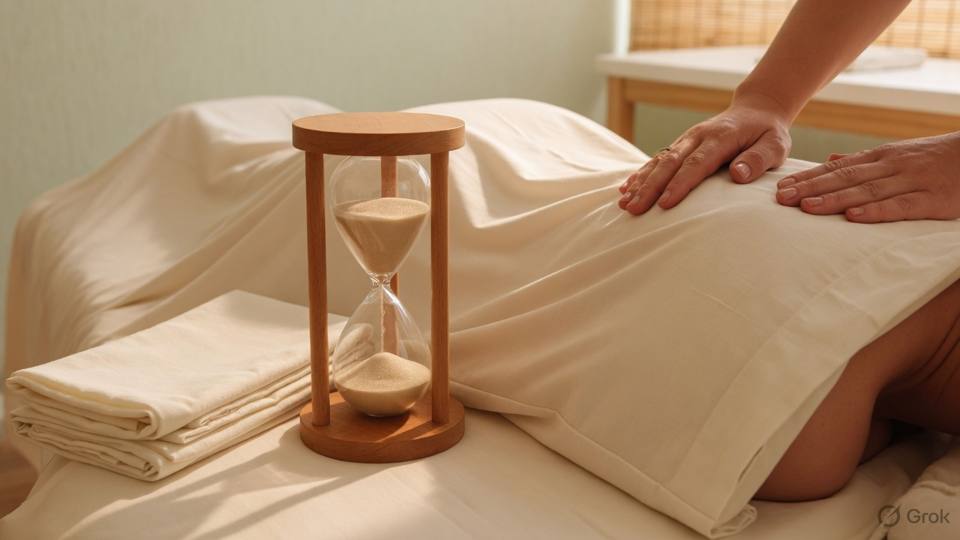
Building the sixty-minute full-body plan
A sixty-minute appointment is not sixty minutes of massage. Allow about five minutes at the start for the intake, undressing, and settling under the sheet, and five minutes at the end for dressing, water, and aftercare. That leaves roughly fifty minutes of hands-on work. Plan the clock before the client arrives, then adjust to what you find. A common full-body plan is twelve minutes on the back and shoulders, ten on the back of the legs, eight on the arms and hands, eight on the front of the legs, six on the neck and scalp, and four on the feet, with two minutes held back for the turn and for settling. Write the plan where you can see it without turning your back on the client.
The clock is a guide, not a ruler. If the shoulders are the reason the client came, give them fifteen minutes and shorten the arms. If the client is cold, add a blanket and a minute of back work rather than rushing the legs. If the client has a foot phobia or a recent ankle injury, drop the feet and give the time to the neck. Keep a clock in view, but do not stare at it. Learn what five minutes of effleurage feels like in your hands so you can pace without checking. The aim is a session that feels unhurried even when the plan changes.
Work in blocks, not in a scatter of small pieces. Finish the back before you move to the legs, and finish one leg before starting the other. A half-worked area feels worse than a skipped one, because the client is left aware of an unfinished job. When you turn the client over, that is one turn, not three; plan the front of the body so you do not need to keep repositioning. Leave the last five minutes for the neck, the scalp, and a quiet close, so the client does not leave the room in a hurry with oil on their shoulders and no idea what was done.
Protect the intake even when the clock is tight. Five minutes of questions is what keeps the session safe: it finds the recent surgery, the blood thinner, the pregnancy, the calf that has been swollen since a flight. If the client arrives late, shorten the massage and say so, but do not shorten the questions. Write the timed plan in the record, along with any change you made and why. A plan on paper is also a defence when a client asks why their feet were not worked, and it makes the next session easier to build. Keep the pad with the plan on it beside the oil, so the timings are visible at a glance rather than stored in your head.
- 1. Reserve five minutes at the start for intake and settling and five at the end for dressing and aftercare.
- 2. Confirm consent, the areas to be worked, and the pressure number before the clock starts.
- 3. Check the drape is secure and the room is warm before the first stroke.
- 4. Spend two minutes on contact and slow effleurage over the back to settle the client.
- 5. Give the back and shoulders twelve minutes, including petrissage and work beside the spine.
- 6. Give the back of the legs ten minutes, one leg at a time, re-covering each as you finish.
- 7. Give the arms and hands eight minutes, then the front of the legs eight minutes if agreed.
- 8. Give the neck and scalp six minutes and the feet four minutes, and skip any area the client declines.
- 9. Hold two minutes for the turn and for smoothing each transition with effleurage.
- 10. Close with two minutes of quiet contact, then step away and let the client sit up slowly.
Salon example
Sana arrives on time for sixty minutes and says her lower back and shoulders are both tight. The therapist confirms the plan, agrees a pressure of five, and writes the timings on the pad by the table: twelve minutes for the back and shoulders, ten for the back of the legs, eight for the arms, eight for the front of the legs, six for the neck and scalp, four for the feet, with two minutes held for the turn and the close. Sana mentions that her feet are sensitive, so the therapist cuts the foot segment to two minutes and gives the extra time to the lower back. At the halfway point the clock shows twenty-five minutes of work left. The back is finished and one leg is done. The therapist shortens the arms to five minutes and keeps the neck segment intact, because Sana mentioned headaches. The front of the legs is trimmed by three minutes, and the session still ends on time with a slow neck and scalp finish. The therapist records the changes next to the original plan.
Caution: If the appointment starts late, shorten the massage, not the intake. A rushed intake misses the information that keeps the session safe.
The thirty-minute back and shoulder plan
The thirty-minute back and shoulder session is the most requested short appointment in most salons. Use three minutes for intake and settling, about fifteen minutes on the back, eight on the shoulders and neck, and four minutes to close, which leaves roughly twenty-seven minutes of hands-on work. Begin with broad effleurage over the whole back for two minutes, then work the side that feels tighter. Spend time on the upper trapezius, around the shoulder blade, and on the muscles beside the spine, but keep the spine itself free of direct pressure. Finish with slow strokes from the neck to the lower back, then hold the shoulders for a few breaths. Ask the client to turn only if you need the front of the shoulder.
A short session works best when it has one clear focus. Ask the client to name the area that bothers them most and agree that the other areas will receive only light work or none at all. If the pain runs down the arm, ask about numbness and weakness before you begin, and refer rather than treating it as a tight muscle. Do not try to cover the whole body in thirty minutes; the result is a rushed, slippery session that helps no one and leaves the client feeling handled rather than treated. One area worked well is a better service than five areas skimmed.
Set up so that no time is lost. Have the oil, a towel, and a clock within reach before the client lies down. Warm the room, put a pillow under the knees, and adjust the face cradle so the neck is not twisted. Know your order in advance: back, then shoulder blades, then trapezius, then neck, then a short scalp finish if the client wants it. If the client arrives late, shorten the session rather than the intake, and say clearly how much time remains. If they arrive early, offer a few extra minutes on the neck rather than starting the deep work sooner.
The thirty-minute format is also a good place to teach the client something small. Show one stretch for the upper back or the front of the chest, and keep it simple enough to do at a desk. Do not build a rehabilitation programme or promise that the tightness will not return. Record what you worked, the pressure, and anything the client reported. If the same shoulder is the complaint every month and the work never holds, say so and suggest a medical or physiotherapy review rather than quietly booking another session. That conversation is part of the service, and it is often the reason the client books the short session again.
- 1. Confirm the booking length, the main area, and the pressure number before the client undresses.
- 2. Explain the drape and that only the back and shoulders will be uncovered.
- 3. Settle the client face down with a pillow under the knees and the face cradle adjusted.
- 4. Spend two minutes on broad effleurage over the whole back to warm the skin.
- 5. Ask which side feels tighter, then give that side more time rather than equal time.
- 6. Work the upper back with petrissage for five minutes, keeping the contact broad.
- 7. Work between the shoulder blades on the muscles beside the spine, never on the vertebrae.
- 8. Give the upper trapezius six minutes, one side then the other, checking the pressure.
- 9. Give the neck four minutes with the head supported, and avoid the front of the neck.
- 10. Finish with a brief scalp stroke, one minute of quiet contact, and clear aftercare advice.
Salon example
Vikram has thirty minutes between meetings and asks for his usual back and shoulder work. The therapist confirms that the upper back and neck are the priority and that the legs and feet will be skipped. Vikram says the pressure should be six, and the therapist repeats the number back. He lies face down, and the therapist spends two minutes with broad effleurage, then works the right side more deeply because Vikram carries his bag there. The therapist spends five minutes around the right shoulder blade with slow petrissage and a little friction on the top of the shoulder, checking after each pass. The left side gets lighter work. With eight minutes left, the therapist moves to the neck with the head supported and keeps the pressure at four, then returns to long effleurage over the whole back and holds both shoulders for three breaths. Vikram leaves on time and says the session did not feel shortened. The therapist records the pressure and the bag habit, and suggests he switch shoulders during the week. He also asks whether the therapist can show him a stretch for the front of the shoulder, and she demonstrates one slow movement he can do at his desk without holding it for a long count.
Caution: Do not promise a full-body massage in thirty minutes. Say clearly what you can do well in the time available, and offer the longer booking.
Adapting when the clock slips
Plans change once your hands are on the body. The client may arrive with a headache, a new bruise, or a request to avoid a leg. The room may be cold, the client may be late, or the previous appointment may have run over. Decide what to drop before you start, and tell the client what you are changing. If you lose ten minutes, cut the feet, the abdomen, and one arm first, not the area they came for. Never rush strokes to catch up; fast, light work feels anxious and leaves the client vaguely unsatisfied without knowing why. If the session must be shorter, say so at the start and offer to focus on one region well.
The next client matters as much as this one. Running over by fifteen minutes steals time from someone who booked and paid for a full session, and it pushes the whole day later. Keep a visible clock and give yourself a two-minute warning before the close. If you are behind, tell the reception desk so the waiting client can be informed rather than left guessing. Do not make the current client feel guilty for the delay, and do not hurry their aftercare to make up time. A calm, honest explanation at the desk is better than a silent wait. A client who is told the truth at the start can decide what matters to them, and most choose the area they came for.
Record the plan and the changes in the client's notes. Note the areas worked, the pressure used, any area avoided, and anything the client reported afterwards. These notes help the next therapist and protect you if a question arises later. They also reveal patterns: a client who always asks for the same shoulder may need a medical opinion rather than another hour of pressure. Keep the notes factual and brief. Write that the client reported numbness in the right hand for two minutes, rather than that the client was difficult. If something worries you, say it plainly to the client and suggest a doctor.
Some sessions should be stopped rather than shortened. If the client becomes dizzy, nauseated, or tearful, or reports a new sharp pain, stop and deal with that first. Offer water, let them sit, and do not restart the clock as though nothing happened. A session that ends ten minutes early because the client felt unwell is a professional session; one that continues because the time was booked is not. The same applies to a client who is intoxicated, feverish, or has a hot swollen calf: the plan is irrelevant once a stop rule applies. Write the time of the stop and the reason, because the record is the only account anyone will have later.
- 1. Check the clock at the start and name the finish time to the client.
- 2. If time is short, say what you are dropping before you begin rather than silently skipping.
- 3. Cut peripheral areas first: feet, abdomen, one arm, and the second leg.
- 4. Keep the intake and the consent check even when the massage is shortened.
- 5. Do not speed up strokes to cover more ground; slow work is safer and feels longer.
- 6. Keep a two-minute warning before the close so the finish is not abrupt.
- 7. Tell the desk if you are running late, so the next client is informed.
- 8. Never take time from the next booking to finish this one.
- 9. Record the areas worked, the pressure, the avoided areas, and the reason for any change.
- 10. Stop the session rather than shortening it if a stop rule applies.
Salon example
The previous appointment runs fifteen minutes over and Priya is waiting for her sixty-minute session. The therapist apologises at the door, explains that the massage will be forty-five minutes, and offers to focus on her back and shoulders or to rebook at no charge. Priya chooses to continue with the shorter session. The therapist drops the feet, the abdomen, and one arm, and keeps the back, neck, and scalp at a calm pace. She does not speed up her strokes to cover more ground, and she keeps the intake questions intact, which is how she learns that Priya has been taking a blood thinner since a procedure last month. That changes the pressure plan: the work stays broad and no deeper than five. At the end she records the shortened areas, the reason, the medication, and the pressure used on the right shoulder. Priya books a longer session for the following week and says she appreciated being told at the start rather than discovering it halfway through. The therapist also tells the desk that the next booking needs a longer gap, so the same delay does not repeat itself in the afternoon.
Caution: Do not silently steal time from the next client. A late finish creates pressure that carries into the rest of the day and the rest of the week.
This is a Nandu Nai textbook. It is a private brand book, not a government licence, and it does not give the right to give medical treatment.