
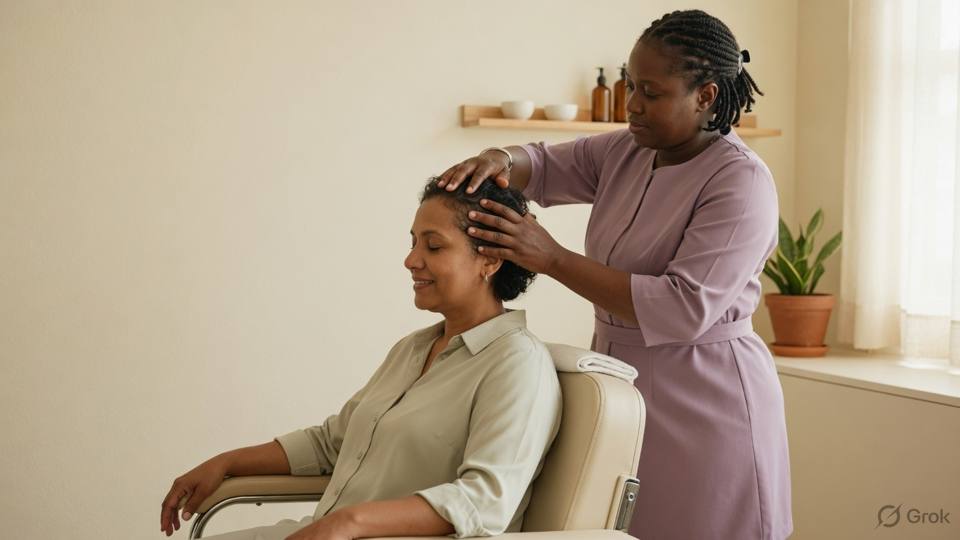
Setting up seated work
Seated head and scalp massage is done with the client fully clothed, in an ordinary chair or a massage chair, and it needs no oil unless the client asks for a scalp treatment. Ask about neck injuries, recent accidents, dizziness, headaches, and scalp conditions before you begin. Place the client so their feet rest flat and their back is supported. Stand behind or beside them, keep your own back straight, and adjust the chair height rather than bending over. Explain that you will work on the scalp, temples, forehead, and the base of the neck, and that they can stop at any time. Tie back long hair only with their permission, and use a clip rather than a band that pulls.
The room matters more than the technique in seated work. A busy salon floor is noisy, so choose a corner away from dryers and conversation, or book a quiet ten minutes. Lower the light if you can, or turn the client away from a bright mirror. Keep your voice low and your movements calm, because the client is sitting upright with their eyes open and can see everything around them. Wash your hands where the client can see you do it, and keep your nails short. If the client is wearing makeup, ask before working the forehead, and use a light touch that does not drag the skin.
Seated work has its own screening. A recent whiplash, a fall, or neck pain with numbness, weakness, or loss of coordination is a reason to stop and refer, not a reason to work more gently. Dizziness, double vision, difficulty speaking, or a sudden severe headache needs medical assessment. Ask about high blood pressure that is not controlled, recent head or neck surgery, and any scalp infection, rash, or open sore. If the client is in the middle of a migraine, postpone the head work and offer a quiet room and water instead. These questions take a minute and prevent the mistakes that end careers.
Set the session up so the client does not have to hold themselves rigid. Their feet should be flat, their hips square, and their hands resting in their lap. A small cushion behind the lower back helps. Stand with one foot slightly forward, knees soft, and shoulders relaxed; if you have to stoop, raise the chair instead. Keep a towel nearby for loose hair and for oil if you use it, and keep a clock visible. Ten to twelve minutes is a full seated routine, and fifteen is a generous one. Longer than that in a busy salon usually means the therapist is filling time rather than working.
- 1. Ask about neck injury, recent falls, dizziness, headaches, blood pressure, and scalp conditions.
- 2. Confirm consent for the scalp, temples, forehead, and neck, and agree whether oil will be used.
- 3. Seat the client with feet flat, back supported, and hands resting in the lap.
- 4. Wash your hands where the client can see, and keep nails short and smooth.
- 5. Tie back long hair only with permission, using a clip rather than a tight band.
- 6. Stand behind or beside the client with soft knees and a straight back, and raise the chair rather than stooping.
- 7. Rest your hands on the shoulders for a minute and ask the client to breathe slowly.
- 8. Keep the drape, meaning a towel across the shoulders, in place if the client is cold or prefers it.
- 9. Work the muscles beside the neck, never the front of the throat or the spine itself.
- 10. Finish with a minute of still contact, then ask the client to stand slowly.
Salon example
Aditi comes in for a scalp massage between a haircut and a meeting, still in her work clothes. The therapist seats her in a quiet corner away from the dryers, checks that the chair supports her back, and asks about neck pain, headaches, and dizziness. Aditi says she has no injury but felt light-headed once this week after skipping lunch. The therapist brings water, suggests a shorter and gentler session, and Aditi agrees. The therapist stands behind her, keeps her own back straight, and begins with a minute of still hands on the shoulders. She works the scalp in slow circles without pulling the hair, then the temples, then the base of the skull. Aditi's shoulders drop and her breathing slows. The therapist finishes with her hands resting on the shoulders and asks her to stand slowly. Aditi says the room feels quieter than when she came in, and the therapist notes the skipped lunch and the shorter session in her record. She also asks whether Aditi would like the chair turned away from the mirror, and Aditi says yes, which makes the corner feel more private.
Caution: If the client feels dizzy or faint, stop, let them sit quietly, offer water, and do not continue the session that day.
A simple seated routine
Start at the sides of the head, above the ears, and move upward with small circles. Keep the fingers slightly spread and the pressure even, as if you were washing hair without water. Work from the hairline to the crown, then from the crown to the base of the skull. Use the thumbs on the ridge at the back of the head, pressing slowly and releasing slowly. Move to the temples and use the fingertips in gentle circles, staying away from the eye. Then place both thumbs at the inner ends of the eyebrows and slide outward with light pressure. Repeat each movement three or four times, and keep the rhythm slow enough that the client can predict it.
The face is optional and should be offered, not assumed. If the client agrees, work the jaw with light circles at the hinge, then the cheeks with flat fingers, always moving outward. Avoid the front of the throat and the area over the carotid arteries. Do not press on the eyes, and do not work inside the ears. Work around the outer ear only, and ask before you touch it. Finish with the scalp again, using broad contact, and then rest both hands on the shoulders for a few breaths. Ask the client to sit still for a moment before standing, because a sudden stand after a relaxed session can make anyone unsteady.
Pressure in seated work is usually lighter than on the table. The scalp accepts a medium pressure through the pads of the fingers, the temples accept less, and the base of the skull accepts slow thumb pressure. Ask for a number on the one-to-ten scale, and expect most clients to choose three or four. If the client asks for more, add pressure slowly and check the jaw and forehead for tension. A scalp massage is not a competition, and a hard rub leaves the client with a headache rather than a sense of calm. Keep the hair moving with your fingers rather than pulling at the roots.
The routine should feel quiet rather than busy. There is no need to fill every second with movement; a few seconds of still contact at the start, between areas, and at the end does more than another technique. If the client talks, answer briefly and let the conversation fade. If they fall silent, that is a good sign. Watch for tension in the forehead, the jaw, and the shoulders, and ease off where you see it. At the end, brush loose hair from the chair and clean your hands before the next client, because a scalp routine leaves your fingers in contact with skin and hair for the whole session.
- 1. Begin with a minute of still hands on the shoulders and slow breathing.
- 2. Work the scalp from the hairline to the crown in small circles, without pulling the hair.
- 3. Move from the crown to the base of the skull, using the pads of the fingers.
- 4. Use slow thumb pressure on the ridge at the back of the head, releasing as slowly as you press.
- 5. Work the temples with light fingertip circles, staying clear of the eyes.
- 6. Stroke the forehead from the centre outward, and only with permission.
- 7. Offer jaw and cheek work separately, moving outward, and never press the throat.
- 8. Avoid the inside of the ear, the eyes, and the front of the neck.
- 9. Keep the pressure at three or four out of ten unless the client asks for more.
- 10. Finish on the shoulders, let the client sit for a moment, and clean the chair afterwards.
Salon example
Rohit books a fifteen-minute scalp add-on after his haircut. He has thick hair and a sensitive scalp, and he asks the therapist not to pull. The therapist begins at the sides of his head with flat fingers, using slow circles and no oil, and asks for a pressure number. Rohit chooses three. The therapist moves to the crown, then to the base of the skull, pausing at the ridge with both thumbs and releasing slowly. She asks whether the pressure is still right, and Rohit says it is. She offers face work, and Rohit declines, so she returns to the scalp with broad contact rather than trying to persuade him. She finishes with her hands resting on his shoulders for three breaths. Rohit says the room feels quieter than when he came in, and that the no-oil choice was right for his hair. The therapist brushes the chair, washes her hands, and notes that Rohit prefers no oil and a pressure of three. He books the same add-on for his next cut and asks for the same therapist, which the desk notes against his name.
Caution: Never press on the eyes, the front of the throat, or the carotid arteries. These are fixed limits, not areas to explore.
When to stop: acute neck injury and migraine
An acute neck injury is a reason to stop and refer, not a reason to work more gently. This includes a recent whiplash, a fall, a sports collision, or any neck pain that came on suddenly with numbness, weakness, or loss of coordination. Severe pain, dizziness, nausea, double vision, or difficulty speaking also require medical assessment. Do not massage the neck to see whether it helps. Do not move the head through its range to test it, and do not crack it. Keep the client still, offer water, and tell them plainly that they need to see a doctor or go to urgent care. Record what they reported and what you advised.
A migraine in progress is another stop sign. The client may arrive hoping that pressure will relieve the pain, but the nervous system is already overloaded. Throbbing pain, nausea, and sensitivity to light or sound mean the session should be postponed or kept extremely light and brief, away from the head and neck. A quiet room, water, and a chance to rest are more useful than massage. A headache with fever and a stiff neck, or a sudden severe headache unlike any before, needs emergency care. Do not treat these as ordinary tension headaches, and do not offer a scalp routine as a substitute for medical help.
Scalp and skin conditions also decide the plan. Ringworm, impetigo, lice, open sores, or a rash on the scalp are reasons to avoid the area and, in contagious cases, to postpone the session and clean the chair and tools. Dandruff is not contagious and does not stop a massage, but do not apply oil to a scalp that is inflamed or broken. If the client has had recent head or neck surgery, ask for the surgeon's clearance before any work near the site. A healing scar is not a place to test pressure. When in doubt, postpone and refer, and write down what you saw.
The therapist's own limits matter too. If you are not trained in a technique that a client requests, say so and offer what you can do. If a client asks you to work on a problem that needs a diagnosis, refuse and refer. If a client becomes upset, angry, or asks for something outside the service, end the session politely and involve the salon manager. Seated work happens in public view, which makes some conversations easier and others harder; keep your language clinical, keep your hands where they can be seen, and do not continue a session that has stopped feeling professional.
- 1. Ask directly about recent falls, whiplash, and sports collisions before any neck work.
- 2. Stop if there is numbness, weakness, loss of coordination, double vision, or difficulty speaking.
- 3. Do not test neck range of motion after an acute injury, and do not crack the neck.
- 4. Postpone head work during a migraine, and offer a quiet room and water instead.
- 5. Treat a headache with fever and a stiff neck, or a sudden severe headache, as an emergency.
- 6. Avoid the scalp if there is a rash, an open sore, or a contagious skin condition.
- 7. Ask for surgical clearance before working near a recent head or neck operation.
- 8. Refuse work that needs a diagnosis, in one short sentence, and refer.
- 9. Record what you observed, what you advised, and who you referred the client to.
- 10. End the session if a client asks for anything outside a professional massage service.
Salon example
Leena arrives for a head massage and mentions that she slipped on a wet floor two days ago and her neck has been stiff since. She has no numbness, but turning her head hurts and she feels a little sick when she looks up. The therapist does not begin the scalp routine and does not test her neck. She asks a few questions, notes that the pain started after the fall, and explains that massage is not appropriate until Leena has been assessed. Leena is disappointed and asks for a light shoulder rub instead. The therapist declines to work near the injured neck but offers a hand and forearm massage while Leena sits comfortably, with her neck still. She advises a medical check the same day and gives her the clinic address the salon uses. Leena messages that evening to say the doctor found a strain and asked her to rest for a week. The therapist records the advice and the referral, and rebooks her for a scalp session a fortnight later with a note that the neck is cleared.
Caution: A headache with fever and a stiff neck, or a sudden severe headache unlike any before, is an emergency. Call for medical help.
This is a Nandu Nai textbook. It is a private brand book, not a government licence, and it does not give the right to give medical treatment.