
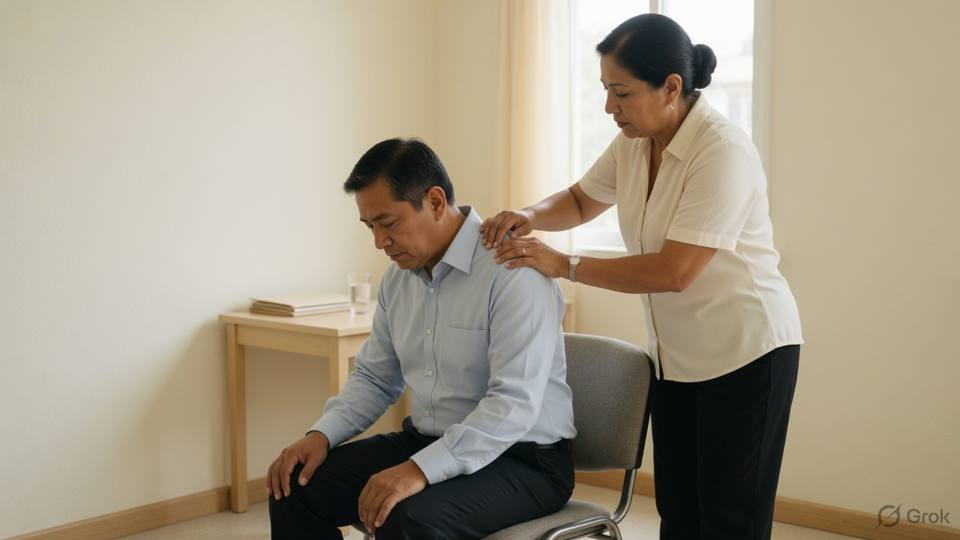
Reading the desk-worker pattern
A desk worker often arrives with a predictable set of complaints: a heavy upper back, tight shoulders, a stiff neck, and a lower back that aches by the end of the day. Long sitting tends to shorten the front of the body and load the back. The head drifts forward, the shoulders round, and the upper trapezius and levator scapulae work hard to hold the head up. The chest muscles shorten, and the lower back takes the strain of a chair that does not fit. None of this is a diagnosis. It is a pattern to observe, describe, and work with, and the client has probably heard a different explanation from three other people already.
Ask about the working day before you touch the body. How many hours are spent sitting, how the screen is placed, whether the phone is held on one side, and whether a bag is carried on the same shoulder every day. Ask about the commute, because a long drive or a train journey with a laptop bag adds its own load. Watch the client stand and sit, and notice which shoulder sits higher or which side of the neck looks guarded. Ask them to show you where the discomfort starts and where it travels. Keep your questions inside your scope: you are gathering information for a massage plan, not testing for a medical condition.
Compare the two sides before you decide where to spend the time. One shoulder is often higher, one forearm thicker, one side of the neck warmer to the touch. A difference in heat, colour, or swelling is a finding that changes the plan, because heat and swelling are not muscle tension. Look at the skin for a rash, a bruise, or a recent scar, and ask about any area that is tender to a light touch. If the client winces when you rest a hand on the shoulder, that is information. Do not press harder to find out how much it hurts.
The pattern also tells you what to teach. A screen that sits too low, a phone tucked between ear and shoulder, a wallet in a back pocket, a bag on one side, and no movement for three hours are all habits that recreate the tension you have just released. Mention one or two of them at the end, in plain language, without turning the session into a lecture. The client came for relief, not a posture audit. A single change that they actually make is worth more than a list of ten that they forget by Monday. Keep the advice to what the client can change this week, and let them choose which one to try first.
- 1. Ask about sitting hours, screen height, phone habits, bag side, and commute before you begin.
- 2. Confirm consent for the back, shoulders, neck, and arms, and explain the drape.
- 3. Watch the client stand and sit, and note shoulder height and head position without labelling it a diagnosis.
- 4. Compare both sides for heat, colour, swelling, and guarding before you touch.
- 5. Ask the client to point to where the discomfort starts and where it travels.
- 6. Ask about numbness, tingling, or weakness in the arms, and refer if any are present.
- 7. Check the skin for rashes, bruises, and recent scars, and avoid anything hot or broken.
- 8. Agree a pressure number for the upper back and a lower one for the neck.
- 9. Plan more time on the tighter side, but do not ignore the other side entirely.
- 10. Choose one or two habits to mention at the end, not a full posture lecture.
Salon example
Deepak books a massage for a burning ache between his shoulder blades. He works at a laptop on a dining table for eight hours a day and holds his phone with his left hand during calls. The therapist asks him to stand and sit, and notices that his head sits forward and his left shoulder is slightly higher. Deepak says the ache worsens after lunch and sometimes reaches his left arm. The therapist asks directly whether he has numbness, tingling, or weakness in the arm, and Deepak says no. That answer keeps the session inside the salon's scope. The therapist plans broad back work, careful shoulder work on both sides, and a short chest stretch, and explains that the left side will get more time. She also asks about his chair and screen, and suggests a stand for the laptop and switching the phone to the other ear on alternate calls. Deepak says no one has asked about the phone before. The therapist records the pattern, the negative nerve signs, and the advice, and notes that the ache reaching the arm should be reviewed if it changes.
Caution: Pain that travels down an arm with numbness, tingling, or weakness is not a routine desk-worker ache. Refer it for assessment.
Working the shoulders and the space around the blade
Warm the whole back before you focus on the shoulders. Use broad effleurage from the waist to the neck, then work the upper trapezius with slow petrissage, keeping the pressure wide rather than pinching. The levator scapulae runs from the top of the shoulder blade to the side of the neck, and it often feels thick and tender. Work it with the flat of the hand or the thumb pad, moving along the muscle rather than jabbing into the corner of the blade. Around the shoulder blade, work the rhomboids with small circles and kneading, and keep the blade itself free of hard pressure. The space between the blade and the spine is small, so use the pads of the fingers and go slowly.
The front of the shoulder and the chest are part of the same pattern, but they need explicit consent and careful draping. Work the upper chest below the collarbone with flat fingers, staying away from the breast tissue and the armpit, and keep the drape over the chest throughout. Never press deeply into the armpit, where nerves and blood vessels sit close to the surface. If the client is ticklish or uncomfortable, skip the area without making it a problem. A tight chest pulls the shoulders forward, so a little light work there can change how the shoulder moves, but it is optional and it is always agreed first.
The arms are often the missing part of a desk-worker session. Forearm work addresses the muscles that type, hold a phone, and grip a mouse, and it is easy to include in the last ten minutes. Work the forearm with effleurage and petrissage, keep away from the inner elbow, and finish with gentle wrist movement only if the client agrees. If the client reports numbness in the hand, stop and refer rather than working harder. The hand itself can be worked with slow thumb circles over the palm and gentle pressure between the bones, but do not pull or crack the fingers.
Finish the shoulder work with slow effleurage and a few seconds of gentle holding. The goal is a shoulder that moves more easily, not a shoulder that has been punished into submission. Ask the client to lift and lower the arm, turn the head, and roll the shoulder, and compare with how it felt at the start. Record what changed and what did not. If the shoulder is no better after several sessions, or if it is losing range, say so and suggest a physiotherapy or medical review rather than quietly booking another month of the same work. That comparison takes thirty seconds and tells both of you whether the session did anything useful.
- 1. Warm the whole back with effleurage before focusing on either shoulder.
- 2. Work the upper trapezius with broad petrissage, never pinching the skin.
- 3. Follow the levator scapulae along its length rather than jabbing into the blade corner.
- 4. Work the rhomboids with small circles, keeping the shoulder blade itself free of hard pressure.
- 5. Keep at least two fingers of contact away from the spine at all times.
- 6. Ask separately before working the chest, and keep the drape over the breast throughout.
- 7. Never press into the armpit, the inner elbow, or the front of the neck.
- 8. Include the forearms for five minutes if the client agrees, and stop for numbness.
- 9. Finish with slow effleurage, a few seconds of holding, and a simple movement check.
- 10. Record changes in range and comfort, and refer if the shoulder is not improving.
Salon example
Nisha comes in with tight shoulders and says she cannot turn her head fully to the right when driving. The therapist warms her back with effleurage for three minutes, then spends time on the right upper trapezius using broad petrissage. Nisha says the pressure is good at six. The therapist moves to the levator scapulae, using the thumb pad along the muscle rather than pressing into the top corner of the blade, and checks the number after each pass. The tissue softens a little. The therapist asks whether Nisha would like work on the front of the shoulder and the chest, explains the draping and the reason, and receives a clear yes. She works below the collarbone with flat fingers, avoiding the breast and the armpit, and keeps the sheet over the chest. Nisha turns her head further to the right afterwards and says the pull has eased. The therapist records the change, the areas worked, and the pressure, and suggests Nisha move her car mirror slightly so she does not twist to reverse. She also asks Nisha to check her driving position, because a seat pushed too far back makes every shoulder check a twist. Nisha says she will try moving the seat forward an inch on the drive home.
Caution: Never press deeply into the armpit or breast tissue. Chest work requires separate consent, a clear explanation, and secure draping.
Do not grind the spine
The spine is a column of bones, discs, nerves, and joints, and it is not a surface to be ground with a thumb or an elbow. Direct pressure on the spinous processes can be painful and does nothing useful for the muscles beside them. Fast friction across the spine can irritate the tissue and give the client a jolting sensation that stays with them for hours. High-velocity manipulation, the kind that produces a pop, is outside the scope of a massage session unless you hold a separate qualification and the client has been assessed. A massage therapist works the muscles that run alongside the spine, not the vertebrae themselves, and says so when asked.
Work parallel to the spine with broad thumbs, fingers, or the flat of the hand. Keep the pressure even and move slowly from the lower back to the neck. Use both hands on either side of the column so the client feels supported rather than prodded. If the client asks you to press directly on a painful vertebra, explain why you will work around it instead, and show them where your hands will be. If they insist, you can rest a flat palm over the area without pressure, but you do not grind it. The muscles beside the spine usually respond to slow, broad work, and they are the reason the area feels tight in the first place.
Be especially careful with older clients, anyone with osteoporosis, and anyone who has used steroids for a long time, because bone strength may be reduced. The same caution applies to clients with a known fracture, a recent fall, or cancer that has spread to bone. Avoid tapotement and strong pressure in these groups, and ask for medical clearance where the craft reference requires it. A rib that cracks under a hand is a serious event, and it happens most often to thin, older clients who asked for firm pressure and were given more than they needed. Broad, slow pressure on the muscle beside the bone is almost always the better answer, and it is the one you can defend if anyone asks what you did.
Some back pain is not a massage problem at all. Unexplained pain that is worse at night, pain with fever, weight loss, a recent fall, or changes in bladder or bowel control needs medical assessment, and quickly. So does pain that comes with numbness around the groin or weakness in both legs. Do not treat these as tight muscles and do not offer a deeper session. Say what you have noticed, keep the session gentle or stop it, and send the client to a doctor. Writing the finding down protects the client and gives the next clinician a clear starting point.
- 1. Confirm consent for back work, and agree a pressure number before you begin.
- 2. Keep the drape at the waist and expose only the strip of back being worked.
- 3. Locate the spine with a flat hand before you apply any pressure.
- 4. Work parallel to the column with broad thumbs, fingers, or the palm.
- 5. Never press, roll, or grind on the spinous processes themselves.
- 6. Avoid fast friction across the spine and any high-velocity manipulation.
- 7. Reduce pressure near the ribs, the kidneys, and the neck, and skip tapotement there.
- 8. Use extra caution with older clients, osteoporosis, long-term steroid use, and known fractures.
- 9. Stop and refer for night pain, fever, weight loss, a recent fall, or bladder changes.
- 10. Record what you found, where you worked, and what you advised.
Salon example
Arjun points to a spot in the middle of his back and asks the therapist to press hard on the bone because it feels stuck. The therapist explains that the spot is a vertebra and that pressing on it is unlikely to help. Instead, she works the muscles on both sides with slow, broad thumb pressure, starting well below the point and moving upward, with one hand always supporting the other side of the column. Arjun says the area feels warm and less guarded. The therapist asks about the history of the pain. Arjun says it has been present for three weeks and wakes him at night. She stops the deeper work, keeps the rest of the session gentle, and asks whether he has had fever, weight loss, or any change in bladder habits. He says no to all three, but the night pain alone is enough. She advises a medical review within the week, writes the finding and the advice in his record, and offers a short, light session on the shoulders instead of more back work. He also asks whether the therapist can work on the spot again next week, and she says she will work the muscles around it, not the bone, and that the night pain needs the doctor's answer first.
Caution: Night pain, fever, weight loss, or loss of bladder control with back pain needs urgent medical assessment, not deeper pressure.
This is a Nandu Nai textbook. It is a private brand book, not a government licence, and it does not give the right to give medical treatment.