
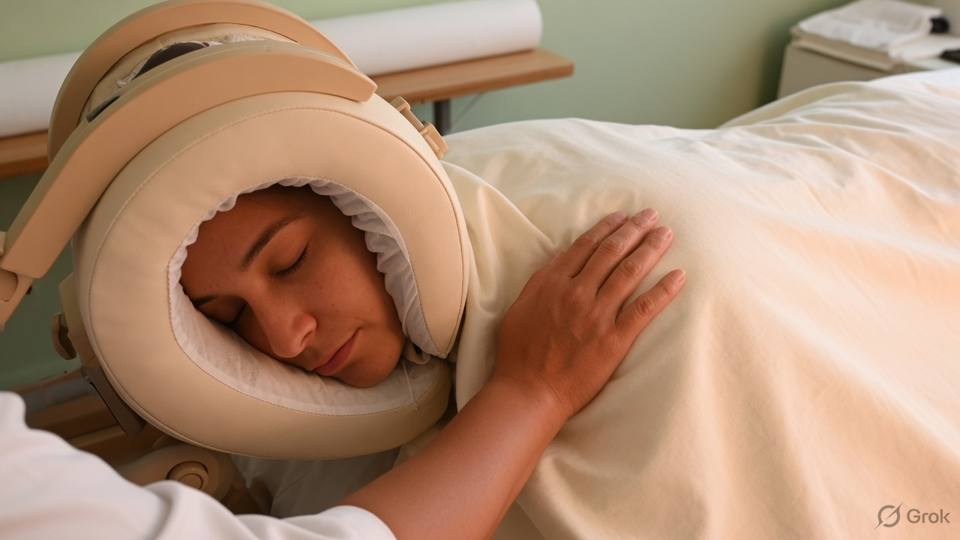
Breath-holding means too much
The breath is the most honest pressure gauge a therapist has. A client may say the pressure is fine while holding their breath, clenching the jaw, or gripping the table. When pressure exceeds what the body can accept, the nervous system protects itself: breathing becomes shallow, muscles brace, and the client may stop talking mid-sentence. That is not a sign of deep work. It is a sign that the body is defending against the work. Reduce the pressure until the breath returns to a slow, steady rhythm, then ask what changed, and believe the answer even if it contradicts what the client said a minute earlier.
Explain this before you begin, so the client knows what you will be watching. Say that you will ask for a number and that you will also watch their breathing, and that they should tell you at once if anything feels sharp. During the session, keep one hand in contact while you check in. Ask open questions such as how does this feel, rather than is this okay, because most people say yes to the second question out of politeness. If the client holds their breath for more than a few seconds, lighten the pressure and wait for the exhale before you speak again.
Breathing is also a tool the client can use. Ask them to breathe out slowly as you sink into a tight area, and to let the muscle soften rather than push back against your hand. Some clients hold their breath from the moment you touch a tender spot, before you have applied any real pressure. In that case, the fear is doing the bracing. Rest a warm hand on the area, ask them to breathe normally, and wait until the shoulders drop before you add anything. This pause costs ten seconds and changes the whole session. The pause is not an interruption of the treatment; it is the treatment.
Watch the rest of the body as well. Curled toes, a lifted shoulder, a hand gripping the table edge, and a jaw that shifts sideways are all pressure signals. So is a sudden silence in a client who has been talking. If you see two or more of these signs together, reduce the pressure without waiting to be asked. A therapist who notices and eases off builds trust faster than one who keeps asking whether everything is fine. The client should leave feeling that their body was listened to, not that they endured a treatment. A client who is watching their own breath is also less likely to drift into holding it without noticing.
- 1. Explain before the session that you will watch the breath as well as ask for a number.
- 2. Agree the pressure number and stay below it for the first minute of any new area.
- 3. Keep one hand in contact whenever you check in.
- 4. Ask open questions about how it feels rather than yes-or-no questions.
- 5. Ease off at once if the breath becomes shallow, the jaw tightens, or the hands grip.
- 6. Ask the client to breathe out slowly as you settle into a tight area.
- 7. Wait for the shoulders to drop before adding pressure to a guarded area.
- 8. Treat a sudden silence, curled toes, or a lifted shoulder as a pressure signal.
- 9. Reduce pressure without waiting to be asked when you see two or more signals together.
- 10. Record the pressure the client accepted in each area, not just the number they requested.
Salon example
Kabir asks for strong pressure on his lower back and says he can take it. The therapist starts at five, and Kabir asks for more. At eight his breathing becomes shallow and his fists close around the edge of the table. The therapist notices, keeps one hand on his back, and asks how the pressure feels. Kabir says it is fine, but he speaks in a tight voice and does not finish the sentence. The therapist reduces to five and asks him to take a slow breath. Kabir exhales and his hands open. He admits that he was holding his breath to get through it, because he thought that was what a deep massage required. The therapist explains that breath-holding means the pressure is too much, not that the work is good, and stays at five for the rest of the back. She asks him to breathe out as she works the tightest band, and the tissue softens more at five than it had at eight. Kabir says afterwards that the lighter session did more than the strong one he had last month.
Caution: A client who is holding their breath is not receiving effective deep work. Reduce the pressure before continuing, even if they asked for more.
Bruises are not a goal
Mild soreness for a day after a massage can happen, especially after work on tight shoulders. A bruise is different. It means that pressure has damaged small blood vessels under the skin, and it is not evidence that the massage was effective. Bruising is more likely in older clients, people who take blood thinners or steroids, people with easy bruising, and anyone who has had recent surgery or injury. It is also more likely when pressure is applied quickly, with a small contact point, or over an area that has not been warmed. The presence of a bruise tells you that the technique was wrong for that body, not that the muscle was stubborn.
If a client bruises, acknowledge it, ask how they feel, and record it. Advise them to avoid strong pressure on the area until it settles, and tell them that a bruise usually fades over one to two weeks. Do not tell them that the bruise is releasing toxins or that it shows the treatment worked. Do not promise a specific recovery time, and do not offer to work on the bruise to break it up. In the next session, reduce the pressure and use broader contact. If bruising happens often or without strong pressure, suggest a medical check, because it can be a sign of a bleeding disorder or a medication effect.
Some clients ask for a bruise. They believe that a massage which leaves marks has done something, and they may push for more pressure when the therapist eases off. Say clearly that the salon does not work to that standard. Explain that soreness is not the same as injury, and that the aim is comfortable movement, not marks on the skin. If the client keeps insisting, offer a different therapist or refuse the booking rather than delivering pressure you know is harmful. A client who wants to be hurt is not a client you can treat safely within a relaxation service.
Bruising is also a clue about medication and health. A client who bruises from a light massage may be taking a blood thinner, steroids, or another medicine that affects clotting, and may not have mentioned it. Ask again, record the answer, and keep the work light. Do not advise them to stop or change any medicine. If they cannot explain the bruising, or if it appears without pressure, send them to a doctor. The therapist's job is to notice, adapt, and refer, not to diagnose a bleeding problem or manage a prescription. Say it once, calmly, and let the booking stand or fall on it.
- 1. Ask about blood thinners, steroids, easy bruising, and recent surgery before you plan the pressure.
- 2. Warm each area with effleurage before any deeper work, and keep the contact broad.
- 3. Never use quick, sharp pressure with a small contact point on a client who bruises easily.
- 4. Check the skin at the end of each area for new marks, and note where they appeared.
- 5. Acknowledge any bruise, ask how it feels, and record its size and position.
- 6. Advise the client to avoid strong pressure on the area until it settles.
- 7. Do not describe a bruise as released toxins or as proof of good work.
- 8. Reduce pressure and broaden contact in the next session, and say why.
- 9. Suggest a medical check if bruising happens often or without strong pressure.
- 10. Refuse to work to a standard that requires leaving marks, and say so plainly.
Salon example
Sunita returns for a follow-up and shows the therapist a purple mark on her upper arm. She says it appeared after her last massage and she assumed it meant the muscle had been released. The therapist looks at the mark, asks whether it is tender, and records its size and position. She explains that the mark is a bruise caused by pressure on small blood vessels, not a sign of release. Sunita mentions that she has been taking a blood thinner since a recent procedure and did not think to mention it at the first visit. The therapist notes the medicine, avoids strong pressure on the arm, and uses broad palm work for the rest of the session. She explains that the next few sessions will stay light and that the bruise should fade on its own. She suggests Sunita mention the easy bruising to her doctor at the next appointment, and Sunita agrees. The therapist also adds a medication question to the intake form, because the omission was the form's fault as much as the client's. The form now asks for medicines by name, which is how the omission should have been caught in the first place. Sunita books again, and the therapist plans a lighter session with a note on the file.
Caution: Do not describe bruises as released toxins or as proof of good work. That claim is false and encourages pressure that injures tissue.
Checking in and adjusting
Checking in is a skill that improves with practice. Ask at the start of each new area, after the first minute of deeper work, and whenever the client's body changes. Use a short, clear script: I am going to work on the upper back now, tell me if the pressure is too much or if you want more. When the client answers, repeat the number back so they know you heard. If they ask for more, increase gradually and check again. If they ask for less, reduce immediately and do not ask twice whether they are sure. A check-in that ends in an argument is not a check-in.
Adjust more than pressure. Speed, direction, contact area, and oil all change the feel of a stroke. A fast stroke with a small contact point feels sharp; the same force spread over a forearm feels broad and calming. If your hands or wrists are tired, use your forearm or change your stance instead of pushing harder through the hands. Keep your shoulders relaxed and your knees soft, and move from your legs rather than your lower back. A therapist who is braced transmits tension down the arm and into the client, and the client often reports it as pressure that feels heavy rather than useful.
Silence needs interpreting. Some clients go quiet because they are deeply relaxed, and others go quiet because they are enduring something. The difference is in the body: relaxed silence comes with slow breathing, soft hands, and a loose jaw, while enduring silence comes with held breath, tight hands, and a lifted shoulder. If you cannot tell which you are seeing, ask a short question and listen to the tone of the answer. Do not assume that quiet means happy, and do not fill every pause with talk. A single well-placed question is better than a stream of chatter. Ask about the area, not about the person, and keep the question short enough that it does not break the rhythm.
At the end, ask how the client feels and whether anything should be different next time. Ask about the pressure, the areas, the room temperature, and the oil, because those are the things you can change. Write the answers where the next therapist will find them. If the client says the pressure was too much in one area, note the area and the number that worked. If they say they wanted more time on the neck, note that too. The next session should begin with that information already in hand, rather than repeating the same discovery from scratch. Write the answer in the client's words where you can, because their description is more useful than your summary of it.
- 1. Check in at the start of each new area, after the first minute of deeper work, and after any position change.
- 2. Use a short script that names the area and invites a number.
- 3. Repeat the client's number back so they know you heard it.
- 4. Act on the answer at once, and do not negotiate a request for less.
- 5. Change speed, contact area, or stance before adding force.
- 6. Distinguish relaxed silence from enduring silence by watching the breath and hands.
- 7. Ask one short question if you cannot tell which silence you are seeing.
- 8. Keep your own shoulders relaxed and your knees soft, and move from your legs.
- 9. At the end, ask what should be different next time.
- 10. Record the answers so the next session starts with them.
Salon example
A therapist is working on a client's calves and feels her own thumbs tiring. Rather than pressing harder, she changes to a broad forearm stroke and slows down. The client, a runner named Mohan, says the new stroke feels deeper and more comfortable. The therapist checks in after a minute, and Mohan asks for a little more pressure near the top of the calf. She increases gradually, asks again, and Mohan says the pressure is right. Later he goes quiet. The therapist watches his breathing, sees it stay slow and his hands stay open, and decides the silence is relaxation rather than endurance, so she does not interrupt it. At the end of the session she asks what should be different next time. Mohan says he would like more time on the calves and less on the feet, and that the room was a little cold. The therapist records the preference and the temperature, adjusts the next plan, and starts the following session with the calves. She also leaves a note for the desk that Mohan prefers a warmer room, and the next booking is placed in the smaller room with the heater. Mohan notices the difference before the massage begins and says so.
Caution: Do not keep pushing because the client asked for more once. Pressure has to be rechecked as the body responds.
This is a Nandu Nai textbook. It is a private brand book, not a government licence, and it does not give the right to give medical treatment.