
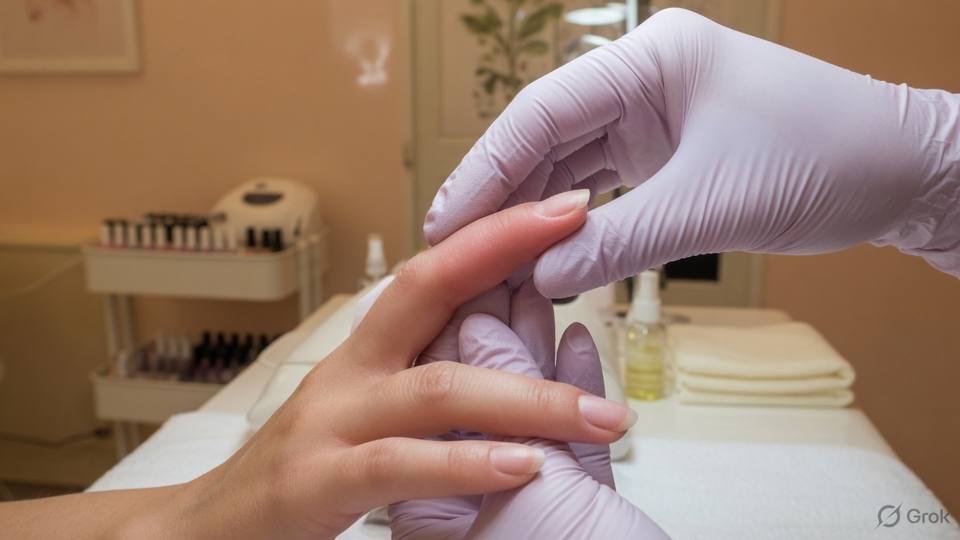
Green stain under a lift
A green or blue-green stain under a lifted product is one of the clearest stop signs in the salon. The colour sits between the product and the plate, usually near a side wall or the cuticle, and it does not scrub off because it is not on the surface. It comes from bacteria that grow in the damp pocket created by the lift. The pocket is warm, protected, and wet, which is exactly what those bacteria need. The stain is not dirt and it is not a stain from polish. Covering it with a new set keeps the pocket damp and gives the bacteria more time.
The first step is to get the product off. File it thin, soak the remaining layer with the correct remover, and lift it only when it is soft. Do not pry, and do not drill into the gap to clean it. Once the product is gone, clean the plate with a soft brush and the appropriate cleanser, dry it, and look at the colour and the surface. A small stain on a firm plate with no pain and no spreading redness may settle once it is exposed to air and kept dry. A stain that is spreading, accompanied by pain, swelling, or a crumbly plate, needs a doctor. Either way, the nail stays bare today.
The client will often ask for a cover because of a wedding, a holiday, or a photograph. The answer is no, and the reason should be physical rather than moral. Say that the colour is coming from bacteria in a damp pocket under the product, that a new set would seal the pocket again, and that the nail needs air and time. Offer alternatives: do the other nine nails, shorten the set, choose a plain polish on the healthy nails, or book the affected nail for a later date. Do not offer a clear gel over the stain as a compromise. Clear product still seals, and the stain will still be there underneath.
Record what you saw, what you removed, and what you advised. Note whether the client accepted the referral or asked for a cover, and note the review date. If the client goes to another salon and returns with a covered stain, do not remove the new product in anger; explain again, offer a removal, and refer if the area looks worse. The salon's job is to be consistent, not to win the argument. A client who hears the same clear explanation from two appointments is more likely to follow it than one who is scolded once and then sold a cover.
- 1. Inspect under and around every lifted edge before starting a fill.
- 2. Remove the lifted product by filing thin and soaking, never by prying.
- 3. Clean the plate gently, dry it, and look at the colour and surface.
- 4. Do not cover a green stain with gel, acrylic, polish, or a clear coat.
- 5. Refer if the stain is spreading, painful, or the plate is crumbly.
- 6. Offer the other nine nails, a shorter set, or a later date.
- 7. Record the observation, the removal, and the advice given.
- 8. Review in a week or two, and check the plate before any new set.
Salon example
A client named Naina arrives with a set of gel extensions and a green patch under the middle fingernail. She is getting married in five days and asks the technician to fill the set and cover the patch with a dark colour. The technician removes the product on that nail, soaks the last layer, and cleans the plate. The stain is small, the plate is firm, and there is no swelling or pain. She explains that the green is from bacteria in the damp pocket under the lift, that covering it would seal the moisture back in, and that she will not do it. She offers to do the other nine nails, shorten the extension on the affected finger, and book a review two days before the wedding. Naina is upset and says another salon will cover it. The technician says that may be true, but that she cannot, and explains what to do if the finger becomes sore. Naina agrees to the nine nails and the review. At the review the stain has faded, the plate is dry, and the nail is left bare under a short, clear strengthener that does not seal the edge. The wedding photographs show nine long nails and one short one, and Naina later says nobody noticed.
Caution: Never cover a green stain with product, however small it looks.
Thick yellow crumbly nail
A nail that is thick, yellow or brown, crumbly at the edge, and separated from the bed is not a candidate for polish or an enhancement. The surface is uneven, the plate is not stable, and there is often debris packed under the free edge. Product needs a sound surface to bond to, and a crumbly plate cannot provide one. More importantly, a cover hides the change. If the nail is being treated by a doctor, the treatment needs to be visible and the nail needs to be assessed as it responds. If it is not being treated, a cover delays the appointment that would start the process. Either way, the salon's job is to refer, not to disguise.
The temptation is understandable. The client may be embarrassed, and a coat of polish would make the nail look normal for a few weeks. But a thick nail does not hold polish well, and the polish will lift from the uneven surface, taking a layer of crumbling plate with it. An enhancement is worse: the product traps moisture against a plate that is already compromised, and the edge lifts quickly. In a worst case, the cover hides a spreading problem until it is much harder to treat. The short-term cosmetic gain is not worth the risk, and the client is paying for a result that will not last.
What can the salon do? It can tidy carefully if the skin is intact and there is no pain: shorten the free edge with a file, clean gently under the edge without digging, push the cuticle, and oil the surrounding skin. It can explain what to expect from a medical assessment, without naming a diagnosis or a treatment. It can offer a plain polish on the healthy nails so the client does not feel unfinished, and it can suggest a colour that is close to the natural nail if they want the affected one to look less obvious without a sealing cover. Some shops use a temporary stain or a buffing cream on the surface, but only if the plate is firm and the client understands it is cosmetic.
Referral language should be plain and non-alarming. Say that the nail has changed in a way that needs a doctor to look at it, that the salon cannot diagnose it, and that a cover would hide the change. Give a realistic timeframe: toenails grow slowly, and a nail that has changed may take months to improve even with treatment. Do not promise a cure, do not recommend a home remedy, and do not suggest stopping a treatment the client is already on. Write the advice on the card and offer a review. If the client returns with a doctor's note or a treatment plan, follow it in the salon only to the extent it concerns cosmetic work, and keep the nail bare until the plate is sound.
- 1. Look at the whole nail: thickness, colour, surface, and separation.
- 2. Check the skin for pain, redness, swelling, or an open area.
- 3. Do not apply polish, gel, or acrylic to a thick, crumbly nail.
- 4. Tidy only if the skin is intact: shorten, clean gently, push, oil.
- 5. Refer the client to a doctor, and do not name a condition.
- 6. Explain that a cover would hide the change and trap moisture.
- 7. Give a realistic timeline, and do not promise a cure.
- 8. Record the advice, and review only when the plate is sound.
Salon example
A client named Bina comes in for a pedicure and asks for a bright red polish on all ten toes. The technician removes her socks and sees that both big toenails are thick, yellow-brown, and crumbling at the corners, with debris under the free edge. The skin around them is intact and there is no pain. She explains that she can tidy the nails and polish the other eight, but that she will not cover the two big ones. Bina is embarrassed and says she has had them like this for years and that polish makes them look better. The technician says she understands, but that a cover would trap moisture and hide any change, and that a doctor should look at the nails. She shortens the nails carefully with a file, cleans under the edge without digging, pushes the cuticle, and oils the skin. She polishes the other eight toes and leaves the two big ones bare with a light buff. She writes the advice on the card and offers a review in six weeks. Bina comes back with a treatment plan from her doctor and asks the technician to keep the nails bare until the course is finished.
Caution: A thick, crumbly, yellow nail is a referral, not a polish job.
Pus and a new dark streak
Pus around a nail is a medical sign, not a cosmetic one. It may come with redness, swelling, heat, and throbbing, and it means the tissue is inflamed and possibly infected. The salon does not squeeze it, does not drain it, does not apply a hot compress and call it a treatment, and does not cover it with product. A pointed tool or a squeeze can push bacteria deeper into the finger, and a cover can seal the area and make it worse. Clean the surface gently if the client asks, keep the area dry, and send them to a doctor, the same day if the redness is spreading or the client has diabetes or a weakened immune system.
A new dark streak under the nail is a different kind of warning. A streak that runs from the cuticle toward the tip, especially one that is widening, has appeared recently, or is darker at the base, needs a doctor's check. It can be harmless, and it can be something serious; the salon cannot tell the difference, and it should not try. The rule is simple: a new dark streak is not covered, not buffed, and not explained away. If the client says it has been there for years and has not changed, it still deserves a check if it is new to you or if anything about it has changed. Do not decide that it is harmless because the client is not worried.
The conversation needs to be direct and calm. Say what you see, say that a doctor should look at it, and say that you will not cover it because a cover would hide any change. Give the client a sentence they can use at the clinic: I have a new dark line under my nail that seems to be getting wider. Do not use the word cancer, and do not say it is nothing. Do not hand them a printout from the internet. Offer to do the other nails, and leave the affected one bare. If the client insists on a cover for an event, refuse and offer a short, plain finish on the other nails. The refusal is the service.
Record both kinds of finding carefully. For pus, note the redness, the swelling, the pain, and whether the client has diabetes or another condition you know about. For a dark streak, note where it starts, how wide it is, how long it has been there, and whether it has changed. Write the advice and the client's response. If the client refuses the referral, write that down and still do not cover the nail. The note is not a diagnosis and it is not a legal document; it is a record that the salon saw something, said something, and did not hide it.
- 1. Look at the skin folds for redness, swelling, heat, and pus.
- 2. Do not squeeze, drain, pierce, or cover an area with pus.
- 3. Keep the area clean and dry, and refer the same day if it is spreading.
- 4. Look at every nail for a new dark streak, and compare both hands.
- 5. Do not buff, cover, or explain away a new or widening dark streak.
- 6. Give the client a plain sentence to use at the clinic.
- 7. Record the finding, the advice, and the client's response.
- 8. Refuse a cover for an event, and offer the other nails instead.
Salon example
A client named Arjun comes for a manicure with a painful index finger. The skin at the side of the nail is red, swollen, and shiny, and there is a small amount of pus at the edge. He asks the technician to squeeze it out and cover it with gel so he can work. The technician does not touch the pus. She explains that squeezing could push the infection deeper, that covering it would seal the area, and that he needs a doctor today. She cleans the surface gently with soap and water, dries it, and puts a loose dressing on it so it does not rub. She does the other nine nails, leaves the index bare, and writes the observation and the advice on the card. Arjun is annoyed because he has a client meeting, but he goes to a clinic that afternoon and is given treatment. He returns a week later with the swelling down. At that visit, the technician notices a new dark streak on the same hand, on a different nail, and refers that too. Arjun laughs and says the salon is more careful than his doctor, but he books the follow-up.
Caution: Pus is a medical problem; the salon does not drain or cover it.
This is a Nandu Nai textbook. It is a private brand book, not a government licence, and it does not give the right to give medical treatment.