
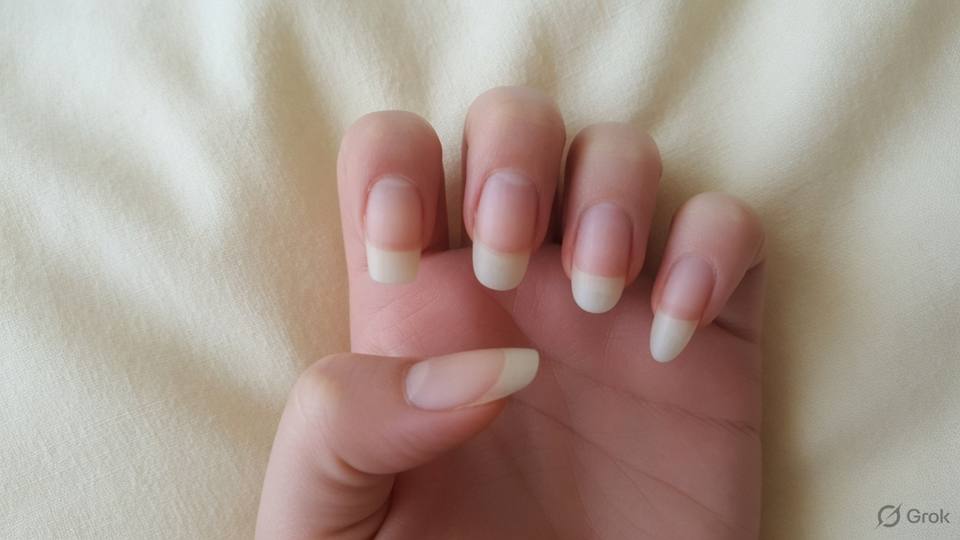
The nail bed decides first
A shape is only as good as the nail bed under it. The nail plate sits on the nail bed, which runs from the matrix at the base to the hyponychium at the tip. A narrow bed cannot carry a wide square tip without stress at the corners, and a short bed cannot carry a long stiletto without a lever arm that pulls on the matrix. Look at bed width, bed length, the curve of the free edge, and the skin along the side walls before you pick up a file. The shape should follow the bed, not fight it, and the client should hear that reasoning before the first stroke.
Measure with your eyes and with your hands. Turn the client's hand over and look at the free edge from the palm side, where the curve of the bed is easiest to see. Compare the width of the nail at the base with the width at the tip; a bed that narrows sharply will look pinched in a square, and a bed that stays wide will look heavy in an almond. Ask what the hands do all day, because a shape that survives a desk job may fail in a kitchen. Two minutes of this conversation prevents a repair appointment and explains, in advance, why the photo on the client's phone may not be the right choice.
The oval shape follows the natural curve of the fingertip and narrows gently at the tip. It suits short to medium beds, narrow beds, and clients who use their hands hard, because there are no sharp corners to catch. File from the side toward the tip in small, even strokes, and keep both sides symmetrical. Stop before the free edge becomes a point, since a narrow oval tip splits more easily than a rounded one. Check the shape from the client's side of the hand, not only from above, because a shape that looks right to you may look crooked to the person wearing it. Symmetry is judged at arm's length, not under a lamp.
Sometimes the right answer is a compromise, and saying so is part of the craft. A client with a short, wide bed who wants length can have a soft oval with a slightly stronger side wall, built over an enhancement rather than on the natural edge. A client with a curved plate can have the product matched to the curve instead of a flat tip forced onto it. What you should not do is file the natural nail thin to make a shape fit, because the plate bends, the product lifts, and the shape lasts a week. Offer the version the bed can carry, show it on one nail, and let the client decide with the evidence in front of them.
- 1. Look at the bed width, bed length, and free-edge curve before choosing a shape.
- 2. View the hand from the palm side to see the true curve of the bed.
- 3. Ask what the hands do all day, and how long the client wants the set to last.
- 4. Show two sample shapes on one hand rather than describing them.
- 5. File the natural edge in small strokes from the side toward the tip.
- 6. Check both side walls from the client's viewpoint, at arm's length.
- 7. Keep the length just past the fingertip on a first set or a working hand.
- 8. Never thin the plate to force a shape the bed cannot support.
Salon example
A client named Meera has short, wide nail beds and asks for long square tips because she saw them on a video. The technician files a sample oval on one nail and a square on another, then holds both hands up so Meera can compare. The square corners sit beyond the bed, and the free edge already looks ready to catch on a sleeve. Meera chooses the oval. The technician keeps the length just past the fingertip, follows the bed curve, and explains that the shape can grow into an almond later when the free edge has more support. She also explains why she will not file the plate thin to make the nail look longer: a thin plate bends under the product, and a bend becomes a lift. Meera books a shorter maintenance visit and says the oval still looks long because the sides are clean. She writes the chosen shape and length on the card, and at the next appointment the technician starts from that note instead of from the video. The card note saves the same conversation at every visit, and the shape stays consistent.
Caution: Do not force a shape the nail bed cannot support.
Squoval and almond
The squoval shape is a straight free edge with rounded corners. It keeps more strength than a pure square because the corners no longer catch, and it suits wide beds, short beds, and clients whose hands are in water or on a keyboard all day. File the edge straight across, then soften each corner with two or three light strokes. Keep the sides parallel rather than pinching them in, because a pinched side wall weakens the stress area. Check the corners with your fingertip; if you can feel a hard point, it will catch on clothing before the week is out. A squoval that is slightly narrower at the tip looks tidier than one that flares.
The almond shape tapers to a soft point and needs length to look right. It flatters long beds and narrow hands, and it gives a slim line without the fragility of a stiletto. Because the tip is narrower than the base, the free edge has less material at the point, so the apex must be built to support it. File the sides in toward the center, keep the curve continuous, and avoid a sharp final point. On a client with a short bed, an almond can look stretched and weak; shorten the ambition before you shorten the nail. On a client with a wide bed, a hard taper makes the nail look pinched, so keep the taper gentle.
The two shapes share a rule: the free edge should never be thinner than the structure behind it. A squoval with a paper-thin corner chips at the corner, and an almond with a thin point splits at the point. When you file, work on the free edge and the side wall, not on the surface of the plate. Keep the file at a slight angle so the edge has a little thickness, and finish with a buffer only on the edge, not across the whole nail. If the client wants the nail to look narrower, take a little from the sides and leave the surface alone; thinness is not elegance, it is a future break.
Ask the client to look at both hands before you move to product. Hands are not identical, and a shape that matches on one side may look off on the other because of the way the fingers curve. Hold the hands together, palm down, at arm's length, and check the tips against each other. If one nail is longer or the curve is flatter, adjust the file rather than the story. Small differences are normal and should be preserved; the goal is a pair of hands that look deliberate, not a set of ten identical plastic tips. A client who sees you check your own work trusts the result more than one who only hears that it looks good.
- 1. Decide the length first, then file the shape into that length.
- 2. For squoval, file the free edge straight across with the file flat.
- 3. Soften both corners with two or three light strokes, and feel them with a fingertip.
- 4. Keep the side walls parallel instead of pinching them inward.
- 5. For almond, taper the sides toward the center in even passes.
- 6. Keep the curve continuous and stop before the tip becomes a sharp point.
- 7. Leave a little thickness at the free edge, and never thin the plate surface.
- 8. Compare both hands at arm's length before you start the product.
Salon example
A receptionist named Anita types for eight hours a day and wants a shape that will not click on the keyboard. The technician suggests squoval in a medium length. She files the edge straight, rounds the corners, and checks that the sides are not pinched. Anita asks for almond instead because it looks more elegant. The technician explains that almond on her short free edge would leave a thin point that would chip within days, and offers a soft squoval with slightly tapered sides as a middle option. Anita agrees. The technician files the taper gently, keeps the corners rounded but not sharp, and checks the edge thickness with her thumb. Two weeks later the set is intact except for one small corner wear, which she smooths with a file in two minutes. Anita books the same shape again, and the technician notes the shape, length, and the slightly tapered side on the card so the next appointment starts consistently. Anita also buys a fine file for the office drawer, and the corner wear becomes a two minute fix instead of a repair booking.
Caution: A pointed almond on a short free edge is a chip waiting to happen.
Coffin and stiletto
Coffin, also called ballerina, has tapered sides and a flat tip. It needs length, a strong apex, and clean corners, because the two outer points take the first impact when the hand hits a surface. File the sides in evenly, keep the flat tip level, and do not thin the corners to make them look sharper. On a natural nail, coffin is usually built with an enhancement rather than formed on the free edge alone, because the natural edge cannot hold a flat tip at that width without support. If the client works with her hands, a shorter coffin is safer than a dramatic one, and a soft square may serve her better.
Stiletto tapers to a narrow point and is the least forgiving shape in the salon. It concentrates stress at the tip, it catches on hair, fabric, and drawers, and it is a poor choice for a nurse, a cook, a mother of small children, or anyone who types hard. When a client asks for stiletto, ask about her work and her daily tasks before you agree. If the nail bed is short or the natural free edge is weak, say no and offer almond. A shape that fails in three days is not a style; it is a repair appointment and a lost client. The client remembers the break, not the photograph that inspired it.
Both shapes live or die on the apex. The apex is the highest point of the enhancement, built over the stress area, roughly the middle of the nail and slightly toward the free edge. On a coffin, the apex keeps the flat tip from levering at the corners. On a stiletto, it keeps the narrow point from snapping at the stress line. Thickness alone is not structure: a thick, flat nail still breaks, and a well-shaped nail can be surprisingly strong at a modest thickness. Build the apex in the right place, keep the cuticle area thin, and taper the sides so the stress travels into the structure instead of into the corner.
Event nails are a separate conversation. A client may want a long stiletto for a wedding on Saturday and return to a desk on Monday. Agree the length, explain what will break first, and book the removal or the reshape before the event, not after the break. If the client travels or works with her hands, offer a shorter version with the same finish. The salon should never promise that a shape will survive work it was not built for. A clear expectation at the desk is better than an emergency message on Sunday night, and it protects both the client's plans and the technician's weekend.
- 1. Ask about work, sport, and daily tasks before agreeing to a long or pointed shape.
- 2. Set the length the free edge can carry, then build the shape within it.
- 3. For coffin, taper both sides evenly and keep the flat tip level.
- 4. Build the apex over the stress area, not at the tip and not at the cuticle.
- 5. Keep the product thin at the cuticle and at the side walls.
- 6. Do not thin the corners or the point to make the shape look sharper.
- 7. Confirm the client can do the shape's daily tasks, and offer a shorter version.
- 8. Book the reshape or removal before the event so nothing is decided in a panic.
Salon example
A client named Pooja asks for long stiletto nails in chrome for a wedding. The technician asks what she does for work. Pooja is a nursery teacher who changes nappies, opens boxes, and lifts children all day. The technician shows her a short almond and a medium coffin on two sample tips, and explains that the stiletto point will catch on nappies and clothing and may lift at the side wall within a week. Pooja chooses the coffin at a shorter length. The technician builds a clear apex over the stress area, keeps the corners slightly rounded, and checks the flat tip with a straight edge so it does not slope. She books a two week check and writes the length on the card. The set survives the wedding and the following week of work, and Pooja returns for a fill instead of a repair. At the fill, the technician shortens the coffin slightly and explains that the shape can be rebuilt longer for the next event, when the client has a few quiet days. Pooja sends a photo from the wedding, and the corners are still level in every frame.
Caution: A stiletto on a working hand is a repair booking, not a style choice.
This is a Nandu Nai textbook. It is a private brand book, not a government licence, and it does not give the right to give medical treatment.