
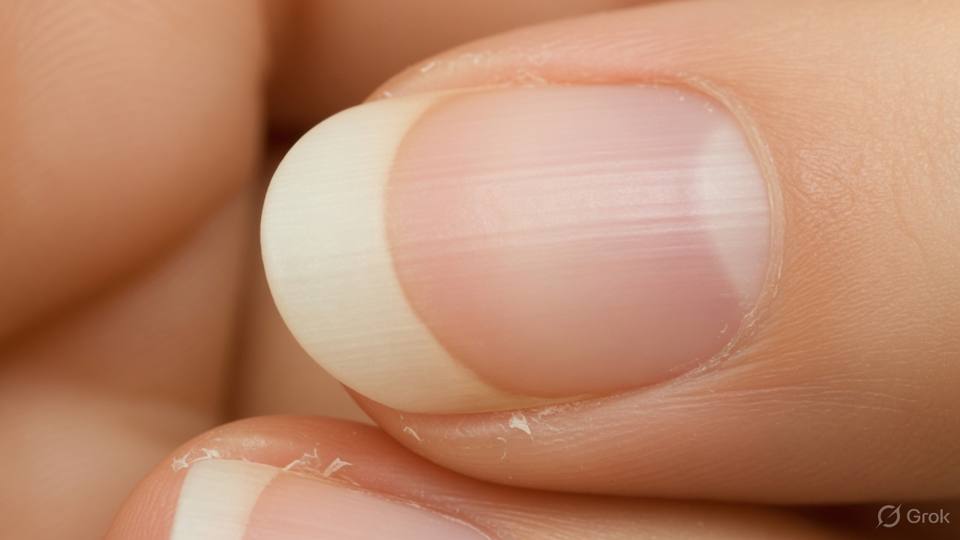
The plate, the bed, and the matrix
The nail plate is the hard, visible part of the nail, built mostly from keratin, the same protein that makes hair and the outer layer of skin. It has a thin dorsal layer, a thicker middle layer, and a thin ventral layer that rests on the bed. The plate is flexible rather than rigid, which is why it can absorb a knock without shattering, and why it bends when it is filed too thin. It has no nerve endings of its own, so a client may not feel damage that is being done to it. That silence is dangerous: a plate can be over-filed without complaint, and the consequence appears a week later as a bend, a split, or a lift.
The nail bed is the skin underneath the plate, running from the matrix at the base to the hyponychium at the tip. It is richly supplied with blood vessels, which give a healthy nail its pink colour, and it is attached to the ventral layer of the plate by fine ridges that lock the two together. Because the attachment is so close, anything that separates the plate from the bed creates a pocket, and a pocket holds air, water, and debris. That is why a lift is never just a cosmetic gap. The bed cannot make a new plate on its own; it supports the plate that the matrix pushes forward, and it needs that plate to stay attached to remain healthy.
The matrix is the tissue at the base of the nail that produces new plate cells. It sits partly under the proximal fold and partly under the lunula, and it is the part of the nail that a technician must never cut, press hard, or treat with harsh product. Cells made in the matrix harden, flatten, and are pushed forward, so damage at the base appears as a ridge, a groove, or a white spot that travels slowly toward the tip. Fingernails grow roughly three millimetres a month, and a full replacement takes four to six months. Toenails grow far more slowly, often taking a year or more, which is why a toenail problem is measured in seasons rather than weeks.
This anatomy sets the limits of the job. You can shape the free edge, push the cuticle, clean under the edge gently, and apply product to the plate. You cannot make a nail grow faster by filing it, and you cannot make it thicker by buffing it; buffing removes material, and a shiny surface is not a stronger one. You cannot repair damage inside the matrix from the outside, and you cannot promise that a nail will grow back normally after an injury. When a client asks for stronger nails, the honest answer is about care, product choice, and time, not about a tool that will change the biology. Knowing what the tissue does is what keeps your hands inside the cosmetic line.
- 1. Look at the plate and note its thickness, colour, and any bend or split.
- 2. Check the bed colour along the length, and compare it with the other nails.
- 3. Look at the base for swelling, redness, or a change in the lunula.
- 4. Ask whether the nail has been injured, and when the change appeared.
- 5. Keep every tool off the matrix area; push the cuticle, never press into the base.
- 6. File only the free edge, and never thin the surface of the plate.
- 7. Explain growth honestly: about three millimetres a month on a finger.
- 8. Record what you saw, so the next appointment has a baseline to compare.
Salon example
A client named Sana comes in with a deep horizontal groove across both thumbnails, about halfway up the plate. She is convinced that a previous salon damaged her with a drill and wants the technician to file the groove out. The technician looks at the groove, asks when it first appeared, and learns that Sana was seriously ill about three months ago and lost weight quickly. She explains, in plain words, that a groove that crosses the whole nail is usually a mark left by something that happened at the base months earlier, and that it will travel out on its own as the nail grows. Filing it out would mean thinning the plate, which would bend and split. Instead she shapes the free edge, buffs only very lightly with a fine buffer, applies a ridge-filling base coat, and books a review in six weeks. Sana is disappointed that the line will not disappear today, but she understands why. At the review the groove has moved closer to the tip, and the nail underneath it is smooth, which is the evidence the technician needed to show that the plate was recovering.
Caution: You cannot file away damage that was made at the matrix; you can only thin the plate above it.
Lunula, cuticle, and side wall
The lunula is the pale half-moon at the base of the nail, the visible part of the matrix where new cells have not yet flattened and hardened. It is not a separate structure to be cleaned or scraped, and it does not need to be exposed. Some clients have a large lunula, some have none at all, and both are normal. Pressing hard on the lunula, massaging the base with force, or pushing product into that area can bruise or irritate the matrix, and the result may be a ridge that takes months to grow out. Treat the base of the nail as the most delicate part of the service, because it is the part that produces everything else.
The cuticle is the thin layer of dead skin that sits on the plate at the base, and behind it lies the living eponychium, which seals the gap between the skin and the nail. In the salon we push the dead cuticle back with a soft pusher and a little warm water or softener. We do not cut the living tissue behind it, and we do not use a credo blade. When that seal is broken, water, shampoo, and cleaning products get into the space around the matrix, and the skin responds with redness and swelling. A cut cuticle may look tidy for a few days, but the seal has to rebuild, and during that time the nail is less protected than before the service began.
The side walls are the folds of skin on each side of the nail, and they form another seal along the lateral edges. They should never be dug into with a file, an orange stick, or a nipper, because the space between the plate and the fold is narrow and easy to injure. A hangnail is a small tag of dead skin along the side wall; it can be trimmed with a nipper only if it is white and clearly separated, and only at the very tip. Pulling it, biting it, or tearing it opens a line that can become inflamed. If the side wall is red, swollen, or tender, stop working in that area, keep product away, and refer if it does not settle.
Under the free edge is the hyponychium, a thin seal of skin that keeps dirt and moisture from getting under the plate. It is not a shelf to be scraped. A soft brush and a little soap are enough to clean the area, and a gentle pass with the corner of a towel is enough to dry it. Metal tools, pointed sticks, and drill bits pushed under the free edge break the seal and create a pocket that stays damp. Clients often ask for deep cleaning under the nail because it looks dirty, but the dirt is usually on the underside of the plate, not in the tissue. Clean what you can see, leave the seal alone, and explain why the shallow clean is the better service.
- 1. Identify the lunula and treat the base as a no-pressure zone.
- 2. Soften the cuticle with warm water or softener before pushing.
- 3. Push the dead cuticle back with a silicone or rubber pusher, at a shallow angle.
- 4. Keep the credo blade and every blade away from the cuticle and side walls.
- 5. Trim a hangnail only if it is white, dead, and clearly separated, at the tip.
- 6. Clean under the free edge with a soft brush, not a metal tool.
- 7. Dry the side walls and the underside without digging into the seal.
- 8. Stop and refer if the side wall is red, swollen, or painful.
Salon example
A client named Nisha asks the technician to cut her cuticles because they look thick and she thinks the nails will look longer. The technician explains what the cuticle does, shows her the seal with a hand mirror, and offers a softener and a gentle push instead. Nisha agrees but asks for a deep clean under the free edge, because she works in a kitchen and food gets under the nails. The technician uses a soft brush and soap, cleans what is visible, and explains that the thin skin under the edge is a seal and that digging with a metal tool would create a pocket where moisture and bacteria collect. She finishes with oil and shows Nisha how to use a nail brush at home, with the brush moving away from the seal rather than into it. Nisha books again, and at the next visit her side walls look calmer than they did at the first appointment, which the technician points out as the result of leaving the seal alone. Nisha also stops using a metal tool at home, and the side walls stay calm between visits.
Caution: The base of the nail and the side walls are seals; pushing is allowed, cutting is not.
What you may touch and what you may not cut
A simple map keeps the service safe. The pusher goes on the dead cuticle at the base, at a shallow angle, moving the tissue back rather than down. The file goes on the free edge and the side wall, never across the surface of the plate. The soft brush goes under the free edge, with light pressure and no digging. The nipper goes only on a white, dead tag that has already separated, and only at its tip. The drill goes on product, not on the natural plate, and never on the skin. If you cannot say which structure a tool is touching, you are not ready to use it on a paying client.
Consent belongs inside this map. Tell the client what you are about to do before you do it, especially before nippers, because the sound and the pressure can be alarming. Show them the tag you intend to trim, and let them see that it is dead and separated. If they say no, leave it and continue with the push and the oil. A client who feels informed is more likely to tell you about tenderness, and that information is worth more than a tidy cuticle line. Do not perform a small procedure in silence and then explain it afterward; that is how trust is lost in a single appointment.
Four signs mean stop, whatever the clock says: pink tissue under a tool, pain when you touch an area, blood, and swelling or heat that was not there at the start. A fifth is a change in colour at the base or along the side wall, especially a new dark area that was not on the other hand. None of these signs is a challenge to your skill; they are information. Stop at the site, clean it, keep product away, and decide whether the service can continue elsewhere. A technician who stops early is not slower than one who pushes on. She is the one who does not spend the next week answering messages about a sore finger.
Documentation closes the loop. Write what you saw, what you did, and what you advised, in plain language, without naming a disease. Note the sensitive spots so the next service starts gently, and note any referral so a colleague does not cover the same nail next week. Keep the notes factual and short: date, nail, observation, action. Do not photograph a client's hand without asking, and do not share the image. The record is not paperwork for its own sake; it is how a small observation becomes a pattern, and how a pattern becomes a decision to refer rather than to cover.
- 1. Name the structure before you touch it: plate, cuticle, side wall, or free edge.
- 2. Use the pusher at a shallow angle on dead tissue only.
- 3. Keep the file on the free edge, never on the plate surface.
- 4. Ask before using nippers, and show the client the tag you plan to trim.
- 5. Stop at pink tissue, pain, blood, or new swelling.
- 6. Keep all product away from an area that has been opened or irritated.
- 7. Write the observation, the action, and any advice on the client card.
- 8. Refer rather than cover when the change is new, spreading, or painful.
Salon example
A new client named Aarti sits down with a small red area along the side of her index finger. She says it has been there for two days and asks the technician to cover it with gel because she has a presentation on Friday. The technician looks at the area, sees redness and a little swelling, and explains that she will not put product over it. She offers to do the other nine nails, keep that finger bare, and show Aarti how to keep the area clean and dry. Aarti is annoyed at first and says another salon would just do it. The technician does not argue; she explains that gel over a hot, swollen area would trap moisture and make the redness worse, and that she would rather lose one nail than cause a problem before a presentation. She finishes the nine nails, writes the observation on the card, and advises Aarti to have the finger looked at if the redness spreads or if it becomes more painful. Aarti returns ten days later with the area settled and asks for the missing nail. She also asks the technician to explain the rule to her sister, who has been covering a similar spot for months.
Caution: If you cannot name the structure under the tool, put the tool down.
This is a Nandu Nai textbook. It is a private brand book, not a government licence, and it does not give the right to give medical treatment.