
Ridges, bitten nails, and a bruise you can see
Not every nail that looks unusual is a medical problem. Longitudinal ridges, which run from the base to the tip like fine corduroy, are common with age and with dry nails, and they are usually harmless. They can be softened with a ridge-filling base coat and a very light buff with a fine grit, but the buff must not thin the plate. A transverse ridge that crosses the whole nail is different: it often marks an illness, a high fever, or a period of poor nutrition that interrupted growth months earlier, and it will travel out on its own. If a client has a new ridge pattern on several nails and no explanation, refer, because the salon should not guess at the cause.
Bitten nails are a cosmetic problem when the skin is intact. The plate is often short, the side walls are ragged, and the free edge may be irregular, but there is no open wound. In that case, gentle work is appropriate: a short oval or squoval, a light buff on the surface only if the plate can take it, and a strengthening base coat rather than a long extension. The first visit should not add length, because a long tip on a bitten nail gives the client something to pick at and puts stress on a plate that is already short. If the skin is broken, bleeding, or weeping, there is no cosmetic service at that site; clean it, cover it, and refer. The habit itself is not yours to treat, and a bad-tasting polish is not a medical plan.
A bruise under the nail, called a subungual hematoma, is visible as a dark red, purple, or black patch under the plate. It usually follows a knock, a door, or a heavy object, and if the nail is not lifting and the finger is not throbbing, it can be left alone while it grows out. Cosmetic work is possible if the skin is intact and the plate is stable, but keep the product thin over the area, avoid pressure, and do not drill or pierce the plate to release blood. That is a medical procedure, not a salon one. If the bruise is new, painful, spreading, or accompanied by swelling, refer, because a collection of blood under pressure needs a clinician. If there was no injury at all and a dark patch appears, refer the same day.
The distinction is not about how strange the nail looks. It is about whether the tissue is intact, whether the change is stable, and whether there is pain, heat, swelling, or separation. A stable ridge on a healthy hand is a cosmetic surface. A new dark streak that has appeared over a few weeks is not. A bruised nail that is settling is a cosmetic surface. A bruised nail that is throbbing and lifting is not. Learn to ask three questions: when did it appear, is it changing, and does it hurt. The answers decide whether you pick up a file or pick up the phone and refer.
- 1. Ask when the change appeared and whether it has changed since.
- 2. Ask whether the nail or the skin around it hurts, throbs, or feels hot.
- 3. Check that the skin is intact before planning any cosmetic work.
- 4. For stable ridges, use a ridge filler and a light buff, never a thinning buff.
- 5. For bitten nails with intact skin, keep the first set short and simple.
- 6. For a stable bruise, work thinly over the area and apply no pressure.
- 7. Do not pierce, drill, or drain a bruised nail under any circumstances.
- 8. Refer a new dark patch, a spreading bruise, or any nail that is painful.
Salon example
A client named Kavita comes in with a dark purple mark under her thumbnail. She shut the thumb in a car door eight days ago and the nail is still attached. The skin is intact, the finger is not swollen, and she says the throbbing stopped after the first two days. The technician checks the other nails, asks whether the mark has spread, and decides that a short, thin gel polish is reasonable as long as she keeps the product thin over the bruise and does not press on it during the massage. She explains that the mark will grow out over several months and that the new nail behind it will look normal. She also explains what would change the plan: if the pain returned, if the nail started to lift, or if the bruise spread, Kavita should see a doctor rather than book a fill. Kavita books a removal in three weeks so the nail can be checked as it grows. At that appointment the mark has moved a little toward the tip, the plate is flat, and the technician takes a note for the file.
Caution: A dark mark that appeared without an injury is a referral, not a design opportunity.
Fungus look, paronychia, and green under a lift
Some nails look thick, yellow-brown, crumbly, and separated from the bed, with debris packed under the free edge. The salon does not decide what that is. It may be a fungal infection, it may be the result of trauma, psoriasis, or a reaction to a product, and only a clinician can tell the difference. What matters at the desk is that a crumbly, lifting nail is not a surface for an enhancement. Product needs a stable plate to bond to, and a plate that is separating and crumbling cannot provide it. Polish or gel over that nail will trap moisture, hide the change, and delay the treatment the client actually needs. Refer, and say why in one sentence.
Paronychia is the name for inflammation around the nail fold, and it can be red, swollen, tender, and sometimes filled with pus. The skin may be warm, and the client may say it throbs. This is not a cuticle that needs pushing, and it is not a nail that needs product. Do not squeeze it, do not try to drain it, do not apply a heated tool, and do not cover it with gel or acrylic. Refer the client to a doctor, especially if the redness is spreading up the finger or if they have diabetes or a weakened immune system. A salon that squeezes a swollen fold is practising medicine badly; a salon that refers is doing its job well.
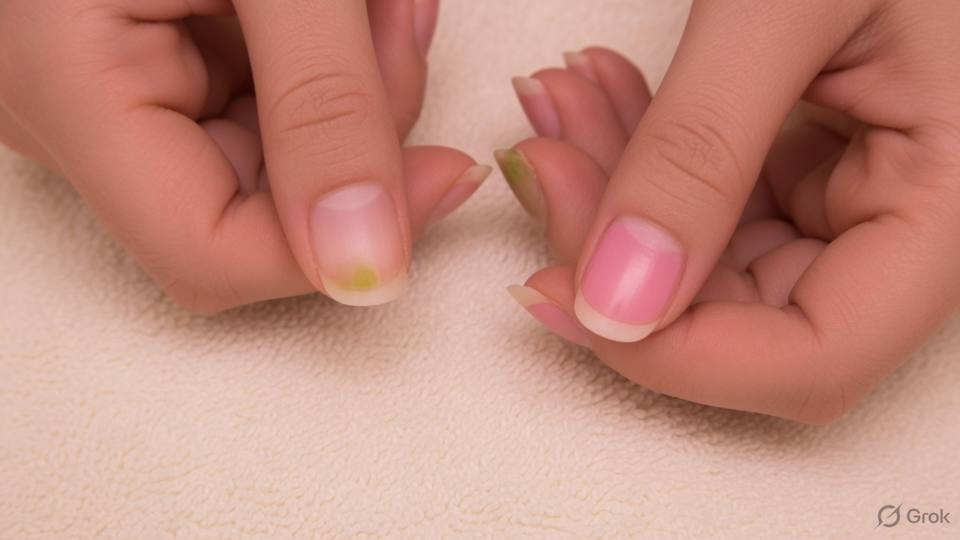
A green or blue-green stain under a lifted enhancement is a familiar sight, and it has a clear explanation. The lift creates a small, warm, damp pocket between the product and the plate, and bacteria that thrive in moisture settle there. The stain is a by-product of that bacterial activity, not dirt, and it is not something to scrub away and cover. The product has to come off, the plate has to be cleaned and dried, and the area has to be kept open until it looks normal. If the stain is spreading, if the nail is painful, or if the skin around it is red and swollen, refer. Do not seal it, and do not fill over it, even if the client has an event and asks for a quick fix.
The conversation is easier when you describe what you see instead of naming a condition. Say that the product has lifted, that moisture has collected underneath, and that the colour is coming from bacteria in that damp space. Say that covering it would keep the moisture in and make it worse. Then offer the rest of the service and a removal on the affected nail. Most clients accept this when the explanation is physical and specific. The ones who argue are usually afraid of the cost or the look, not of the science, so give them a plan: removal today, a review in a week, and a new set when the plate is sound. That plan is the service.
- 1. Look at every nail before you agree to a service, including the ones under old product.
- 2. Note thickness, colour, crumbling, separation, and debris under the edge.
- 3. Check the skin folds for redness, swelling, heat, or pus.
- 4. Do not squeeze, drain, treat, or cover an inflamed nail fold.
- 5. Remove lifted product rather than filling over it, and do not seal a green stain.
- 6. Refer a thick, crumbly, yellow nail instead of polishing it.
- 7. Explain the damp pocket under a lift in plain words, without naming a disease.
- 8. Offer the rest of the service and a review date so the client has a plan.
Salon example
A client named Ritu arrives with a set of acrylics that she has kept for seven weeks because she has been busy. Two nails have lifted at the cuticle, and under one of them the plate shows a green-black patch. The technician removes the other nails first, then works on the green one with a gentle soak and a plastic pusher, never prying. She cleans the plate, dries it, and looks at it under the lamp. The stain covers a small area near the side wall, and the plate underneath is firm. She explains that moisture was trapped under the lift, that the colour is from bacteria in that damp pocket, and that she will not put new product on it today. She refers Ritu to a doctor if the area becomes painful or spreads, and gives her a review appointment in ten days. She also explains that the lift started because the set was left too long, and books the next fill at three weeks. Ritu is unhappy about leaving with one bare nail, but she keeps the review, and at the review the stain has faded and the plate is sound.
Caution: A green stain means the product comes off and the nail stays open; it never gets covered.
You do not diagnose
The salon does cosmetic work. It does not diagnose a fungal, bacterial, or viral condition, and it does not prescribe a cream, a tablet, or a home remedy. This is not a limitation to apologise for; it is the boundary that keeps clients safe and the business out of trouble. A diagnosis made in a salon can be wrong, and a wrong diagnosis can delay real treatment. A client who is told that a nail is just dry may wait six months before seeing a doctor, and by then a treatable problem has become a harder one. Say what you see, say what you will and will not do, and send the client to someone who can examine, test, and prescribe.
The language matters as much as the decision. Use descriptions instead of labels: thick and crumbly, separated at the tip, red and swollen at the fold, dark line from the base. Avoid the words fungus, infection, and melanoma unless you are quoting what a doctor has already told the client. Avoid saying that something is nothing, because you cannot know that. A useful sentence is short: I can see a change here that I should not cover, and I would like you to have a doctor look at it before I work on this nail. Then stop talking and let the client respond. The silence after a clear sentence is more persuasive than a long explanation.
Record the observation and the advice, and keep the wording neutral. Write the date, the nail, what you saw, and what you recommended, without a diagnosis. If the client declines the referral and asks for a cover, write that down too, and still refuse the cover. A note that says the client was advised to see a doctor protects the shop if the client later says nobody told them. Do not photograph the hand without permission, and store any image the way the shop stores other client records. The note is not evidence against the client; it is a record of care, and it should read like one.
Some findings need speed rather than a routine referral. Spreading redness, a fever, pus, a wound on a diabetic foot, a nail that has lifted after an injury, and a new dark streak that is widening are all reasons to send the client the same day, not next month. Say clearly that this is not a wait-and-see situation, and give the reason in one sentence. Do not drive them to a particular clinic or sell a product on the way out. The role ends at a clear, calm referral, and the client should leave knowing exactly what to do next and why the salon stopped.
- 1. Describe what you see instead of naming a condition.
- 2. Ask when it started, whether it is changing, and whether it is painful.
- 3. Decide whether the skin is intact and the plate is stable.
- 4. Refuse product on any nail you cannot safely cover, and say why briefly.
- 5. Recommend a doctor or a podiatrist, without naming a treatment.
- 6. Do not sell a cream, a supplement, or a home remedy as a cure.
- 7. Record the observation, the advice, and the client's response.
- 8. Send spreading redness, pus, fever, or a new dark streak the same day.
Salon example
A client named Dev has a dark streak running from the cuticle to the tip of his little finger. He has had it for about two months and says it is getting wider. He wants a clear gel coat so it looks neater at work. The technician looks at the streak, compares it with the other hand, and sees that the colour starts under the cuticle and fades toward the tip. She does not call it a name. She says that a new dark line that is widening is something a doctor should look at, and that she will not cover it because a cover would hide any change. Dev says his mother has a similar line and that it is nothing. The technician repeats that she cannot know that, and that the safe step is a check. She offers to do the other nine nails and leaves the little finger bare. She writes the observation and the advice on the card, and gives him a note with the words he can use at the clinic. Three weeks later he messages to say the doctor wants to monitor it and thanked him for coming in early.
Caution: Do not name a disease you are not qualified to diagnose, and do not cover what you cannot explain.
This is a Nandu Nai textbook. It is a private brand book, not a government licence, and it does not give the right to give medical treatment.