
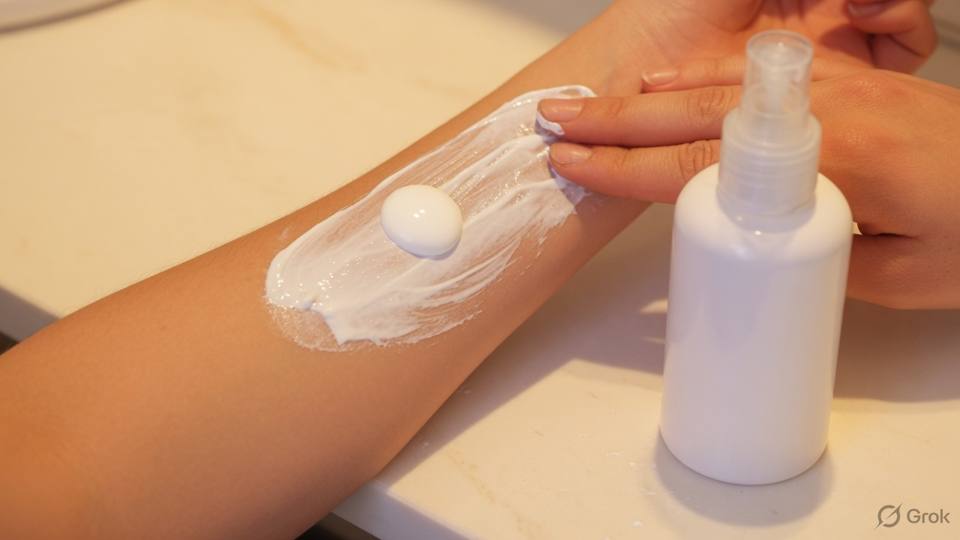
How much and when
Sunscreen is the most useful product in a skin plan, and it is also the one most people use badly. The FDA advises applying it about fifteen minutes before sun exposure, so the film has time to form before the skin meets the sun. For an average adult body, the FDA describes about one ounce, roughly a shot glass, as the amount needed for even coverage. That is far more than most people use. The laboratory test that sets an SPF uses two milligrams of product per square centimetre of skin, and the one-ounce body measure is the practical version of that density. The therapist does not need to quote the lab number to every client, but it explains why a thin smear is not enough.
For the face and neck, a practical measure is easier to teach than a weight. Two finger lengths of product, applied evenly and including the ears, is a common demonstration. A face-only gram dose should not be invented, because the amount depends on the product, the face size, and the number of applications. The therapist should show the client the measure on their own hand, then watch them copy it. The aim is enough product for an even film, not a ritual of precision. A sunscreen that is applied generously and feels comfortable will be used again tomorrow; one that is applied in a tiny dot to avoid shine will not protect the skin.
The missed spots are predictable. The FDA lists the ears, nose, lips, neck, hands, feet, and hairline as areas people often forget. Add the sides of the neck, the tops of the ears, the parting, and any exposed scalp. Lips need an SPF lip balm, because a face sunscreen is not pleasant to taste and is often licked away. Hands are exposed while driving and should be covered if the client is outdoors. Feet matter for clients who wear sandals. The therapist should turn the application into a short routine: face, ears, neck, hands, then any exposed part. A mirror and a written card help the client remember the order until it becomes automatic.
Application conditions matter as much as the amount. Apply to dry skin, because a wet surface dilutes the film. If the client uses a moisturiser, apply the sunscreen after it and wait a moment so the products do not pill. If the client uses an insect repellent, follow the label and keep the sunscreen underneath where the directions say so. Sprays should not be applied directly to the face; spray into the hands first and then apply, and keep the eyes and mouth away from the mist. Store the bottle out of direct sun and heat, because a car dashboard can degrade the product. Check the expiry date, and discard a bottle that has changed colour or smell.
A sunscreen habit is built on a realistic morning. Ask when the client leaves the house, what they do first, and whether they wear makeup. If the answer is that they dress the children and run, put the sunscreen beside the door or the toothbrush. If they work outdoors, choose a water-resistant product and plan a reapplication. If they work nights, the routine follows daylight rather than the clock. The therapist should not hand over a product and assume it will be used. Demonstrate, ask for a repeat demonstration, write the amount on the card, and review the technique at the next visit. The best sunscreen is the one the client applies correctly on ordinary days, not the one with the highest number on the bottle.
- 1. Apply sunscreen about fifteen minutes before going into the sun.
- 2. Use about one ounce, a shot-glass amount, for an average adult body.
- 3. Use a practical face-and-neck measure such as two finger lengths.
- 4. Cover the ears, nose, lips, neck, hands, feet, and hairline.
- 5. Apply to dry skin, after moisturiser, and let it settle before makeup.
- 6. Use an SPF lip balm and do not spray directly onto the face.
- 7. Store the bottle out of heat and check the expiry date.
- 8. Show the client the amount and ask them to repeat the technique.
Salon example
A fictional client, Ramesh, age forty-six, worked as a site supervisor and spent most of the day outdoors. He used a sunscreen in the morning but applied a small dot to each cheek and nothing else. He could not understand why his forehead and ears were darker than his cheeks. The therapist asked him to show the amount on his hand, then demonstrated two finger lengths for the face and neck. She showed him how to cover the ears, the hairline, and the back of the neck, and suggested an SPF lip balm. For the body he was shown the one-ounce, shot-glass measure described by the FDA, and he agreed to keep a bottle in his bag. He also chose a hat with a brim for the site. At the review he said the routine took an extra minute, but his ears no longer burned and he was reapplying at lunch. He also asked for a sunscreen stick for his ears, which was easier to use on site than a lotion, and a spare bottle to leave in the site office so he never had to carry one home.
Caution: Do not invent a face-only gram dose, and do not let a high SPF number replace correct application.
Reapply through the day
Reapplication is where sunscreen plans usually fail. The FDA advises reapplying at least every two hours, and sooner if the client is swimming or sweating. No sunscreen is waterproof, and a water-resistant label describes a limited time in water or sweat, usually forty or eighty minutes, not a whole afternoon. A client who applies once at seven in the morning and eats lunch outdoors at one has been unprotected for hours. The therapist should ask about the real day: the commute, the school run, the lunch break, the evening walk. The plan should place reapplication at moments the client already remembers, such as after lunch, before the afternoon break, and before driving home.
Reapplication does not always mean a full new face of cream over makeup. A light lotion can be patted over the skin if the client is willing to disturb the makeup, and a tinted sunscreen can double as touch-up. An SPF powder or a cushion can top up over makeup, but it should not be the only product, because the amount applied is usually small. A sunscreen stick is practical around the eyes, ears, and hairline, though it should be applied several passes to build a film. The client should not rely on a setting spray with SPF as the main protection. The therapist can help the client choose a method that fits their day and their tolerance for shine.
Water and sweat change the schedule. After swimming, towelling off, or heavy exercise, reapply immediately, even if the label says water resistant. A wet towel removes product as effectively as water. On a humid day, a lighter formula may be more comfortable and therefore more likely to be reapplied. On a dry, windy day, the skin may need a moisturising sunscreen. The client should keep a second bottle in the bag or at the desk, because a product at home protects no one. If the client wears a helmet, a mask, or a cap, the friction can remove sunscreen from the edges; those areas need extra attention. The plan should be built around the client's actual exposure, not an idealised one.
The therapist should also explain that sunscreen is one layer of protection. Shade, a wide-brimmed hat, sunglasses, and clothing reduce the amount of ultraviolet light reaching the skin. Midday sun is stronger, and the client should plan outdoor tasks for earlier or later where possible. A tinted sunscreen with iron oxides can help with visible light, which matters for pigment conditions. None of these measures makes the client invincible, and none replaces reapplication. The honest message is simple: apply enough, apply it before the sun, and apply it again through the day. A client who does that with an ordinary SPF 30 is better protected than one who uses a high-SPF product once and forgets it.
- 1. Reapply at least every two hours, and sooner after swimming or sweating.
- 2. Reapply immediately after towelling off or heavy exercise.
- 3. Keep a second bottle in the bag, car, or desk.
- 4. Use a stick or SPF powder to top up over makeup, not as the only layer.
- 5. Do not spray directly onto the face; spray into the hands first.
- 6. Pay extra attention where a helmet, mask, or cap rubs the skin.
- 7. Add shade, a hat, and sunglasses for long outdoor time.
- 8. Plan reapplication around meals, breaks, and the drive home.
Salon example
A fictional client, Sneha, age thirty-one, applied sunscreen before work and then spent her lunch hour walking in the park. She did not reapply because she did not want to disturb her makeup, and she believed her SPF 50 product lasted all day. The therapist explained that the FDA advises reapplying at least every two hours and sooner after sweating, and that no sunscreen is waterproof. Sneha chose a sunscreen stick for her ears and hairline and a tinted powder for the centre of her face, while keeping a light lotion for the walk. She moved her walk to before the hottest part of the day and began carrying a hat. At the next visit she said the routine was easier than she expected once the products were in her bag. The therapist checked her application and corrected the amount on her forehead, which had been too thin. Sneha also began keeping a small reminder note in her lunch bag, because the afternoon walk was the step she forgot most often, and she set a phone alarm for the first week.
Caution: Do not describe any sunscreen as waterproof or all-day, and do not treat makeup with SPF as enough.
Broad spectrum in plain words
Broad spectrum is a plain phrase with a specific meaning. The sun gives off ultraviolet B rays, which cause sunburn, and ultraviolet A rays, which penetrate deeper and contribute to aging and pigment. An SPF number describes protection against UVB, not UVA. A broad-spectrum label means the product has passed a test for both. On some products the UVA protection is also shown as a PA rating, with more plus signs meaning more protection. The therapist does not need to teach the physics. The client needs to know that an SPF number alone is not the whole story, and that the words broad spectrum belong on the bottle.
SPF is not a measure of time. An SPF 30 product does not give the client thirty times longer in the sun, and it does not allow a longer day without reapplication. The number describes how much UVB reaches the skin under test conditions compared with unprotected skin, and those conditions assume a generous application. In real life, a thin layer lowers the effective protection well below the label. The FDA explains that higher SPF values offer more protection against sunburn, but the client still has to apply the full amount and reapply on schedule. A high number with poor technique is not better than a moderate number applied well.
Deeper skin needs sunscreen for reasons beyond sunburn. Melanocytes in darker skin respond to ultraviolet light by making more pigment, so sun exposure can deepen existing marks and trigger new ones. Melasma and post-inflammatory marks are driven partly by light and heat. A client who says they do not burn may still see dark patches worsen after a sunny holiday. The therapist should explain this without suggesting that the client is at no risk. Sun protection is part of pigment care, not a cosmetic extra. A broad-spectrum product with iron oxides can help with visible light, which some pigment conditions respond to. The client should choose a texture they will wear and reapply, because consistency matters more than a perfect label.
Practical label reading helps the client choose. Look for broad spectrum, SPF 30 or higher, and a direction that matches the day. Check the expiry date and the storage advice. A product without an expiry date and more than three years old should be replaced. A sunscreen that has separated, changed colour, or smells different should not be used. The therapist should also explain that sunscreen is not recommended for infants under six months, who should be kept out of the sun and covered with clothing and a hat; ask a doctor before using any product on a baby. For older children, follow the label. These details are not marketing. They are the difference between a product that protects and one that gives false confidence.
- 1. Choose a product labelled broad spectrum, not only a high SPF number.
- 2. Use SPF 30 or higher for daily wear.
- 3. Explain that SPF is not a measure of time in the sun.
- 4. Reapply even if the label says high protection.
- 5. Consider a tinted product with iron oxides for pigment-prone skin.
- 6. Check the expiry date and replace a separated or changed product.
- 7. Keep infants under six months out of the sun and ask a doctor before use.
- 8. Treat sunscreen as one layer alongside shade, a hat, and clothing.
Salon example
A fictional client, Ayesha, age thirty-five, had a bottle of SPF 50 that she had kept in her car for two summers. She used it only on beach holidays and believed her skin did not need protection because she rarely burned. She also had melasma on her cheeks that worsened after every holiday. The therapist explained the difference between UVB and UVA, why broad spectrum matters, and why heat and light can deepen patches even without a burn. Ayesha chose a tinted broad-spectrum sunscreen with iron oxides, kept it in her bag rather than the car, and began applying it every morning. She also started wearing a wide-brimmed hat on her evening walk. At the review she said the patches had not darkened after a weekend away, which was the first time in two years. The therapist checked the expiry date and helped her replace the old bottle. Ayesha also started applying the product to her ears and the back of her neck, which she had never covered, and she stopped leaving the bottle in the car, where the heat had probably shortened its life.
Caution: Do not say that deeper skin does not need sunscreen, and do not imply that SPF replaces reapplication.
This is a Nandu Nai textbook. It is a private brand book, not a government licence, and it does not give the right to give medical treatment.