
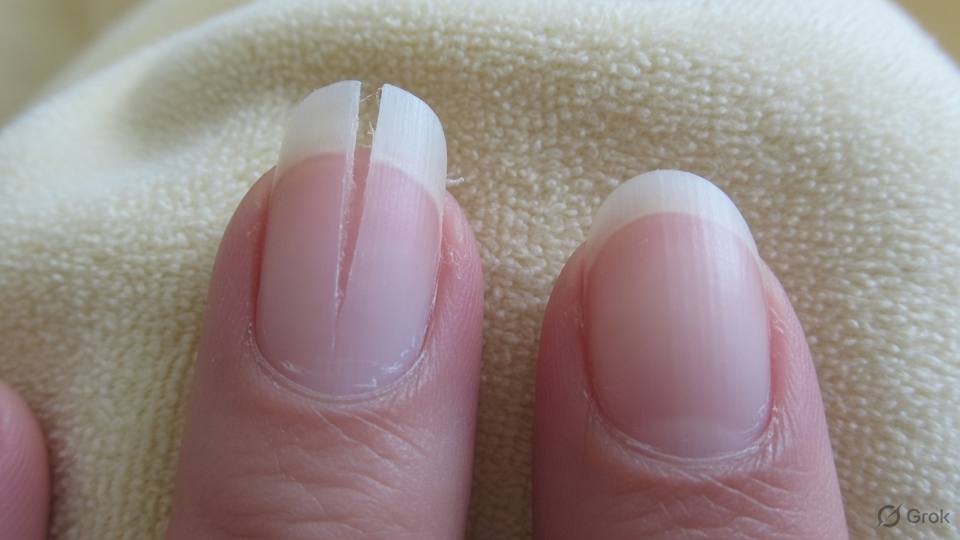
Over-filing
Over-filing is the quiet injury of the trade. The plate gets thinner with every pass, and because the plate has no nerves, the client does not feel it happening. The first sign is often heat under the file, then a white patch at the edge, then a nail that bends when pressed. A thin plate flexes under the product, and flexing breaks the seal at the edge. The set lifts, the client picks at it, and the next appointment begins with a nail that is already damaged. By the time the damage is visible, several services may have contributed to it, which is why the habit is so hard to trace.
Technicians over-file for understandable reasons. A lift has to be removed, a shape has to be corrected, a set has to come off before the next client arrives, and a coarse bit cuts faster than a hand file. Each of those reasons is real, and none of them justifies taking plate. The rule is simple: file product, not the natural nail. Stop at the line where the product ends and the plate begins, and change to a finer grit as you get close. A coarse file on the natural plate leaves grooves that catch the light and never grow out evenly. A drill on the plate does the same thing faster and with more heat.
Check the tools and the pressure, not only the hand. A worn file still looks like a file but cuts unevenly, and a bit that is clogged with dust generates heat instead of removing product. Keep the file moving, use light pressure, and let the grit do the work. On a natural nail, use a fine grit and short strokes, and keep the file flat rather than angled into the edge. On product, use the coarseness the product needs, then finish by hand near the cuticle. If the client says the file feels hot, stop, let the nail cool, and change to a gentler tool. Heat is friction, and friction is damage.
Recovery takes time and honesty. A plate that has been over-filed needs a rest from product, a strengthener if the shop uses one, oil daily, and a shorter length. Do not apply a new set to make it look better, because the new product will lift from the thin surface and the cycle will repeat. Tell the client what happened without blaming a colleague, and give a realistic timeline: a fingernail grows out in four to six months, and the thin section has to travel to the tip before it is gone. Book a review in two weeks, then a month, and check the plate each time. The client will respect the plan more than a quick cover.
- 1. Watch for heat, white patches, bending, and sensitivity at every visit.
- 2. File product only, and stop at the line where the plate begins.
- 3. Change to a finer grit as you approach the natural nail.
- 4. Keep the file moving with light pressure, and keep the bit clean.
- 5. Never use a coarse bit or a worn file on the natural plate.
- 6. If the nail feels hot, stop and switch to a gentler tool.
- 7. Rest the plate from product, oil it daily, and keep the length short.
- 8. Review in two weeks, then a month, and record the plate condition.
Salon example
A client named Shalini has worn gel for a year without a break, and her nails have started to bend when she types. The technician removes the set and sees white patches near the free edge on six nails and a surface that looks polished but feels flexible. She asks about the last few appointments and learns that the previous technician used a drill to remove the gel each time because it was faster. She explains that the plate has been thinned, that the white patches are where layers have come away, and that a new set today would lift from the weak surface. She offers a rest: a strengthener, oil daily, a shorter length, and no gel for four weeks. Shalini is reluctant because her nails look uneven without colour. The technician offers a plain polish that can be removed with a gentle solvent, and books a review in two weeks. At the review the plate looks smoother, and at six weeks the white patches have grown toward the tip. Shalini returns to gel after eight weeks, and the technician removes it by soaking rather than drilling.
Caution: Heat during filing is a warning, not a normal part of the service.
No apex
When an enhancement has no apex, it breaks at the stress line. The stress line is the place where the nail bends most, roughly the middle of the nail and slightly toward the free edge, and without a dome of product above it, the force of a knock concentrates there. The crack usually starts at a side wall and runs across, or it snaps cleanly at the same point on several nails. Clients often describe it as the nail being weak, and they ask for a thicker layer. Thickness is not the answer. The missing piece is the arch, and until it is rebuilt, the same break will happen again.
A missing apex is easy to see from the side. The nail looks flat, like a ruler, with the same thickness from cuticle to tip. When you press the free edge gently, the whole nail flexes instead of resisting. From above, the surface may look perfect, which is why the problem survives so many appointments. Apex is also lost at the fill: as the nail grows, the high point moves forward, and a technician who only adds colour at the base leaves the structure behind. A fill that does not rebuild the apex is a colour service, not a structural one, and the break is already on its way.
The fix is to rebuild, not to patch. Patching means putting product over the crack or over the weak zone, which hides the damage and adds weight without support. Rebuilding means removing the product in the stress area, checking the plate, and placing a new apex in the right position. If the crack has reached the plate, the nail may need to be shortened and the product removed entirely before rebuilding. If the plate is sound, the rebuild can happen in one appointment, with thin layers and a full cure. Tell the client what you are doing and why, because the difference between a patch and a rebuild is visible in how long the set lasts, not in the conversation at the desk.
Prevention belongs at application and at every fill. At application, place the apex before the product sets, and check the side profile before the client leaves. At the fill, look at where the high point sits now, and move it back to the stress area as the nail has grown. If the set is too long for the new structure, shorten it. If the client's work has changed, for example a new job with heavy lifting, rebuild for the new load. Apex is not a one-time step; it is a maintenance item, and the technician who checks it every visit has fewer repairs and fewer lost clients.
- 1. Look at the side profile of every enhancement, not only the surface.
- 2. Press the free edge gently and see whether the nail flexes.
- 3. Mark where the stress line sits on this client's nail.
- 4. Build the apex over that line, slightly toward the free edge.
- 5. At a fill, check whether the apex has moved forward with growth.
- 6. Rebuild a migrated apex instead of adding colour over it.
- 7. Shorten the length if the structure can no longer support it.
- 8. Record the apex position and the length so the next fill starts correctly.
Salon example
A client named Rhea has had three repairs on the same nail in two months, always at the same line across the middle. The technician examines the nail from the side and sees a flat profile with a thick tip and a thin middle. She explains that the break is not bad luck and not a weak nail; the structure is missing an apex. She removes the product on that nail, checks the plate, and finds it sound. She rebuilds it with a clear apex over the stress area and shortens the free edge by three millimetres. She also checks the other nine and finds that the apex on each has moved forward with growth, so she files the surface and adds a small amount of product at the base to bring the structure back. She shows Rhea the side view of the rebuilt nail and explains what to look for at home. At the next fill there are no new cracks, and Rhea books a three week interval instead of waiting for a repair. Rhea also keeps the length shorter for two cycles, and the same break does not return.
Caution: Patching a stress fracture without rebuilding the apex invites the same break.
Peeling gel
Peeling gel usually starts at an edge and travels inward, lifting in thin sheets rather than breaking cleanly. The cause is almost always one of five things: the plate was not clean or dry, the coats were too thick, the free edge was not capped, a coat was under-cured, or the client picked at it. A thick coat cures on the surface and stays soft below, so the whole layer can peel away like a sticker. A missed cap leaves the tip exposed, and water gets between the layers. Oil or lotion on the plate before the base coat prevents the bond from forming at all. None of these is a mystery, and each has a fix.
The wrong response is to fill over the peeled edge, glue it down, or add another layer of colour. A peeled edge is an open layer, and product applied over it bonds to the old gel rather than to the plate. The peel continues underneath, and the new layer hides it until the whole patch comes away, often at a worse moment. Glue is worse still: it is not designed for nails, it traps moisture, and it makes the eventual removal harder. If the client has already picked or glued at home, do not scold them. Look at what happened, explain the cause, and remove the product properly.
The correct repair is a removal and an inspection. Soak off the gel, clean and dry the plate, and look for damage. If the plate is sound, re-prep carefully, apply thin coats, cap every layer, and cure each one for the full time. If the plate is thin or white, give it a rest and book the next set later. If the peel was caused by the client's habits, for example using nails to open cans or picking at an edge, give one clear instruction rather than a lecture: book a removal instead of peeling, and keep the nails out of packaging. A repair that does not address the cause will peel again in the same place.
Prevention is a checklist, not a hope. Clean and dehydrate the plate, apply thin coats, cap the free edge on every layer, cure fully, and check the cuticle line before the client leaves. Ask about the last set: how long it lasted, where it lifted first, and whether it was picked. If the same client has peeling every time, watch her application and her aftercare rather than blaming the product. Sometimes the cause is the lamp, sometimes the primer, sometimes the way the hand sits in the lamp. Change one variable at a time and note the result. That is how a recurring problem becomes a solved one.
- 1. Ask where the peeling started and how long the set lasted.
- 2. Remove the product with a soak instead of filling over the edge.
- 3. Inspect the plate for thin spots, white patches, and separation.
- 4. Re-prep with a clean, dry plate and no oil on the surface.
- 5. Apply thin coats, and cap the free edge on every layer.
- 6. Cure each coat for the full lamp time, including the top coat.
- 7. Rest a thin plate instead of applying a new set over it.
- 8. Give one clear aftercare instruction and book the next removal.
Salon example
A client named Isha returns after ten days with gel peeling from the tips of both thumbs. The technician asks how the set has been and learns that Isha has been opening her daughter's lunchbox with her thumbnail. She also notices that the peeling starts at the free edge, which suggests the cap was thin or missing. She removes the gel with a soak, inspects the plate, and finds it healthy. She re-preps, applies thin coats, and caps the edge on the base, both colour coats, and the top coat, checking each one. She shows Isha the capped edge and explains that the tip is where water gets in. She also offers a practical alternative for the lunchbox: use the side of the thumb or a spoon, and book a repair if an edge lifts rather than picking it. Isha returns three weeks later with the set intact except for normal growth, and the technician books her next removal at three weeks rather than four. Isha also puts a fine file in her bag, and leaves the lunchbox to a spoon rather than a thumbnail.
Caution: Do not fill over a peeled edge; remove it and find the cause.
This is a Nandu Nai textbook. It is a private brand book, not a government licence, and it does not give the right to give medical treatment.